

Introduction
Achieving a high result in the IELTS Reading section isn’t only about knowing English well. Success also comes from smart planning along with sharp exam habits. This resource breaks down key approaches that can boost your performance on this tough part.
Key Strategies for IELTS Reading Success
1. Strategic Time Management
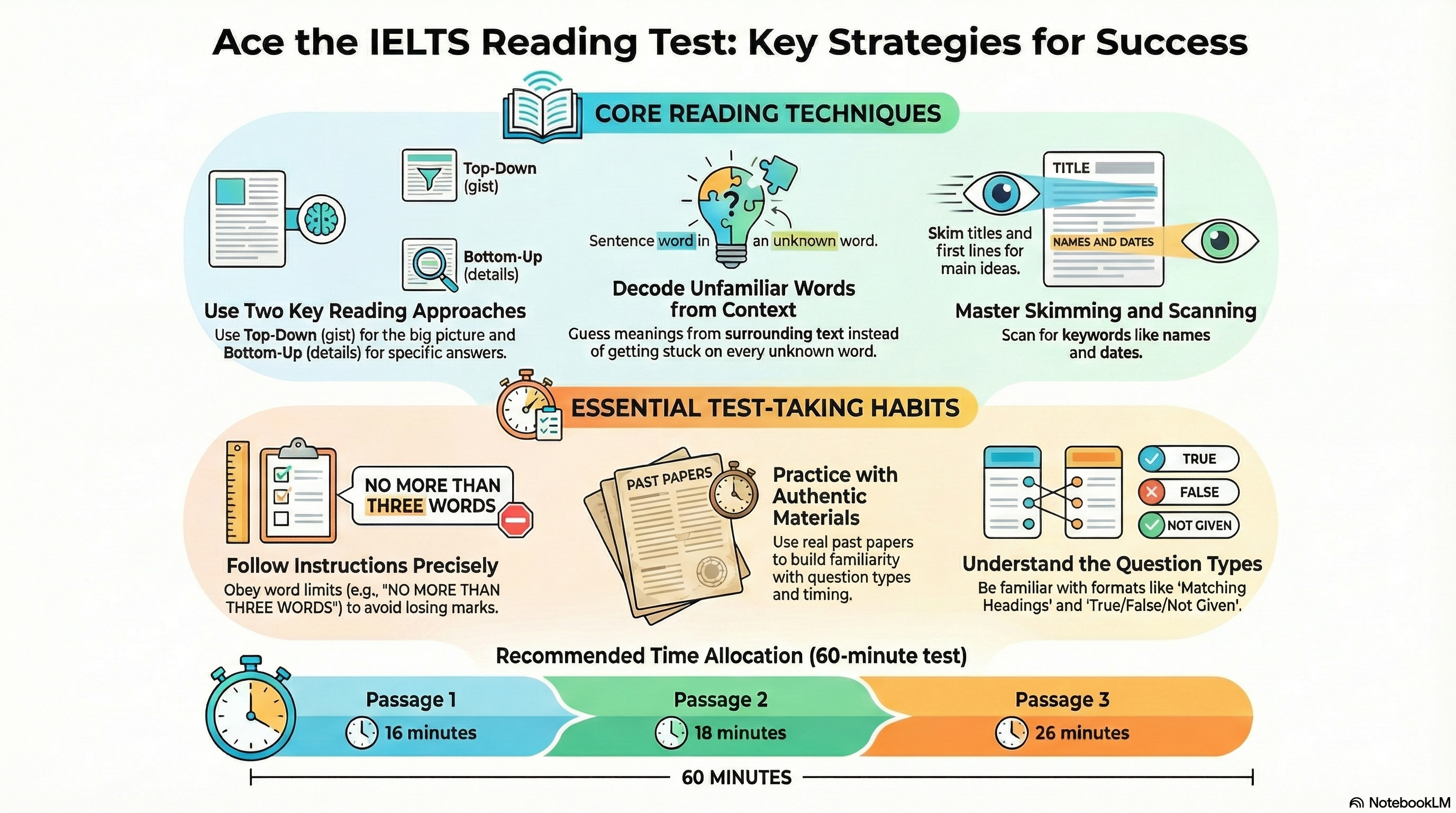
The IELTS Reading section includes three texts with 40 questions total – you’ve got one hour flat. Try timing yourself using the recommendations below;
Passage 1 – 16 minutes
Passage 2 – 18 minutes
Passage 3 – 26 minutes
If a question feels too hard, skip it for now but flag it just in case. Come back to those tricky ones only when you can. Oh, and don’t forget, save some seconds at the end to copy your answers properly.
2. Active Skimming and Scanning Techniques
Build up how fast you catch key points and see the big picture in any piece. Start with looking at titles, then check section headers, first lines of paragraphs, also last parts to get how things are laid out. Mix that by hunting down exact details – search for terms, years, people’s names or figures tied to what’s being asked.
3. Use effective reading techniques that efficient readers use to interrogate a text
Top- Down Approach
The main purpose of using the” Top-Down” approach is to get a general idea of a passage. This approach views a passage as a whole unit from a bird’s eye view or an aerial view. It involves readers drawing on their own intelligence, using their common sense and bringing to the table their past experience on the topic.
First, readers begin by looking at the title and sub-title in a passage. This initial glance at the heading and subheading in a text triggers ones schemata, which is previous knowledge that is stored in the reader’s mind related to the topic.
This stored knowledge triggers assumptions that the reader expects the writer to make in the passage, which in turn helps a reader to make predictions to understand and see the overall purpose of a text and to get a rough idea of the pattern of the writer’s argument.
The Top-Down approach includes some of the important reading sub-skills such as:
- Prediction
- Skimming
- Gist reading (when time is of the essence in the reading test)
Bottom – UP Approach
The main aim of using the “Bottom-Up” approach is to understand various levels of meaning tested in the IELTS exam. For this approach, a reader builds up meaning from words, phrases, and sentence structure in a passage. Furthermore, readers also need to scrutinize the vocabulary and understand grammar to make sense of the meaning of sentences, contexts, as well as understand the writer’s opinion and attitude expressed in the passage.
When using the bottom-of-approach a reader develops a detailed understanding of what exactly the question asks for , then reads parts of the relevant text in detail (calmly and intensively) to understand meaning, before Interrogating other parts of the text effectively to recognize and understand deep meaning at various levels that are tested in the IELTS reading module.
Therefore, the bottom-up approach primarily involves reading in detail or intensive reading at a moderate speed; not too slow or too fast. The main purpose to read the text is to understand different levels of meaning that are commonly tested in the IELTS reading paper, such as;
- Word level
The meaning a word can have on its own also called conceptual meaning.
- Sentence level
The meaning a sentence can have on its own is also called propositional meaning.
- Contextual level
The meaning a sentence can have only when in context. Also known as force of functional value
- Pragmatic level
The meaning a sentence has only as part of the interaction between writer and reader. Basically, it’s the meaning that reflects the writer’s feelings, attitude, and intentions in the text. Also referred to as “inferential” reading sub-skill, and is one of the most challenging sub-skills that is tested in the IELTS, specifically tested on multiple-choice questions (MCQs).
Both the top-down and the bottom-up approaches are extremely useful strategies that efficient readers use to effectively dissect and interrogate a text for their purpose. Competent readers use both approaches interchangeably or flexibly in an interactive way. They make conscious decisions about which method to mobilise depending on what they want from the text. Both are important strategies to improve reading skills.
4. Understanding Various Question Types
The IELTS Reading part includes different kinds of questions ;
- Multiple Choice (one answer) — choose the single best answer from a list.
- Multiple Choice (more than one answer) — select two or more correct options from a list.
- True / False / Not Given (Identifying factual information) — decide whether statements match facts in the text.
- Yes / No / Not Given (Identifying writer’s views/claims) — like TFNG but about opinions or attitudes.
- Matching Headings — match paragraph or section to the best heading (tests main idea).
- Matching Paragraph Information (or Matching Information) — find which paragraph contains specific details.
- Matching Features / Matching Names to Facts — link items (people, studies, features) to descriptions or facts.
- Matching Sentence Endings — complete the second half of a sentence by choosing the correct ending.
- Sentence Completion — finish a sentence using words from the passage.
- Summary Completion Type 1: With a word list, a paragraph with missing words and a box with a list of words each word is lettered (ABCD)
- Summary completion, Type 2: without a word list; fill gaps in a summary of part of the text using words from the passage or a list.
- Note / Table / Flow-chart Completion — complete notes, tables, or flow-charts with information from the text.
- Diagram / Label Completion — label a diagram or process using words or short phrases from the passage.
- Short-Answer Questions — answer questions with a short phrase or word limit, using information from the text.
- Classification / List Matching — assign items or statements to categories or lists based on the text.
5. Vocabulary Development Through Context
You’ll run into unknown words on the test – no surprise there. When that happens, stay calm instead of stressing out. Use hints from nearby parts of the passage to guess what they mean. Check the lines close by for explanations or examples tucked inside. Break down tricky terms: spot familiar roots or prefixes slapped onto them.
Think about the big picture – the general topic might point you toward a solid hunch. Avoid looking up the meaning of every unknown word as most words are throw away vocabulary and are just there in the text. These words don’t really need to be understood for your purpose for reading.
Just Say BLA- BLA and move on to get the bigger picture instead of getting stuck. Remember to enjoy the canopy of the forest from above rather than counting the trees in the forest, you’ll miss the wood.
6. Attention to Detail and Instructions
Carefully stick to every direction about word counts, layout rules, or task types. Say you see “NO MORE THAN THREE WORDS” – go past that line, get it wrong, no matter how good your pick sounds.
7. Consistent Practice with Authentic Materials
Doing real IELTS tests often makes a big difference – using these materials builds familiarity over time. When you work through them, you get used to how the questions look, how fast you need to go, while slowly picking up on formal ways ideas are written. Instead of just moving on, take time after each try; see where slips happen so you can spot repeating issues that need extra attention.
8. Avoid Making Assumptions
Stick to what’s written in the text, when answering don’t add outside info. This check looks at how well you understand the text, not what you already know.
Conclusion
Improving at IELTS Reading comes from steady prep, smart methods, yet ongoing drills. Use these tips while sticking to daily training – it’ll boost your results along with help hit your goal band. Keep in mind progress takes time; stay calm but keep going no matter what.