
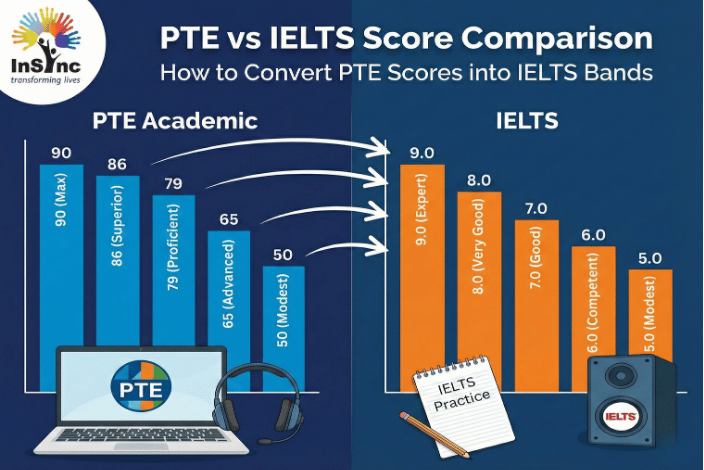

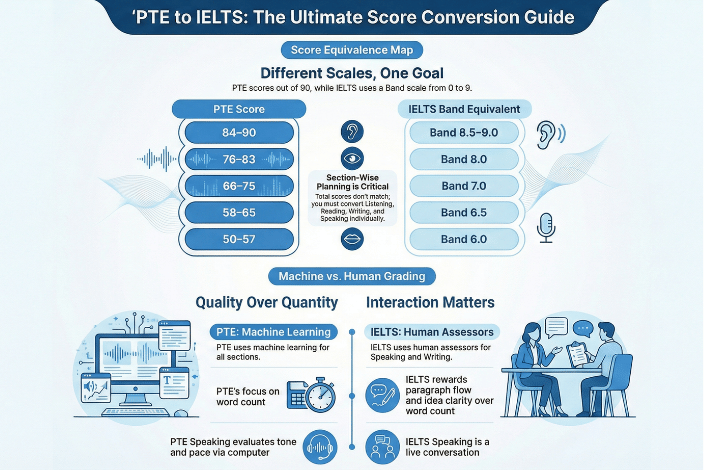
You may have already taken the PTE exam and are now planning to switch to IELTS. Or you may be wondering how PTE scores compare if your university or immigration consultant asks for an IELTS band instead. While both tests measure English skills, they do it in different ways. PTE gives you a score out of 90, while IELTS uses a band scale from 0 to 9. You cannot guess how one maps onto the other unless you check the official equivalence chart. This blog explains how each PTE score converts to an IELTS band for listening, reading, writing, and speaking.
Why do test scores not match by default?
The first mistake many candidates make is trying to convert a total score. This creates confusion. IELTS does not give one number. It gives four bands and an overall band calculated from those four. PTE gives one final score and sectional scores. These are based on computer-scored tasks. IELTS makes use of human assessors in writing and speaking. Therefore, a total of 65 in PTE does not mean a 7 in IELTS. Each skill must be viewed separately. You need to understand how each section converts before you assume any band equivalence.
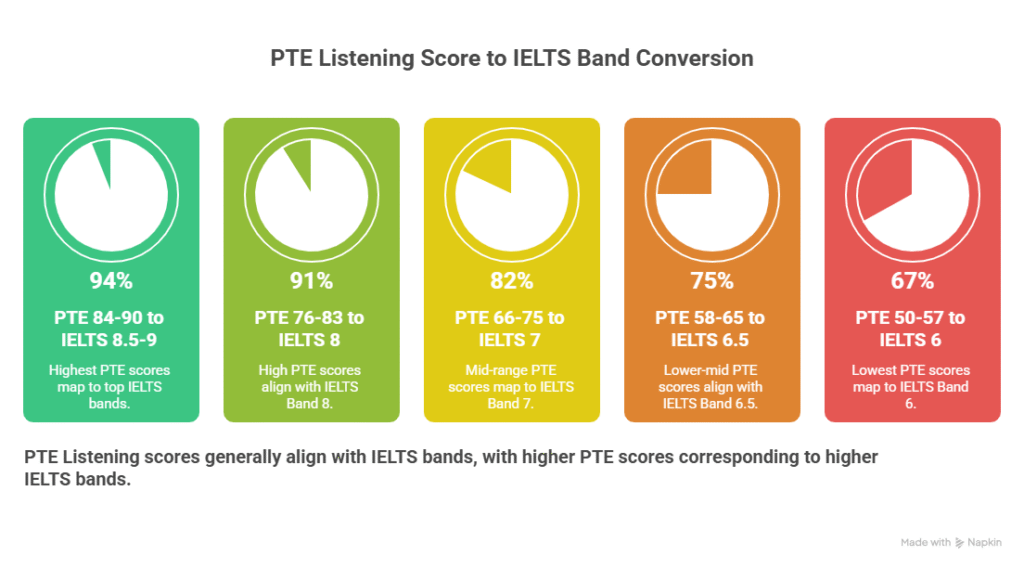
Listening score comparison:
PTE Listening tests academic content using fill-in-the-blanks, highlight summary, and multiple-choice questions. IELTS Listening uses four audio recordings and forty questions. The IELTS band depends on how many answers you get right. In PTE, the score is based on fluency, vocabulary, and listening accuracy. The match between scores is as follows:
PTE Listening Score IELTS Band
| PTE Listening Score | IELTS Band |
| 84–90 | Band 8.5–9 |
| 76–83 | Band 8 |
| 66–75 | Band 7 |
| 58–65 | Band 6.5 |
| 50–57 | Band 6 |
The listening format in IELTS demands faster thinking and stronger focus on keywords. Timing becomes critical because there are no replays.
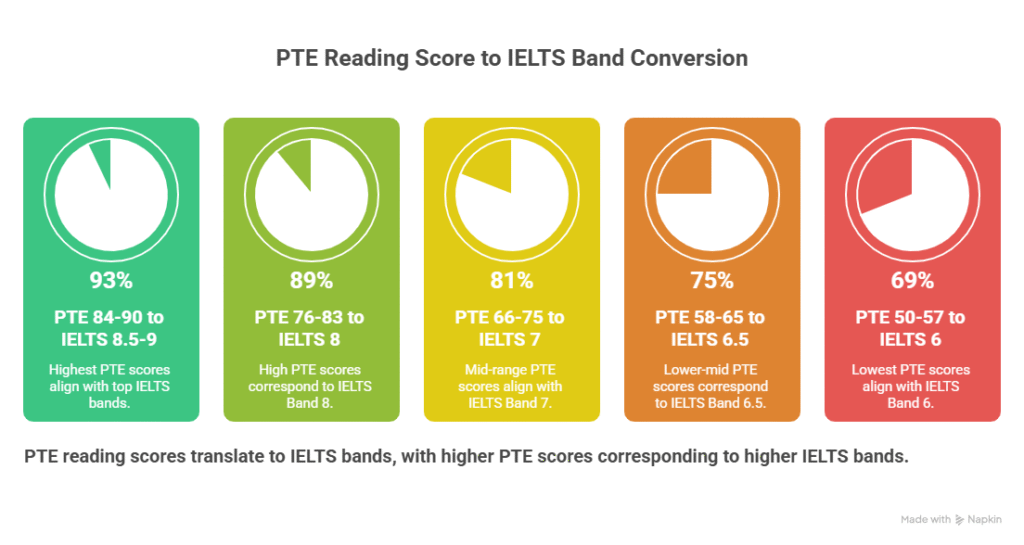
Reading score comparison:
PTE reading entails fill-in-the-blanks, rearranging paragraphs and summarizing written text. The reading in IELTS will give you three long texts and forty questions. These consist of matching headings, true-false-not given and sentence filling in. PTE scores are computed using the algorithm. IELTS scores in reading are given in raw formats and converted into bands. Here’s how the scores align:
PTE Reading Score IELTS Band
| PTE Reading Score | IELTS Band |
| 84–90 | Band 8.5–9 |
| 76–83 | Band 8 |
| 66–75 | Band 7 |
| 58–65 | Band 6.5 |
| 50–57 | Band 6 |
IELTS reading rewards speed along with comprehension. Unlike PTE, there is no autocorrection. So test-takers need to avoid spelling mistakes and stay alert to time pressure.
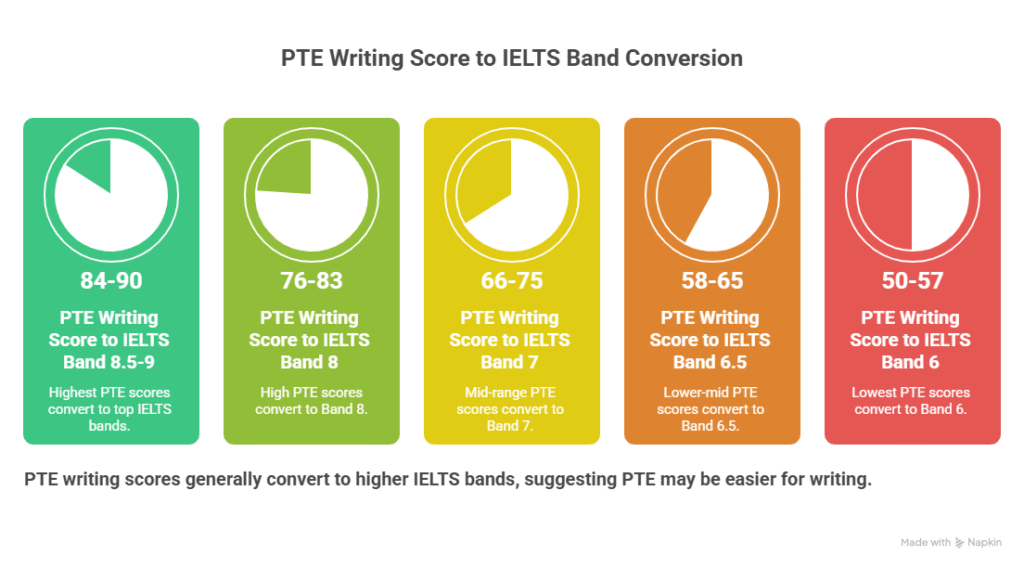
Writing score comparison:
Writing is often where PTE test-takers score well, but then struggle with IELTS. This is because PTE tasks include summarising spoken text and writing short essays. IELTS Writing has two tasks. Task 1: summary of a chart or a letter. Task 2 is an opinion-based essay. PTE is graded by using machine learning and IELTS writing is graded by using four different criteria. The score conversion is shown below:
PTE Writing Score IELTS Band
| PTE Writing Score | IELTS Band |
| 84–90 | Band 8.5–9 |
| 76–83 | Band 8 |
| 66–75 | Band 7 |
| 58–65 | Band 6.5 |
| 50–57 | Band 6 |
Most learners find IELTS writing more demanding. Paragraph flow, idea clarity, grammar, and vocabulary range matter more than just word count. Examiner insight plays a major role here.
Speaking score comparison:
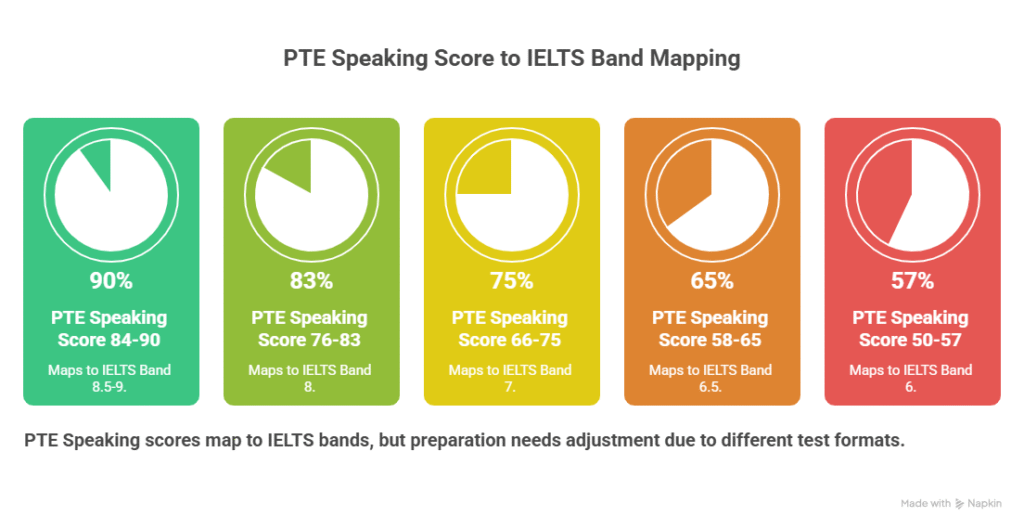
PTE Speaking includes tasks like read-aloud, repeat sentence, and describe an image. The computer evaluates tone, fluency, and pace. IELTS Speaking is a live conversation. It includes personal questions, cue cards, and follow-up discussion. Many learners feel more pressure during the IELTS speaking test because of human interaction. But the feedback is more precise, and the test is flexible to different accents and speaking styles. Here’s how the scores map:
PTE Speaking Score IELTS Band
| PTE Speaking Score | IELTS Band |
| 84–90 | Band 8.5–9 |
| 76–83 | Band 8 |
| 66–75 | Band 7 |
| 58–65 | Band 6.5 |
| 50–57 | Band 6 |
In case you scored highly on PTE speaking, you should not be optimistic that the same will occur in IELTS. The job is not the same, and preparation must be adjusted accordingly.
Why these scores matter for your goal:
Many immigration and licensing bodies now accept both IELTS and PTE. But some countries, like the UK and Canada, still prefer IELTS. Universities often accept either, but assign minimum score bands for each module. That is why section-wise planning matters. Having a PTE Reading at 65, and a PTE Writing at 58, your IELTS Reading is likely to translate to a Band 7, but your writing is likely to translate to a Band 6.5. That half may play with your application. It is always better to break down each skill, compare scores, and then rebuild your IELTS strategy around it.
Where Shane Jordan fits into this process:
Shane Jordan is not a coach who is theory-based. He is an ex-IELTS examiner who has more than 20 years of experience in the evaluation of writing and speaking. He has evaluated more than thirty-five thousand responses across global test centres. At InSync Learning and Development, Shane helps learners shift from PTE habits to IELTS scoring logic. His feedback is based on how real band scores are decided. If you are unsure how your current PTE level translates to IELTS, he will give you a skill-wise estimate and outline the gaps that need fixing.
How InSync supports the PTE to IELTS transition:
You do not need to start from zero. If you’ve already cleared PTE, you’ve built skills that still count. The problem is structure. At InSync, we offer:
- Two-tier English assessment with CEFR mapping and IELTS-format mock.
- Score conversion guidance with section-wise band targets.
- Examiner-led writing and speaking corrections with detailed feedback on strengths and weaknesses.
- Speaking mock tests with scoring based on IELTSspeaking band descriptors.
- Class timing flexibility for working professionals and students.
This is not generic coaching. Each plan starts with your actual PTE scores and builds a targeted IELTS preparation schedule around them.
What to do if you already have a PTE score:
Start by checking your sectional scores across all four PTE modules. Then match them with the band table above. Once done, book a private level check session with Shane Jordan. In that session, you’ll speak for 10–15 minutes and receive an IELTS band estimate for speaking. You’ll also receive writing tasks to submit for band evaluation. Based on that, a study plan is created. You can choose morning shifts, afternoon or evening shifts as per your convenience. Mocks, corrections, and repeat classes support till the day of the test will also be available to you.
Final message if you’re comparing or switching tests:
PTE and IELTS tests similar skills, but they score them differently. Machine grading is not the same as examiner judgment. If you are switching to IELTS, the score conversion is just the starting point. What matters more is how you adjust your structure and mindset for each module. We help with that adjustment by using actual exam logic, not tips or templates. You can make the switch without losing confidence or progress. You just need to train the right way.