Study in the UK Without IELTS: Complete Guide for Indian Students (2026)
Every year, thousands of Indian students make plans to study in the UK. And almost every week, someone asks the same question:
Can I study in the UK without IELTS?
The short answer is yes, but the full story is more important. IELTS may be replaced by a few UK universities. Nevertheless, these avenues alone may be counterproductive, particularly when you are targeting the most desirable universities, scholarships, or long-term goals such as employment or immigration. This guide will take you through the meaning of IELTS-free, the dangers of the same and why it may still be your best bet to prepare to take IELTS.
Is it possible to study in the UK without IELTS?
- Yes, there are universities in the UK where students can apply without an IELTS score. Instead, they may accept:
- A certificate of Medium of Instruction (MOI) from your college or university.
- Good marks in English in Class 12 (typically 70 percent or above)
- The university conducted a short interview and accepted the student without IELTS into their course.
- An English course prior to starting their main academic course.
The British Council Study UK website and its student guides provide details about such cases.
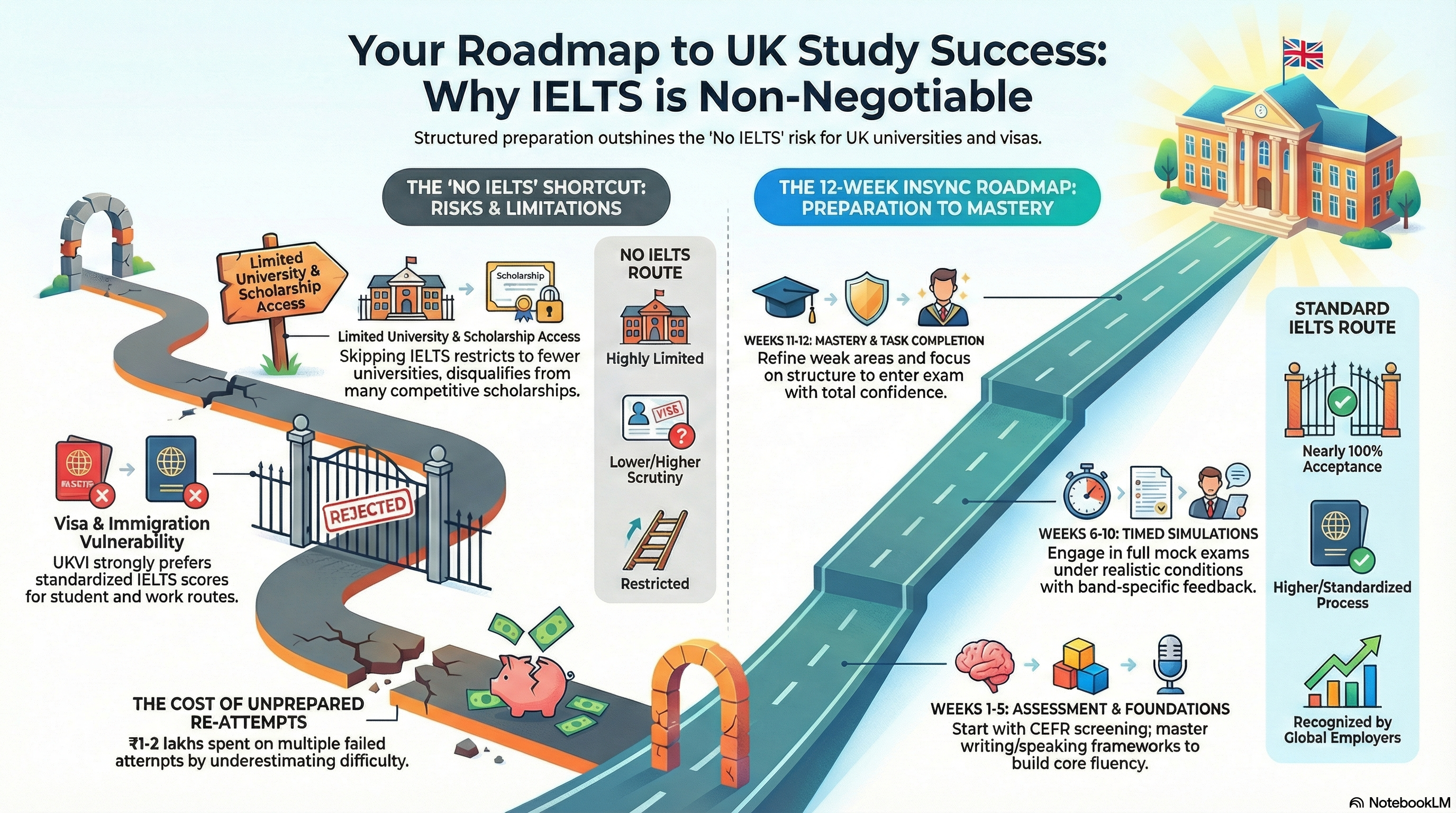
However, these options are limited. Not all universities offer them, and they usually apply to specific programs or student profiles. You will still require IELTS in case you desire the liberty to use widely, or in case you desire to obtain a scholarship or a competitive course.
Why IELTS Still Matters for Indian Students
IELTS is not a test of any kind. It is the most popular English proficiency test in UK universities and the UK visa procedure. Many students who try to avoid it later realise that skipping IELTS reduces their chances of getting into better universities and stronger visa applications.
Here is why IELTS remains important:
- It is accepted by nearly all UK universities, unlike internal interviews or MOI certificates
- It strengthens your scholarship applications by proving your language ability in a standardised format
- It is preferred by UK Visas and Immigration (UKVI), especially when applying for student or work visas
- It supports long-term plans like applying for the Graduate Route or permanent residency
- It is recognised by employers and immigration bodies across the UK and many other countries
You can read more about IELTS testing formats and how they are accepted by UKVI on the IELTS official site and Cambridge English UK visa page.
If you are aiming for more than just a basic admission letter, preparing for IELTS is often the better path.
The Better Question: Can I Crack IELTS in Three Months?
This is the question that really matters. Most students are not afraid of the IELTS exam itself. They are afraid of wasting time and still falling short of their target band.
The truth is, you can prepare for IELTS and succeed in just three months. But only if you stop guessing, stop downloading random tips, and start working with real feedback from someone who understands how IELTS is scored.
That is where Shane Jordan comes in.
What Makes Shane Jordan’s IELTS Coaching Unique?
Shane Jordan is not a motivational coach. He is a former British Council IELTS examiner who has assessed over 35,000 scripts and conducted the same number of speaking interviews for test takers. He leads the IELTS training at InSync, where students follow a clear and proven 12-week plan, resulting in candidates achieving the highest band scores for their visa process.
Instead of memorising model answers or watching endless YouTube videos, students at InSync learn how the IELTS scoring system actually works. They understand what examiners reward, what they ignore, and how to stop making the same mistakes over and over again.
The 12-Week IELTS Plan at InSync. 100% progress guarantee!
Here is how the plan works, week by week.
- Weeks 1 to 2
- Start with a CEFR-based screening test and a full IELTS mock exam
- Receive personal feedback from Shane on your current level
- Set realistic band goals and build a personalised study schedule
- Get introduced to the fundamentals of the test modules
- Engage in skills-building tasks targeted to enhance fluency across all 4 exam papers
- Weeks 3 to 5
- Learn the correct format and practice various writing tasks to build fluency
- Practice a range of speaking frameworks for parts 1-3 to enhance confidence and fluency
- Fix common writing and speaking errors that affect clarity, meaning and tenses
- Understand the timing strategy for each module through test simulations
- Weeks 6 to 8
- Start timed writing and speaking practice
- Receive band-specific feedback using actual IELTS rubrics
- Identify weak points and track progress weekly
- Weeks 9 to 10
- Simulate full IELTS tests under exam conditions
- Work on structure, speed and focus
- Get detailed performance reports and support tools to develop test skills
- Weeks 11 to 12
- Focus on fluency, structure, and task completion
- Repeat and refine weak areas
- Go into the exam knowing exactly what to expect
Every student’s tasks are marked by IELTS-trained assessors and reviewed by Shane himself. He stays involved throughout the course to make sure feedback is accurate and progress is visible.
Why Most Three-Month Plans Fail
The biggest problem is not a lack of time. It is a lack of direction. Many students start with the right energy, but lose momentum because they do not get feedback or follow a system.
Most people avoid writing and speaking practice because it is hard. But that is exactly where the scores are hiding. The InSync system pushes students into the right discomfort, so they grow faster and avoid wasting weeks doing what does not work.
Experience one-of-a- kind IELTS coaching at InSync.
LearnInSync is not just a coaching center. It is a structured support system that combines examiner-level guidance with flexibility for working professionals and students.
Here is what students get:
- Feedback from Shane Jordan on key tasks and continuous support until test day
- Flexible scheduling with morning, evening, or late-night batches
- Weekly mock tests and progress tracking
- Option to repeat missed classes in other batches
- A plan built around your goals, not a generic template. 100% progress Guarantee.
Whether you are aiming for higher education, work, or immigration, this is a system that has worked for hundreds of learners—and it can work for you too.
Shane Jordan’s Message to IELTS Aspirants
This section will be written directly by Shane Jordan.
The IELTS Reality Check: A Message from an Examiner’s Desk
I’ve been an IELTS examiner with the British Council and have 24 years of teaching experience. Over this period, especially here in Chennai, I have seen hundreds of candidates making silly mistakes that mostly cause their UK dreams to come to an end before their start.
The Brutal Truth from 24 Years of Coaching and Assessing
Frequently, I assess candidates who took shortcuts. They believed they could “manage” without proper preparation. Research shows that students who take IELTS multiple times without addressing fundamental language weaknesses often score worse in subsequent attempts. I’ve seen students burn through ₹1-2 lakhs across four or five test attempts, each time scoring 5.5 or 6.0 when they needed 7+
I’ve also come across candidates from very wealthy and affluent families who go ahead and book all the available test dates for the whole year with IDP. These are students with low levels of English proficiency ( A1-A2 on CEFR) who need 6.5-7+ for their visa requirements. They believe that by retaking the test several times they can improve their test scores or they have faith that they might just get lucky on any one of the tests.
Why do students end up repeating the test several times? Best solution
Most students tend to underestimate the IELTS exam. They treat this test as if I were just another English test at school for college. Most test takers fail to realize that the IELTS is a Cambridge high- stakes exam which from my perspective is a real “Goliath” and a “devil in disguise”. This test is by no means a” cake walk”. In fact, IELTS will push your boundaries and can get under your skin if you take it lightly. The whole purpose of this test is to assess one’s competency in using English fluently across all 4 core skills of listening, reading, writing and speaking.
Another major factor for falling short in the exam is relying heavily on online coaching through YouTube tutorials, generic apps, or coaching centres run by individuals with zero examining experience. Students tend to memorize template answers that examiners spot instantly. Learners practice with out-dated or sub-standard materials. Test takers fail to understand that IELTS isn’t just an English test, it’s a high-stakes assessment of your ability to function in a demanding academic environment.
Therefore, no amount of re-attempting the test or focusing only on doing several mock tests is going to improve your score significantly, until and unless, you don’t find the right kind of mentor; someone with extensive experience and a deep understanding of how the test works and its expectations, someone who understands the evaluation criteria inside out to be able to assess and provide targeted feedback to help students improve their test performance and boost scores. At InSync, you will experience examiner –led instruction in every lesson. We are the only IELTS coaching academy in India with an actual IELTS assessor as head coach.
I’d like to list out some recurring patterns why learners face disappointment on the IELTS
Underestimating the test difficulty. Candidates tend to believe that a strong command of conversational English will guarantee success in IELTS. It doesn’t. The test calls for a precise set of skills: efficient reading and listening sub-skills, clear pronunciation, natural fluency, a sophisticated grammar range, accurate vocabulary, and the capability to think critically.
Poor time management during preparation. Learners sign up for tests ahead of their readiness, thinking that practice alone will be enough. Time mismanagement during the actual test is, in fact, one of the most common IELTS mistakes with the test taker spending too much time on the difficult questions and not answering any of the easier ones.
The Professional Guidance Difference: Such an exam warrants a genuine preparation with the right mentor, someone who not only “teaches English” but is familiar with the assessment criteria from the inside of the system. A competent trainer will pinpoint your particular weaknesses, take you away the pronunciation errors that are costing you bands, introduce you to real speaking strategies, and guide you through the exact writing structures that the examiners are looking for.
Closing thoughts
If you’re serious about studying or working in the UK, invest 8-12 weeks of focused IELTS preparation with a certified examiner or trainer from a recognized institution. Don’t gamble with your future by taking shortcuts or trusting unqualified “experts.” The money you spend on proper coaching is nothing compared to the ₹15-20 lakhs you’ll invest in your UK education, or the devastating cost of visa rejection.
The UK isn’t looking for students who barely scrape through language requirements. They want academically prepared individuals who will thrive, not struggle. IELTS is your first opportunity to prove you’re that candidate.
Prepare seriously. Choose your coach wisely. Your future deserves that level of commitment.
Final Thoughts: Should You Skip IELTS?
It may seem tempting to apply without IELTS, especially if you are short on time. But the reality is, IELTS gives you more control, more credibility, and more options.
Instead of asking how to avoid it, ask how to prepare for it with purpose. If you start with a proper assessment, a clear timeline, and real feedback, you will stop guessing and start progressing.
If you are serious, book your first CEFR screening and IELTS mock. Let Shane and the team at InSync build your 12-week roadmap.
That first step could be the one that changes your entire application journey.Start here: https://learninsync.in