

Many IELTS candidates struggle with writing, even when their English is good. The problem is rarely vocabulary alone. In most cases, it comes down to poor structure. Ideas are scattered, paragraphs are unclear, and the examiner finds it hard to follow the argument. This directly affects your score in Coherence and Cohesion.
If you are aiming for a Band 7 or higher, learning how to write well-structured paragraphs in IELTS essays is not optional. It is essential. A clear paragraph shows the examiner that you can organise ideas logically and develop them with precision.
In fact, when you learn from a former British Council IELTS examiner, one thing becomes very clear. Examiners are not impressed by complicated words. They look for clarity, structure, and control over ideas.
In this guide, you will learn exactly how to structure your paragraphs in IELTS Writing Task 2. We will break it down step by step, show examples, and help you avoid common mistakes that cost marks.
Why Paragraph Structure Matters in IELTS
Paragraph structure plays a major role in your IELTS Writing score. It directly impacts the “Coherence and Cohesion” band descriptor, which is worth 25% of your total marks.
When your paragraphs are well organised, the examiner can easily follow your argument. Each idea flows naturally into the next. This creates a strong impression of control and clarity.
On the other hand, poorly structured paragraphs confuse the reader. Ideas overlap. Sentences feel disconnected. Even if your grammar is correct, your score will drop.
From an examiner’s point of view, a good paragraph answers three simple questions:
- What is the main idea?
- How is it explained?
- Is there a clear example or support?
If any of these are missing, the paragraph feels incomplete.
This is one of the most common reasons why students fail to move beyond Band 6. If you want a deeper understanding of why many candidates struggle, you can read this detailed breakdown:
A well-structured paragraph does not just improve readability. It shows maturity in writing. It tells the examiner that you can present ideas in a logical and organised way, which is exactly what the test is designed to assess.
Ideal IELTS Essay Structure
Before focusing on paragraphs, you need to understand the overall essay structure. A strong IELTS essay usually follows a simple four-part format:
1. Introduction
This is where you paraphrase the question and clearly state your position or main idea.
2. Body Paragraph 1
Your first main idea is presented, explained, and supported with an example.
3. Body Paragraph 2
Your second main idea is developed in the same structured way.
4. Conclusion
You summarise your argument and restate your position clearly.
Each body paragraph should focus on only one main idea. This is where many students go wrong. They try to include too many points in one paragraph, which weakens their argument.
When you study under a real examiner, you quickly realise that simplicity is powerful. Clear structure always scores better than complicated writing.
If you are looking for guided training with structured writing practice, you can explore the programs offered here:

Perfect IELTS Paragraph Structure
Now let’s focus on the most important part of this guide. A high-scoring IELTS paragraph is not random. It follows a clear and repeatable structure.
You can think of it as a simple four-step process.
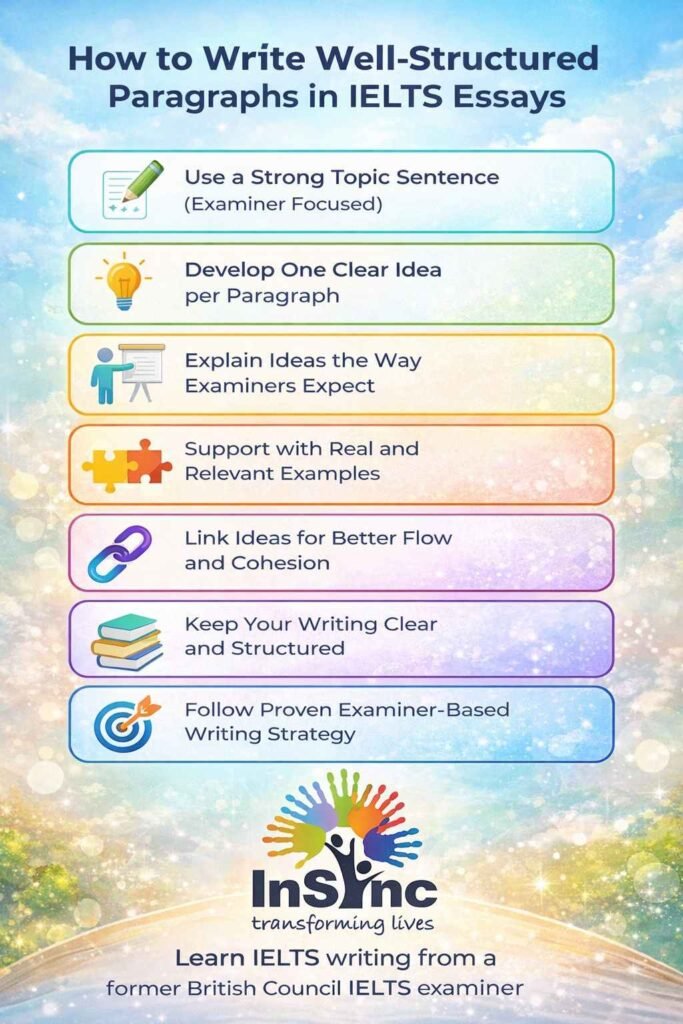
1. Topic Sentence
This is the first sentence of your paragraph. It tells the examiner what the paragraph is about. It should be clear and direct.
2. Explanation
After introducing the idea, you need to explain it. This is where you add detail and show your reasoning.
3. Example
A strong paragraph always includes an example. It can be real or logical, but it must clearly support your idea.
4. Linking Sentence
This sentence connects your idea back to the question or leads smoothly to the next paragraph.
When you follow this structure, your writing becomes easier to read and more convincing. It also helps you stay focused and avoid unnecessary sentences.
Many students who join structured programs, such as this ielts coaching in Chennai, notice a quick improvement in their writing simply by applying this method consistently.
If you are based in another on Pondicherry, you can also explore:
Example of a Well-Structured Paragraph
Let’s understand this with a real IELTS-style example.
Question:
Some people believe that online learning is more effective than traditional classroom education. To what extent do you agree or disagree?
Weak Paragraph (Unstructured)
Online learning is becoming popular nowadays. Many students use the internet for studying. It is flexible and convenient. People can learn from home. Technology is growing fast, and education is changing. Students also save time and money.
Strong Paragraph (Well-Structured)
Online learning has become more effective than traditional classroom education due to its flexibility. Students can access study materials at any time, which allows them to learn at their own pace. This is particularly helpful for working professionals who cannot attend fixed classroom sessions. For example, many learners now prepare for exams like IELTS through online platforms while managing full-time jobs. As a result, online education provides a practical and efficient learning solution for modern students.

Why the Second Paragraph Scores Higher
The difference is clear when you look closely.
- It starts with a clear topic sentence
- The idea is properly explained
- A relevant example is included
- The final sentence connects the idea logically
This is exactly what examiners look for.
If you want to see how speaking responses are also evaluated in a structured way, this guide can help:
Common Mistakes Students Make
Even students with good English often lose marks because of avoidable mistakes in paragraph writing.
1. No Clear Topic Sentence
Many students start writing without clearly stating the main idea. This confuses the examiner from the beginning.
2. Too Many Ideas in One Paragraph
A paragraph should focus on one idea only. Adding multiple points weakens your argument and reduces clarity.
3. Lack of Examples
Without examples, your paragraph feels incomplete. The examiner cannot see how your idea applies in real life.
4. Overly Long Sentences
Trying to sound “advanced” often leads to long and confusing sentences. Simple and clear sentences score better.
5. Poor Linking Between Sentences
If your sentences do not connect logically, your paragraph will feel disjointed.
These mistakes are very common, especially among students who prepare without proper guidance. This is why structured training and regular feedback make a big difference.
Click on the link to review real student experiences and success stories here:
Tips to Improve Your Paragraph Structure
Improving your writing does not require complex techniques. Small changes can lead to big results.
Focus on One Idea Per Paragraph
Before you start writing, decide on your main idea. Stick to it and develop it fully.
Use Simple Sentence Structures
Clarity is more important than complexity. Write in a way that is easy to read.
Practice Writing Regularly
Consistency matters. Even writing one paragraph daily can improve your structure over time.
Always Add an Example
Make it a habit. Every paragraph should include at least one clear example.
Review and Edit Your Work
After writing, check if your paragraph follows the 4-step structure.
Get Expert Feedback
This is where most students improve the fastest. When you learn from a former British Council IELTS examiner, you understand exactly what needs to change in your writing.
If you want personalised feedback and structured guidance, you can get in touch here:
Examiner Insights: What Actually Gets You a Higher Band
Most students believe that a better vocabulary leads to a higher score. That is only partly true. From an examiner’s perspective, structure carries more weight than people realise.
When you learn from a former British Council IELTS examiner, you start to see how answers are actually evaluated. Examiners are trained to look for clarity, logical progression, and relevance. If your paragraph is easy to follow, you are already ahead of many candidates.
Here are a few insights that can make a real difference:
Clarity always beats complexity
Using simple sentences with clear meaning is far more effective than trying to impress with difficult words.
Each paragraph must feel complete
A strong paragraph presents an idea, develops it, and supports it. If any part is missing, it feels weak.
Relevance is critical
Every sentence should connect to the main idea. Irrelevant points reduce your score.
Consistency in structure builds confidence
When your essay follows a clear pattern, the examiner finds it easier to award a higher band.
This is why structured training matters. It is not just about writing more. It is about writing in a way that matches how examiners think.
If you want to explore more about the institute and its approach, you can also check their professional presence here:
https://www.linkedin.com/company/insync-learning-development-pvt-ltd/
You can also watch practical guidance and student-focused content here:
https://www.youtube.com/@insyncld860
And for regular tips and updates:
https://www.instagram.com/insyncielts_oet/
Practice Question with Model Paragraph
Let’s apply everything you have learned so far.
Question:
Some people think that governments should invest more in public transport instead of building new roads. To what extent do you agree or disagree?
Model Paragraph
Investing in public transport is more beneficial than building new roads because it reduces traffic congestion. When reliable buses and trains are available, more people prefer using them instead of private vehicles. This leads to fewer cars on the road and smoother traffic flow. For instance, cities with well-developed metro systems often experience lower levels of congestion during peak hours. Therefore, improving public transport can be a more effective long-term solution to traffic problems.
This paragraph follows a clear structure:
- The main idea is introduced
- It is explained logically
- A relevant example is added
- The conclusion reinforces the point
Practising with such structured responses can significantly improve your writing score over time.

Frequently Asked Questions
How many paragraphs should I write in an IELTS essay?
Most IELTS essays include four paragraphs: one introduction, two body paragraphs, and one conclusion.
How long should each paragraph be?
There is no fixed length, but a good paragraph usually contains 4–6 sentences that fully develop one idea.
Is it necessary to include examples in every paragraph?
Yes, examples strengthen your argument and make your writing more convincing.
Can I write more than two body paragraphs?
It is possible, but not recommended unless you can manage your time well and maintain clarity.
What is the fastest way to improve paragraph structure?
Practice regularly and get feedback from an expert. Learning from a real examiner helps you understand exactly where you are losing marks.
Improve Your IELTS Writing with InSync
If you want to move beyond Band 6 and start writing well-structured IELTS essays, the right guidance makes a real difference. At InSync Learning and Development, you learn directly from a former British Council IELTS examiner who understands exactly how your writing is evaluated. With focused feedback, regular practice, and a proven structure, many students see clear improvement in a short time. You can explore the full program here, or learn more about our specialised IELTS coaching in Chennai