Many IELTS candidates struggle with the reading section, not because their English is weak, but because they run out of time.
You may have experienced this yourself.
You begin with confidence. The first passage feels manageable. Then, somewhere in the middle, time starts slipping away. By the last passage, you feel rushed and unsure.
This is where most students lose marks.
The truth is simple. IELTS Reading is not just a language test. It is a test of strategy, focus, and decision-making.
When you learn from a former British Council IELTS examiner, you quickly realise that success depends on how you approach the test, not how fast you read.
In this guide, you will learn how to stay in control, manage your time effectively, and handle all 40 questions with confidence.
Why IELTS Reading Feels Difficult
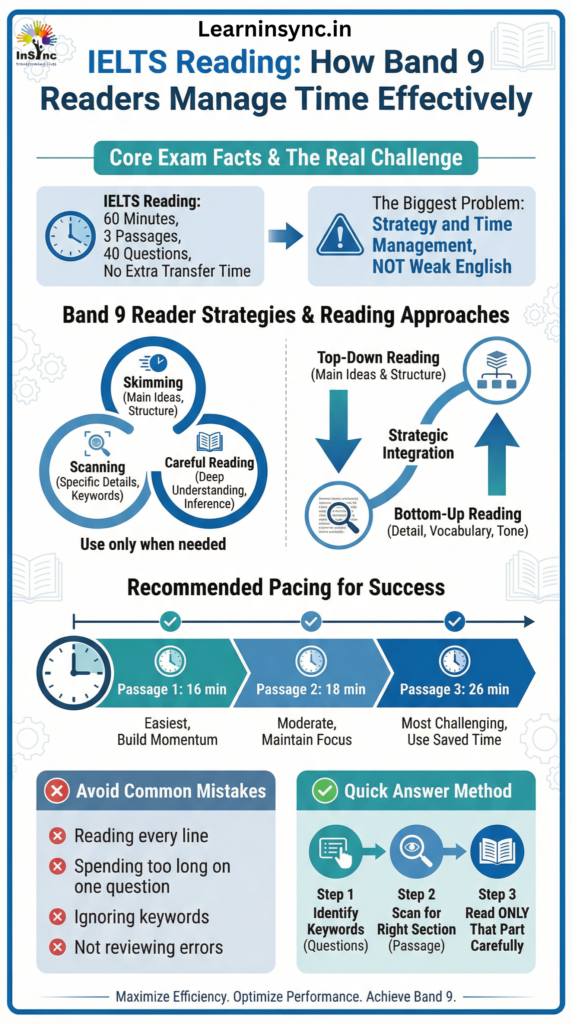
At first glance, the reading section looks simple. Three passages. Forty questions. Sixty minutes.
But once you start practising, the challenge becomes clear.
The passages increase in difficulty. Passage 1 is easier, while Passage 3 is more complex. Without a clear plan, it is easy to lose momentum.
Time pressure is the biggest challenge. You must read, understand, and answer everything within 60 minutes. There is no extra time to transfer answers.
In IELTS Academic, you deal with around 2650–2900 words. In General Training, it is slightly less, but still demanding.
For many students, it feels like a wall of text.
So how do you handle it?
Not by reading harder, but by reading smarter.
You need strong reading sub-skills. These help you process information quickly without getting overwhelmed.
Another challenge is the variety of question types. Each one requires a different approach. If you use the wrong method, you waste time and increase your chances of making mistakes.
Most students think their English is the problem. In reality, the bigger issue is strategy.
If you are looking for structured guidance and practice, you can explore programs here:

IELTS Reading Test Format
Before you improve your score, you need to clearly understand the test format.
The IELTS Reading section includes:
- 3 passages
- 40 questions
- Total time: 60 minutes
In Academic IELTS, passages are longer and more complex.
In General Training, the texts are more practical and based on everyday situations.
If you want to build this habit with guided practice, you can also explore:
Common question types include:
- Multiple Choice
- True / False / Not Given (or Yes / No / Not Given)
- Matching Headings
- Matching Information
- Sentence or Summary Completion
- Diagram or Table Completion
- Short Answer Questions
Each correct answer gives you one mark.
One important detail many students ignore:
There is no extra time at the end.
Everything must be completed within 60 minutes.
Biggest Mistakes Students Make
One of the biggest mistakes is underestimating the exam.
Many candidates assume IELTS is just another English test. It is not.
It is a high-stakes exam developed by Cambridge, and it tests how well you think under pressure.
Another common mistake is using the wrong reading approach.
Also, Read – Top 10 Reasons Why IELTS Candidates in Chennai Fail – And Exactly How to Fix Them
Here are some habits that cost marks:
- Spending too long on one question
- Ignoring keywords in questions
- Reading every line instead of scanning
- Poor time management across passages
- Practising without reviewing mistakes
Many students only take mock tests but never analyse their errors.
If you do not understand why you got something wrong, your score will not improve.
How Band 9 Readers Actually Read
Band 9 readers are not just fast readers. They are efficient readers.
They use two key approaches.
Top-Down Approach
This focuses on understanding the overall idea of the text.
Readers:
- Look at headings and structure
- Use their background knowledge
- Predict the content
- Identify the writer’s purpose
They build a clear picture before going into details.
Bottom-Up Approach
This focuses on accuracy and detail.
Readers:
- Pay attention to vocabulary
- Analyse sentence structure
- Understand meaning clearly
- Identify tone and opinion
What Makes Band 9 Readers Different
They do not rely on just one method.
They switch between approaches depending on the question.
For example:
- They skim to understand the general idea
- They scan to find specific information
- They read carefully only when needed
They also know when to move on.
If a question takes too long, they skip it and return later. This helps them save time and avoid stress.
If you want to build this habit with guided practice, you can also explore:
Band 9 Strategies You Can Use
To complete all 40 questions, you need a clear and repeatable method.
Start with purpose.
Sometimes it helps to read the questions first. This allows you to identify keywords and understand what to look for.
Other times, you can skim the passage first to understand its structure.
Focus on keywords in each question. These may include names, dates, or specific terms.
Then scan the passage. Do not read line by line. Move quickly to find where the answer is likely located.
Once you find the relevant section, read only that part carefully.
And remember this:
If a question takes too long, move on.
Spending too much time on one question can cost you several marks.

Time Management Strategy
Time management is the key to completing all 40 questions.
A simple structure you can follow:
- Passage 1: 16 minutes
- Passage 2: 18 minutes
- Passage 3: 26 minutes
The first passage is usually easier, so complete it quickly. This gives you more time for the final passage.
Avoid spending more than one minute on a question.
Answer questions as you read instead of waiting until the end.
Practising under timed conditions will help you build confidence and improve your speed.
You can explore more expert-level insights here:
Question Types and How to Solve Them
Each question type requires a slightly different approach.
Multiple Choice
Read carefully and eliminate incorrect options first.
True / False / Not Given
- True means the statement matches the passage
- False means it contradicts the passage
- Not given means the information is not mentioned
Matching Headings
Focus on the main idea of each paragraph.
Sentence Completion
Follow the word limit and check grammar.
Fill in the Blanks
Look for synonyms rather than exact words.
Example: How to Find the Answer Quickly
Question:
What is the main reason people prefer online learning?
First, identify keywords: people, prefer, online learning.
Next, scan the passage to find where online learning is discussed.
Then read only that section.
You may find a sentence like:
“Many individuals choose online learning because it offers flexibility.”
The answer is clear: flexibility.
You did not read the entire passage. You focused only on what mattered.
Suggested – How to Write Well-Structured Paragraphs in IELTS Essays (Band 7+ Guide)
Tips to Improve Reading Speed
Improving reading speed is not about rushing. It is about being efficient.
- Practise skimming for general ideas
- Develop scanning for specific details
- Build your vocabulary gradually
- Read daily, even for 20 minutes
- Take regular timed mock tests
Consistency is the key to improvement.
Examiner Insight: What Actually Improves Your Score
From an examiner’s perspective, the difference between Band 6 and Band 7 is not intelligence.
It is control and consistency.
Band 6 students often rush and make avoidable mistakes.
Band 7 and above students follow a method. They stay calm and focus on accuracy.
The test does not require perfect understanding of every word.
It requires correct answers based on clear evidence.
If you want to see how expert-led training helps students improve their performance, you can also explore:

Frequently Asked Questions
Can I really finish all 40 questions in IELTS Reading?
Yes, you can. Most students struggle because they don’t follow a clear strategy. Once you learn how to scan, identify keywords, and manage your time, finishing all 40 questions becomes much more realistic.
Should I read the full passage before answering questions?
Not always. In many cases, it is more effective to read the questions first. This helps you know exactly what to look for, so you don’t waste time reading unnecessary parts of the passage.
Which passage should I be most careful about?
Passage 3 is usually the most challenging. It includes more complex ideas and vocabulary, so it requires extra focus. This is why saving enough time for the last passage is important.
What is the fastest way to improve my IELTS Reading score?
Focus on the right things. Build strong reading strategies, practise regularly under time limits, and review your mistakes carefully. Improvement comes from understanding your errors, not just doing more tests.
Is IELTS Reading difficult for most students?
It feels difficult in the beginning, especially because of time pressure. But once you understand how the test works and apply the right techniques, it becomes much easier to manage.
Conclusion
Most students don’t lose marks in IELTS Reading because the test is too hard. They lose marks because they run out of time or follow the wrong approach.
The moment you stop trying to read everything and start reading with a clear purpose, things begin to change.
When you learn how to pick keywords, scan quickly, and move on from difficult questions, the test feels more manageable. You don’t feel rushed. You don’t panic. You stay in control.
That’s exactly what Band 7 and above students do differently.
If your goal is to improve, don’t just practise more. Practise the right way. Focus on strategy, review your mistakes, and build consistency.
With the right approach, finishing all 40 questions on time is not just possible, it becomes your new normal.
Improve Your IELTS Reading with InSync Learning and Development
If you want to improve your IELTS Reading score and build the right strategy from the beginning, InSync Learning and Development can guide you.
You will learn directly from a former British Council IELTS examiner who provides clear guidance, structured practice, and personalised feedback.
Many students who struggle with time management see steady improvement once they follow a proven system.
To explore the program or get started, you can visit the official website or connect with the team directly.