
Preparing for IELTS without coaching has become much more common in recent years. Many students now prefer self-study because it offers flexibility, lower costs, and the freedom to learn at their own pace. Whether someone is preparing alongside college, a full-time job, or immigration plans, self-study gives them control over their schedule.
However, one major problem most students face is choosing the right IELTS study material.
There are thousands of PDFs, YouTube channels, websites, Telegram groups, and practice books available online. Instead of helping, this often creates confusion. Students spend weeks collecting resources but struggle to follow a proper preparation strategy. In many cases, they practice regularly but still fail to improve their Writing or Speaking scores.
This is why selecting the best study guides for IELTS self-study is extremely important.
A good IELTS study guide does more than provide practice questions. It helps students understand the exam structure, improve time management, avoid common mistakes, and develop the language skills required for higher band scores.
At InSync Learning and Development, many students initially begin with self-study and later realise that structured preparation and expert feedback can significantly improve their performance. With guidance from a former British Council IELTS Examiner who has examined over 35,000 test takers, students gain a clearer understanding of what examiners actually expect in the IELTS exam.
You can also explore real student experiences and score improvements through these IELTS success stories and testimonials.
If you are planning to prepare from home, this guide will help you choose the right IELTS self-study resources without wasting time on outdated or ineffective materials.
Why IELTS Self-Study Is Becoming More Popular
IELTS self-study has grown rapidly because students today have easier access to online learning resources than ever before. From practice tests to vocabulary lessons, almost everything is available online. But access alone does not guarantee success.
Most students choose self-study for three main reasons:
Flexibility and Convenience
Many IELTS candidates are working professionals, college students, or healthcare workers preparing for overseas opportunities. Attending fixed classroom sessions every day may not always be practical.
Self-study allows learners to prepare:
- Early morning or late night
- During weekends
- Alongside work or studies
- At their own learning speed
This flexibility makes IELTS preparation more manageable for busy learners.
Affordable Preparation Option
Some students begin self-study because they want to reduce preparation costs. Free YouTube lessons, online IELTS materials, and downloadable practice tests make it possible to start preparation without immediately investing in a coaching program.
Resources like this detailed guide on free IELTS materials online can help beginners understand where to start and which resources are genuinely useful.
However, while free resources are helpful in the beginning, students aiming for Band 7 or above usually need a more structured preparation approach.
Some students later combine self-study with professional support programs like IELTS coaching in Chennai to improve Writing, Speaking, and mock test performance more effectively.
Access to Unlimited Online Resources
Today’s IELTS candidates have access to:
- Mock tests
- Cambridge practice books
- Speaking samples
- Vocabulary lists
- Grammar lessons
- Reading strategies
- Listening exercises
The challenge is not finding materials anymore. The real challenge is knowing which materials are reliable and relevant to the current IELTS exam pattern.
At InSync Learning and Development, many students mention that they wasted months switching between random resources before following a more structured study plan. Consistency usually matters more than collecting too many books or PDFs.
Students can also follow updates, preparation tips, and student success stories through the official InSync Instagram page and professional updates on LinkedIn.
What Makes a Good IELTS Study Guide?
Not every IELTS preparation book or online course is worth your time. Some materials focus heavily on shortcuts and tricks, while others contain outdated question patterns that no longer reflect the real exam.
A good IELTS self-study guide should help students build both exam skills and English language confidence.
Updated IELTS Exam Pattern
The IELTS exam continues to evolve, especially with computer-based testing becoming more common. A reliable study guide should include:
- Latest IELTS question types
- Academic and General Training formats
- Updated Writing tasks
- Current Speaking topics
- Real exam-style Reading passages
Students should also clearly understand the difference between Academic and General Training IELTS before selecting study materials. This guide on IELTS Academic vs General Training can help students choose the correct exam format based on their goals.
Real Practice Tests and Mock Exams
One of the biggest mistakes students make during self-study is solving random practice questions that do not match actual IELTS difficulty levels.
A quality IELTS study guide should include:
- Full-length practice tests
- Time-based exercises
- Audio transcripts
- Sample answers
- Detailed explanations
Mock tests are especially important because IELTS is a time-management exam as much as a language exam.
Students preparing seriously for higher band scores often benefit from structured mock test practice. Resources like best platforms to book IELTS mock tests online can help candidates practice under realistic exam conditions.
Writing and Speaking Support
Reading and Listening can usually be self-checked. Writing and Speaking are much harder to evaluate independently.
Many self-study candidates repeatedly make the same mistakes because they never receive proper correction or feedback.
At InSync, students receive:
- Writing correction with estimated band scores
- Weekly Reading and Listening mock discussions
- Free grammar lessons five days a week
- Free speaking fluency classes
- Continuous progress tracking
This type of structured support helps students identify weaknesses earlier instead of discovering them after receiving disappointing IELTS results.
Students who want personalised guidance or a preparation roadmap can directly contact the InSync team here for a free strategy discussion before starting their preparation journey.
The Official Cambridge Guide to IELTS
When students search for the best study guides for IELTS self-study, the Cambridge IELTS books are usually the first recommendation and for good reason.
These books are considered the closest to the actual IELTS exam pattern. Unlike many random PDFs available online, Cambridge materials are designed around real exam standards, which makes them far more reliable for serious preparation.
The Official Cambridge Guide to IELTS is especially useful for beginners and intermediate learners because it combines:
- Skill-building lessons
- Practice exercises
- Full-length mock tests
- Listening practice
- Writing guidance
- Speaking examples
One of the biggest advantages of this guide is that it explains why answers are correct instead of simply giving answer keys. This helps students improve their understanding of IELTS question types rather than memorizing patterns.
The book is also useful for students preparing for both:
- IELTS Academic
- IELTS General Training
Candidates who are still unsure about which IELTS format they should choose can first read this detailed comparison on IELTS Academic vs General Training. For self-study students, this book works best when combined with:
- Regular timed practice
- Vocabulary revision
- Writing evaluation
- Speaking fluency practice
Many Band 7+ candidates use Cambridge materials as their primary preparation source throughout their IELTS journey.
Cambridge IELTS Practice Test Series
The Cambridge IELTS Practice Test Series is one of the most important resources for students preparing independently.
While many books focus on strategies and theory, these books focus heavily on realistic exam practice.
Each book contains:
- Full Reading tests
- Listening tests
- Writing tasks
- Speaking test samples
- Audio recordings
- Answer explanations
The biggest benefit of solving Cambridge practice tests is that students become familiar with:
- Real exam difficulty levels
- Time pressure
- Common trap questions
- Different Listening accents
- Reading passage complexity
This reduces exam anxiety significantly.
Many students make the mistake of solving random online tests that are either too easy or unrealistically difficult. This creates confusion about their actual IELTS level.
Cambridge tests are much more dependable because they closely reflect the real IELTS exam pattern.
At InSync Learning and Development, mock test practice is treated as a major part of score improvement. Students regularly practice Reading and Listening under exam conditions and then participate in detailed review discussions to understand:
- Why mistakes happen
- How time is lost
- Which question types create difficulty
- How to improve accuracy consistently
This type of analysis is often more valuable than simply taking unlimited mock tests without feedback.
Students looking for additional mock test resources can also explore this guide on best platforms to book IELTS mock tests online.
Barron’s IELTS Superpack
Barron’s IELTS Superpack is another strong option for IELTS self-study, especially for students aiming for Band 7 or higher.
Compared to Cambridge books, Barron’s materials usually provide:
- More vocabulary support
- More grammar explanations
- Additional practice exercises
- Detailed strategy discussions
This makes it particularly useful for students who feel their English foundation needs improvement before focusing entirely on exam techniques.
The Superpack typically includes:
- Practice books
- Audio materials
- Writing guidance
- Skill-building exercises
- Practice tests
One reason many self-study students prefer Barron’s books is because the explanations are beginner-friendly and easier to follow.
Students who struggle with:
- Sentence structure
- Grammar accuracy
- Vocabulary range
- Writing organisation
often find Barron’s resources more supportive during the early stages of preparation.
However, students should avoid depending on only one book throughout their preparation. The most effective IELTS self-study plans usually combine:
- Cambridge practice tests
- Vocabulary improvement
- Speaking practice
- Writing correction
- Timed mock exams
At InSync, students also receive:
- Free grammar support classes five days a week
- Speaking fluency sessions
- Writing feedback with estimated band scores
- Continuous progress tracking
This helps learners avoid one of the biggest IELTS preparation mistakes practicing regularly without understanding what needs improvement.
Students looking for flexible online preparation support can also explore IELTS coaching in Pondicherry designed for learners who prefer expert online guidance alongside self-study preparation.
IELTS Trainer by Cambridge
IELTS Trainer by Cambridge is one of the most practical study guides for students who feel confused about how to begin their IELTS preparation.
Unlike books that only provide practice tests, IELTS Trainer focuses on guided learning. It teaches students how to approach each section of the exam step by step, making it especially useful for first-time test takers.
The book includes:
- Practice exercises for all four modules
- Strategy-based lessons
- Timed mock tests
- Writing samples
- Examiner-style guidance
- Common mistake explanations
One reason this book works well for IELTS self-study is that it gradually builds confidence. Instead of immediately jumping into difficult mock tests, students first learn:
- How to manage time
- How to understand question patterns
- How to structure Writing tasks
- How to answer Speaking questions naturally
This approach helps reduce stress for beginners.
Many students preparing alone struggle because they keep solving tests without understanding the logic behind the exam. IELTS Trainer helps bridge that gap between practice and strategy.
At InSync Learning and Development, students are taught a similar approach through examiner-focused preparation methods. Instead of memorizing templates, they learn how examiners assess:
- Task response
- Coherence
- Vocabulary usage
- Grammar accuracy
- Pronunciation and fluency
This helps students develop long-term exam confidence instead of temporary shortcuts.
Road to IELTS by British Council
Road to IELTS is a useful online preparation platform developed by the British Council. It is designed for students who prefer digital learning instead of traditional printed books.
The platform offers:
- Interactive exercises
- Online mock tests
- Video tutorials
- Listening practice
- Writing samples
- Study planners
For self-study students, one major advantage of online preparation platforms is convenience. Learners can practice from anywhere using:
- Mobile phones
- Laptops
- Tablets
This makes preparation easier for working professionals and students managing busy schedules.
Road to IELTS is particularly helpful for candidates preparing for computer-based IELTS because it familiarizes them with:
- On-screen Reading practice
- Computer-based Listening format
- Typing speed management
- Digital navigation during the test
However, one limitation of most online self-study platforms is the lack of personalized feedback.
Students can practice independently, but many still struggle to understand:
- Why their Writing score is low
- Why Speaking fluency is not improving
- Which grammar mistakes are affecting band scores
This is where expert evaluation becomes important.
At InSync, students receive:
- Detailed Writing correction
- Mock test review sessions
- Speaking fluency guidance
- Continuous progress assessments
- Weekly grammar support classes
The institute also offers unlimited classes until the exam date, which helps students continue improving without feeling pressured by fixed class durations.
Students can also explore real student reviews and preparation experiences through the official Google reviews of InSync Learning and Development.
IELTS Liz and Free Online IELTS Resources
Not every useful IELTS resource needs to be paid.
Some free online platforms genuinely provide high-quality preparation support, especially for students who are just starting their IELTS journey.
IELTS Liz is one of the most widely used free IELTS preparation websites because it offers:
- Writing task explanations
- Speaking topic guidance
- Vocabulary support
- Grammar tips
- Video lessons
- Band descriptor explanations
Many beginners find these resources helpful because the explanations are simple and easy to understand.
Free materials can help students:
- Understand the exam structure
- Learn basic strategies
- Improve vocabulary
- Build preparation habits
However, students should be careful not to depend entirely on scattered free resources.
One of the biggest problems with free IELTS preparation is information overload. Students often spend:
- More time collecting materials
- Less time practicing consistently
This creates confusion and weak preparation structure.
A better approach is to:
- Select a few trusted resources
- Follow a proper study routine
- Practice under timed conditions
- Track progress regularly
Students looking for reliable free preparation resources can also explore this detailed guide on free IELTS materials online.
For students who eventually need additional support with Writing, Speaking, or mock test evaluation, professional guidance can help accelerate improvement more effectively than random self-study alone.
Free vs Paid IELTS Study Guides
One of the most common questions students ask before starting IELTS preparation is whether free study materials are enough to achieve a high band score.
The answer depends on three main factors:
- Your current English level
- Your target band score
- How disciplined your preparation is
For some students, free resources may be enough to understand the basics of the IELTS exam. But students targeting Band 7 or above often realise that structured preparation becomes necessary after a certain point.
Free IELTS Study Resources
Free IELTS materials are useful for:
- Understanding exam format
- Learning basic strategies
- Practicing simple exercises
- Improving vocabulary gradually
Today, students can easily access:
- YouTube lessons
- Practice PDFs
- Vocabulary lists
- Free mock tests
- Speaking videos
- Writing samples
Platforms like IELTS Liz and Cambridge sample materials are commonly used by beginners during the early stages of preparation.
Students can also explore this detailed collection of free IELTS materials online to find reliable preparation resources without wasting time on low-quality websites.
However, free materials also come with certain limitations.
Many free resources:
- Lack proper structure
- Do not provide Writing correction
- Offer no Speaking evaluation
- Use outdated question formats
- Focus too heavily on shortcuts
As a result, students often practice regularly but fail to improve their actual band scores.
Paid IELTS Study Guides
Paid IELTS books and structured courses usually offer:
- Organized study plans
- Better-quality practice tests
- Detailed explanations
- Writing evaluation
- Speaking guidance
- Progress tracking
This type of preparation is especially helpful for students who:
- Need faster score improvement
- Have limited preparation time
- Repeatedly miss their target score
- Struggle with Writing and Speaking
At InSync Learning and Development, many students join after months of self-study because they feel stuck at the same band score. In most cases, the issue is not hard work, it is lack of proper feedback and exam strategy.
Students preparing through structured IELTS programs often benefit from:
- Weekly mock tests
- Examiner-focused strategies
- Writing correction with estimated band scores
- Speaking fluency sessions
- Free grammar support classes
- Continuous progress checks
This type of guided preparation helps students identify weaknesses much earlier.
Which Option Is Better?
There is no single answer for everyone.
Free resources work well for:
- Beginners
- Students exploring IELTS for the first time
- Learners with strong English foundations
Paid preparation usually becomes more useful for:
- Band 7+ targets
- Reattempt candidates
- Students are weak in Writing or Speaking
- Candidates preparing within a short timeline
The best approach for many students is often a combination of both:
- Use trusted free materials for daily practice
- Use structured guidance for evaluation and improvement
This balanced method helps students avoid both overspending and underpreparing.
Common Mistakes Students Make During IELTS Self-Study
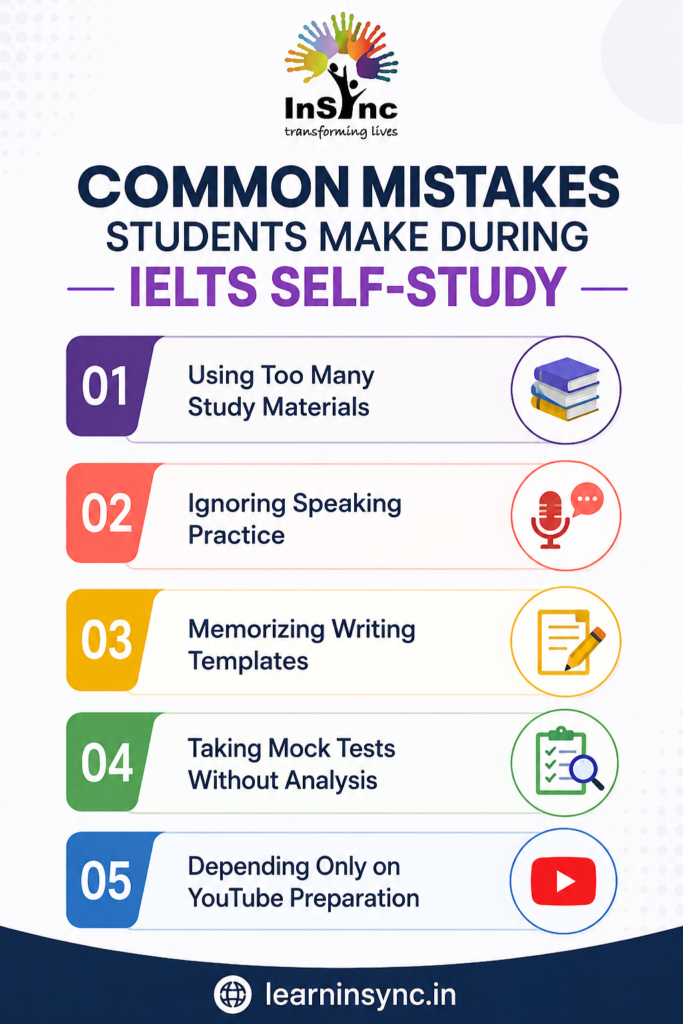
Many IELTS candidates spend months studying but still fail to achieve their target score because they repeat the same preparation mistakes.
Understanding these mistakes early can save significant time and frustration.
Using Too Many Study Materials
One of the biggest problems during IELTS self-study is resource overload.
Students download:
- Multiple PDFs
- Random eBooks
- Different YouTube strategies
- Unverified practice tests
Eventually, they become overwhelmed and lose consistency.
Instead of using ten different resources, it is usually better to focus on:
- Cambridge IELTS books
- One reliable vocabulary source
- Timed mock tests
- Consistent Writing practice
Quality matters more than quantity.
Ignoring Speaking Practice
Many self-study students spend most of their preparation time on Reading and Listening because these sections feel easier to practice alone.
However, Speaking requires regular fluency practice.
Students who avoid speaking practice often struggle with:
- Hesitation
- Lack of confidence
- Limited vocabulary usage
- Pronunciation issues
At InSync, students attend free Speaking fluency sessions five days a week to improve confidence through regular communication practice instead of memorized answers.
Memorizing Writing Templates
Many students try to memorize complete essays or fixed templates for IELTS Writing.
This usually creates unnatural responses and limits flexibility during the actual exam.
Examiners look for:
- Clear ideas
- Logical organization
- Vocabulary range
- Grammar accuracy
- Task achievement
Strong Writing scores come from understanding structure and practicing consistently not memorizing essays.
Taking Mock Tests Without Analysis
Mock tests are useful only when students analyse their mistakes properly.
Many candidates repeatedly solve tests without understanding:
- Why answers are wrong
- Which question types are difficult
- Where time is lost
- Which grammar mistakes repeat frequently
At InSync Learning and Development, students participate in detailed mock test discussions that help them improve accuracy instead of simply checking scores.
Students looking for reliable mock test resources can also read this guide on best platforms to book IELTS mock tests online.
Depending Only on YouTube Preparation
YouTube can be helpful for learning concepts, but many students rely completely on short videos without following a structured study plan.
Watching preparation videos is not the same as active practice.
Real IELTS improvement requires:
- Timed exercises
- Writing correction
- Vocabulary revision
- Speaking fluency practice
- Progress tracking
Students who balance learning with consistent practice usually improve much faster than those who only consume preparation content passively.
Conclusion
Choosing the best study guides for IELTS self-study can make your preparation much more focused and effective. Instead of collecting too many random materials, it is better to follow a few trusted IELTS books, practice consistently, and regularly analyse your mistakes.
Books like Cambridge IELTS, IELTS Trainer, and Barron’s IELTS Superpack can help students improve Reading, Listening, Writing, and Speaking in a structured way. At the same time, mock tests, vocabulary practice, and speaking fluency sessions play a major role in achieving higher band scores.
Many students start with self-study and later realise that expert feedback helps them improve faster, especially in Writing and Speaking. At InSync Learning and Development, students receive examiner-focused guidance, detailed mock test discussions, Writing correction, grammar support, and unlimited classes until the exam date.
Whether you prepare independently or combine self-study with expert support, consistency and smart preparation are the real keys to IELTS success.
Students who want a personalised preparation roadmap or expert guidance can directly contact the InSync team here.
FAQs
What is the best study guide for IELTS self-study?
The Official Cambridge Guide to IELTS is considered one of the best study guides for IELTS self-study because it includes authentic practice tests, skill-building exercises, and detailed explanations for all four modules.
Can I prepare for IELTS at home without coaching?
Yes, many students successfully prepare for IELTS at home using trusted study materials, mock tests, and consistent practice. However, Writing and Speaking often improve faster with expert feedback and evaluation.
Which IELTS book is best for Band 7 or Band 8?
Cambridge IELTS Practice Test Series and Barron’s IELTS Superpack are commonly recommended for students targeting Band 7 or higher because they provide advanced-level practice and realistic exam difficulty.
How many months are enough for IELTS self-study?
Most students require around 2 to 4 months of structured preparation, depending on their current English level and target band score.
Are free IELTS materials enough for preparation?
Free IELTS resources are useful for beginners, but students aiming for higher scores usually need structured mock tests, Writing correction, and proper feedback to improve consistently.