Many Indian students lose marks in IELTS Writing Task 2 before the examiner even reaches the body paragraphs.
The problem usually starts in the introduction.
Students often believe that a high-scoring IELTS introduction must sound extremely formal, complicated, or “advanced.” Because of this, they try to use memorized templates, difficult vocabulary, or long sentences that sound unnatural. Instead of improving the essay, these introductions usually create grammar mistakes, unclear ideas, and weak task response.
In reality, IELTS examiners are not looking for decorative English.
They want:
- Clear communication
- Proper understanding of the question
- Logical structure
- Natural sentence formation
At InSync Learning and Development, many IELTS candidates are surprised when they discover that simple, direct introductions often score higher than complicated ones. Under the guidance of a former British Council IELTS Examiner who has examined over 35,000 test takers, students learn how examiners actually evaluate IELTS essays instead of relying on outdated writing myths.
This article explains the biggest introduction mistake Indian students make in IELTS Writing Task 2, why it affects band scores, and how to write introductions that sound natural, clear, and examiner-friendly.

Why IELTS Task 2 Introductions Matter
Many students underestimate the importance of the introduction because they believe the main arguments matter more.
While body paragraphs are extremely important, the introduction still plays a major role in the examiner’s first impression of the essay.
A strong introduction immediately shows:
- Understanding of the topic
- Control over language
- Clarity of ideas
- Logical essay direction
A weak introduction often signals the opposite.
If the opening feels memorized, confusing, or poorly structured, the examiner may already notice problems related to:
- Task response
- Grammar accuracy
- Coherence
- Vocabulary usage
This is why experienced IELTS trainers focus heavily on introduction writing during preparation.
At InSync, students regularly practice Writing Task 2 introductions during mock tests and receive detailed feedback on:
- Sentence clarity
- Paraphrasing quality
- Grammar mistakes
- Position statements
- Essay structure
This helps students avoid repeating the same Writing mistakes in the actual exam.
Students looking to improve their IELTS Writing preparation can also explore these real student success stories and testimonials to understand how structured feedback improves Writing performance over time.
The Biggest Mistake Indian Students Make in IELTS Introductions
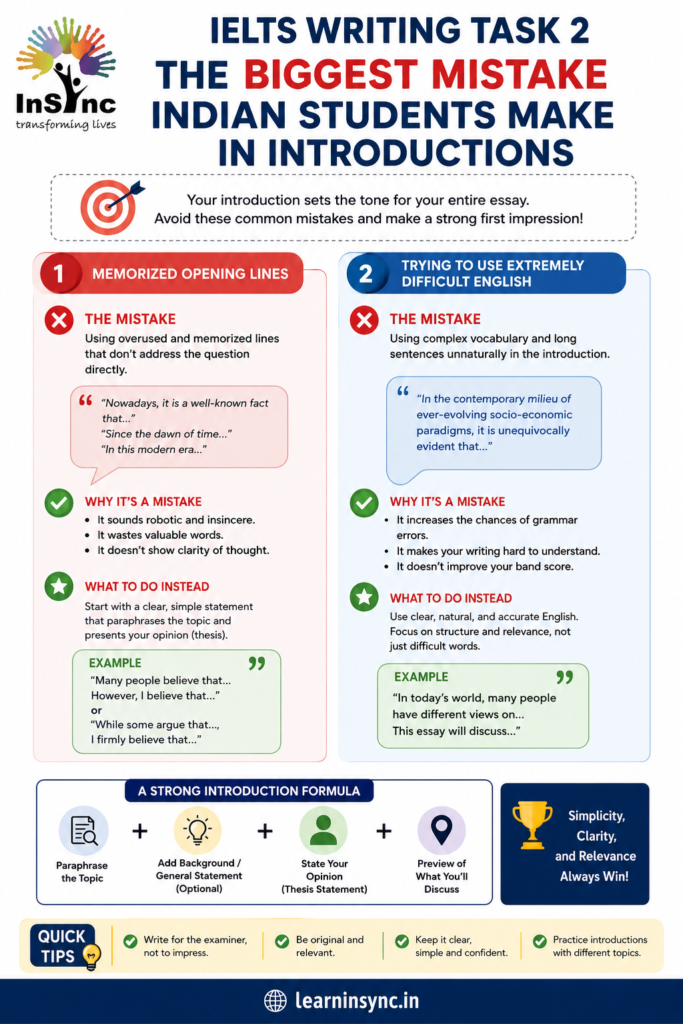
The biggest mistake Indian students make in IELTS Writing Task 2 introductions is overcomplicating the opening paragraph.
Many students try too hard to sound “academic” or “high level.” As a result, they write introductions that are:
- Too long
- Difficult to understand
- Filled with memorized phrases
- Grammatically inaccurate
- Indirect and repetitive
Instead of helping the essay, this usually lowers the overall Writing score.
Memorized Opening Lines
Many Indian students still begin essays with lines like:
- “In today’s modern world…”
- “Every coin has two sides…”
- “Since the dawn of civilization…”
- “Technology is a boon and a bane…”
These phrases have become extremely common in IELTS Writing.
Examiners read hundreds of essays regularly. Memorized openings are very easy to identify and often make the writing sound artificial.
Strong IELTS introductions should feel natural and directly connected to the essay question.
Trying to Use Extremely Difficult English
Another common mistake is forcing advanced vocabulary into simple ideas.
For example, instead of writing:
“Many people prefer online education.”
students may attempt:
“A plethora of individuals are inclined towards the proliferation of digital pedagogical methodologies.”
This usually creates:
- Grammar problems
- Awkward sentence structure
- Loss of clarity
IELTS Writing rewards clear communication more than complicated vocabulary.
A simple sentence written accurately will always score better than a confusing sentence filled with unnecessary words.
InSync Learning and Development, students are trained to focus on clarity first. Writing correction sessions and estimated band score feedback help candidates understand how examiners actually evaluate essays instead of chasing “fancy English.”
Students preparing independently can also improve their preparation through this guide on free IELTS materials online, which explains how to use reliable IELTS resources more effectively.
Not Answering the Actual Essay Question
Another major mistake Indian students make in IELTS Writing Task 2 introductions is failing to answer the actual question properly.
Many candidates spend too much time trying to paraphrase the topic in complicated language and completely forget to present their opinion or response clearly.
For example, if the essay asks:
“Do you agree or disagree?”
the introduction should clearly show the writer’s position.
However, many students write vague openings that never directly answer the task. This creates problems in:
- Task Achievement
- Coherence
- Essay clarity
Examiners should not have to guess what the writer thinks.
A strong IELTS introduction immediately tells the reader:
- What the topic is
- What the writer’s opinion is
- What direction the essay will follow
This is one reason why many students continue scoring Band 6 or 6.5 in Writing even after months of preparation.
At InSync, Writing correction sessions focus heavily on helping students understand:
- What the question is actually asking
- How to identify keywords
- How to build direct introductions
- How to avoid unnecessary sentences
This examiner-focused approach helps students improve Writing accuracy much faster.
What Examiners Actually Want in an IELTS Introduction
Many students believe examiners expect highly sophisticated English in the introduction.
That is not true.
IELTS examiners primarily look for:
- Clear understanding of the topic
- Logical sentence structure
- Relevant paraphrasing
- Direct response to the task
- Natural language usage
A high-scoring introduction does not need:
- Fancy quotes
- Memorized lines
- Difficult vocabulary
- Long background explanations
In fact, overly dramatic introductions often reduce clarity and increase grammar mistakes.
The best IELTS introductions are usually short, simple, and direct.
A Simple IELTS Introduction Structure That Works
A strong IELTS Writing Task 2 introduction usually follows this structure:
1. Paraphrase the Question
Rewrite the topic naturally using your own words.
2. Give Your Opinion or Main Position
Clearly answer the task question.
3. Mention Essay Direction (Optional)
Briefly indicate what the essay will discuss.
This structure works because it keeps the writing:
- Organised
- Easy to follow
- Relevant to the question
Most importantly, it reduces the risk of unnecessary mistakes.
Example of a Weak vs Strong IELTS Introduction
Essay Question
“Some people think online learning is better than classroom learning. Do you agree or disagree?”
Weak Introduction
“In today’s modern era, education has become a controversial issue among people. Every coin has two sides and online learning has both merits and demerits which will be discussed in this essay.”
Problems:
- Memorized phrases
- No clear opinion
- Repetitive wording
- Weak task response
- Sounds unnatural
Improved Introduction
“Many people believe that online learning is more effective than traditional classroom education. I partly agree with this view because online education offers flexibility, although classroom learning still provides important face-to-face interaction.”
Why this works:
- Clear opinion
- Direct response
- Natural vocabulary
- Easy to understand
- Stronger coherence
This is exactly the type of clarity examiners prefer in IELTS Writing Task 2.
At InSync Learning and Development, students regularly practice introduction writing during weekly mock tests and receive detailed feedback from experienced trainers. This helps them avoid common mistakes before the actual IELTS exam.
Students preparing for Writing improvement can also explore this guide on best platforms to book IELTS mock tests online to practice under realistic exam conditions.
Why Indian Students Specifically Struggle With IELTS Introductions
Indian students are hardworking, but many face similar Writing challenges because of the way English writing is traditionally taught in schools and colleges.
One major reason is memorization-based learning.
Students are often trained to:
- Memorize essays
- Use “formal” sounding phrases
- Write lengthy introductions
- Focus more on difficult vocabulary than communication clarity
As a result, many candidates believe simple English is “weak English.”
But IELTS does not reward complexity for the sake of complexity.
Examiners reward:
- Clarity
- Accuracy
- Relevance
- Logical organisation
Another issue is direct translation from native language thinking patterns into English. This often creates:
- Unnatural sentence structure
- Word repetition
- Grammar mistakes
- Long confusing sentences
Students who improve fastest are usually those who stop trying to impress the examiner and start focusing on clear communication instead.
At InSync, students receive continuous Writing feedback, grammar support classes, and Speaking fluency practice to improve natural English usage rather than memorized patterns.
Students who prefer classroom-based IELTS preparation can explore IELTS coaching in Chennai at the Egmore centre, while learners from other locations can choose flexible online preparation support.
How to Write Better IELTS Task 2 Introductions
Improving IELTS introductions is not about learning difficult vocabulary or memorizing templates. It is about developing the ability to communicate ideas clearly and naturally.
Most students can improve their introductions significantly with regular practice and proper feedback.
Practice Paraphrasing Daily
Paraphrasing is one of the most important IELTS Writing skills.
Instead of copying the essay question directly, students should learn how to rewrite the topic naturally using:
- Synonyms
- Sentence restructuring
- Different grammar patterns
However, many students make the mistake of overcomplicating paraphrasing. The goal is not to make the sentence sound “advanced.” The goal is to make it sound natural and accurate.
For example:
Original question:
“Many people prefer online shopping over traditional shopping.”
Simple paraphrase:
“A large number of people now choose online shopping instead of visiting physical stores.”
This is clear, relevant, and easy to understand.
Daily paraphrasing practice improves:
- Vocabulary flexibility
- Sentence control
- Writing confidence
Stop Memorizing Fancy Introduction Templates
Memorized introductions are one of the fastest ways to make an IELTS essay sound unnatural.
Examiners immediately recognize phrases like:
- “Every coin has two sides”
- “Since the dawn of civilization”
- “This topic has sparked heated debate”
These expressions do not improve the essay. In many cases, they weaken it.
A better approach is:
- Read the question carefully
- Understand the task clearly
- Write directly and naturally
Strong IELTS Writing is usually simple, controlled, and relevant.
Focus on Clarity Before Vocabulary
Many Indian students believe higher band scores require extremely difficult vocabulary.
This is not true.
Band scores improve when students can:
- Express ideas clearly
- Organize sentences logically
- Avoid grammar mistakes
- Stay relevant to the topic
Simple vocabulary used accurately is much more effective than advanced vocabulary used incorrectly.
At InSync Learning and Development, students receive detailed Writing correction and estimated band score feedback to understand which mistakes actually reduce scores. This helps learners focus on practical improvement instead of memorizing “high-level” words unnecessarily.
The institute also provides:
- Weekly Reading and Listening mock discussions
- Free grammar classes five days a week
- Speaking fluency support
- Continuous progress tracking
- Unlimited classes until the exam date
This structured approach helps students build stronger Writing skills gradually and naturally.
Learn From Writing Feedback
One reason many self-study students struggle in IELTS Writing is because they never receive proper evaluation.
They continue repeating:
- Grammar mistakes
- Weak sentence structures
- Poor introductions
- Unclear opinions
without realizing it.
Writing improvement becomes much faster when students receive regular correction and understand:
- Why marks are lost
- Which grammar mistakes repeat
- How coherence affects scores
- What examiners actually expect
Students can also read these IELTS student success stories and testimonials to understand how detailed Writing feedback helps candidates improve their band scores more effectively.
Common IELTS Introduction Templates Students Should Avoid
Many introduction templates taught in older coaching materials no longer help students score well in IELTS Writing Task 2.
The problem is not only that these phrases sound memorized. They also waste time and reduce clarity.
“In today’s modern world…”
This opening is extremely overused and adds no meaningful information to the essay.
Examiners already know the topic is modern. The sentence does not help answer the question.
“Every coin has two sides…”
This phrase is commonly memorized by students writing discussion essays.
The problem is that it sounds informal, repetitive, and unrelated to academic writing style.
“Since the dawn of civilization…”
This type of dramatic opening is unnecessary in IELTS essays.
IELTS Writing is not a history essay or a storytelling task. Long background introductions often confuse the main argument.
“This topic has become controversial…”
Many students use this phrase without even explaining why the topic is controversial.
Instead of generic statements, introductions should focus directly on the actual essay question.

A Simple IELTS Introduction Strategy That Actually Works
Students often perform better when they follow a simple structure consistently.
A reliable IELTS introduction strategy is:
Step 1:
Paraphrase the essay topic naturally.
Step 2:
Clearly answer the question or give your opinion.
Step 3:
Move directly into the body paragraphs.
That’s it.
Most high-scoring IELTS introductions are only 2–3 sentences long.
They work because they are:
- Clear
- Focused
- Relevant
- Easy to follow
Students preparing independently can also improve their Writing preparation through this guide on free IELTS materials online, which explains how to use trusted IELTS resources more effectively instead of depending on random templates or outdated preparation methods.
Can a Bad Introduction Reduce Your IELTS Band Score?
Yes, it absolutely can.
A weak introduction may not destroy the entire essay, but it can negatively affect multiple scoring areas in IELTS Writing Task 2.
Many students think:
“It’s only the first paragraph.”
But examiners use the introduction to quickly evaluate:
- Understanding of the topic
- Grammar control
- Coherence
- Vocabulary usage
- Task response
If the introduction feels memorized, confusing, or irrelevant, it creates an immediate impression that the essay may lack clarity overall.
Grammar Mistakes Increase in Long Introductions
Many Indian students try to impress examiners with long opening sentences filled with advanced vocabulary.
Unfortunately, longer sentences often increase:
- Grammar mistakes
- Punctuation errors
- Awkward phrasing
- Sentence confusion
Simple writing with strong grammar usually scores better than complicated writing with frequent mistakes.
At InSync Learning and Developmen, students are trained to prioritize clarity and sentence accuracy before attempting advanced vocabulary usage. This helps improve Writing consistency and overall band performance.
Conclusion
The biggest mistake Indian students make in IELTS Writing Task 2 introductions is trying too hard to sound “advanced.”
In reality, examiners prefer introductions that are:
- Clear
- Direct
- Relevant
- Easy to understand
Memorized phrases, overly complicated vocabulary, and long confusing sentences usually reduce clarity instead of improving band scores.
A strong IELTS introduction does not need to impress the examiner with difficult English. It simply needs to:
- Paraphrase the question naturally
- Clearly answer the task
- Introduce the essay logically
Students who focus on clarity, grammar accuracy, and structured practice usually improve their Writing scores much faster.
At InSync Learning and Development, students learn IELTS Writing directly through examiner-focused strategies, detailed feedback, weekly mock test discussions, and continuous progress tracking. With guidance from a former British Council IELTS Examiner, candidates understand what actually improves IELTS Writing scores instead of relying on memorized templates.

FAQs
How should I start an IELTS Writing Task 2 introduction?
Start by paraphrasing the essay question naturally and clearly stating your opinion or main response to the task.
How long should an IELTS Task 2 introduction be?
A strong IELTS introduction is usually around 2–3 sentences long. It should be concise, clear, and directly related to the essay question.
Can memorized introductions reduce IELTS Writing scores?
Yes. Memorized introductions often sound unnatural and may negatively affect Task Achievement and Coherence scores.
Do IELTS examiners prefer advanced vocabulary in introductions?
Examiners prefer clear and accurate English over unnecessarily difficult vocabulary. Simple sentences with strong grammar usually perform better.
Why do many Indian students struggle with IELTS introductions?
Many students rely on memorized templates, complicated vocabulary, and school-style essay writing habits, which often reduce clarity and natural communication in IELTS Writing Task 2.