Many Indian students feel nervous even before starting IELTS preparation. Some believe the exam is extremely difficult, while others hear stories about students failing repeatedly despite studying for months.
The truth is more balanced.
IELTS is not impossible, but it is also not an exam that can be cleared through memorization alone. Students who understand the exam format, practice consistently, and improve their communication skills usually perform much better than those who depend only on shortcuts or random preparation materials.
One reason IELTS feels difficult for many Indian students is because the exam tests practical English usage in real-life situations. It focuses heavily on:
- Communication clarity
- Time management
- Vocabulary usage
- Grammar accuracy
- Listening concentration
- Speaking confidence
At InSync Learning and Development, many students initially join with the fear that IELTS is too difficult for them. However, under the guidance of a former British Council IELTS Examiner who has examined over 35,000 test takers, they often realise that smart preparation matters far more than “perfect English.”
This article explains why IELTS feels difficult for many Indian students, the most common challenges candidates face, and what actually helps improve band scores effectively.
Is IELTS Really Difficult?
The difficulty level of IELTS depends on several factors, including:
- Current English level
- Preparation quality
- Study consistency
- Familiarity with exam patterns
- Confidence during the test
For students who regularly use English in daily life, IELTS may feel manageable after a few months of focused preparation.
For others, especially students who rarely speak or write in English outside academics, the exam can initially feel challenging.
However, one important thing many students misunderstand is this:
IELTS is not designed to test “perfect English.”
Examiners are not expecting candidates to sound like native speakers. Instead, they evaluate whether students can:
- Communicate ideas clearly
- Understand spoken English
- Organize written responses logically
- Handle practical communication situations
This is why many average students successfully achieve Band 7 or higher every year.
At InSync, students are trained using examiner-focused preparation methods instead of memorization-based techniques. The program includes:
- Weekly Reading and Listening mock tests
- Free grammar support classes five days a week
- Speaking fluency sessions
- Writing correction with estimated band scores
- Continuous progress tracking
This structured approach helps reduce exam fear and improves preparation consistency.
Students who want to understand effective IELTS preparation strategies can also explore this guide on free IELTS materials online to find reliable study resources without wasting time on low-quality materials.

Why Many Indian Students Find IELTS Difficult
Many Indian students are intelligent and hardworking, but they still struggle in IELTS because the exam requires a different type of English preparation compared to traditional school or college learning.
Weak Speaking Confidence
One of the biggest problems Indian students face is lack of speaking confidence.
Many candidates:
- Understand English reasonably well
- Can read and write basic English
- Know grammar rules
but still hesitate while speaking.
This usually happens because students are not used to communicating in English naturally during daily life.
Common Speaking problems include:
- Translating from native language before answering
- Long pauses
- Fear of making mistakes
- Memorized answers
- Lack of fluency
In IELTS Speaking, confidence and natural communication matter more than “perfect English.”
At InSync, students attend dedicated Speaking fluency sessions regularly to improve spontaneous communication skills instead of depending on memorized responses.
Students can also explore these real IELTS student success stories and testimonials to understand how confidence-building and structured practice help candidates improve their scores.
Problems in IELTS Writing
Writing is usually the most difficult module for Indian students.
Many candidates struggle because they try to write overly complicated English instead of focusing on clarity.
Common IELTS Writing mistakes include:
- Memorized essay templates
- Long confusing sentences
- Grammar mistakes
- Weak paragraph structure
- Repetitive vocabulary
- Poor task response
At InSync Learning and Development, Writing preparation focuses heavily on:
- Examiner expectations
- Clear essay structure
- Grammar accuracy
- Writing correction
- Mock test evaluation
Students receive detailed feedback and estimated band scores so they understand exactly where marks are lost and how improvement happens practically.
Candidates who struggle with essay writing can also read this guide on IELTS Writing Task 2 introduction mistakes to avoid one of the most common problems Indian students face in IELTS essays.
Time Management Problems in IELTS Reading
Many Indian students find IELTS Reading difficult not because the passages are impossible, but because they struggle to complete all questions within the time limit.
The Reading test requires:
- Fast comprehension
- Keyword identification
- Skimming and scanning skills
- Understanding paraphrasing
- Quick decision-making
Students who are used to slow academic reading often spend too much time trying to understand every single word. As a result, they panic during the final sections of the test.
Another common issue is paraphrasing.
IELTS rarely repeats the exact words from the passage in the questions. Instead, it uses:
- Synonyms
- Reworded phrases
- Similar meanings
Students who do not practice this skill regularly often lose marks even when they understand the overall passage.
At InSync, Reading preparation includes weekly timed mock tests and detailed discussion sessions where students learn:
- How to manage time properly
- How to locate answers faster
- Which question types create confusion
- How to improve accuracy consistently
This type of structured practice helps students become more comfortable with exam pressure over time.
Students preparing independently can also explore this guide on best platforms to book IELTS mock tests online to practice under realistic IELTS conditions.
Listening Concentration Problems
Many Indian students believe IELTS Listening will be easy because they understand English movies or YouTube videos.
However, the actual IELTS Listening test requires very focused attention.
Students often lose marks because of:
- Spelling mistakes
- Losing concentration for a few seconds
- Difficulty understanding accents
- Missing keywords
- Writing answers too slowly
Unlike casual listening, IELTS Listening gives candidates only one chance to hear the audio.
This creates pressure, especially for students who are not familiar with:
- British accents
- Australian accents
- Fast conversations
- Academic discussions
Another common mistake is focusing too much on one missed answer. Students panic after missing a word and lose focus on the next few questions as well.
Strong Listening scores usually come from:
- Daily practice
- Accent exposure
- Transcript review
- Keyword prediction practice
At InSync Learning and Development, students regularly practice Listening under exam conditions through weekly mock tests and review sessions that help them identify recurring mistakes before the actual exam.

The Biggest Myths About IELTS in India
One reason IELTS feels difficult for many Indian students is because of misinformation and unrealistic myths surrounding the exam.
These myths often create unnecessary fear before preparation even begins.
“Only Fluent English Speakers Can Score High”
This is one of the biggest misconceptions about IELTS.
Many students believe Band 7 or Band 8 is possible only for students who speak English fluently from childhood.
That is simply not true.
Every year, thousands of Indian students from regional language backgrounds achieve strong IELTS scores through:
- Consistent practice
- Proper strategies
- Mock test analysis
- Vocabulary improvement
- Speaking confidence building
IELTS does not require “perfect English.” It requires effective communication.
Students who communicate clearly and avoid major grammar mistakes often perform much better than students trying to sound overly advanced.
“You Need Fancy Vocabulary for Band 7+”
Many Indian students spend months memorizing difficult vocabulary lists because they think complex words automatically improve Writing and Speaking scores.
In reality, incorrect or unnatural vocabulary usage usually reduces clarity.
Examiners prefer:
- Natural language
- Relevant vocabulary
- Clear sentence structure
- Accurate grammar
Simple English used correctly scores far better than complicated English filled with mistakes.
At InSync, students are trained to improve practical communication skills first instead of memorizing “high-level” words unnecessarily.
“IELTS Is Impossible Without Coaching”
Coaching can definitely help, especially for Writing and Speaking feedback, but IELTS self-study is absolutely possible for disciplined students.
Many candidates successfully prepare through:
- Structured study plans
- Authentic practice materials
- Regular mock tests
- Consistent Speaking practice
However, students often improve faster when they receive proper evaluation and examiner-focused guidance.
At InSync, students learn directly from a former British Council IELTS Examiner with over 24 years of English language teaching experience. The preparation approach focuses on:
- Continuous progress tracking
- Writing correction with estimated band scores
- Weekly mock discussions
- Grammar support classes
- Speaking fluency sessions
- Unlimited classes until the exam date
Students who prefer classroom-based preparation can explore IELTS coaching in Chennai at the Egmore centre, while students from other locations can choose flexible online preparation support.
Which IELTS Module Is Hardest for Indian Students?
The answer varies from student to student, but for most Indian candidates, Writing is usually the most difficult IELTS module.
Each section presents different challenges.
Listening
Many students initially feel confident about Listening, but scores often drop because of:
- Spelling mistakes
- Missing keywords
- Accent confusion
- Lack of concentration
Students who practice regularly under timed conditions usually improve steadily in this module.
Reading
Reading becomes difficult mainly because of time pressure.
Students often struggle with:
- Long passages
- Paraphrased answers
- Matching headings
- True/False/Not Given questions
The biggest mistake is trying to understand every word instead of learning scanning and skimming techniques.
Speaking
Speaking feels difficult for students who rarely communicate in English naturally.
Common issues include:
- Hesitation
- Fear of mistakes
- Memorized answers
- Lack of fluency
- Translation from native language
However, students who practice speaking daily usually improve much faster than expected.
Writing – The Hardest Module for Many Indian Students
Writing is where most Indian students lose marks consistently.
This happens because Writing requires several skills together:
- Grammar accuracy
- Vocabulary control
- Clear organisation
- Logical development
- Time management
- Task response understanding
Many students also believe complicated English automatically creates higher band scores. As a result, they write:
- Long confusing sentences
- Memorized introductions
- Unnatural vocabulary
- Weak paragraph structures
At InSync Learning and Developmen, Writing correction and examiner-focused feedback are major parts of IELTS preparation. Students regularly receive:
- Estimated band score analysis
- Grammar correction
- Structure improvement guidance
- Mock Writing evaluation
- Detailed feedback discussions
This helps candidates understand exactly why they are losing marks and how to improve strategically instead of guessing.
Students who want to better understand common writing mistakes can also read this guide on IELTS Writing Task 2 introduction mistakes which explains one of the biggest reasons many Indian students lose marks in essays.
Common IELTS Mistakes Indian Students Make
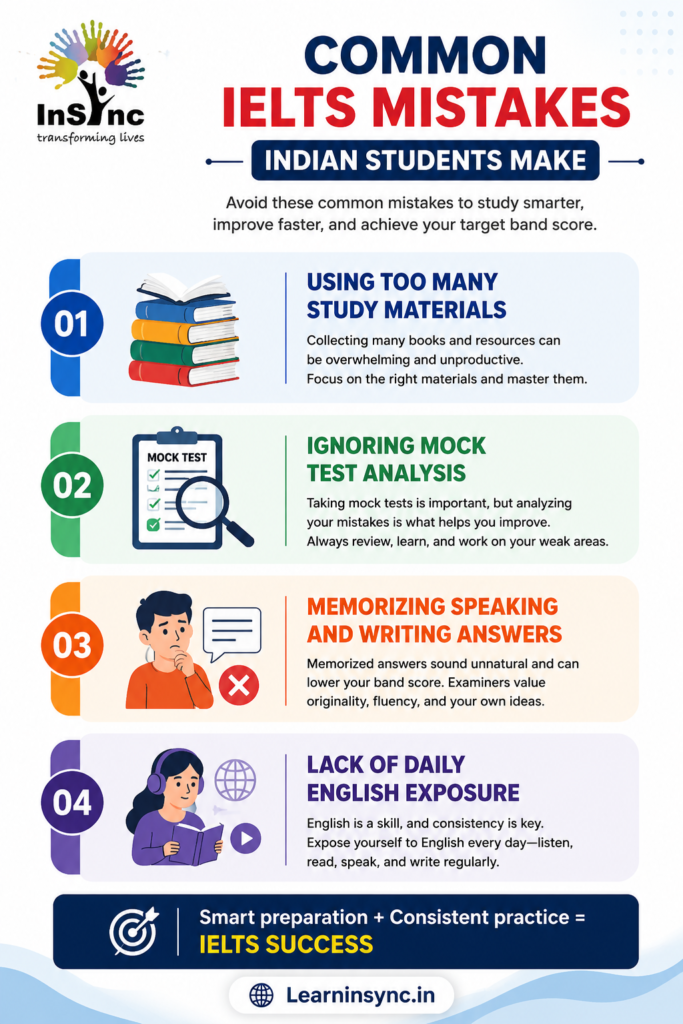
Many IELTS candidates work hard but still fail to improve because they repeat the same preparation mistakes for months.
Using Too Many Study Materials
One of the biggest problems is resource overload.
Students often:
- Download too many PDFs
- Watch random YouTube channels
- Follow conflicting advice
- Switch strategies every week
This creates confusion instead of improvement.
Using a few trusted IELTS resources consistently is usually far more effective.
Ignoring Mock Test Analysis
Some students solve multiple mock tests every day but never review their mistakes properly.
Improvement happens when students analyse:
- Why answers were wrong
- Which grammar mistakes repeat
- Which question types are weak
- How time management affects scores
Mock tests without analysis have limited value.
Memorizing Speaking and Writing Answers
Many students still depend heavily on memorized content.
This creates problems because:
- Responses sound unnatural
- Fluency decreases
- Ideas become repetitive
- Examiners notice memorization quickly
IELTS rewards natural communication, not rehearsed performances.
Lack of Daily English Exposure
Some students study IELTS only during coaching hours or mock tests.
But language improvement requires regular exposure through:
- English conversations
- Reading articles
- Listening practice
- Vocabulary revision
- Daily communication
Even small daily practice sessions can create noticeable improvement over time.
How Indian Students Can Make IELTS Easier
IELTS becomes much easier when students stop preparing randomly and follow a structured system.
Follow a Clear Study Plan
Students should divide preparation properly across all four modules:
- Reading
- Listening
- Writing
- Speaking
Balanced preparation prevents weak areas from affecting the overall band score.
Practice Speaking Every Day
Speaking confidence improves through regular communication practice.
Students should:
- Record answers
- Speak on random topics
- Practice fluency naturally
- Reduce hesitation gradually
This builds confidence much faster than memorizing answers.
Use Authentic IELTS Resources
Using reliable IELTS preparation material is extremely important.
Students preparing independently can improve preparation quality through:
- Official Cambridge IELTS books
- Structured mock tests
- Examiner-based guidance
- Reliable online resources
This guide on free IELTS materials online can help students identify trustworthy IELTS preparation resources instead of wasting time on low-quality materials.
Improve Through Feedback
Students improve faster when they understand their mistakes clearly.
At InSync, students receive:
- Writing correction
- Weekly mock discussions
- Grammar support
- Speaking fluency sessions
- Continuous progress tracking
This structured feedback system helps candidates improve more efficiently than studying alone without evaluation.
How Long Does IELTS Preparation Usually Take?
The preparation time for IELTS depends on:
- Current English level
- Target band score
- Daily study consistency
- Familiarity with the exam format
There is no single timeline that works for everyone.
However, most Indian students generally require between 2 to 6 months of focused preparation.
Beginners
Students with limited English communication skills usually need more preparation time.
Common beginner challenges include:
- Grammar mistakes
- Low vocabulary
- Weak fluency
- Slow reading speed
- Difficulty understanding accents
For these students, preparation often takes around:
- 4 to 6 months
depending on consistency and practice quality.
Intermediate-Level Students
Students who already use English reasonably well in academics or work environments usually improve faster.
They mainly need:
- IELTS exam strategies
- Mock test practice
- Writing correction
- Speaking confidence
- Time management improvement
Most intermediate learners can prepare effectively within:
- 2 to 4 months
with structured preparation.
Advanced Students
Students who already communicate comfortably in English may only need:
- Familiarity with IELTS question types
- Mock test practice
- Writing structure improvement
- Time management refinement
These students often prepare within:
- 4 to 8 weeks
especially when targeting Band 7 or Band 8.
At InSync Learning and Development, students receive personalised preparation guidance based on their current English level and target score. Continuous progress tracking helps candidates understand where improvement is needed instead of following a generic study routine.
Is Self-Study Enough for IELTS?
Yes, self-study can work very well for IELTS preparation.
Many Indian students successfully achieve strong band scores through disciplined self-study using:
- Official IELTS books
- Mock tests
- Daily Speaking practice
- Vocabulary building
- Listening exercises
However, self-study becomes difficult when students do not receive proper feedback.
This is especially true for:
- Writing
- Speaking
Many students continue repeating the same mistakes because nobody evaluates:
- Grammar accuracy
- Essay structure
- Coherence
- Fluency
- Pronunciation
As a result, students sometimes remain stuck at the same band score despite practicing regularly.
This is why many candidates combine self-study with expert guidance or mock test evaluation support.
At InSync, students receive:
- Writing correction with estimated band scores
- Weekly Reading and Listening mock discussions
- Free grammar classes five days a week
- Speaking fluency sessions
- Unlimited classes until the exam date
- Continuous progress evaluation
This combination of self-study and structured feedback often helps students improve more efficiently.
Students can also read these Google reviews from IELTS students to understand how structured preparation and examiner-focused feedback have helped candidates improve their confidence and scores.
Why Some Indian Students Improve Faster Than Others
Many students prepare for the same number of hours but achieve very different IELTS results.
The difference usually comes down to preparation quality rather than effort alone.
Students who improve faster often:
- Analyse mistakes carefully
- Follow structured routines
- Practice consistently
- Focus on weak areas
- Use authentic IELTS materials
- Improve communication skills gradually
On the other hand, students who struggle often:
- Depend heavily on memorization
- Switch resources constantly
- Ignore feedback
- Avoid Speaking practice
- Study without strategy
Consistency is one of the biggest factors in IELTS improvement.
Even 2–3 focused study hours daily can produce excellent results when preparation is organized properly.
Can Average Students Score Band 7 or Higher?
Yes, absolutely.
Many Indian students wrongly assume that only “English-medium toppers” can achieve Band 7 or Band 8.
In reality, many average students improve significantly through:
- Smart preparation
- Regular mock tests
- Daily Speaking practice
- Writing correction
- Vocabulary improvement
- Proper exam strategies
IELTS does not reward perfection.
It rewards:
- Clear communication
- Logical organisation
- Grammar control
- Consistency
- Confidence
At InSync, students learn directly from a former British Council IELTS Examiner with over 24 years of teaching experience. The preparation system focuses on practical score improvement through:
- Examiner-based strategies
- Mock test analysis
- Continuous assessment
- Flexible online learning support
- Classroom IELTS sessions available in Egmore, Chennai
Students who prefer classroom-based preparation can explore IELTS coaching in Chennai, while students from other locations can access guided online preparation support through InSync’s flexible learning programs.

Conclusion
IELTS may feel difficult for many Indian students initially, but it becomes much more manageable with the right preparation approach.
The exam is not designed to test perfect English. It mainly evaluates how effectively candidates can communicate ideas through Listening, Reading, Writing, and Speaking.
Most students struggle because of:
- Lack of strategy
- Weak Writing structure
- Limited Speaking confidence
- Poor time management
- Memorization-based preparation
Students who focus on consistency, structured practice, mock test analysis, and communication clarity usually improve much faster than those relying on shortcuts.
At InSync Learning and Development, students prepare through examiner-focused guidance, Writing correction, weekly mock discussions, grammar support, and Speaking fluency practice designed to improve real IELTS performance instead of memorized learning patterns.
FAQs
Is IELTS hard for Indian students?
IELTS can feel challenging initially, especially for students who are not comfortable communicating in English regularly. However, with proper preparation and consistent practice, many Indian students achieve strong band scores successfully.
Which IELTS module is hardest for Indian students?
Writing is usually considered the most difficult module because it requires grammar accuracy, clear organisation, vocabulary control, and proper task response within limited time.
Can average students score Band 7 in IELTS?
Yes. Many average students achieve Band 7 or higher through structured preparation, regular mock tests, Speaking practice, and Writing feedback.
How many months are enough for IELTS preparation?
Most students prepare effectively within 2 to 6 months depending on their current English level and target band score.
Is self-study enough for IELTS?
Self-study can work well for disciplined students, especially when combined with authentic IELTS materials and regular mock practice. However, Writing and Speaking often improve faster with expert feedback.