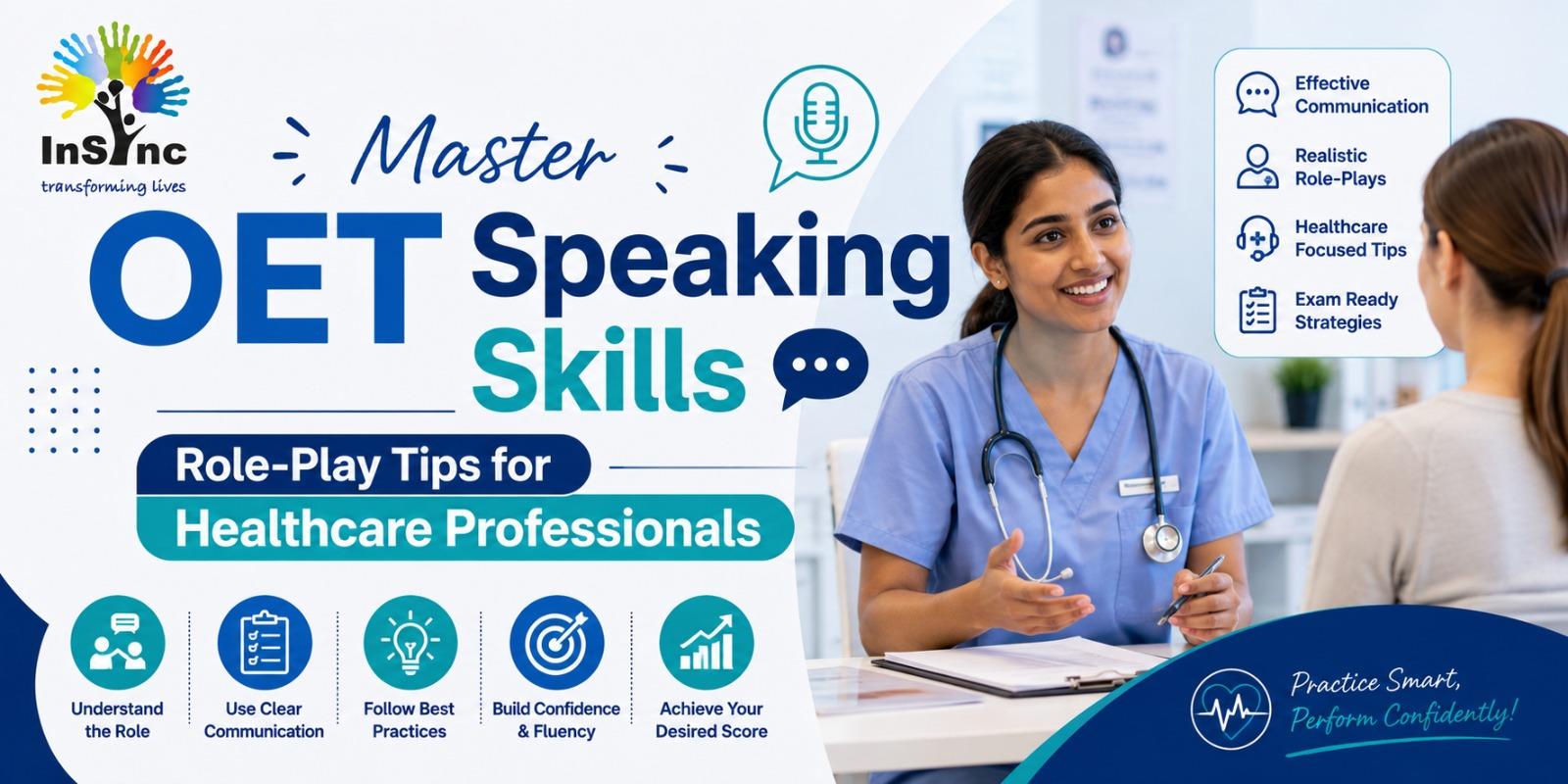

The OET Speaking sub-test is designed around realistic healthcare communication rather than general conversation. To perform well, nurses and healthcare professionals need to show that they can communicate clearly, explain information appropriately, understand a patient’s concerns and build a professional relationship. Practising realistic scenarios with structured feedback through OET Coaching in Chennai can help you develop these skills with greater confidence.
OET Speaking involves two role-plays in which the candidate plays a healthcare professional while the interlocutor acts as a patient, carer or relative. The scenarios are profession-specific, so nurses may receive nursing situations while doctors receive medical scenarios.
What Is the OET Speaking Role-Play?
The OET Speaking sub-test uses healthcare situations that reflect professional communication. Instead of answering abstract questions, you participate in a simulated consultation where you need to communicate with a patient or another person involved in their care.
For nurses, the scenario could involve:
- Explaining a treatment or procedure
- Discussing medication
- Giving discharge advice
- Addressing a patient’s concerns
- Explaining lifestyle changes
- Providing reassurance
- Discussing follow-up care
- Responding to an anxious or confused patient
The objective is not simply to demonstrate medical knowledge. You must communicate information in a way that is appropriate for the person in front of you.
OET highlights that the Speaking sub-test reflects real healthcare communication and requires candidates to communicate clearly with patients or relatives while adapting technical language appropriately.
What Does OET Assess in Speaking?
Many candidates assume that speaking well simply means using advanced English vocabulary. However, effective OET Speaking performance involves much more than vocabulary.
You need to demonstrate:
- Clear and understandable communication
- Appropriate language
- Natural fluency
- Effective information gathering
- Appropriate information giving
- Relationship building
- Understanding of the patient’s perspective
- Empathy and reassurance
- Logical organisation of the conversation
This means that a candidate can have good English but still struggle if they communicate too mechanically or fail to respond to the patient’s concerns.
That is why OET preparation should focus on communication behaviour as well as language accuracy.
How Should You Start an OET Speaking Role-Play?
The opening of your role-play creates the first impression.
Avoid immediately discussing the medical problem. Start by establishing a professional and comfortable interaction.
A simple opening could be:
“Good morning. My name is Sarah and I’m one of the nurses looking after you today. How are you feeling?”
Depending on the situation, you can then confirm the patient’s identity and introduce the purpose of the conversation.
For example:
“I understand that you have some concerns about your medication. Would you mind telling me what is worrying you?”
This approach immediately encourages the patient to speak and gives you an opportunity to understand their perspective.
Why Is Relationship Building Important?
Healthcare communication is not only about delivering information. Patients may be worried, confused, frustrated or afraid.
Acknowledging their emotions can make the interaction more patient-centred.
Useful expressions include:
- “I can understand why you might be concerned.”
- “That sounds quite difficult for you.”
- “I appreciate that this may be worrying.”
- “Let me explain what we can do.”
- “Please feel free to ask me any questions.”
The objective is not to memorise these sentences and use them mechanically. Learn the communication function behind them and adapt your language naturally.
How Can Nurses Show Empathy in OET Speaking?
Empathy is particularly important when dealing with sensitive healthcare situations.
Suppose the patient says:
“I’m really worried that this condition is going to get worse.”
A weak response would be:
“You need to take your medication and come back for your appointment.”
A more patient-centred response would be:
“I understand that you’re worried. The good news is that there are treatments available and I’d like to explain what we can do to manage your condition.”
The second response acknowledges the patient’s emotion before moving into information giving.
Use the Acknowledge–Respond–Explain Approach
A simple structure can help:
Acknowledge: Recognise the concern.
Respond: Show empathy or reassurance.
Explain: Provide relevant information.
For example:
Acknowledge: “I understand that you’re concerned about the side effects.”
Respond: “It’s completely reasonable to ask about this.”
Explain: “Let me explain which side effects you should look out for and what you should do if they occur.”
This keeps the conversation professional and patient-focused.
How Can You Avoid Using Too Much Medical Jargon?
One of the biggest challenges for healthcare professionals is remembering that patients may not understand clinical terminology.
OET specifically focuses on healthcare communication in which technical language may need to be translated into language that patients can understand.
For example:
Instead of:
“You have hypertension and require antihypertensive medication.”
You could say:
“Your blood pressure is higher than it should be, so we need to use medication to bring it down.”
Instead of:
“You need to undergo an MRI.”
You could say:
“You need to have a scan called an MRI, which will allow the doctors to get a clearer picture of the problem.”
A Simple Rule
Medical term → Simple explanation → Check understanding
For example:
“You have hypertension, which means your blood pressure is consistently too high. Does that explanation make sense?”
This demonstrates that you are not simply displaying medical vocabulary; you are communicating effectively.
How Can You Ask Better Questions in OET Speaking?
Information gathering is an important part of a healthcare conversation.
Avoid asking a series of disconnected questions without responding to the patient’s answers.
Instead, use open questions first.
For example:
“Can you tell me more about the pain?”
Then use focused questions:
“When did it start?”
“Does anything make it better or worse?”
“How would you describe the pain?”
Most importantly, listen to the answer and respond appropriately.
If the patient says:
“It becomes much worse when I walk.”
You can respond:
“I see. So the pain increases when you’re walking. How far can you usually walk before it starts?”
This creates a genuine conversation rather than an interview-style sequence of questions.
How Can You Structure Your OET Role-Play?
A clear structure can help you remain organised when the scenario becomes challenging.
A useful framework is:
1. Establish the Relationship
Introduce yourself and create a comfortable environment.
2. Discover the Patient’s Concerns
Ask open questions and listen carefully.
3. Explore the Situation
Gather relevant information and clarify important details.
4. Explain the Problem
Use simple, patient-friendly language.
5. Discuss Management
Explain appropriate treatment, advice or next steps.
6. Address Concerns
Invite questions and respond to worries.
7. Close the Conversation
Summarise the key points and confirm the patient’s understanding.
This framework should guide your conversation rather than become a script that you repeat word for word.
How Can You Handle a Difficult Patient?
Role-plays may involve patients who are:
- Angry
- Anxious
- Confused
- Reluctant
- Frustrated
- Uncertain
- Afraid
- Unwilling to follow advice
Do not respond defensively.
Instead, acknowledge the emotion and identify the underlying concern.
For example:
Patient: “Nobody has explained anything to me. I don’t understand why I need this treatment.”
Better response:
“I’m sorry that this hasn’t been explained clearly. Let me go through the treatment with you and answer any questions you have.”
This approach demonstrates empathy while moving the conversation forward.
What Should You Do If You Forget a Word?
Do not panic if you cannot immediately remember a particular word.
Trying to force yourself to remember a complex medical term can create unnecessary hesitation.
Instead, explain the concept using simpler English.
For example, if you forget “hypertension,” you could say:
“Your blood pressure is consistently higher than normal.”
If you forget a technical term for a procedure, describe what happens.
The ability to communicate meaning clearly is more useful than becoming stuck on one vocabulary item.
How Can You Improve Fluency for OET Speaking?
Fluency develops through repeated speaking practice.
Try this daily routine:
10 Minutes: Speak Without Stopping
Choose a healthcare topic and speak continuously for two minutes.
10 Minutes: Role-Play Practice
Complete one OET-style role-play using a timer.
5 Minutes: Review
Listen to your recording and identify:
- Long pauses
- Repeated phrases
- Grammar errors
- Unclear pronunciation
- Overuse of fillers
- Missed patient concerns
5 Minutes: Repeat
Perform the same role-play again while correcting the identified weaknesses.
This method is more productive than simply reading model answers.
Why Should You Record Your OET Speaking Practice?
Recording yourself allows you to hear your performance from the listener’s perspective.
You may notice that you:
- Speak too quickly
- Use repetitive expressions
- Pause unnecessarily
- Sound too formal
- Use excessive medical terminology
- Fail to acknowledge emotions
- Give too much information at once
Keep a weekly record of your speaking practice and compare your recordings over time.
The goal is not perfection after one practice session. The goal is measurable improvement.
How Can You Improve Your OET Speaking Pronunciation?
You do not need to eliminate your natural accent. Your priority should be clear and understandable speech.
Focus on:
- Word stress
- Sentence stress
- Final sounds
- Difficult consonants
- Vowel sounds
- Speaking pace
- Natural pauses
- Connected speech
Read healthcare-related passages aloud and record yourself.
You can also use the listen–repeat–record–compare technique:
Listen → Repeat → Record → Compare → Correct
This can gradually improve pronunciation and speaking confidence.
What Are Common OET Speaking Role-Play Mistakes?
1. Giving Information Too Quickly
Healthcare professionals may naturally communicate efficiently at work. However, the patient needs time to understand and respond.
2. Using Excessive Medical Vocabulary
Technical terminology should be adapted to the patient’s level of understanding.
3. Ignoring Emotional Concerns
A medically correct response can still be ineffective if you fail to acknowledge the patient’s feelings.
4. Asking Too Many Questions
Do not turn the role-play into a checklist. Respond to the patient’s answers naturally.
5. Memorising Complete Scripts
Memorised conversations can sound unnatural and may not adapt well to unexpected responses.
6. Forgetting to Check Understanding
After explaining important information, ask whether the patient understands.
For example:
“Does that make sense?”
or
“Would you like me to explain that in another way?”
7. Focusing Only on Grammar
Grammar matters, but successful OET Speaking also requires patient-centred communication and appropriate interaction.
How Can OET Coaching Improve Role-Play Performance?
Self-study can help you understand the test format, but speaking skills are easier to improve when another person evaluates your performance.
Structured OET Coaching in Chennai can provide opportunities to practise realistic role-plays, receive expert feedback, identify communication weaknesses and repeat scenarios until your responses become more natural.
For example, InSync’s OET preparation programmes include speaking role-play practice and feedback, with profession-specific preparation for healthcare professionals including nurses and doctors.
InSync also provides dedicated OET Speaking preparation with assessed speaking assignments, role-play practice and personalised feedback.
You can explore the OET Coaching programme at InSync to learn more about its preparation options for nurses and healthcare professionals.
Why Is Profession-Specific OET Preparation Useful?
OET is designed for healthcare professionals and speaking scenarios are profession-specific.
A nurse needs to practise nursing communication scenarios. A doctor needs to practise doctor-patient consultations. A pharmacist may need to focus on medication counselling and related interactions.
Profession-specific practice helps you become familiar with the vocabulary, communication patterns and situations relevant to your profession.
InSync offers profession-specific OET preparation for nursing, medicine, pharmacy and dentistry.
How Can You Practise OET Role-Plays With a Partner?
Find a study partner and assign roles.
One person becomes the healthcare professional while the other becomes the patient.
Use this practice structure:
Step 1: Read the role card.
Step 2: Take the preparation time seriously.
Step 3: Start the conversation naturally.
Step 4: Follow the patient’s responses rather than reading a memorised script.
Step 5: Ask your partner for feedback.
Step 6: Repeat the same role-play after correcting your weaknesses.
Change the patient’s personality each time. For example, practise with an anxious patient, an angry patient, a confused patient and a patient who asks many questions.
This prepares you to respond flexibly.
What Should You Do During Preparation Time?
Use the preparation time to identify the key objectives of the role-play.
Do not try to memorise every sentence you intend to say.
Instead, identify:
- Who the patient is
- Why they are speaking with you
- Their main concern
- The information you need to gather
- What you need to explain
- Possible emotional concerns
- The expected outcome
Create a mental roadmap rather than a complete script.
This allows you to sound more natural during the actual interaction.
Frequently Asked Questions About OET Speaking Role-Plays
1. How can nurses improve OET Speaking role-play performance?
Nurses can improve by practising profession-specific scenarios, developing patient-centred communication, using simple language, asking effective questions, acknowledging concerns and receiving regular feedback on fluency, pronunciation and communication skills.
2. How important is empathy in OET Speaking?
Empathy is important because OET Speaking involves realistic healthcare interactions. Candidates need to recognise patient concerns, respond appropriately and maintain a supportive professional relationship rather than simply deliver medical information.
3. Should I memorise OET Speaking answers?
No. Memorising complete answers can make your communication sound unnatural. Instead, learn flexible communication structures, useful expressions and strategies that you can adapt to different role-play scenarios.
4. How can I handle an angry patient in OET Speaking?
Remain calm, acknowledge the patient’s frustration, listen carefully, identify the underlying concern and respond professionally. Avoid becoming defensive or immediately interrupting the patient with explanations.
5. Can OET coaching help with Speaking role-plays?
Yes. Structured coaching can provide realistic role-play practice, professional feedback, performance evaluation and repeated opportunities to improve communication. InSync offers dedicated speaking assessments and role-play feedback as part of its OET preparation.
Conclusion
OET Speaking is not simply an English conversation test. It evaluates how effectively healthcare professionals communicate in realistic patient-centred situations. Nurses and other healthcare professionals need to demonstrate clear language, appropriate fluency, empathy, information gathering, effective explanations and relationship-building skills.
The most effective way to improve is to practise realistic role-plays regularly, record your performance, identify specific weaknesses and repeat the scenarios with targeted feedback.
If you are preparing for OET and want structured guidance, profession-specific practice and expert speaking feedback, OET Coaching in Chennai can give your preparation a more focused direction.
Ready to Improve Your OET Speaking Score?
Prepare with InSync Learning & Development through structured OET training, speaking role-plays, mock assessments and personalised feedback.
Explore OET Coaching in Chennai and take the next step towards achieving your target OET score.
For official preparation guidance and current OET information, visit the official OET website. OET itself recommends preparation across all four sub-tests and provides preparation resources for candidates.