
Can I Crack IELTS in 3 Months? A Realistic Study Plan From a Former IELTS Examiner- Shane Jordan
You’ve probably heard mixed opinions. Some say three months is more than enough. Others warn you that it takes six months or more. The truth sits somewhere in between. If you already understand English and use it in some form daily, then yes, three months can be enough. The real difference comes from how you plan, who trains you, and how early you start getting real feedback. Many learners at InSync begin with the same question and go on to achieve their target band within this exact timeframe.
Why three months is enough if used the right way
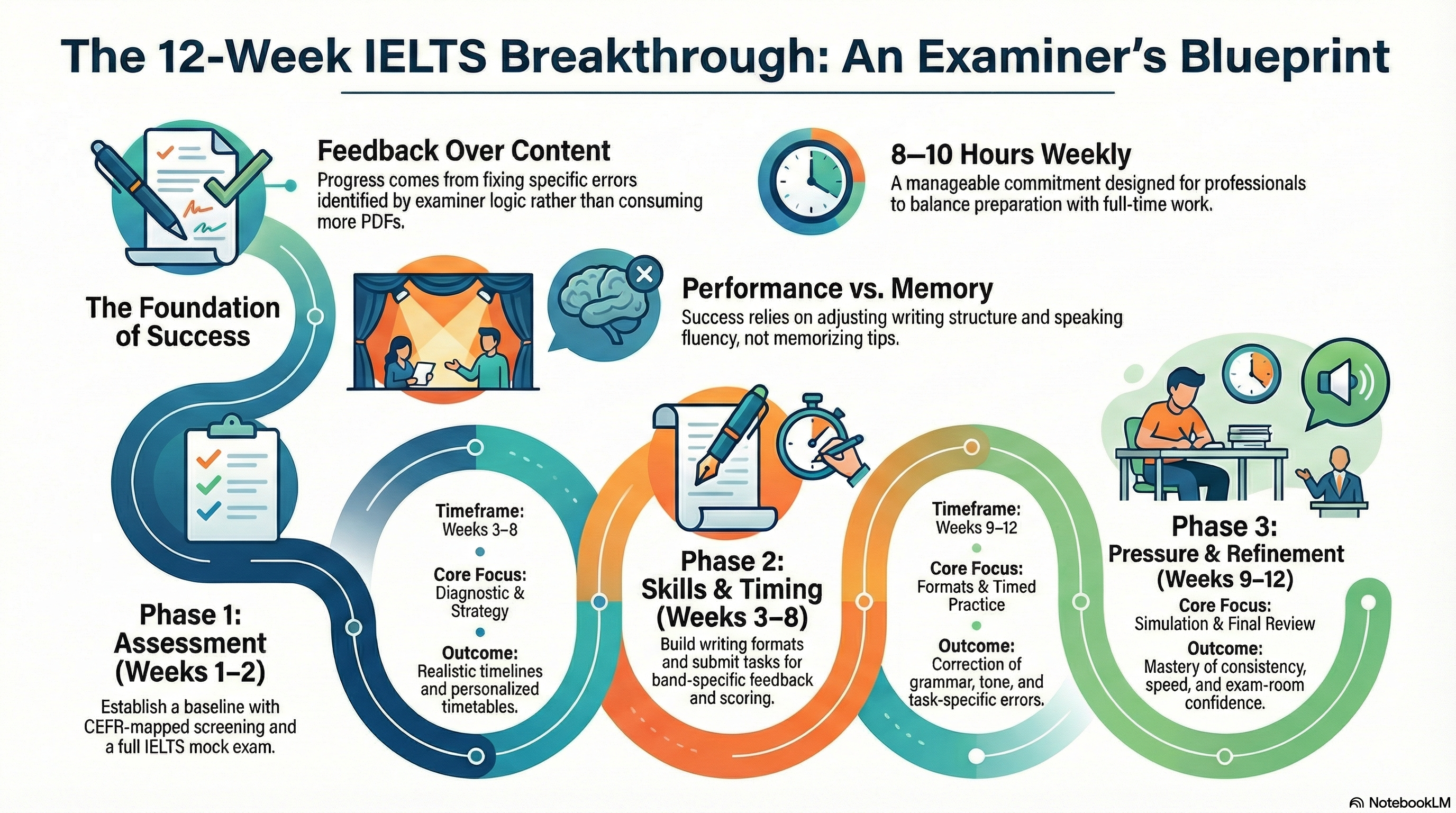
IELTS is not a memory test. It is a performance test. You need time to understand the format, adjust your writing, and fix your speaking structure. Three months gives you that space without letting motivation fade. You don’t need to study full-time. You need to study with purpose. Eight to ten hours a week is enough when your practice is reviewed, corrected, and guided properly. Most Band 6 students who follow a clear process reach Band 7 or higher in around ten to twelve weeks. The timeline works if the effort is focused.
Why do most three-month attempts fail before they start
It’s easy to waste the first few weeks without noticing. Many learners start by downloading PDFs, watching videos, or copying tips. These activities fill time but do not move your score. Without feedback from someone who understands the scoring logic, you keep making the same errors. Most people avoid writing and speaking practice because it feels uncomfortable. That’s exactly where progress is waiting. The issue is not your ability. The issue is the lack of a system that shows what to fix and how soon you can improve with the right guidance.
This is why timeframes vary so much between learners. If you’re curious, this guide on moving from Band 5.0 to 8.0+ shows the broad range and what influences real progress.
How does Shane Jordan change the direction of preparation?
Shane Jordan is not a motivational coach. He is a former IELTS examiner who has marked over thirty-five thousand scripts and conducted the same number of speaking interviews. His feedback is based on his real-world experience, not assumptions. With over twenty-four years of teaching and assessment, Shane leads the IELTS training at InSync. He brings examiner experience into every lesson and works closely with learners to guide them to achieve the maximum scores on the test. Whether it’s a first mock or final review, his insight stays involved. That’s what helps students prepare without confusion. You are not taught theory, instead, you are immersed in authentic tasks and activities and you experience first hand what works in real test rooms, marked by real examiners.
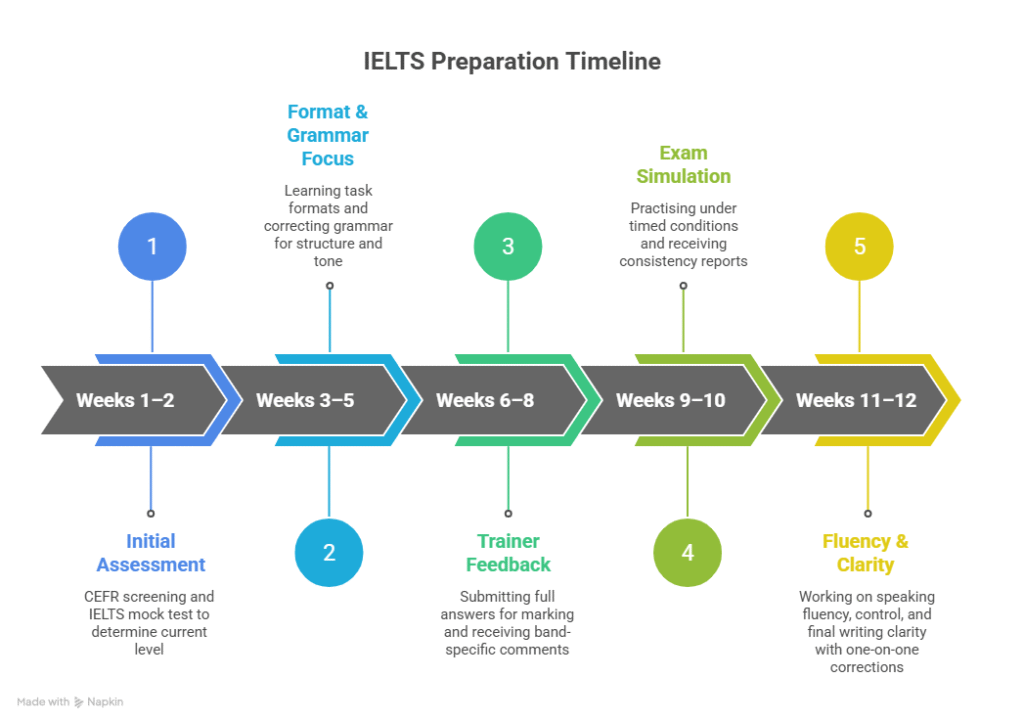
The three-month plan we follow at InSync
Preparation does not need to be complicated. It needs to be practical and well planned. The InSync system follows five stages. Each stage builds toward exam readiness without pressure. You do not need to rush or overcommit. You just need to follow the structure, attend feedback sessions, and apply corrections.
Weeks 1–2:
- You begin with an English level screening test and a full IELTS mock exam. These results are mapped to the CEFR (Common European Framework of Reference for Languages: )
- You receive feedback from Shane Jordan, (former) IELTS examiner on your current CEFR and IELTS diagnostic test scores. He explains what the test scores mean and helps you choose the best IELTS timetable taking into consideration your personal preferences for learning, any time constraints or factors that might hinder your performance on the course.
- Shane conducts a needs analysis, clarifies course expectations and sets realistic timelines for achieving your target band scores for either further education, immigration or work purposes.
- You go through a step-by-step process covering all four exam papers to form a sound foundation on test format, assessment parameters for writing and speaking and grading systems for listening and reading.
- Weeks 3–5: You build writing formats, speaking fluency, and module timing. All errors are corrected by trained assessors and reviewed by Shane.
- Weeks 6–8: You start timed practice. Each writing task is marked with real band breakdowns. Speaking is reviewed using real test prompts.
- Weeks 9–10: You simulate full tests. Focus is on structure, speed, and stress handling. You receive detailed performance tracking.
- Weeks 11–12: You close the gaps. Final reviews target consistency. Weak areas are repeated. You enter the exam knowing how to respond, not hoping for luck.
| Week Range | What Happens During This Stage |
| Weeks 1–2 | You begin with a CEFR-based screening test and a full IELTS mock to assess your actual level. |
| Weeks 3–5 | You learn the correct formats for each task and fix grammar issues that affect structure and tone. |
| Weeks 6–8 | You submit full answers that are marked by IELTS trainers with band-specific comments and scores. |
| Weeks 9–10 | You practise under exam pressure with timed tasks and receive written reports on your consistency. |
| Weeks 11–12 | You work on fluency, speaking control, and final writing clarity with one-on-one corrections. |
If you’re wondering how this compares with more generic learning paths, data from this Cambridge overview helps show how structured systems like InSync accelerate learning.
What makes this system work within three months
The goal is not to finish more content. It is to reduce confusion. When your essays are corrected by someone who has marked IELTS, you stop guessing. When your speaking is reviewed using actual scoring rubrics, you stop repeating vague answers. This is not about giving more information. It is about giving the right corrections in time. Many learners improve by two bands without needing more practice. They improve because they stop doing what examiners do not reward. That shift only happens when you train inside a system shaped by examiner logic.
What students say after finishing the cycle
Ravi, an HR professional from Bangalore, said the first mock shattered his assumptions. He thought his writing was fine until he saw Shane’s feedback. By the eighth week, his essays had a clear flow, and his score jumped from Band 6 to Band 7. Dr. Farzana, who had only weekend time due to hospital shifts, worked on speaking fluency through late-night slots. She cleared with Band 7.5 after just ten weeks. These are not scripted stories. They reflect what happens when people prepare with clarity, not pressure. Progress follows when feedback is honest, and support is real.
What to do if you’re planning your own three-month prep
Start with your current level. Not with the target. At InSync, we offer a two-step entry assessment. You first take a CEFR-based screening test, followed by an IELTS-format mock. These results tell you where you are and what needs to change. After that, your schedule is built around your availability. You can join morning, afternoon, evening, or late-night batches. All materials, mocks, and sessions are structured to keep progress visible. Feedback does not wait until the end. You receive it every week. You can also repeat sessions and speak to your mentor when needed.
What you should see by the final two weeks
If you follow the plan, your final phase will feel more confident than your first. By Week 10, most students have reduced their writing time. They no longer overwrite or miss task requirements. Speaking becomes clearer and more developed. Ideas flow naturally, and pauses reduce. Listening accuracy improves as attention shifts from understanding words to catching meaning. Reading becomes faster with better keyword spotting. Most importantly, you stop second-guessing yourself. You know how to handle questions, how to structure answers, and how to manage time without rushing. That is when scores move.
If you are serious, begin with a clear first step
It is not necessary to do this by oneself. You can start with a free individual session with Shane Jordan. During that call, the level of speaking will be checked, and the appropriate plan will be discussed. There, you can select a schedule that fits your time. You do not have to switch your job or routine. There is a system that works around it that you need to follow. It has been done in twelve weeks or less by hundreds. You can too. Whether you can or not is not the question. It is whether you shall start here and now or wait.
Frequently Asked Questions:
Will I be able to achieve Band 7 in three months given that I am at Band 6?
Yes, provided your learning is organized and tutored by a trainer who knows how to score in IELTS. Most Band 6 candidates can become Band 7 with the appropriate correction and weekly feedback in 10-12 weeks.
Do I have to go to lessons on a daily basis to implement this plan?
Yes, you will need to attend punctually every day to make progress. We expect 90% attendance on all our courses.
What amount of time should I dedicate to this plan every week?
You need to target eight to ten hours per week. That will consist of live sessions, practice activities, and revision on the basis of your writing and speaking feedback.
Can I start this plan while working full-time?
Yes, the schedule is designed for working professionals. You can choose from early morning, late night, or weekend sessions depending on your routine and availability.
What happens if I miss a class during the twelve-week cycle?
All missed classes are made up. You can either make up for the missed classes by attending the same classes in another batch or repeat the topic later either online or offline, whichever is comfortable for you. The sessions are flexible, so no topic is missed completely.
Will Shane Jordan personally review my writing and speaking tasks?
Yes, Shane Jordan reviews mocks and key submissions during the course. He provides detailed feedback on writing and speaking mocks and shares useful insights from an examiner’s position to help you make the fastest progress and achieve the maximum band score.