How long should you prep for IELTS?
Here’s the honest breakdown to hit Band 7 or higher – no fluff, just facts
IELTS isn’t just a random quiz on weird English facts you memorize last minute. This test checks real-world language use through listening, reading, writing, speaking – skills that matter worldwide. Hitting band 7 or higher takes time, so plan ahead with a schedule that actually fits your pace.
In this post, I’ll guide you step by step – using clear examples along the way.
What This Guide Covers
- Here’s why hitting Band 7 doesn’t happen right away
- How much time each level actually needs
- What sets quick learners apart
- Exact figures for time, speed and key points
- Stories from my coaching sessions – Chennai based
- A step-by-step plan laid out for each week that’s easy to stick with
What Does Band 7 Really Mean?
IELTS checks how well you know English, going from Band 0 (non-user) to Band 9 (expert user) . There is no pass or fail in the IELTS test. It doesn’t label results as passed or failed; instead, it shows your ability in speaking, listening, reading, and writing. Each skill counts on its own.
Plenty of colleges, work permits, job licenses, or advanced courses ask for a score of 7 in each exam paper with an overall band 7 or 7.5, often needing nothing lower than 6.5 in any part.
To hit Band 7, it’s not just about knowing English, instead, test smarts matter, along with smart exam moves, practicing under time pressure, checking your own work, also thinking deeply on how you learn.
Eat Your Reality Pill: You Can’t Improve Instantly
How much time’s needed to lift your score?
Cambridge research highlights plus IELTS prep findings show typical results like this:
- Three months of steady practice might boost your test result by nearly half a band or even a full one – according to Cambridge research
- Some well-known studies suggest moving up a whole level usually needs about 3–4 months – roughly 200 to 300 hours – with proper guidance
That’s tons of:
- hands-on teaching
- drills
- going over material
- getting tips
- using tactics
Not those throwaway Youtube lectures, PDFs, PPTs you glance at right before the test.
If somebody says “a couple weeks” or “just one weekend webinar” can land you Band 7, pause… then slowly back away. Many flyby trainers and dubious IELTS coaching institutes make false promises and tall claims to trap candidates. Avoid falling for such traps. Take a step back and make a wise decision; otherwise, you’ll end up burning your fingers by having to repeat the test several times. Anything cheap and fast is a clear no-no for IELTS.
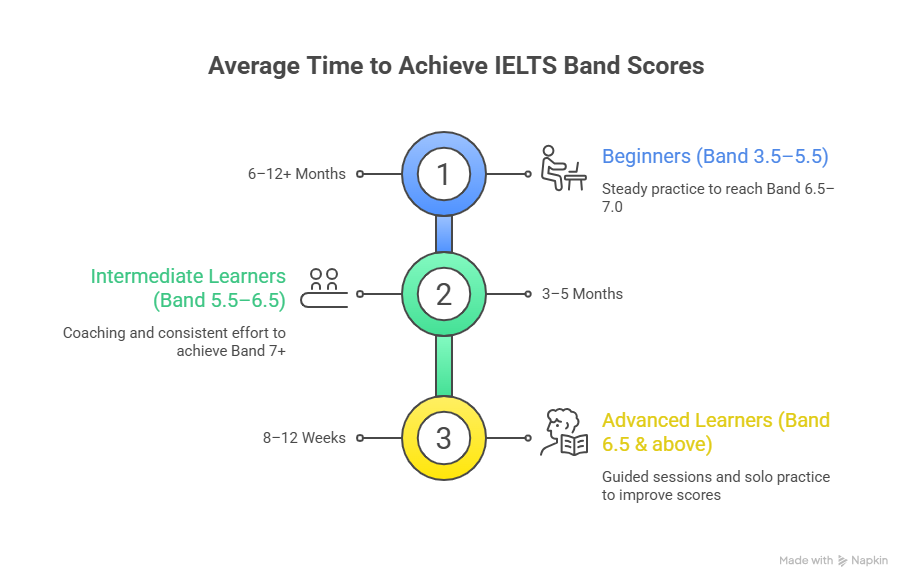
How Long Does It Take on Average?
Rather than a made-up story, here’s what actually happens instead.
Beginners or Lower Intermediate (Band 3.5–5.5)
Could take half a year or more – sometimes over a year – with steady practice to hit scores between 6.5 and 7.0.
Intermediate Learners (Band 5.5–6.5)
Most students need about three to five months of coaching to hit Band 7 or higher, making steady gains in each section.
Advanced Learners (Band 6.5 & above)
Most times, around 8 to 12 weeks of guided sessions followed by serious solo practice might do the trick.
These levels are real – they match typical worldwide schedules shared by IELTS coaching pros.
What Actually Slows Students Down
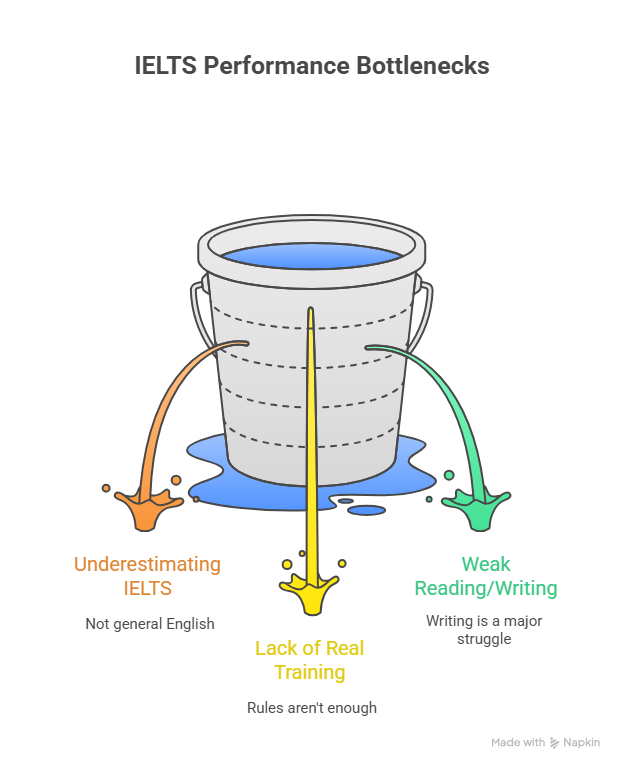
Many learners tend to underestimate these 3 things;
1. Thinking IELTS is “just general English”
That’s not true. This situation depends on school demands and stress from timed exams.
2. Never training under real exam conditions
Just flipping through rules or reading random files won’t work.
3. Weak Reading and Writing skills
Info suggests that globally, lots of test takers struggle most with writing; this is true even more so for people from India.
In India, most people score between 5.5 and 6 on the test and writing tends to lag behind the rest.
Each learner begins at their own level, with unique aims, so your path should fit you alone.
Real Case Studies from My Coaching Classes
Here’s when ideas hit actual life – learners juggling daily routines, work duties, yet still pushing forward.
Case Study 1: Saravanan: From Band 3.5 to 6.5
Once he started, the assessment put him right around Level 3.5 – sitting in the lower middle range.
He stuck with me regularly over a year, balancing work while teaching himself.
Through steady work plus a solid plan, he hit Band 6 at last.
This path shows a truth few experts admit:
If your starting point’s weak, progress needs patience instead of quick fixes.
We’re seeing actual change now – none of that shallow stuff.
Case Study 2: Hrithik: From Band 5.5 to 7.5 in 3.5 Months
Hrithik came across as an average student in class. His thoughts came out clear when he spoke up during lessons; however, things like understanding spoken words, going through texts, or putting ideas on paper gave him a tough time.
- He showed up for most classes, around nine out of ten
- Spent around two or three hours each day practicing more after class
- Used the English lab every day, also made use of the on-site help resources through the week
- Got into the Toastmasters Club ’cause I suggested it. This club helps boost speaking ability through real practice.
He spent roughly 20 to 24 hours every week studying; way more than most students. Because he stayed focused and pushed hard, he hit a 7.5 average score in just under four months.
This is what many IELTS tutors aim for, though not all get it right.
Case Study 3: Prerna: Upper Intermediate, Overall Band 8 in 8 Weeks
Prerna started coaching at Band 6.5, this gave her a solid English base to grow quickly.
She put in serious hours, stuck to the advice without fail, sharpened rough spots fast, yet reached Band 8 in two months.
This is how it goes when things start off strong, yet the person stays focused while staying open to feedback.
Different Learner Types and Timelines
Here’s how it works in real life:
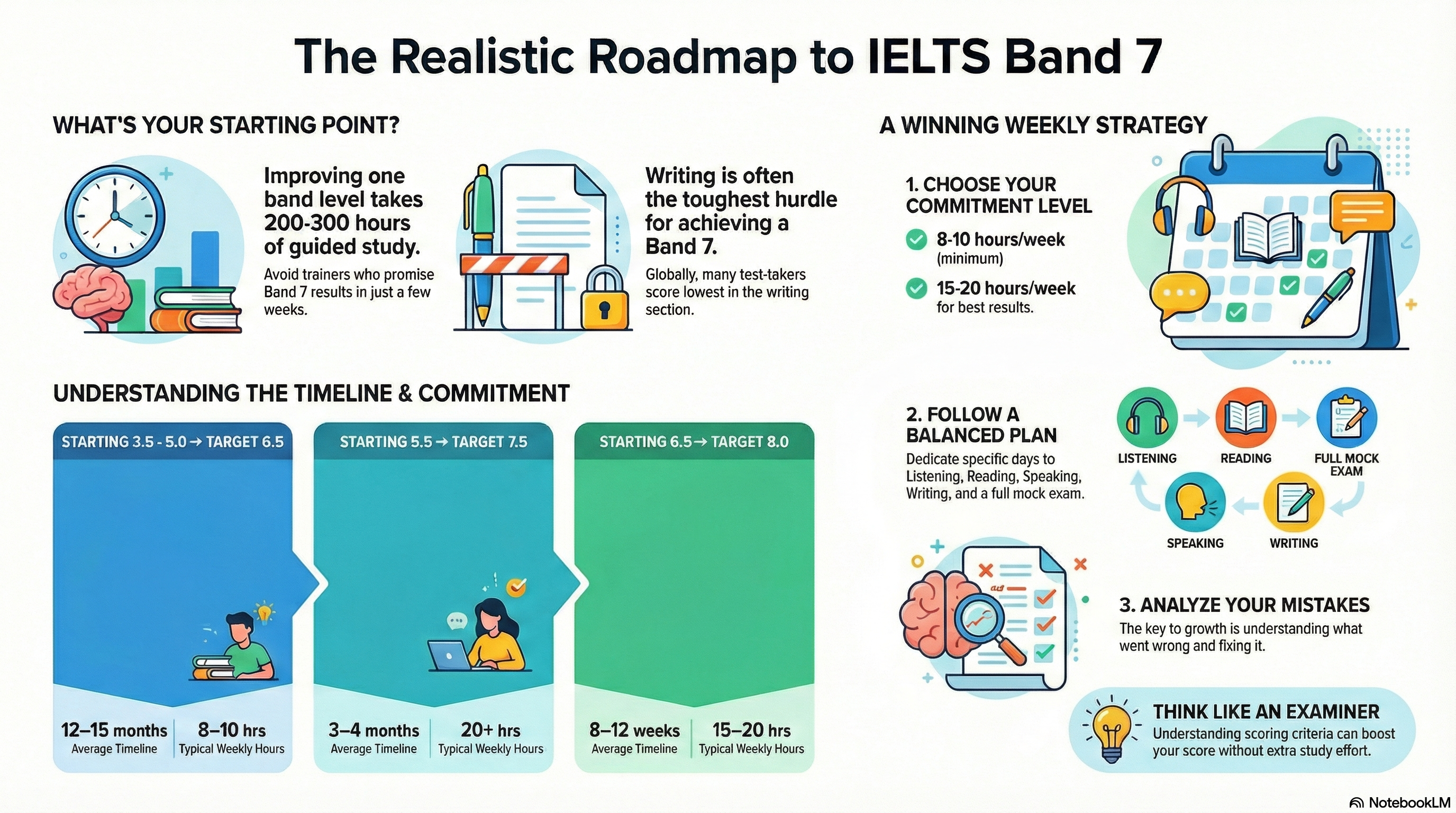
| Starting Band | Target Band | Average Timeline | Typical Weekly Hours |
|---|---|---|---|
| 3.5 | 6.5 | 12–15 months | 8–10 hrs |
| 5.5 | 7.5 | 3–4 months | 20+ hrs |
| 6.5 | 8.0 | 8–12 weeks | 15–20 hrs |
| 6.0 | 7.0 | 8–12 weeks | 8–10 hrs |
These aren’t hunches – instead, they match up with real outcomes from leading coaches and verified studies.
Weekly Strategy for Band 7 Success
This is an actual plan you can use after figuring out where you stand right now.
Time Commitment Levels
- Minimum Commitment: 8–10 hours per week
- Best Commitment: 15–20 hours per week
- Highly Focused Commitment: 24+ hours (like Hrithik)
Sample Weekly Plan
| Day | Focus |
|---|---|
| Monday | Listening skills + how to get better at them |
| Tuesday | Reading mini-skills along with time-based texts |
| Wednesday | Practice talking out loud while someone listens – then get quick tips |
| Thursday | Practice tasks along with working on writing layout |
| Friday | Grammar plus word choice fine-tuned |
| Saturday | Complete practice exam followed by breakdown |
| Sunday | Fix mistakes while targeting shaky areas |
Check what went wrong – that’s how you actually grow. Figure out the mistakes, then fix them next time.
What Really Turns Scores Around
Examiner Insights and Real Rubric Understanding
Many learners get way better once they see both what’s being asked and how examiners score it.
This one idea could push you from a basic 6 to a solid 7 – without extra effort. It’s not magic, just smarter thinking.
Becoming an IELTS examiner gave me real insight into the actual scoring criteria they follow, unlike the usual advice floating around the internet.
Official Band Descriptors
What’s the first step to begin studying for my IELTS exam?
Start off by checking how good your English really is right now. Reach out to InSync Learning and Development. They’re known for top-notch IELTS training in Chennai. Infact, InSync is considered the best IELTS coaching centre in India. Take their free English screening test whenever you’re ready. Better yet, have a past British Council IELTS examiner review your speaking – for free. Then try a complete practice IELTS exam to see exactly where you stand. You won’t need to figure out your stage or goals alone. At InSync, you receive clear transparent feedback on your strengths and weaknesses along with realist timelines in which to achieve your dream score. No false promises or assurances at InSync, you can trust us 100%.
Try these to test skill level – also good for review or getting better at tasks
- Take a free English level test at InSync ( www.learninsync.in or Whatsapp : 9962091700, 8939374953, 99621980272, email; insync.service@gmail.com
- Try a complete IELTS practice test at InSync – call 9962091700, or reach out on 8939374953, also try 9962180272.
- Book a” Free Speaking Assessment” with former IELTS examiner Shane Jordan through Calendly:
- Attend Free IELTS lessons at InSync before signing up or paying anything
Why Learning from a Former British Council IELTS Examiner Changes Everything
Most IELTS classes rely on old tips, guesses, or copied ideas about the exam. But at InSync Learning and Development, you’re coached by someone who actually graded IELTS responses for the British Council. Since I used to assess speaking and writing – over 35,000 times – I know exactly how bands are decided, where people slip up, and what markers really notice beyond the official scoring guide.
Because of this hands-on experience, learners here practice with clear direction, fewer errors, and more self-assurance instead of just hoping things work out. Each comment, review chat, and trial test matches actual examiner standards, so typical mistakes get caught early before they lead to failed attempts and extra fees. Fuelled by top student ratings and real success stories, InSync teaches IELTS using how examiners think – honest coaching, clear progress, zero hype. Since your aim counts, training shaped by the assessors themselves changes everything.
Module-Specific Realities
Listening
Good listening skills usually show up early since learners get to use actual recordings. A clear schedule lasting half a dozen weeks or more tends to bring quick progress.
Reading
This messes up schedules way more than kids fess up to. Not that they don’t get English – it’s just hard to skim, scan, or guess right when the clock’s ticking. It’s about practice, not smarts.
Writing
This is the level where getting a Band 7 gets toughest. Not focused on learning terms by heart – instead, it’s shaped by organization, how you answer the prompt, flow between ideas, correct grammar, or word choice.
Speaking
This gets better quickly through focused training, input from others, yet mindful note-taking. Still, self-assurance and smooth speaking need patience to grow when a person feels quiet.
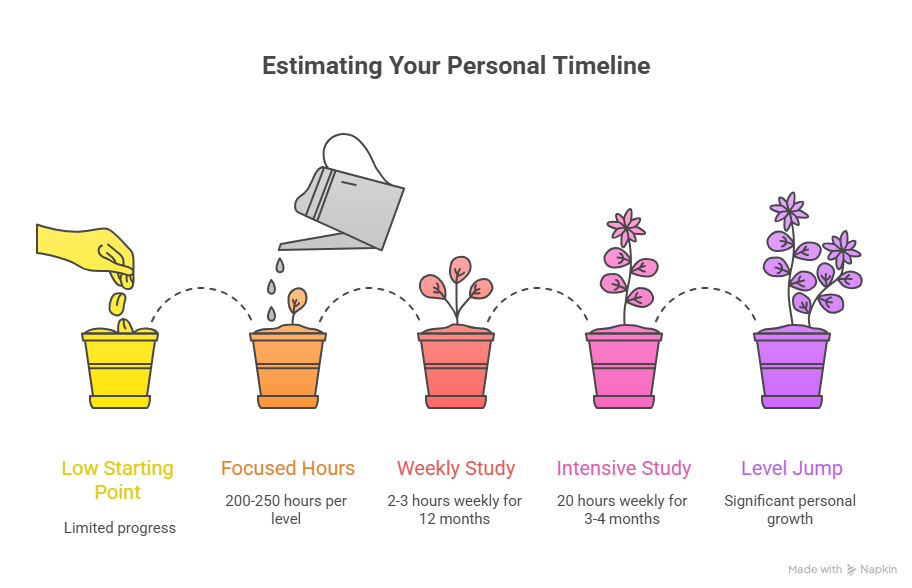
How to Estimate Your Personal Timeline
- If your starting point’s low, moving forward takes more time
- Moving up one level usually needs 200 to 250 focused hours
- Studying two or three hours weekly may take around twelve months for one level jump
- Studying around 20 hours weekly could show a one-level jump in three to four months
This isn’t theory. These are coaching outcomes backed by real numbers.
Common Misconceptions That Kill Timelines
Many students think:
- I might pick up some moves then get through
- Watching random YouTube and PDFs will solve it
- Building vocabulary alone lifts scores
- I might hit Band 7 in fourteen days
All of these collapse under real test pressure.
Final Bottom Line
If you’re aiming for Band 7, here’s the realistic roadmap:
Upper Intermediate Students (Band 6+)
8–12 weeks, around 8–15 hours per week
Intermediate Students (Band 5.5)
3–5 months, around 15–25 hours per week
Lower Level Students (Band 3–5)
Six months to over a year with steady support
It won’t happen overnight, yet progress follows a pattern.
Remember This
IELTS isn’t about rushing to memorize stuff.
It tests real communication skills using practical tasks.
When you stop chasing shortcuts and start building ability, Band 7 stops being a wish and starts becoming expected.