
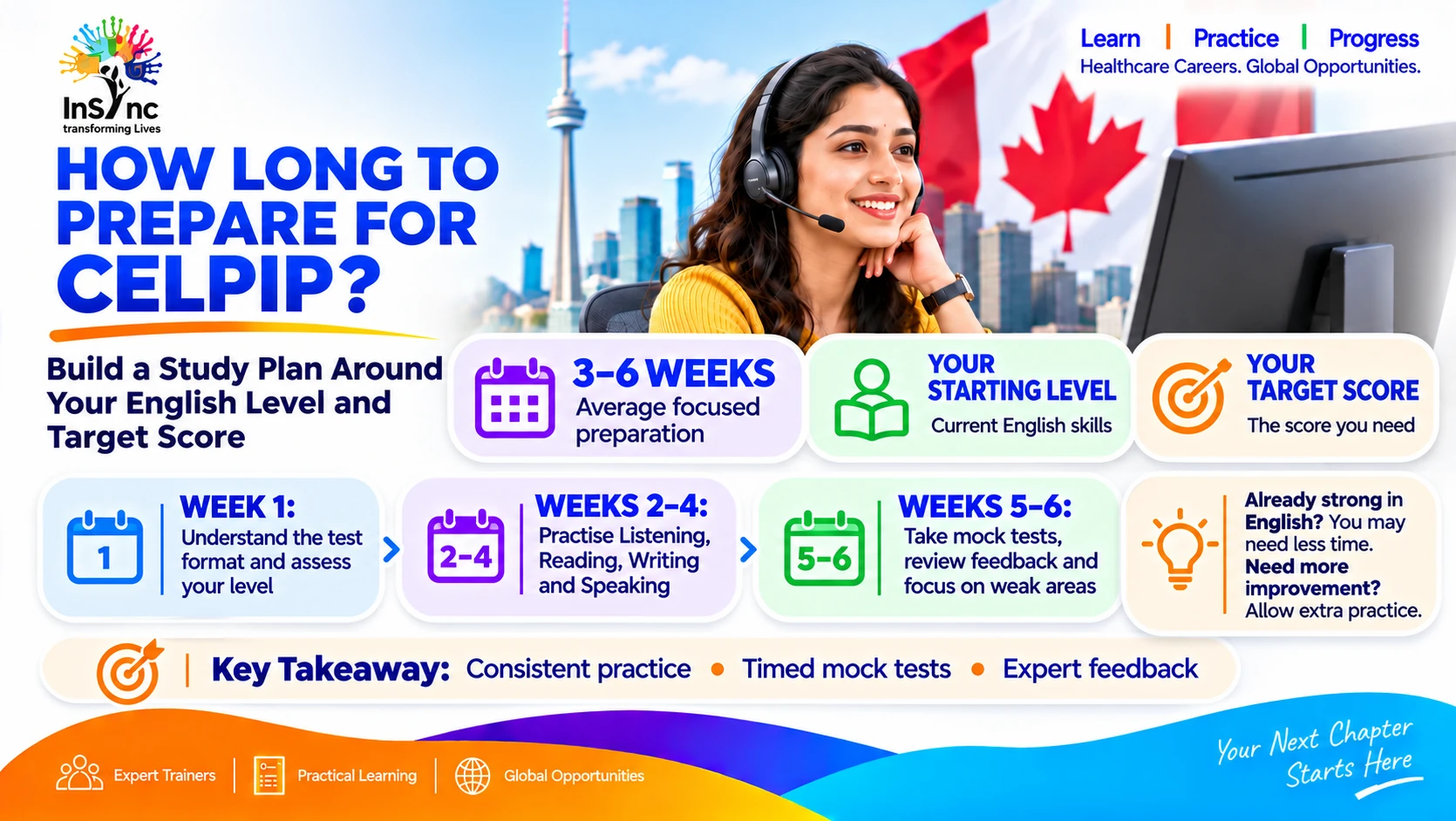
Ask this question and you get numbers. Two weeks. Four weeks. Twelve weeks if you are below Canadian Language Benchmark 5. Ten to fifteen hours a week. A hundred to two hundred hours per CLB level.
We read the first page of results for five versions of this query and checked the sourcing on every figure. Not one of them cites a source. The hundred-to-two-hundred-hours figure, the most repeated number in the niche and now recycled inside Google’s own summary as “general language research,” names no study, no author, no institution and no year on any page that publishes it.
The test owner has published prep guidance of its own. It is narrower than the corpus suggests, and it is a better place to start.
The Test Owner Publishes Two Figures, Not A Table
The first sits in a blog post from 2020:
“We suggest spending up to 30 minutes each day preparing for your test, but we understand that everyone is busy!”
The same post opens with advice that reads oddly against the urgency of most prep content: “When you are getting ready for CELPIP, the best advice we can give you is: take your time.”
The second figure is newer, from a one-month plan published in July 2026, which states a “Recommended Study Time: 1.5–3 hours per day” across a 30-day structure of four weeks.
That is the whole of it. No total-hours figure. No weeks-to-target table. No mapping from your current level to a duration. Candidates below CLB 5 are not told to budget twelve weeks by anyone who runs the test.
One page ranking on the first page says this outright, and deserves credit for it: “CELPIP does not publish a recommended preparation time, and nobody can promise a level by a date.” That was true when it was written and is now out of date by one figure, since the 1.5-to-3-hours recommendation was published in July 2026.
Where The Published Numbers Contradict Each Other
The hour count for the official free material depends which page you read.
| Resource | Hours published | Where |
|---|---|---|
| Free webinars | “over 10 hours” | Prep overview page |
| Free webinars | “over 15 hours” | Guidebook for test takers, July 2026 |
| Free webinars | “over 18 hours” | Same guidebook, later page, and the Path to Success document |
| CELPIP Accelerate | “over 30 hours of material” | Guidebook, paid products section |
| CELPIP Accelerate | “40+ hours of material” | Same guidebook, products page |
| Free practice tests | “2 free practice tests” | Guidebook, July 2026 |
| Free practice tests | “a free practice test” | Prep overview page |
None of the three totals survives the arithmetic. The webinars page says “all webinars are 2 hours in duration,” and the July 2026 guidebook describes “8 live, interactive lessons,” which multiplies to 16 hours. So the published figures are 10, 15 and 18, and the implied figure is 16. Google’s summary quotes the 10-hour version.
None of the official prep products carry a public price. The store is behind a sign-in, and the only figure you can read without an account is the test fee itself. If a page quotes you a rupee price for CELPIP Accelerate, ask where it came from.
Stop Counting Weeks And Read The Distribution Instead
The useful question is not how long preparation takes in general. It is how far you are from your target in the skill you are weakest at, and the test owner publishes the data that frames that.
From the 2025 test taker data report, the share of CELPIP-General candidates reaching band 9 or above:
| Skill | Mean | Band 9 or above |
|---|---|---|
| Listening | 8.33 | 53.2% |
| Speaking | 7.94 | 34.9% |
| Reading | 7.27 | 33.0% |
| Writing | 7.87 | 24.1% |
That ordering is the real study plan. More than half of all candidates already reach Listening 9. Fewer than a quarter reach Writing 9. If your target is Canadian Language Benchmark 9 across all four skills, which is what competitive Express Entry profiles aim at, the published data says Writing and Reading are where your time belongs, and that extra listening practice is the most comfortable way to waste a month.
Reading deserves a particular note, because it is the component candidates under-prepare. Its mean of 7.27 is the lowest of the four and its standard deviation of 2.31 the widest, so results scatter further there than anywhere else.
India’s figures run slightly above the global means on all four skills: Listening 8.68, Speaking 8.03, Writing 7.90 and Reading 7.46. India’s Writing standard deviation of 1.39 is the tightest of the top ten declared nations, which says Indian candidates cluster hard just below 9 in the component with the smallest share of 9s. That is a narrow, specific gap, and it is closed by criteria work rather than by more hours.
The report publishes no sample size and no reporting dates beyond the year, so read these as the shape of the candidate population and not as precision instruments.
The Booking Calendar May Decide Your Timeline For You
A detail every prep plan ignores: you do not get to pick your test date freely, and in south India the constraint runs in two opposite directions.
Checked on 12 November 2026, Chennai listed six CELPIP sittings for the next three months, every one a Saturday, with the earliest two days away on 14 November. Puducherry listed 60 sittings running Wednesday to Sunday, but its earliest was 9 December, 27 days out. That count had read 59 a few hours earlier the same day, which is the clearest illustration available of why you check on the day you book.
So Chennai offers a date almost immediately and then almost nothing; Puducherry offers a great deal of choice but not for four weeks. A candidate who decides on “four weeks of preparation” and assumes a date will be waiting is planning the wrong half of the problem. Book the sitting first, then fit the preparation to it. CELPIP test centres in India sets out how to read the booking engine, and availability moves weekly, so check both pages on the day.
A Second Attempt Starts Five Days Later, Not Sooner
The retake rule on the policies page is published and short:
“You may register for no more than one Test Session within five (5) calendar days. Test session registrations that violate this rule are subject to cancellation by Paragon.”
The same page adds that the office “recommends that you do additional studying before retaking the test.”
Two consequences for a timeline. First, a failed attempt costs you five calendar days minimum plus whatever the booking calendar allows, which in Chennai means the next Saturday or later. Second, there is no single-skill retake, so one weak component sends the whole test back at the full fee. The cancellation, transfer and re-evaluation charges are in what CELPIP costs in India.
Re-evaluation is the alternative to a resit, and it has its own clock: six months from the test date to apply, one to two weeks for a result, one re-evaluation per component, and the fee refunded if the Speaking or Writing level rises. For a candidate one level short on a productive skill, that is usually faster and cheaper than preparing again.
What The Reddit Threads Actually Tell You
Search this question and the forum results are striking. Thread titles cluster at one day, two days, three days, five days, one week, two weeks and three weeks, with high scores claimed throughout.
Read those as what they are. People who score 11s and 12s post their score reports. People who score 6s mostly do not. The self-reported distribution on a forum is the opposite skew to the published one, where under a quarter of candidates reach Writing 9. Both can be accurate at once, and only one of them describes the population you belong to.
A caveat on how we read those threads. Reddit refused every automated request we made, so what we could read was the thread titles and the snippets Google renders beside them, not the posts themselves. The titles are evidence of what people claim; the bodies are not something we verified, and we are not quoting them as if we had.
How To Set Your Own Timeline
Four steps, in this order, and none of them starts with a number of weeks.
Sit the [free sample test](https://www.celpip.ca/free-practice-tests/) before you plan anything. It is free, needs no account, and gives correct answers for Listening and Reading. Two free practice tests follow on creating an account. You cannot plan a timeline without a baseline, and a baseline from a timed official test is worth more than a self-assessment.
Identify your lowest skill and your target gap. Your Canadian Language Benchmark is set by your weakest ability, not an average. A candidate at 9, 9, 9, 7 has one problem, not four.
Check the booking calendar for your city, then book. The date is a harder constraint than your study schedule, and in Chennai it is a Saturday or nothing.
Work the published criteria for the skill you are short on. Writing and Speaking are each scored on four named dimensions with five performance levels apiece. Knowing what Task Fulfillment contains is worth more than another ten hours of generic practice, which is the whole argument of CELPIP Writing and CELPIP Speaking.
If you have not yet settled on the test itself, what CELPIP is covers the format and the scale, and the score chart shows what each level asks for. Our CELPIP coaching works from a baseline test and the published dimensions rather than from a fixed number of weeks.
Key Facts
- The test owner publishes two prep figures: “up to 30 minutes each day” and, in a 30-day plan from July 2026, “1.5–3 hours per day.”
- It publishes no total-hours figure and no table mapping your current level to a duration.
- No ranking page cites a source for any prep-duration number. The 100-to-200-hours-per-CLB-level figure names no study anywhere, including inside Google’s summary.
- Free webinar hours are published three ways: over 10, over 15 and over 18. Eight live lessons at two hours each implies 16, which matches none of them.
- No official prep product price is public. The store sits behind a sign-in.
- Band 9 or above is reached by 53.2% in Listening, 34.9% in Speaking, 33.0% in Reading and 24.1% in Writing.
- Reading has the lowest mean, 7.27, and the widest spread, a standard deviation of 2.31.
- India’s means run above global on all four skills, with the tightest Writing spread of the top ten nations at 1.39.
- Chennai listed six sittings, all Saturdays, earliest two days out. Puducherry listed 60 across five days a week, earliest 27 days out.
- Retakes are limited to one test session in five calendar days, and no single-skill retake exists.
- Re-evaluation runs six months from the test date, takes one to two weeks, and refunds the component fee if the Speaking or Writing level rises.
Questions Candidates Ask Before Booking
How long should I study for CELPIP?
The test owner publishes two recommendations and no week count: up to 30 minutes a day, and 1.5 to 3 hours a day across a 30-day plan. Every “two weeks” or “twelve weeks” figure you have read elsewhere is an unsourced assertion. A better approach is to sit the free sample test, find your weakest skill, and work from the gap rather than from a calendar.
How many hours a day should I prepare for CELPIP?
The only official figures are up to 30 minutes a day, from a 2020 post, and 1.5 to 3 hours a day inside a one-month plan published in July 2026. Google’s summary gives 2 to 3 hours daily and 30 to 45 minutes as alternatives, which is close to the official range but is attributed to sources that did not publish it.
Can I prepare for CELPIP in one month?
The test owner publishes a 30-day plan itself, at 1.5 to 3 hours a day, so a month is a structure it endorses. Whether it is enough depends on your gap, not the calendar: 53.2% of candidates already reach Listening 9 while only 24.1% reach Writing 9. A month of reading and writing work is a different proposition from a month of listening practice.
Is 100 to 200 hours per CLB level a real figure?
No page that publishes it names a study, author, institution or year. It is the most repeated number in CELPIP prep content and it has now been absorbed into Google’s AI summary, attributed to “general language research.” Treat it as folklore until someone cites the research.
How soon can I retake CELPIP?
You may register for no more than one test session within five calendar days. Beyond that rule, your real constraint is the booking calendar: Chennai listed only six sittings for the next three months on 12 November 2026, all on Saturdays. There is no single-skill retake, so one weak component means sitting the whole test again at the full fee.
Is it better to re-evaluate or retake CELPIP?
If you are one level short on Speaking or Writing, re-evaluation is usually faster and cheaper. You may apply within six months of the test date, results arrive in roughly one to two weeks, there is a limit of one per component, and the fee is refunded if the level rises. Re-evaluating Listening or Reading is unlikely to change anything, because those are computer rated.
Which CELPIP skill should I spend my preparation time on?
Reading and Writing, for most candidates targeting CLB 9. The published 2025 distribution shows 24.1% of candidates reaching Writing 9 or above and 33.0% reaching Reading 9, against 53.2% in Listening. Reading also has the lowest mean of the four at 7.27 and the widest spread at 2.31, so it is where results scatter most.
How far in advance should I book my CELPIP test?
Check your city before you plan. On 12 November 2026 Chennai’s earliest sitting was two days away but it had only six in three months, all Saturdays, while Puducherry had 60 sittings across Wednesday to Sunday with nothing for 27 days. Availability moves weekly. Book the date first and fit your preparation around it.
Are the free CELPIP preparation materials enough?
They are more substantial than most candidates use: seven study packs covering the overview and each skill, a free sample test, a podcast with transcripts, and a webinar series of eight two-hour lessons. The guidebook says account registration brings two free practice tests; the prep overview page says one. What they do not give you is feedback on your own speaking and writing against the four rating dimensions.
How many times do most people take CELPIP?
The test owner does not publish it. Its 2025 data report covers age, declared nation, purpose and score distributions, but carries no attempt-count or repeat-taker statistic, and since CELPIP has no pass mark there is no pass rate either. Any figure you see for the average number of attempts is not coming from the test owner.