

For many nurses working in Bangalore hospitals, preparing for OET can feel more exhausting than the exam itself. Long night shifts, rotating schedules, emergency duties, and physical fatigue often leave very little time or energy for focused study. Many healthcare professionals start their OET preparation with motivation, but eventually struggle to maintain consistency because their work schedules constantly change.
The reality is that most nurses preparing for UK or Australian registration are not full-time students. They are working professionals managing demanding hospital responsibilities while trying to improve their OET scores at the same time.
This is one reason many candidates fail to achieve their target score even after months of preparation. The issue is often not lack of ability. It is usually the absence of a realistic study system that fits around hospital life.
With more than 24 years of experience training healthcare professionals, InSync Learning & Development has worked with thousands of nurses balancing OET preparation alongside busy hospital schedules. Instead of unrealistic study plans, experienced trainers focus on practical preparation methods that healthcare professionals can actually sustain long term.
Healthcare professionals searching for structured online guidance often explore OET Coaching in Bangalore for flexible OET preparation support while continuing their hospital duties in Karnataka. However, students should note that physical classroom training is available only in Chennai.

Why OET Preparation Feels Difficult for Nurses Working Night Shifts
Preparing for OET while working night duty is very different from preparing as a full-time student.
Most nurses working in Bangalore hospitals deal with:
- irregular sleeping patterns
- physical exhaustion after shifts
- mental fatigue
- unpredictable schedules
- emergency patient responsibilities
- rotating ward duties
After a demanding hospital shift, sitting down for a two-hour writing session or a full mock test can become extremely difficult. Even candidates who are highly motivated often struggle with concentration and consistency because their energy levels fluctuate throughout the week.
Night shifts can also affect memory, focus, and time management. This becomes especially noticeable in sections like OET Writing and Reading, where concentration and organisation are extremely important.
Another challenge many nurses face is guilt-based studying. They feel pressured to study for long hours every day because they believe that “serious preparation” must involve intense schedules. In reality, this often leads to burnout within a few weeks.
At InSync Learning & Development, many healthcare professionals preparing for OET choose flexible learning options because they need preparation systems that fit around hospital responsibilities instead of disrupting them completely. The training support includes recorded lessons, grammar support sessions, speaking fluency classes, writing corrections, and continuous progress tracking designed specifically for busy healthcare professionals.
Candidates who are researching preparation options before starting OET training often read resources like How to Choose the Right OET Coaching for Healthcare Professionals to better understand what kind of support system works best for working nurses.
The Biggest Mistake Nurses Make While Preparing for OET
One of the biggest mistakes healthcare professionals make is creating unrealistic study schedules.
Many nurses start OET preparation believing they must study for five or six hours daily to achieve a good score. This approach may work temporarily, but it usually becomes impossible to maintain alongside hospital duties.
After a few difficult shifts, candidates often:
- skip study sessions completely
- lose consistency
- feel mentally exhausted
- become discouraged
- stop practising important modules like writing and speaking
This cycle is extremely common among nurses preparing for healthcare migration exams.
In reality, consistency matters far more than extreme study hours.
A nurse who studies productively for 60 to 90 minutes regularly will usually improve more than someone who studies heavily for a few days and then stops completely because of fatigue.
This is especially true in OET preparation because the exam focuses heavily on communication skills, organisation, and familiarity with healthcare language patterns. These skills improve gradually through regular exposure and guided practice.
At InSync Learning & Development, healthcare professionals preparing for OET receive structured support through small interactive live sessions, recorded lesson access, mock tests, writing assignments with detailed feedback, and speaking practice sessions. Many working nurses prefer this approach because it allows them to continue preparation even during busy hospital schedules.
Candidates comparing different preparation providers also explore articles such as Top OET Coaching Centres in Chennai 2026 before choosing a structured OET training program.
How to Create a Realistic OET Study Schedule Around Night Shifts
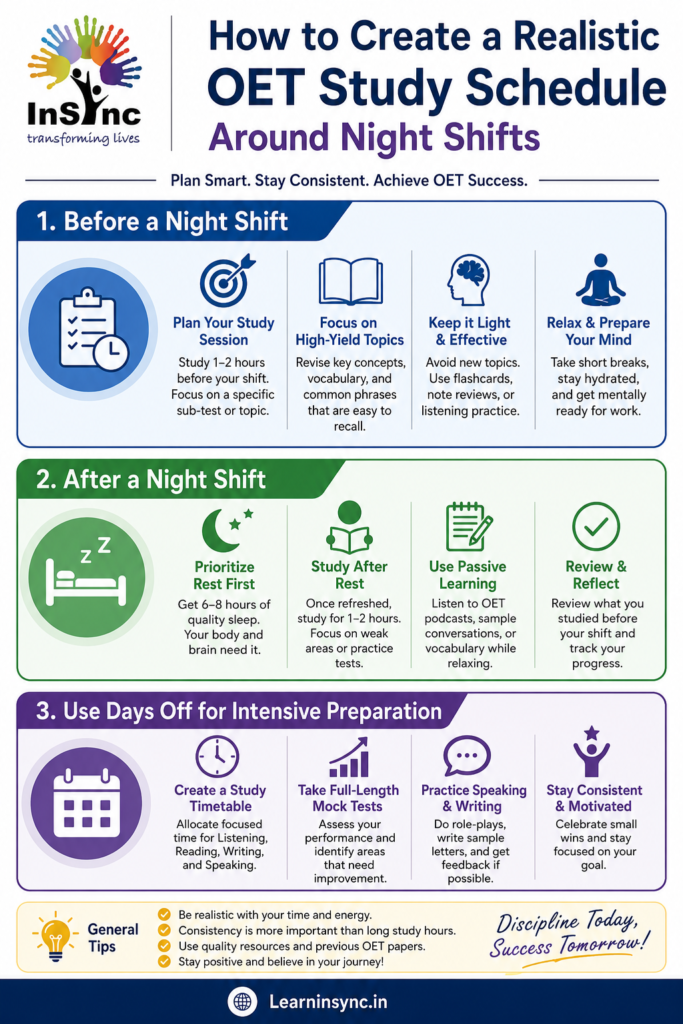
One of the smartest things healthcare professionals can do during OET preparation is stop following rigid study schedules that do not match hospital life.
Hospital duties are unpredictable. Some shifts are manageable, while others become physically and mentally exhausting. A realistic OET study plan should adapt to your work schedule instead of fighting against it.
Candidates who prepare successfully while working night shifts usually focus on consistency, flexibility, and smart task selection rather than long study hours.
Before a Night Shift
The hours before a shift are often better for lighter preparation activities that require moderate concentration.
This is usually a good time for:
- vocabulary revision
- reading practice
- listening exercises
- reviewing writing corrections
- analysing speaking roleplays
- grammar improvement sessions
Many candidates make the mistake of attempting full writing tasks before night duty. This often creates mental fatigue even before the shift begins.
Short focused sessions usually work much better.
For example:
- 30 minutes of listening practice
- 20 minutes reviewing writing feedback
- 20 minutes vocabulary revision
This type of preparation is easier to maintain consistently.
After a Night Shift
After completing a night shift, most healthcare professionals experience mental exhaustion. This is not the ideal time for intensive writing practice or full mock tests.
Instead, candidates can focus on:
- reviewing recorded lessons
- listening to healthcare English audio
- short speaking practice
- reading sample OET letters
- reviewing grammar mistakes from previous assignments
The priority after night duty should always be recovery first. Sleep deprivation directly affects concentration, memory, and writing organisation.
Many candidates lose marks in OET Writing simply because they practise while mentally exhausted and develop poor organisational habits.
This is why flexible preparation systems become extremely important for working nurses.
At InSync Learning & Development, healthcare professionals receive access to recorded lesson libraries, grammar support tools, speaking fluency sessions, and flexible online learning support designed to fit around demanding work schedules. Physical classroom training is available only at the Chennai centre, while candidates from Bangalore and other cities typically join through online and hybrid learning formats.
Use Days Off for Intensive Preparation
Days off are usually the best opportunity for more demanding preparation tasks such as:
- full mock tests
- timed writing practice
- speaking roleplays
- reading practice sets
- listening assessments
- detailed correction review
This is also the ideal time to practise OET Writing because candidates are generally more mentally alert and able to focus on planning, structure, and organisation properly.
Many healthcare professionals preparing for UK or Australian registration underestimate how important mental freshness is during writing practice. Strong OET letters require concentration, clinical relevance, and logical organisation.
Candidates who regularly practise writing while exhausted often repeat the same mistakes without noticing them.
Why OET Writing Becomes Harder During Night Shift Schedules
Among all four modules, OET Writing is usually the most difficult section to manage alongside hospital shifts.
Writing requires:
- concentration
- organisation
- planning
- logical sequencing
- professional tone
- attention to detail
These are exactly the skills that become weaker when candidates are physically tired after hospital duty.
One of the most common problems nurses face is poor planning during writing tasks. Candidates often rush into the letter without properly selecting relevant case notes or organising paragraph flow. As a result, the letter becomes disorganised and difficult to follow.
This is why many experienced trainers recommend structured planning methods such as SBAR-style thinking during OET preparation.
SBAR refers to:
- Situation
- Background
- Assessment
- Recommendation
This framework helps healthcare professionals organise information more logically and improve clarity within referral and discharge letters.
At InSync Learning & Development, candidates receive detailed writing feedback, estimated grades, and practical correction support to help improve organisation, relevance, and professional communication skills. The program also includes continuous progress tracking, small interactive sessions, and one-on-one support options for candidates who need additional guidance.
Healthcare professionals can also explore real student experiences and preparation journeys through the Testimonials Page before starting their OET preparation.
Smart OET Preparation Strategies for Busy Nurses
Healthcare professionals working rotating shifts usually perform better when they follow practical preparation strategies instead of unrealistic study routines.
One of the biggest advantages in OET preparation is learning how to study efficiently even when time is limited.
Focus on Short, Productive Study Sessions
Long study hours are not always necessary.
In many cases, nurses improve faster when they:
- study consistently
- focus on one skill at a time
- review corrections properly
- avoid burnout
For example:
- 30 minutes of reading practice
- 20 minutes reviewing writing feedback
- 15 minutes speaking fluency practice
can sometimes be more effective than sitting with books for several unproductive hours after a tiring shift.
Spend More Time Reviewing Feedback
Another mistake many candidates make is constantly doing new practice tests without analysing previous mistakes.
Improvement usually happens when candidates:
- understand why they lost marks
- identify recurring grammar issues
- improve paragraph organisation
- learn better case note selection
- understand examiner expectations
This is why detailed correction plays such an important role in OET preparation.
At InSync Learning & Development, healthcare professionals receive writing and speaking assignments with detailed feedback and estimated grades to help them improve communication skills systematically instead of repeatedly making the same mistakes.

Use Flexible Learning Tools
Flexible preparation becomes extremely important for nurses working night shifts.
Many healthcare professionals prefer learning systems that include:
- recorded lessons
- hybrid learning support
- mock tests
- grammar support tools
- speaking fluency sessions
- one-on-one guidance
This allows candidates to continue preparation even during unpredictable hospital schedules.
For healthcare professionals balancing OET preparation with clinical responsibilities, flexibility often becomes just as important as course quality itself.
Why Flexible OET Coaching Matters for Working Healthcare Professionals
Many nurses preparing for OET struggle not because they lack ability, but because their preparation system does not fit their lifestyle.
Rigid schedules become difficult to maintain for candidates working:
- rotating shifts
- emergency duties
- ICU schedules
- overtime hospital responsibilities
This is one reason flexible learning support has become increasingly important in OET preparation.
Healthcare professionals usually benefit more from programs that offer:
- flexible timings
- online access
- recorded lessons
- continuous progress tracking
- detailed correction support
- speaking fluency sessions
- unlimited class access until the test date
At InSync Learning & Development, healthcare professionals preparing for OET receive structured support designed specifically for working candidates. The institute provides online and hybrid learning support for students across India, while physical classroom training is available only in Chennai.
With more than 24 years of teaching experience, India’s 1st OET Teacher Trainer, over 35,000 test takers examined, and more than 5 lakh students trained, the focus remains on helping healthcare professionals build sustainable preparation habits instead of relying on short-term intensive study routines.
Candidates who want guidance regarding course options, free trial classes, or preparation support can connect directly through the Contact Page.
Conclusion
Preparing for OET while managing night shifts at Bangalore hospitals is challenging, but it is completely achievable with the right preparation strategy.
Most healthcare professionals do not fail because they lack English skills. The real challenge is maintaining consistency while balancing demanding hospital schedules, physical exhaustion, and exam pressure at the same time.
Instead of forcing unrealistic study routines, candidates usually perform better when they:
- follow flexible preparation plans
- study consistently
- focus on quality over study hours
- review corrections carefully
- build strong communication habits gradually
With structured guidance, detailed feedback, and realistic preparation methods, many working nurses successfully achieve their target OET scores while continuing their hospital responsibilities.
For regular updates, healthcare-focused English preparation tips, and student success stories, healthcare professionals also follow InSync on LinkedIn and InSync on Instagram

Frequently Asked Questions
Can nurses prepare for OET while working night shifts?
Yes. Many healthcare professionals successfully prepare for OET while managing hospital duties and rotating shifts. The key is following a realistic study plan that fits around work schedules instead of trying to study for long hours every day.
How many hours should working nurses study for OET daily?
There is no fixed number of hours that works for everyone. For many working nurses, 60 to 90 minutes of focused daily preparation is often more effective than irregular long study sessions. Consistency usually matters more than study duration.
Why is OET Writing difficult after hospital shifts?
OET Writing requires concentration, planning, and logical organisation. After long hospital shifts, candidates often experience mental fatigue, which affects paragraph structure, clarity, and time management during writing tasks.
What is the best OET study schedule for nurses working night duty?
A flexible weekly schedule usually works better than a strict daily routine. Many nurses use lighter tasks like listening, vocabulary, and grammar practice before shifts, while reserving mock tests and writing practice for days off.
Is online OET coaching suitable for nurses working in Bangalore hospitals?
Yes. Many working healthcare professionals prefer flexible online or hybrid learning because hospital schedules can change frequently. This allows candidates to continue preparation without depending on fixed classroom timings.
Do I need coaching to pass OET while working full-time?
Some candidates prepare independently, but many healthcare professionals improve faster when they receive structured feedback, writing corrections, speaking evaluations, and guidance from experienced OET trainers.
Are physical OET classes available in Bangalore?
Currently, physical classroom training is available only in Chennai at InSync Learning & Development. Candidates from Bangalore and other cities usually join through online and hybrid learning programs designed for working healthcare professionals.