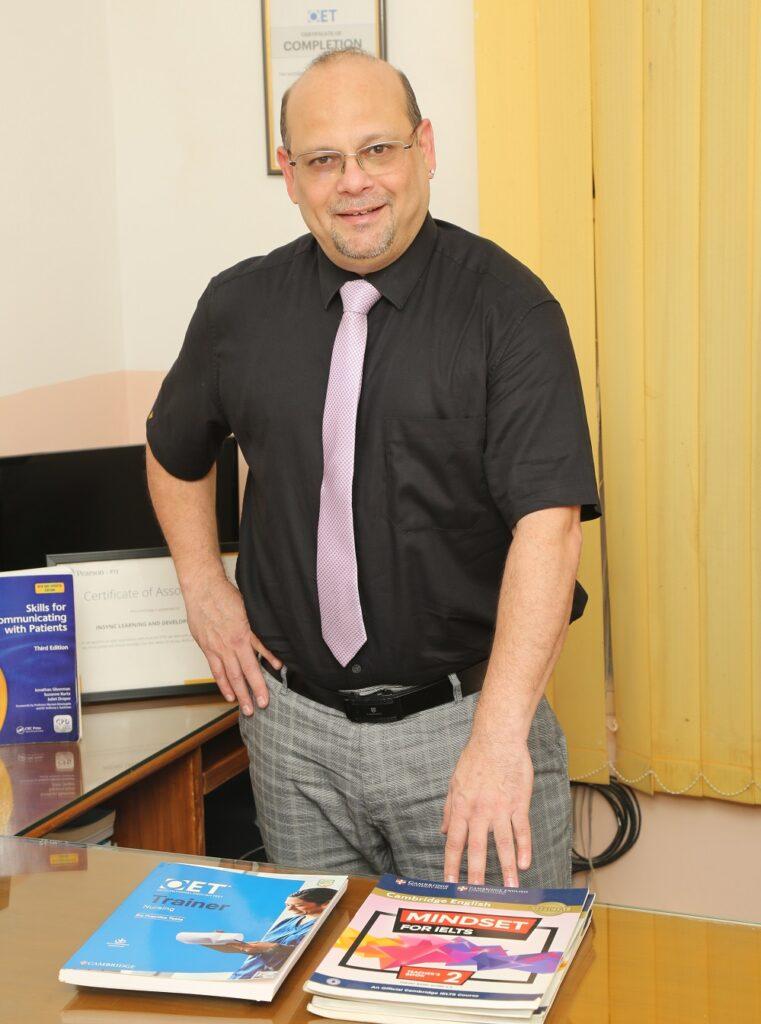
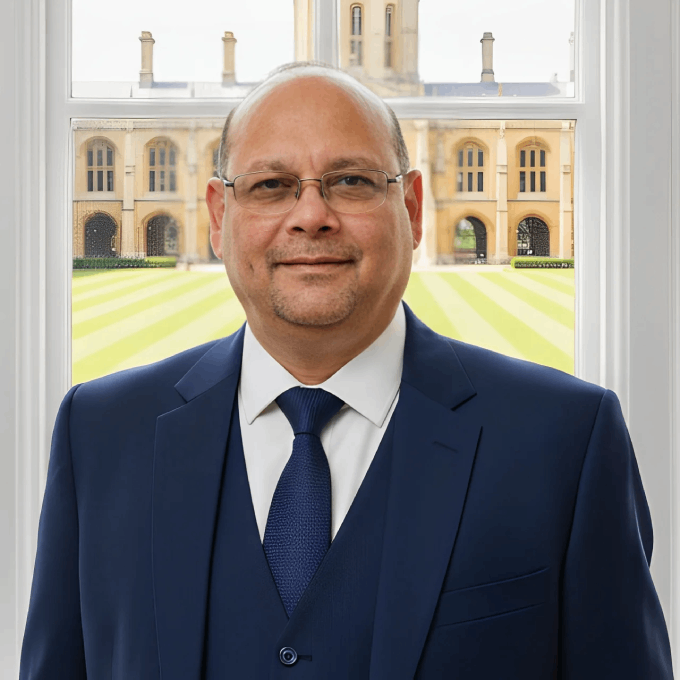
By Shane Jordan – India’s 1st OET Teacher Trainer, Cambridge CELTA/DELTA Certified, Former British Council IELTS Examiner with 35,000+ candidates assessed
If you are a nurse or doctor planning to register and work in the UK, Australia, Canada, or the UAE, the question of OET vs IELTS for healthcare professionals will define your entire preparation journey.
I have been on both sides of this decision for 24 years. As a former British Council IELTS Examiner who assessed over 35,000 candidates and then became India’s first certified OET Teacher Trainer, I can tell you with authority: for healthcare professionals, OET is almost always the better path. But “almost always” matters, so this guide will give you every fact you need to decide for yourself.
Let’s break it down completely.
What Is OET? What Is IELTS?
OET — Occupational English Test is designed exclusively for healthcare professionals. Every task in the test mirrors a real clinical scenario, writing a referral letter, speaking with a patient, reading a case note. It covers 12 healthcare professions including nursing, medicine, pharmacy, and dentistry. It is developed by Cambridge Boxhill Language Assessment (CBLA).
IELTS — International English Language Testing System is a general English test used by universities, immigration bodies, and employers across virtually every industry. The Academic version is the one required by most healthcare regulators. It tests your English across topics that may have nothing to do with medicine from fine art to environmental science.
Both tests assess four skills: Listening, Reading, Writing, and Speaking. The critical difference is not the skill it is the world in which those skills are tested.

OET vs IELTS: Full Side-by-Side Comparison
| Feature | OET | IELTS Academic |
| Who it’s designed for | Healthcare professionals only | Students, migrants, general workforce |
| Listening content | Doctor-patient consultations, clinical handovers | University lectures, social conversations |
| Reading content | Clinical case notes, point-of-care documents | Academic texts on astronomy, economics, history |
| Writing task | Referral or discharge letter to a clinician | Academic essay + graph/data description |
| Speaking task | Profession-specific patient role-play | Interview on abstract topics unrelated to work |
| Score needed (UK NMC/GMC) | Grade B in all 4 sub-tests | Band 7–7.5 in all sections |
| Score needed (AHPRA, Australia) | Grade B in all 4 sub-tests | Band 7–8 in all sections |
| Accepted by ECFMG (USA) | ✅ Yes — OET only | ❌ Not accepted |
| Test centres globally | 40+ countries | 140+ countries |
| Test dates per year | 14 | ~48 (4 per month) |
| InSync first-attempt pass rate | 70% | Band 7.5 avg improvement |
Is OET Harder Than IELTS for Nurses and Doctors?
This is the most searched question on this topic and it deserves a direct, honest answer.
The required English level is identical. OET Grade B is benchmarked to approximately IELTS Band 7–7.5. So neither test is “easier” in terms of the English standard demanded.
Where OET has a genuine advantage for healthcare professionals is the cognitive load during preparation. In IELTS, a nurse preparing for the Writing section must learn how to structure academic essays about topics she has never studied. She must understand how to describe bar charts and process diagrams. She must prepare to speak fluently about topics ranging from urban architecture to childhood psychology.
In OET, that same nurse is practising tasks she does every working day writing to a doctor about a patient, communicating a patient’s concerns, and reading a clinical referral. The vocabulary is already in her head. The context is already familiar.
This is why InSync’s OET coaching programme in Chennai achieves a 70% first-attempt pass rate the highest in India, officially recognised by OET Australia and Health Education England. It is not because OET is easier. It is because prepared healthcare professionals are already halfway there when the content is clinical.
5 Reasons OET Wins for Healthcare Professionals
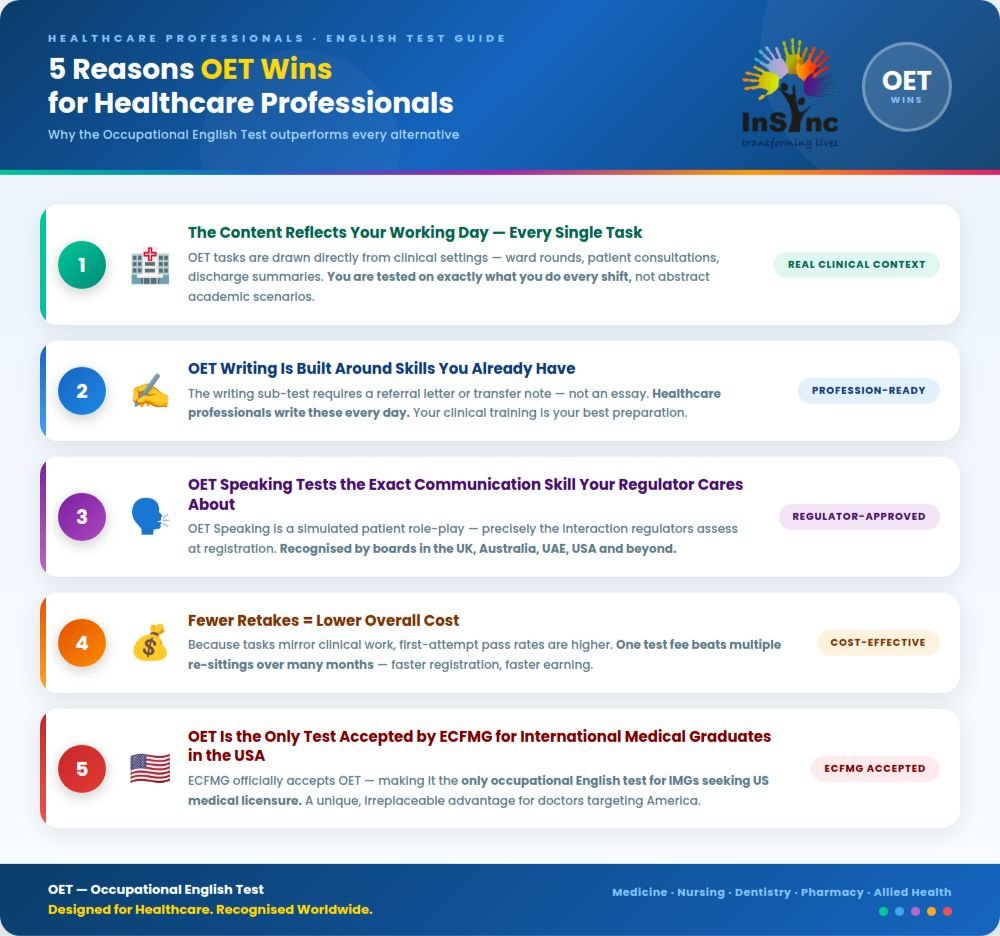
1. The Content Reflects Your Working Day — Every Single Task
In the OET Listening sub-test, you will hear a doctor taking a patient history or a nurse conducting a medication review. In OET Reading, you will work through clinical case notes and workplace communications. In OET Writing, you will write a referral letter to a specialist the same letter you would write at work. In OET Speaking, you will role-play a patient consultation in your own profession.
Compare that with IELTS Listening, where you might hear a lecture about marine biology. Or IELTS Writing Task 2, where you might be asked to argue whether governments should fund space exploration.
For a nurse with 10 years of ward experience, which content do you think produces a more natural, fluent response?
2. OET Writing Is Built Around Skills You Already Have
The OET Writing sub-test requires you to write a letter typically a referral or discharge summary based on given case notes. As a healthcare professional, you have been writing letters like this since your first clinical placement. You understand the structure, the clinical language, the tone, and the purpose.
IELTS Writing Task 1 requires you to analyse graphs, tables, or process diagrams a skill that belongs in an academic statistics class, not a hospital ward. Task 2 demands a 250-word argumentative essay on a topic assigned on the day. Neither task reflects what healthcare professionals actually do.
3. OET Speaking Tests the Exact Communication Skill Your Regulator Cares About
Regulators like the NMC and GMC are not assessing whether you can discuss climate change with an IELTS examiner. They need to know whether you can communicate safely and effectively with patients breaking bad news, explaining a procedure, managing an anxious relative.
OET Speaking tests precisely that. Your role-play scenarios are built around nurse-patient or doctor-patient interactions specific to your profession. This means your Speaking preparation simultaneously builds the real clinical communication skills that will make you a better practitioner from day one in your new country.
4. Fewer Retakes = Lower Overall Cost
OET has a higher upfront test fee than IELTS. This puts many candidates off. But consider the full picture.
A candidate who takes IELTS three or four times before reaching Band 7.5 in all sections which is very common – spends significantly more on test fees, preparation courses, and delayed career progression than a candidate who passes OET in their first attempt.
At InSync, 70% of candidates pass OET on their first attempt. If you invest in proper OET preparation, OET is almost always cheaper in the long run.
5. OET Is the Only Test Accepted by ECFMG for International Medical Graduates in the USA
This is a fact most candidates do not know until it is too late. The Educational Commission for Foreign Medical Graduates (ECFMG) in the United States does not accept IELTS. If a doctor’s long-term plan includes the USA, OET is the only valid test there is no choice.
When IELTS Is Actually the Better Option
Honesty matters here. IELTS is the right choice when:
- You are not a healthcare professional and need an English test for general immigration or study.
- Your destination country or university requires IELTS and does not yet accept OET (always verify with the specific body before choosing).
- You need maximum scheduling flexibility IELTS runs roughly four times a month globally, while OET has only 14 annual test dates.
- Your goal includes university admission alongside professional registration, since IELTS is more universally accepted by academic institutions.
InSync offers expert IELTS coaching in Chennai for candidates in these situations taught by the same Cambridge-certified team with the same examiner-led rigour. If you also need PTE coaching for Canadian or Australian migration routes, that is available too.
What Score Do You Need? (By Country and Regulator)
| Destination | Regulatory Body | OET Requirement | IELTS Equivalent |
| United Kingdom | NMC (Nursing) | Grade B all sub-tests | Band 7.0 all sections |
| United Kingdom | GMC (Medicine) | Grade B all sub-tests | Band 7.5 all sections |
| Australia | AHPRA | Grade B all sub-tests | Band 7.0–8.0 (varies by profession) |
| Canada | NCLEX / provincial bodies | Grade B all sub-tests | Band 7.0 all sections |
| UAE / Gulf | MOH / DHA / HAAD | Grade B all sub-tests | Band 6.5–7.0 |
| USA | ECFMG (Doctors only) | Grade B all sub-tests | ❌ Not accepted |
InSync’s OET Method: Why 70% Pass First Time
The average OET first-attempt pass rate globally sits well below 50%. InSync’s 70% rate the highest in India comes from a specific teaching method that most coaching centres do not apply.
The course is built on three principles. First, skill-by-skill focused teaching across all four sub-tests, not generic English improvement. Second, live sessions with OET experts from the UK (Specialist Language Courses), Australia (E2 Language), and Germany (Alecia Banfield) giving candidates exposure to real examiner-standard feedback. Third, unlimited classes until your exam date, so no candidate is left behind because they need more time.
This is what a properly structured OET programme looks like not four weeks of worksheets, but a systematic path to Grade B.
InSync offers OET coaching in Chennai, Bangalore, Pondicherry, and fully online live classes for candidates across India, the Middle East, and the UK.
Read real student results and testimonials →
Still Unsure? Take the Free Level Check
If you are still weighing OET vs IELTS for your specific situation your current English level, your target country, your registration body the fastest answer comes from a 30-minute free call with Shane Jordan directly.
Shane will assess your current level, clarify which test is the right fit, and give you a personalised study plan with a realistic timeline to your target score. No sales pressure. No obligation.
Book your free strategy call →
Or if you want to experience the teaching before committing to anything, InSync offers a 5-day free trial attend full live OET classes for five days completely free.
Frequently Asked Questions
Q: Is OET easier than IELTS for nurses?
The required English level is the same for both tests. However, because OET uses healthcare content exclusively, nurses find the preparation more familiar and the tasks more intuitive. InSync’s 70% first-attempt pass rate is direct evidence of this advantage when candidates are properly prepared.
Q: Which English test does the UK NMC accept in 2025?
The NMC accepts both OET (Grade B in all sub-tests) and IELTS Academic (Band 7.0 in all sections). Most healthcare professionals preparing for NMC registration find OET the more effective route because of its healthcare-specific content.
Q: Can I prepare for OET online from outside Chennai?
Yes. InSync’s online live classes are taught by UK, Australian, and German OET experts. Candidates from across India, the Middle East, and the UK have achieved Grade B through the online programme. View the online OET course →
Q: How long does OET preparation take?
Most InSync candidates reach Grade B within 10–12 weeks of consistent preparation 4 live classes per week. Candidates who join with a stronger English foundation sometimes achieve their target score faster.
Q: Does InSync offer coaching for both nurses and doctors?
Yes. InSync runs separate OET courses for nurses and for doctors, with profession-specific materials, role-plays, and writing tasks relevant to each. See all OET courses and fees →
Q: What if I only fail one sub-test?
InSync offers targeted Speaking Intensive and Writing Intensive modules for candidates who have passed most sub-tests but need to improve one specific skill. These focused modules deliver expert feedback and error correction to get you over the line without repeating the full course.
The Verdict: OET vs IELTS for Healthcare Professionals
For nurses and doctors whose goal is to register and work in an English-speaking country, OET is the smarter, more relevant, and statistically more successful test. It tests the English you already use at work, builds clinical communication skills you will need from day one, and is accepted by every major healthcare regulator in the UK, Australia, Canada, and beyond.
The right preparation makes the difference between first-attempt success and repeated, expensive retakes. Explore InSync’s full OET programme →
Shane Jordan is India’s first and only OET Teacher Trainer, Cambridge CELTA/DELTA certified, and a former British Council IELTS Examiner. InSync Learning & Development is India’s #1 OET Accredited Premium Preparation Partner officially endorsed by Cambridge Boxhill Language Assessment and recognised by OET Australia and Health Education England.