


If you’ve ever submitted an OET letter and come back with a C or C+, you probably felt a bit confused. You thought the letter sounded fine. You covered the case notes. You even re-read it before submitting. So what went wrong?
Here’s the honest answer most trainers won’t tell you early enough: OET Writing is not just about what you write, it’s about how precisely and purposefully you write it.
Most beginners lose marks not because they don’t know English, but because they haven’t yet understood what OET examiners are actually looking for. This guide is going to fix that. By the end, you’ll know exactly where candidates go wrong, how to self-correct like a pro, and what habits will move your letter from a C to a solid B.
Why OET Writing Trips Up Even Experienced Nurses and Doctors
Poor Planning Is Quietly Destroying OET Writing Scores
One of the biggest reasons candidates fail OET Writing has nothing to do with grammar or vocabulary.
It’s poor planning.
Most candidates open the task, panic slightly, and immediately begin writing sentences. That approach almost always leads to disorganised paragraphs, irrelevant information, repetition, and weak clinical flow, all of which reduce marks under Conciseness & Clarity, Content, and Genre & Style.
Strong OET writers do something differently:
They plan before they write.
In fact, experienced OET trainers recommend spending around 8 minutes purely on planning and organising before writing the letter itself.
A practical breakdown looks like this:
- First 4 minutes: Identify and select only the relevant case note information
- Next 4 minutes: Organise the information into logical paragraph groups according to the purpose of the letter and the clinical timeline
This small habit alone can dramatically improve Writing scores.
Many candidates lose Band B because their letters feel like a random list of notes instead of a professionally structured clinical communication.Why OET Writing Trips Up Even Experienced Nurses and Doctors
Let me tell you something. I’ve worked with hundreds of healthcare professionals, nurses, doctors, physiotherapists, who speak perfectly fluent English at work. They consult with patients. They write clinical notes. And then they sit the OET Writing sub-test and get a C.
It’s frustrating. But it’s also completely understandable once you see what’s happening.
OET Writing is assessed on five specific criteria: Purpose, Content, Concise & Clarity, Genre & Style, and Language. Most beginners focus almost entirely on “content”, making sure they’ve included all the clinical information. But the examiner is scoring you across all five. A letter can be medically accurate and still fail on Concise, Style, or Language.
The test is, essentially, a professional writing test, not just a comprehension exercise.

The SBAR Approach Can Improve Your OET Letter Structure
A useful framework many OET trainers teach is the SBAR approach, commonly used in healthcare communication.
SBAR stands for:
- Situation — Why are you writing the letter?
- Background — Relevant medical and social history
- Assessment — Current condition, findings, or concerns
- Recommendation — What action is needed from the reader?
You do not need to literally write headings inside your OET letter. However, thinking in this structure helps you organise information logically and avoid jumping between unrelated details.
For example:
- Opening paragraph = Situation
- Middle paragraphs = Background + Assessment
- Final paragraph = Recommendation
This creates a smooth clinical flow that examiners immediately recognise as professional and purposeful.
Candidates who use structured planning methods like SBAR usually write clearer, more concise letters because they already know:
- what information belongs where
- what details are unnecessary
- how each paragraph supports the purpose of the letter
That’s exactly what OET examiners reward.
The 3 OET Writing Errors That Cost You Band B Every Single Time
There are three mistakes examiners see repeatedly in lower-scoring OET letters. These errors alone can pull a potentially good letter down from a B to a C+.
1. Writing Without a Plan
Candidates who skip planning often produce letters with poor paragraph structure, repeated information, and unclear clinical progression.
The result?
The letter feels rushed and difficult to follow.
Even strong English speakers lose marks here because OET assesses professional communication — not speed writing.
2. Including Every Single Case Note
Many beginners think “more information = better score.”
Actually, the opposite is true.
OET rewards relevant information selection, not note dumping.
Including irrelevant details weakens clarity and shows the examiner that the candidate has not understood the purpose of the task or the needs of the reader.
3. Copying the Case Notes Directly
This is one of the fastest ways to lose marks in Language and Style.
Examiners want to see that you can process clinical information and communicate it professionally in your own words.
Even simple paraphrasing shows stronger language control than directly lifting phrases from the notes.
The Most Common OET Writing Mistakes Beginners Make
Before we get into correction tips, let’s be honest about where marks actually disappear.
1. Copying from the Case Notes Word-for-Word
This is the single biggest mistake. Candidates look at the case notes, see “patient complains of shortness of breath,” and write exactly that in the letter. OET specifically penalises verbatim copying. It tells the examiner you haven’t processed the information, you’ve just transferred it.
Instead, paraphrase. “Mr Patel presented with increasing breathlessness over the past two weeks” is far stronger than copying the case note directly.
2. Including Irrelevant Information
Not everything in the case notes belongs in your letter. The case notes give you raw data, it’s your job as the letter writer to select what’s relevant for the specific reader and purpose. Including every detail is a Conciseness & Clarity issue and will cost you marks.
3. Wrong Tone for the Reader
An OET letter to a GP reads differently from one to a physiotherapist or a community nurse. Beginners often write in a generic style without considering who is actually receiving this letter. The formal, technical tone appropriate for a specialist referral is different from the cooperative handover tone used for a community care letter.
4. Grammar Errors That Disrupt Clarity
You don’t need perfect grammar to pass OET Writing. But you do need grammar that doesn’t obscure meaning. Common issues include incorrect tense consistency, missing articles (“a/an/the”), subject-verb agreement errors, and misuse of passive voice. These aren’t catastrophic in isolation, but several together drop you from B to C+ quickly.
5. Weak Opening and Closing Sentences
“I am writing to inform you about Mrs Sharma” this kind of vague, flat opening appears in nearly every C-grade letter. Examiners want a Purpose statement that is clear, professional, and specific. Similarly, many candidates forget to close the letter with a clinical request or professional offer of further contact.
OET Writing Correction Tips That Actually Work
Now let’s get into what you should do differently. These are the tips we use inside the OET coaching programme at InSync, and they’re the ones that make a real difference.
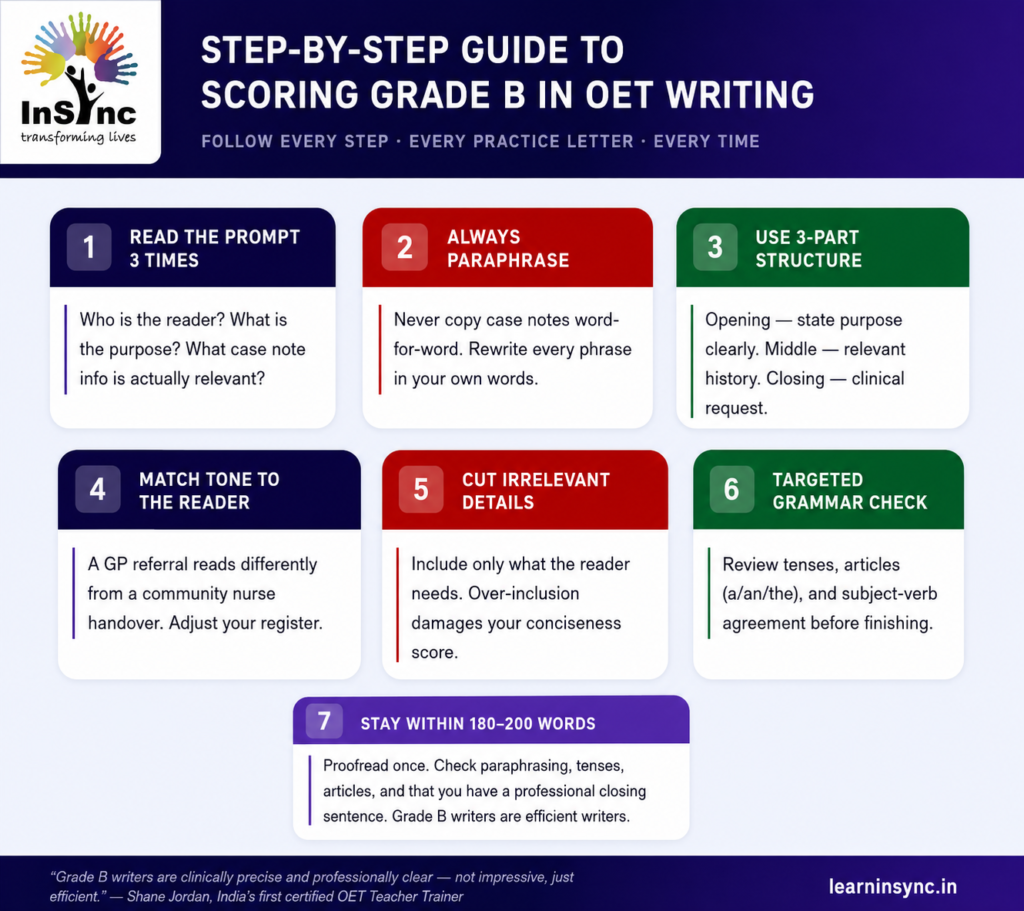
Tip 1: Read the Task Prompt Three Times Before You Write
Seriously, three times. First to understand the reader. Second to identify the purpose. Third to decide what case note information is actually relevant. This takes about 90 seconds and it completely changes the quality of your letter.
Tip 2: Paraphrase Every Piece of Information
Make it a rule: if a phrase appears in the case notes, rewrite it before it goes in your letter. This doesn’t have to be complicated. “Mild hypertension noted” becomes “Mr Ahmed has been managing mild hypertension.” Short, simple, but your own words.
Tip 3: Structure Your Letter with a Clear Three-Part Framework
A well-written OET letter generally follows this shape:
- Opening paragraph: Reader, purpose, and the patient in one or two sentences
- Middle paragraphs: Relevant history, treatment, current status, patient concerns, grouped logically, not listed randomly
- Closing paragraph: Clear request or recommendation, offer of further contact
Following this framework means examiners can immediately see your Genre & Style control, which is one of the marking criteria.
Tip 4: Reduce Over-Explanation
If a detail is obvious from context, you don’t need to spell it out. “She was diagnosed with Type 2 diabetes mellitus, which is a condition characterised by elevated blood sugar levels” remove the definition. The reader is a healthcare professional. Over-explaining wastes words and signals to the examiner that you’ve misunderstood the professional register.
Tip 5: Correct Your Grammar — But Not the Way You Think
Don’t proofread for grammar in the abstract. Instead, do a targeted check on three specific areas after writing:
- Tenses: Are you consistent? Have you used the past tense for completed events and the present for ongoing conditions?
- Articles: Check every noun. Did you use “the”, “a”, or nothing correctly?
- Relative clauses: “…who was referred by” vs “…which was diagnosed with.” Small errors here look careless.

Weak vs. Improved OET Letter Examples
Here’s a quick real-world comparison.
Weak version (C-grade style):
“The patient has hypertension and is taking medication. She had a fall. She is 72 years old. I am referring her to you.”
Improved version (B-grade style):
“I am writing to refer Mrs Grace Fernando, a 72-year-old retired teacher, for further assessment following a recent fall at home. She has a background of hypertension, currently managed with Amlodipine 5mg daily.”
The second version demonstrates purpose, conciseness, professional style, and appropriate language all in two sentences. That’s what Grade B writing looks like.
Time Management During the OET Writing Sub-Test
You have 45 minutes. Most beginners spend 35 minutes writing and five minutes panicking at the end. Here’s a better split:
- Minutes 1–5: Read the case notes and task prompt carefully. Decide what’s relevant.
- Minutes 5–8: Mentally (or lightly) plan your three-part structure.
- Minutes 8–38: Write the letter.
- Minutes 38–45: Proofread specifically for paraphrasing, tenses, articles, and clarity.
If you practise this rhythm during your OET coaching classes, it becomes automatic by exam day.
A Self-Correction Checklist Before You Submit
Use this after every OET writing practice attempt:
- Did I state the purpose clearly in the opening sentence?
- Did I paraphrase all case note information (zero copied phrases)?
- Did I exclude irrelevant clinical details?
- Is the tone appropriate for the specific reader?
- Are my tenses consistent throughout?
- Did I use articles correctly?
- Did I close with a clear request or professional offer?
- Is my letter between 180–200 words?
Print this out. Use it every single time you write a practice letter.
Expert Advice: What Shane Jordan Tells Every Student on Day One
Shane Jordan – India’s first OET Teacher Trainer, certified by Cambridge Boxhill Language Assessment, has a phrase he repeats in every class at InSync:
“OET Writing is not about impressing the examiner with your vocabulary. It’s about being clinically precise and professionally clear. Grade B writers are efficient writers.”
That distinction matters. Many beginners try to sound sophisticated, using long vocabulary chains and complex sentence structures. Grade B letters are actually concise and direct. If you’re already preparing with the team at InSync Learning and Development, you’ll hear this reinforced in every writing session.

Frequently Asked Questions About OET Writing
Q: How long should an OET letter be?
A: OET recommends between 180 and 200 words. Going significantly over or under can affect your Concise & Clarity score.
Q: Can I use bullet points in an OET letter?
A: No. OET letters must be written in continuous prose paragraphs. Bullet points are not appropriate for the letter format and will affect your Genre & Style score.
Q: How many corrections do I need before I’m ready for the exam?
A: It varies, but most students need at least 6–10 corrected letters with proper expert feedback before their writing reaches Grade B consistency. At InSync, each OET course includes 6 writing corrections by a certified OET trainer.
Q: Does grammar need to be perfect for OET Writing?
A: Not perfect, but accurate enough to not disrupt meaning. One or two minor errors won’t fail you. Repeated patterns of error in tense, articles, or sentence structure will bring you down.
Q: Is OET Writing harder than IELTS Writing?
A: They test different skills. OET Writing is harder if you try to approach it like IELTS. Once you understand the letter format and criteria, many healthcare professionals find OET Writing more manageable because it uses familiar clinical content. If you’re still comparing both tests, talk to an OET advisor at InSync to get personalised guidance.
OET Writing Isn’t a Language Test — And That’s Exactly Why Many Candidates Struggle
This surprises many healthcare professionals.
They assume OET Writing works like a traditional English exam where advanced vocabulary and complex grammar automatically lead to higher scores.
But OET Writing is actually testing something far more specific:
your ability to communicate clinical information clearly, professionally, and purposefully.
That’s why fluent English speakers sometimes fail.
And it’s also why candidates with average English can still achieve Grade B when they understand:
- how to plan properly
- how to organise information logically
- how to select only relevant details
- how to write with professional clarity instead of unnecessary complexity
The highest-scoring OET letters are not the most “advanced.”
They are the most clinically effective.
That shift in mindset changes everything.
The Bottom Line
OET Writing is absolutely passable on your first attempt when you understand what the examiner is actually marking and train yourself to correct the right things. Most beginners fail because they practise writing letters but don’t practise correcting them with the marking criteria in mind.
Start using the self-correction checklist above on every practice letter. Get expert feedback at least six times before your exam. And stop copying case notes.
If you want to get your OET writing corrected by a certified OET Teacher Trainer, or if you’d like to attend a free trial class before you commit to anything, reach out to the InSync team here. Shane and the team work with nurses and doctors across India, the Middle East, and the UK, and they’ll tell you exactly where your letter needs work.
Ready to get your OET letter corrected by India’s #1 OET Teacher Trainer?
Book a free 30-minute call with Shane Jordan or start your 5-Day Free Trial attend full live classes before you pay a rupee.
👉 Start Free Trial Classes 📞 Book Free Call with Shane