How much time required for IELTS Preparation

Can I Crack IELTS in 3 Months in India

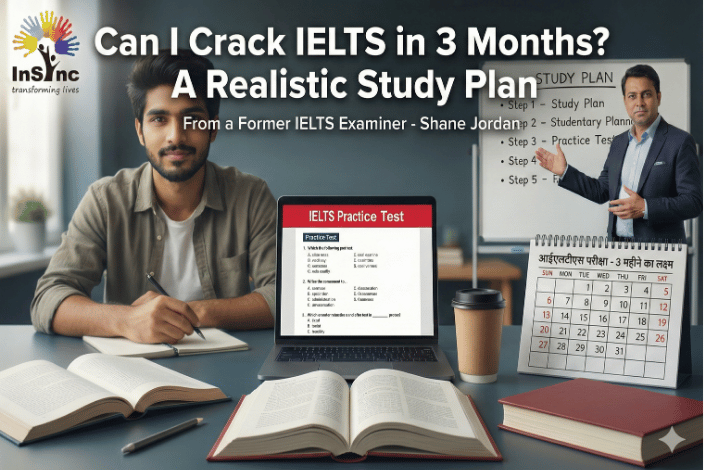
Can I Crack IELTS in 3 Months? A Realistic Study Plan

Can I Crack IELTS in 3 Months? A Realistic Study Plan From a Former IELTS Examiner- Shane Jordan You’ve probably heard mixed opinions. Some say three months is more than enough. Others warn you that it takes six months or more. The truth sits somewhere in between. If you already understand English and use it in some form daily, then yes, three months can be enough. The real difference comes from how you plan, who trains you, and how early you start getting real feedback. Many learners at InSync begin with the same question and go on to achieve their target band within this exact timeframe. Why three months is enough if used the right way IELTS is not a memory test. It is a performance test. You need time to understand the format, adjust your writing, and fix your speaking structure. Three months gives you that space without letting motivation fade. You don’t need to study full-time. You need to study with purpose. Eight to ten hours a week is enough when your practice is reviewed, corrected, and guided properly. Most Band 6 students who follow a clear process reach Band 7 or higher in around ten to twelve weeks. The timeline works if the effort is focused. Why do most three-month attempts fail before they start It’s easy to waste the first few weeks without noticing. Many learners start by downloading PDFs, watching videos, or copying tips. These activities fill time but do not move your score. Without feedback from someone who understands the scoring logic, you keep making the same errors. Most people avoid writing and speaking practice because it feels uncomfortable. That’s exactly where progress is waiting. The issue is not your ability. The issue is the lack of a system that shows what to fix and how soon you can improve with the right guidance. This is why timeframes vary so much between learners. If you’re curious, this guide on moving from Band 5.0 to 8.0+ shows the broad range and what influences real progress. How does Shane Jordan change the direction of preparation? Shane Jordan is not a motivational coach. He is a former IELTS examiner who has marked over thirty-five thousand scripts and conducted the same number of speaking interviews. His feedback is based on his real-world experience, not assumptions. With over twenty-four years of teaching and assessment, Shane leads the IELTS training at InSync. He brings examiner experience into every lesson and works closely with learners to guide them to achieve the maximum scores on the test. Whether it’s a first mock or final review, his insight stays involved. That’s what helps students prepare without confusion. You are not taught theory, instead, you are immersed in authentic tasks and activities and you experience first hand what works in real test rooms, marked by real examiners. The three-month plan we follow at InSync Preparation does not need to be complicated. It needs to be practical and well planned. The InSync system follows five stages. Each stage builds toward exam readiness without pressure. You do not need to rush or overcommit. You just need to follow the structure, attend feedback sessions, and apply corrections. Weeks 1–2:  Week Range What Happens During This Stage Weeks 1–2 You begin with a CEFR-based screening test and a full IELTS mock to assess your actual level. Weeks 3–5 You learn the correct formats for each task and fix grammar issues that affect structure and tone. Weeks 6–8 You submit full answers that are marked by IELTS trainers with band-specific comments and scores. Weeks 9–10 You practise under exam pressure with timed tasks and receive written reports on your consistency. Weeks 11–12 You work on fluency, speaking control, and final writing clarity with one-on-one corrections. If you’re wondering how this compares with more generic learning paths, data from this Cambridge overview helps show how structured systems like InSync accelerate learning. What makes this system work within three months The goal is not to finish more content. It is to reduce confusion. When your essays are corrected by someone who has marked IELTS, you stop guessing. When your speaking is reviewed using actual scoring rubrics, you stop repeating vague answers. This is not about giving more information. It is about giving the right corrections in time. Many learners improve by two bands without needing more practice. They improve because they stop doing what examiners do not reward. That shift only happens when you train inside a system shaped by examiner logic. What students say after finishing the cycle Ravi, an HR professional from Bangalore, said the first mock shattered his assumptions. He thought his writing was fine until he saw Shane’s feedback. By the eighth week, his essays had a clear flow, and his score jumped from Band 6 to Band 7. Dr. Farzana, who had only weekend time due to hospital shifts, worked on speaking fluency through late-night slots. She cleared with Band 7.5 after just ten weeks. These are not scripted stories. They reflect what happens when people prepare with clarity, not pressure. Progress follows when feedback is honest, and support is real. What to do if you’re planning your own three-month prep Start with your current level. Not with the target. At InSync, we offer a two-step entry assessment. You first take a CEFR-based screening test, followed by an IELTS-format mock. These results tell you where you are and what needs to change. After that, your schedule is built around your availability. You can join morning, afternoon, evening, or late-night batches. All materials, mocks, and sessions are structured to keep progress visible. Feedback does not wait until the end. You receive it every week. You can also repeat sessions and speak to your mentor when needed. What you should see by the final two weeks If you follow the plan, your final phase will feel more confident than your first. By Week 10, most students have reduced their writing time. They no longer overwrite or miss

Can I Crack IELTS in 3 Months? A Realistic Study Plan Read More »
How long should you prep for IELTS Chennai

How long should you prep for IELTS?

How long should you prep for IELTS? Here’s the honest breakdown to hit Band 7 or higher – no fluff, just facts IELTS isn’t just a random quiz on weird English facts you memorize last minute. This test checks real-world language use through listening, reading, writing, speaking – skills that matter worldwide. Hitting band 7 or higher takes time, so plan ahead with a schedule that actually fits your pace. In this post, I’ll guide you step by step – using clear examples along the way. What This Guide Covers What Does Band 7 Really Mean? IELTS checks how well you know English, going from Band 0 (non-user) to Band 9 (expert user) . There is no pass or fail in the IELTS  test. It doesn’t label results as passed or failed; instead, it shows your ability in speaking, listening, reading, and writing. Each skill counts on its own. Plenty of colleges, work permits, job licenses, or advanced courses ask for a score of 7 in each exam paper with an overall band 7 or 7.5, often needing nothing lower than 6.5 in any part. To hit Band 7, it’s not just about knowing English, instead, test smarts matter, along with smart exam moves, practicing under time pressure, checking your own work, also thinking deeply on how you learn. Eat Your Reality Pill: You Can’t Improve Instantly How much time’s needed to lift your score? Cambridge research highlights plus IELTS prep findings show typical results like this: Reference That’s tons of: Not those throwaway  Youtube lectures, PDFs, PPTs you glance at right before the test. If somebody says “a couple weeks” or “just one weekend webinar” can land you Band 7, pause… then slowly back away. Many flyby trainers and dubious IELTS coaching institutes make false promises and tall claims to trap candidates. Avoid falling for such traps. Take a step back and make a wise decision; otherwise, you’ll end up burning your fingers by having to repeat the test several times. Anything cheap and fast is a clear no-no for IELTS. How Long Does It Take on Average? Rather than a made-up story, here’s what actually happens instead. Beginners or Lower Intermediate (Band 3.5–5.5) Could take half a year or more – sometimes over a year – with steady practice to hit scores between 6.5 and 7.0. Intermediate Learners (Band 5.5–6.5) Most students need about three to five months of coaching to hit Band 7 or higher, making steady gains in each section. Advanced Learners (Band 6.5 & above) Most times, around 8 to 12 weeks of guided sessions followed by serious solo practice might do the trick. These levels are real – they match typical worldwide schedules shared by IELTS coaching pros. What Actually Slows Students Down Many learners tend to underestimate these 3 things; 1. Thinking IELTS is “just general English” That’s not true. This situation depends on school demands and stress from timed exams. 2. Never training under real exam conditions Just flipping through rules or reading random files won’t work. 3. Weak Reading and Writing skills Info suggests that globally, lots of test takers struggle most with writing; this is true even more so for people from India. In India, most people score between 5.5 and 6 on the test and  writing tends to lag behind the rest. Each learner begins at their own level, with unique aims,  so your path should fit you alone. Real Case Studies from My Coaching Classes Here’s when ideas hit actual life – learners juggling daily routines, work duties, yet still pushing forward. Case Study 1: Saravanan:  From Band 3.5 to 6.5 Once he started, the assessment put him right around Level 3.5 – sitting in the lower middle range. He stuck with me regularly over a year, balancing work while teaching himself. Through steady work plus a solid plan, he hit Band 6 at last. This path shows a truth few experts admit: If your starting point’s weak, progress needs patience instead of quick fixes. We’re seeing actual change now – none of that shallow stuff. Case Study 2: Hrithik:  From Band 5.5 to 7.5 in 3.5 Months Hrithik came across as an average student in class. His thoughts came out clear when he spoke up during lessons; however, things like understanding spoken words, going through texts, or putting ideas on paper gave him a tough time. He spent roughly 20 to 24 hours every week studying; way more than most students. Because he stayed focused and pushed hard, he hit a 7.5 average score in just under four months. This is what many IELTS tutors aim for, though not all get it right. Case Study 3: Prerna:  Upper Intermediate, Overall Band 8 in 8 Weeks Prerna started coaching at Band 6.5, this gave her a solid English base to grow quickly. She put in serious hours, stuck to the advice without fail, sharpened rough spots fast, yet reached Band 8 in two months. This is how it goes when things start off strong, yet the person stays focused while staying open to feedback. Different Learner Types and Timelines Here’s how it works in real life: Starting Band Target Band Average Timeline Typical Weekly Hours 3.5 6.5 12–15 months 8–10 hrs 5.5 7.5 3–4 months 20+ hrs 6.5 8.0 8–12 weeks 15–20 hrs 6.0 7.0 8–12 weeks 8–10 hrs These aren’t hunches – instead, they match up with real outcomes from leading coaches and verified studies. Weekly Strategy for Band 7 Success This is an actual plan you can use after figuring out where you stand right now. Time Commitment Levels Sample Weekly Plan Day Focus Monday Listening skills + how to get better at them Tuesday Reading mini-skills along with time-based texts Wednesday Practice talking out loud while someone listens – then get quick tips Thursday Practice tasks along with working on writing layout Friday Grammar plus word choice fine-tuned Saturday Complete practice exam followed by breakdown Sunday Fix mistakes while targeting shaky areas Check what

How long should you prep for IELTS? Read More »

Can You Prepare for IELTS in 15-30 Days

Can You Prepare for IELTS in 15-30 Days and Score Band 7+? The Honest Truth! You are squeezed for time as you need to meet college application deadlines or you apply for an express entry work visa to Canada which requires an overall 7.5 in the IELTS General module. You want to crack the test in the fastest time span as well as score the maximum.  Right now, you’re quickly searching online – “Is it possible to pass IELTS in two weeks?” Here’s something most coaching centers won’t say right away.  The Quick Answer (Because you’re in a hurry) YES, it’s doable – though only when certain requirements are met. This isn’t some magic fix or hidden hack. It’s really knowing your starting point which is finding out about your current English level – then deciding if 6-8 weeks window fits your reality. Here’s the moment of truth: Cambridge English Assessment says most IELTS test candidates need over 200 hours of serious practice to move up by just one level on the CEFR. Time to break it down:        Yeah, the schedule’s packed – still doable though. Who Can Actually Get Band 7+ in 15–30 Days?  You’re a Strong Candidate If: 1. Your Current English Level is Already High (Band 6.5) 2. You Have Strong Academic/Professional English Background 3. You Can Dedicate 6-8 Hours Daily ❌   This Timeline is Unrealistic If: The British Council says most learners take 3 to 6 months of steady practice to jump from Band 5.0 to 7.0 – going too fast usually leads to poor results, plus they end up losing money on retests (that’s over ₹18,000 in India). What the Official Sources Say Cambridge English Language Assessment Guidelines; Cambridge – known for creating IELTS – shares straightforward tips on how much time you’ll need to get ready. Cambridge says you’ll need around 200 hours or more if you want to move up by one band, though results can differ depending on how consistent you are Learning on your own? It might get you there – just expect it to take nearly half again as much time compared to having a teacher guiding you. Skill Development: Speaking and Writing skills develop slower than Reading and Listening  Reference: Cambridge English Assessment – Learning Hours Framework URL: https://www.cambridgeenglish.org/Images/126011-using-cefr-principles-of-good-practice.pdf British Council’s Official Stance British Council, a co-owner of IELTS, recommends: At least 6 to 8 weeks – anyone aiming high, beginning at Band 6.0. But only if you’re truly committed, starting from that level. A few months – usually between three and six – for anyone beginning under Band 6.0 Check symptoms early – before picking a test day Reference: British Council India – IELTS Preparation URL: https://www.britishcouncil.in/exam/ielts/prepare IDP Education’s Recommendation IDP, another official IELTS partner, suggests: Try a sample quiz at first – this shows where you stand now Zero in on shaky spots instead of spreading effort everywhere Build in extra minutes – just in case something goes off track  Reference: IDP IELTS Preparation Resources URL: https://www.ielts.org/for-test-takers/how-to-prepare The Real Data: What Indian Test-Takers Actually Achieve Let me share some ground realities from India (based on British Council and IDP data trends): Average Band Scores in India (2023-2024) Skill- average band score          Overall: 6 The Writing Issue: See how Indians often trip up at Writing (5.5). That’s the area taking longest to get better, yet it’s toughest to fix fast – so progress feels slow no matter what. Source: IELTS Official Statistics (available in annual reports on IELTS.org) Your 15-30 Day Action Plan (If You Still Want to Try) If you’re sticking to this schedule no matter what hurdles pop up, here’s how you move forward: Week 1: Assessment & Foundation (Days 1-7) Day 1: Take a FULL Mock Test Stop right there. Here’s the truth – get clear on your position now or pay later. Free Official Practice Tests: What to do: If you get less than 6.0 overall, think twice before taking the test – trust me, it’s better late than broke. Yeah, it sucks to wait, still rushing now could burn your cash and mess with your head. Days 2-3: Deep Dive into Band Descriptors Key Focus Areas for Indian Students: Take a moment: go over these descriptions carefully. Write them down on paper. See how Band 6 stands apart from Band 7 for every category. Days 4-7: Skill-Specific Intensive Work Reading (2 hours/day): Writing (2-3 hours/day): Speaking (1-2 hours/day): Week 2-3: Intensive Practice & Error Correction (Days 8-21) Daily Schedule (6-8 hours): Critical Resources for These Weeks Online Resources: Week 4: Final Sprint (Days 22-30) – If You Have This Time Days 22-25: Full Mock Tests Days 26-28: Refinement Days 29-30: Rest & Mental Preparation The Most Common Mistakes Indian Students Make (That Kill Band 7 Dreams) 1. Starting with YouTube Instead of Official Materials The issue? You can find useful advice on YouTube, yet plenty of those giving it don’t actually grade IELTS tests. A fair number share old details – or worse, stuff that’s just wrong. The Solution: Start with official materials first: 2. Memorizing “Templates” for Writing/Speaking The truth is, IELTS graders know when you’re reciting something stored in memory. If they catch it, your mark might drop – so relying on set phrases isn’t safe. Official Warning from IELTS.org: “Examiners can recognize memorized responses and will mark you down for lack of genuine communication.” Source: https://www.ielts.org/for-test-takers/test-day-advice Better Way: Pick up adaptable methods instead of fixed formulas. 3. Ignoring Task Response in Writing The issue? Six out of ten students in India end up scoring lower – simply because their answers miss part of what’s being asked. Instead of covering everything, they leave bits out, which costs them points on tests.     A classic blunder looks like this: Question: “Do you agree or disagree?” Your response: you look at one side, then the other – balancing each without leaning too hard either way 4. Overthinking Pronunciation in Speaking Myth: “My Indian accent will reduce my score.” Truth from Official IELTS

Can You Prepare for IELTS in 15-30 Days Read More »