
Every year, thousands of students in Chennai prepare for the IELTS exam with the hope of studying, working, or immigrating abroad. Many of them spend weeks or even months studying. Yet a surprising number fail to reach their target band score.
The problem usually isn’t intelligence or lack of effort. In most cases, candidates follow the wrong preparation strategies. They rely on random internet advice, memorize answers, or underestimate the difficulty of the test.
At InSync Learning and Development, students receive guidance from a former British Council IELTS examiner with over 24 years of teaching experience who has assessed more than 35,000 IELTS test takers. This kind of experience helps identify the most common mistakes candidates make.
If you are preparing for IELTS, especially in Chennai, understanding these mistakes can help you avoid them and significantly improve your score.
Understanding What “Failing IELTS” Actually Means
Technically, the IELTS exam does not have a pass or fail system. The test measures English proficiency on a band scale from 0 to 9.
However, many candidates feel they have “failed” when they do not reach the band score required for their goals.
For example:
- Canada immigration often requires CLB 9, which means an IELTS score of 8-7-7-7.
- Many universities require Band 6.5 or 7.
- Healthcare professionals often need high scores in English tests for licensing.
When students repeatedly score Band 6 or 6.5, it can delay their plans to study or work abroad. This situation is quite common, and the reasons are often predictable.
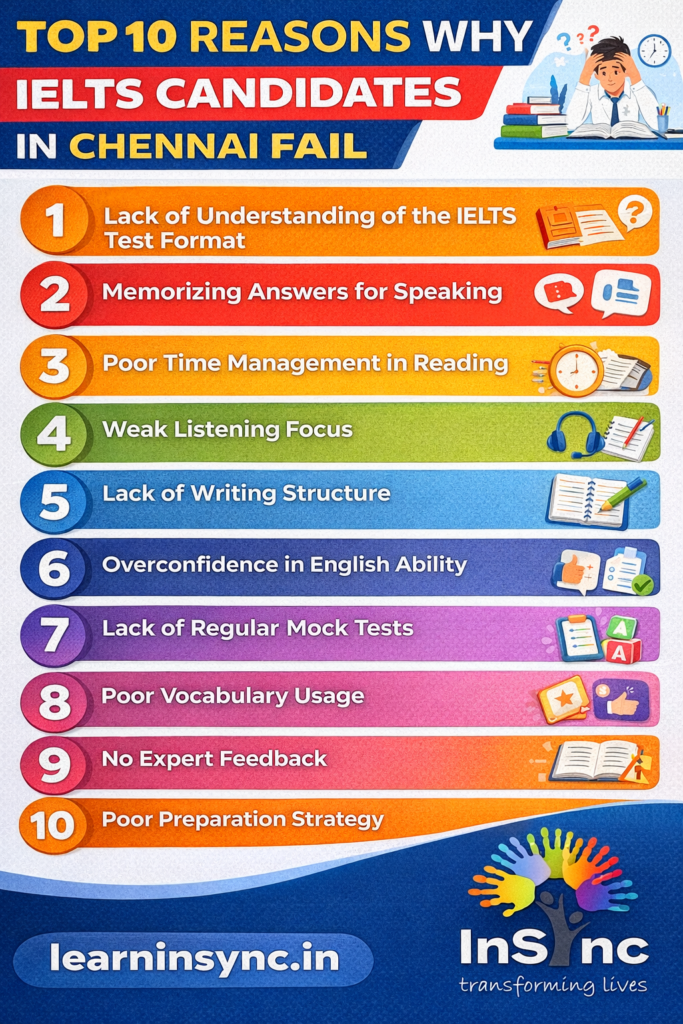
Reason 1 – Lack of Understanding of the IELTS Test Format
Many students start preparing without fully understanding how the exam works.
They may not know:
- the structure of each module
- The timing for the reading and listening sections
- the expectations in writing and speaking tasks
Without this knowledge, even strong English speakers can lose marks.

How to Fix It
Start by studying the exam format carefully. Understand the types of questions in each section. Take diagnostic tests to evaluate your current level.
Students who attend structured training at an IELTS coaching centre in Chennai often begin with these diagnostic tests so they can identify their strengths and weaknesses early.
Reason 2 – Memorizing Answers for Speaking
This is one of the most common mistakes IELTS examiners notice.
Many candidates memorize speaking answers from YouTube videos or sample scripts online. While this may sound impressive during practice, it rarely works in the real exam.
Examiners are trained to recognize memorized responses immediately.
Also, Read – IELTS Speaking Band 9: Secrets Only a Real IELTS Examiner Would Ever Tell You
How to Fix It
Focus on speaking naturally. Instead of memorizing answers, practice expanding your ideas.
Real conversation practice helps you respond confidently even when the examiner asks unexpected questions.
Reason 3 – Poor Time Management in Reading
The IELTS Reading section is challenging for many candidates.
The main problem is not difficulty but time management. Students spend too much time on difficult questions and rush through the rest of the test.
How to Fix It
Practice skimming and scanning techniques. Learn how to locate information quickly instead of reading every line.
Timed practice tests are very effective. Students who regularly practice reading strategies, such as those explained in this guide on mastering IELTS reading strategies, often improve their scores significantly.
Reason 4 – Weak Listening Focus
Listening may appear easy at first, but it requires strong concentration.
Many candidates lose marks because they:
- lose focus during the recording
- miss important keywords
- make spelling mistakes
How to Fix It
Train your listening skills with real IELTS practice tests. Pay attention to spelling and note-taking.
Exposure to different English accents can also help you feel more comfortable during the exam.
Reason 5 – Lack of Writing Structure
Writing is often the most difficult module in IELTS.
Many candidates struggle because they do not understand how to structure essays or task responses.
Common mistakes include:
- unclear arguments
- weak introductions
- poor paragraph organization
How to Fix It
Learn a clear structure for Task 1 and Task 2 essays. Practice writing regularly and get your work corrected by experienced trainers.
Feedback is extremely important because it shows exactly where you lose marks.
Suggested – How to Convert PTE Scores into IELTS Bands
Reason 6 – Overconfidence in English Ability
Some students believe they will score high because they already speak English in daily life.
However, IELTS is not just about English ability. It is also about test strategy and exam awareness.
Even fluent speakers can lose marks if they do not follow the correct format.
How to Fix It
Take diagnostic tests to understand your real band level. Compare your performance with official IELTS band descriptors.
This helps you focus on areas that need improvement.
Reason 7 – Lack of Regular Mock Tests
Many students study theory but rarely take full-length mock tests.
Without mock tests, it is difficult to understand how you perform under exam conditions.
How to Fix It
Practice with full IELTS mock tests regularly. This helps improve time management, confidence, and exam familiarity.
Structured programs often include weekly mock tests, which allow students to track their progress consistently.

Reason 8 – Poor Vocabulary Usage
Vocabulary is important in IELTS, but many students misunderstand how to use it.
Some candidates use only basic words, while others try to use advanced vocabulary incorrectly.
Both approaches can affect your score.
How to Fix It
Focus on natural and accurate vocabulary. Learn how words are used in context instead of memorizing long word lists.
Building topic-based vocabulary can help improve both speaking and writing performance.
Reason 9 – No Expert Feedback
Self-study can be helpful, but without feedback, it is easy to repeat the same mistakes.
Many students do not know:
- Why does their writing score stay at Band 6
- Why does their speaking score not improve
How to Fix It
Get feedback from experienced trainers who understand IELTS scoring criteria.
At InSync Learning and Development, students receive detailed writing corrections and speaking assessments from trainers with extensive IELTS experience.
You can read about real student experiences on the student testimonials page or check verified feedback on the institute’s Google reviews.
Reason 10 – Poor Preparation Strategy
Many candidates prepare for IELTS using scattered resources from the internet.
They watch random videos, download multiple practice materials, and follow conflicting advice.
This creates confusion and slows progress.
How to Fix It
Follow a structured preparation plan that includes:
- regular mock tests
- speaking practice sessions
- writing feedback
- progress tracking
Students preparing through structured programs at the IELTS coaching centre in Chennai, or Pondicherry often benefit from guided preparation and expert feedback.
You May Also Like – How InSync Learning and Development Helps Students Score 8+ Bands in IELTS
How Expert IELTS Coaching Helps Candidates Improve Faster
Structured training can make a significant difference in IELTS preparation.
Students benefit from:
- experienced trainers
- regular mock tests
- writing corrections with band score feedback
- speaking practice sessions
- progress monitoring
One major advantage of studying at InSync Learning and Development is that training is led by a former British Council IELTS examiner with over 24 years of experience. This provides students with insights into how examiners actually evaluate speaking and writing tasks.
Why Many IELTS Candidates in Chennai Choose Structured Training
Candidates often choose structured coaching because it provides:
- a clear study plan
- expert feedback
- flexible learning options
- continuous assessment
If you are exploring preparation options, this guide on top IELTS coaching centres in Chennai can help you compare institutes.
Some students also attempt very short preparation timelines. If you are considering that approach, this article explains the reality of preparing for IELTS in 15–30 days.
Conclusion: Avoid These Mistakes to Improve Your IELTS Score
Most IELTS candidates in Chennai do not fail because they lack ability. They struggle because they follow the wrong preparation strategy or do not understand the exam properly.
With the right guidance, consistent practice, and expert feedback, students can significantly improve their band scores.
If you are planning to take the IELTS exam and want structured preparation, you can contact the team at InSync Learning and Development for guidance.
You can also follow their learning updates and IELTS preparation tips on social media:
LinkedIn
https://www.linkedin.com/company/insync-learning-development-pvt-ltd/
YouTube
https://www.youtube.com/@insyncld860
Instagram
https://www.instagram.com/insyncielts_oet/
With the right strategy and preparation, reaching your target IELTS band score becomes far more achievable.

FAQ:
1. Why do many IELTS candidates fail to achieve their target band score?
Most IELTS candidates do not reach their target score because they follow incorrect preparation strategies. Common mistakes include memorizing speaking answers, poor time management in the reading section, weak writing structure, and a lack of regular mock tests. Many students also prepare without expert feedback, which makes it difficult to identify mistakes and improve their performance.
2. Is IELTS a pass or fail exam?
IELTS does not have a pass or fail system. The test measures English proficiency on a band score scale from 0 to 9. However, candidates often feel they have “failed” when they do not achieve the band score required by universities, immigration programs, or employers. For example, many study abroad programs require Band 6.5 or 7, while Canadian immigration often requires CLB 9 (8-7-7-7 in IELTS).
3. What is the most difficult section of the IELTS exam for most students?
Many students find the Writing and Reading modules the most challenging. Writing requires strong grammar, vocabulary, and clear essay structure, while the reading section demands excellent time management and comprehension skills. Regular practice tests and expert feedback can help candidates improve their performance in these modules.
4. How can IELTS candidates improve their band score quickly?
Candidates can improve their IELTS score by following a structured preparation plan. This includes practicing daily speaking sessions, taking timed mock tests, learning reading strategies, improving vocabulary, and receiving detailed feedback on writing tasks. Consistent practice and understanding the IELTS scoring criteria can significantly increase band scores.
5. How important are mock tests in IELTS preparation?
Mock tests play a crucial role in IELTS preparation because they simulate the real exam environment. Regular mock tests help students improve time management, identify weak areas, and build confidence before the actual exam. Candidates who practice with full-length mock tests often perform better during the real IELTS test.
Related Post – How long should you prep for IELTS?