
For many Indian doctors, OET preparation starts with confidence. After all, English has been a part of their academic and professional journey for years. From writing exams to communicating with colleagues, they already function comfortably in the language.
Yet, when it comes to OET results, things often don’t go as expected.
Many capable doctors fall short of the required score, especially in Writing and Speaking. This creates confusion and frustration, because the effort doesn’t seem to match the outcome.
The problem is not a lack of English skills.
The real issue is a misunderstanding of what OET actually tests. Unlike traditional exams, OET focuses on how effectively you can communicate in a healthcare setting. It’s not about how much English you know, it’s about how well you use it in the right context.
The Biggest Misconception About OET
One of the most common mistakes candidates make is treating OET like a general English exam.
Preparation usually includes:
- Learning advanced vocabulary
- Practicing grammar rules
- Reading newspapers or articles
While these activities improve overall language ability, they don’t directly help in OET performance.
Why?
Because OET is not designed to test complex English. It is designed to evaluate professional communication in real medical situations.
For example:
- Using difficult words does not improve your score
- Writing long answers does not make them better
- Speaking fluently without structure does not guarantee marks
This gap between preparation and expectation is where most candidates lose marks.
Understanding this early can completely change how you prepare.
What OET Really Tests
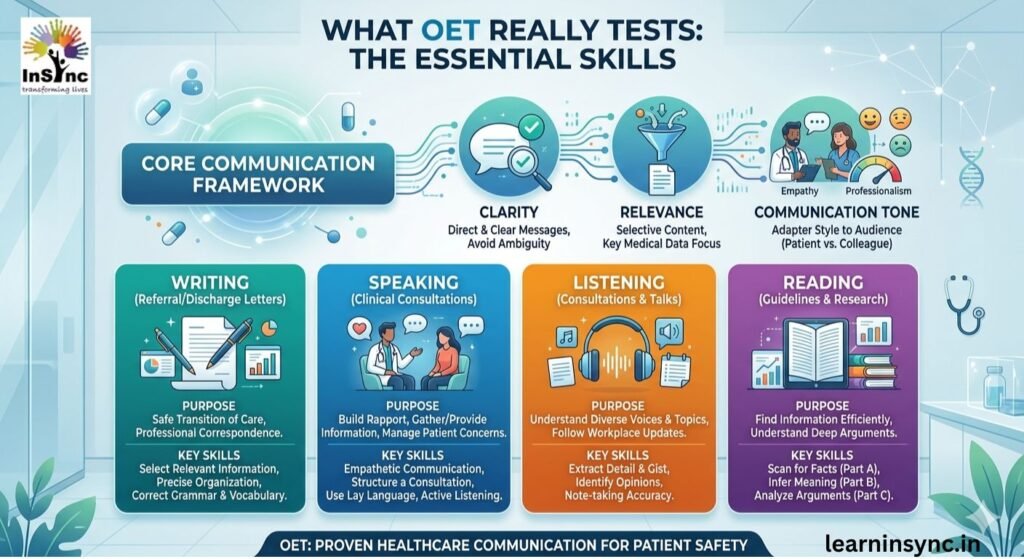
OET is built around real-life healthcare communication. Every section of the test is designed to reflect situations that doctors face in their daily practice.
It focuses on three key abilities:
- Clarity: Can you express medical information in a clear and structured way?
- Relevance: Can you choose only the important details from given information?
- Communication tone: Can you adjust your language depending on whether you are speaking to a patient or another healthcare professional?
Each sub-test has a specific purpose:
- Writing: Your ability to draft professional medical letters with the right structure and purpose
- Speaking: How effectively you interact with patients, including empathy and reassurance
- Listening & Reading: Your ability to understand, extract, and respond to medical information accurately
In simple terms, OET measures how well you can function as a healthcare professional in English, not just how fluent you are.
Where Most Indian Doctors Actually Struggle
Even experienced doctors face specific challenges in OET, not because of weak English, but because of unfamiliar test expectations.
Writing: Lack of Structure and Relevance
The Writing sub-test is where many candidates lose their B grade.
Common issues include:
- Including too much unnecessary clinical detail
- Missing the main purpose of the letter
- Poor paragraph structure and flow
In OET, it’s not about showing everything you know. It’s about selecting and presenting only what matters to the reader.
Speaking: Missing the Human Element
Many candidates focus on speaking correctly, but overlook how they sound to a patient.
Typical problems:
- Giving information without empathy
- Not addressing patient concerns properly
- Using complex medical terminology unnecessarily
OET examiners look for connection, not just correctness. A patient should feel understood, not overwhelmed.
Listening & Reading: Lack of Strategy
These sections often seem easier, but scores still drop due to:
- Missing key details while listening
- Poor time management in reading
- Not understanding question patterns
Without a clear approach, even strong candidates struggle to perform consistently.
The Gap Between Clinical Knowledge and Communication
Indian doctors are highly skilled and knowledgeable. But OET does not test how much you know, it tests how well you communicate that knowledge.
There is a clear difference between:
- Thinking like a doctor
- Communicating like a doctor
For example, in real practice, using medical terminology is normal. But in OET, especially in Speaking, patients expect simple and clear explanations.
Bridging this gap requires conscious effort.
It’s about:
- Simplifying language
- Structuring responses
- Adapting tone based on the situation
This shift is often the turning point in OET preparation.
Also, Read – How Can I Study OET at Home? A Practical Plan That Actually Works
Why Traditional Preparation Methods Fail
Many candidates rely on self-study or general English practice. While this feels productive, it often doesn’t lead to score improvement.
Common problems with traditional preparation:
- Practicing without understanding mistakes
- No expert feedback on Writing and Speaking
- Lack of clarity about evaluation criteria
Repeating the same mistakes without correction leads to stagnation.
This is why many candidates get stuck at the same score, even after multiple attempts.
Effective preparation is not just about practice, it’s about guided practice with correction.
The Role of Strategy in Cracking OET
Once candidates understand that OET is different, the next step is building the right strategy.
Success in OET is not random, it follows a clear, structured approach.
Strong candidates usually:
- Understand the exact format of each sub-test
- Follow a fixed structure for Writing tasks
- Use frameworks during Speaking role-plays
- Apply time management techniques in Reading and Listening
Instead of trying new things every day, they stick to proven methods.
For example:
- Knowing what to include, and what to exclude, in a letter
- Handling patient concerns in a step-by-step manner
- Identifying keywords quickly in Listening
These small strategic shifts create a big difference in scores.
The Importance of Expert Guidance
At this stage, clearing OET is no longer about how much effort you put in, it’s about how correctly you prepare.
Many candidates study for months, yet their scores don’t improve. The reason is simple: practice without the right feedback leads to repeated mistakes.
What candidates actually need is structured guidance that shows:
- What examiners are really looking for
- Where they are losing marks
- How to correct those mistakes step by step
This is where a well-designed training system makes a real difference.
At InSync Learning and Development, the approach goes beyond basic teaching. The focus is on building exam-ready performance through a proven, structured method.
With over 24 years of experience from an OET master trainer, the program is designed to address the exact challenges Indian healthcare professionals face.
What makes the preparation more effective:
- Small group live interactive sessions (70+ hours)
Ensures personal attention, active participation, and better understanding - Up to 35 mock tests + 3 full online mock exams
Helps candidates get comfortable with real exam pressure and patterns - 8 Writing & 6 Speaking assignments with detailed feedback and grades
Not just practice, clear insights on where you stand and how to improve - Unlimited classes until your test date
So preparation continues until you are fully ready, not just until the course ends - Daily support with grammar and speaking fluency sessions (5 days a week)
Builds consistency and strengthens core communication skills - Access to 100+ hours of study materials, 70+ video tutorials, and support tools
Covers grammar, vocabulary, and practical application in one place - Flexible learning options (fast-track, hybrid, one-on-one classes)
Designed to suit different schedules and learning speeds - Continuous progress tracking with regular assessments
So you always know your improvement level
What truly sets this apart is the INSYNC Progress Promise, a system built to ensure that every candidate keeps improving until they reach their target score.
This is reflected in the results:
- 70% success rate in the first attempt
- 5 lakh+ students trained
- 35,000+ test takers assessed
- 765+ positive Google reviews with a 4.9 rating
- India’s first OET teacher trainer
There’s also flexibility built into the learning journey. Candidates enrolled in the Reach OET B Nursing package can continue attending live classes even after their subscription ends, ensuring support doesn’t stop midway.
Because the goal here is not just to complete a course.
It’s to make sure you are fully prepared, confident, and ready to clear OET.
You can also check real student feedback and ratings here:
For regular tips and updates, you can follow:
- https://www.linkedin.com/company/insync-learning-development-pvt-ltd
- https://www.instagram.com/insyncielts_oet/
What Successful Candidates Do Differently
If you observe candidates who clear OET in their first attempt, their approach stands out.
They don’t rely on guesswork.
Instead, they:
- Focus on task-specific practice rather than general English
- Actively work on feedback and corrections
- Maintain consistency in preparation
- Prioritize quality over quantity
They understand that repeating mistakes won’t change results, correcting them will.
Another key difference is mindset.
Successful candidates don’t just prepare to “attempt” the exam.
They prepare to meet the exact scoring criteria.
If you need guidance or want to discuss your preparation plan, you can connect here:
Suggested – How to Pass OET in 30 Days: A Simple Plan That Works
Conclusion: It’s Not About English, It’s About the Right Approach
The idea that “good English is enough” has misled many capable doctors.
Fluency alone does not guarantee success in OET.
What truly matters is:
- Understanding how the exam works
- Communicating with clarity and purpose
- Practicing with the right structure
- Learning through expert feedback
Once this shift happens, results start improving.
Because in OET, success is not about how much English you know, it’s about how effectively you use it in the right situation.
And with the right approach and guidance, achieving your target score becomes not just possible, but predictable.

FAQ
1. Is good English enough to pass OET?
No. OET is not a general English exam. It tests how effectively you communicate in healthcare situations. Clarity, relevance, and professional tone matter more than advanced vocabulary.
2. Why do many Indian doctors fail OET despite being fluent in English?
Most candidates focus on general English instead of OET-specific skills like letter writing, patient interaction, and structured communication. This mismatch leads to lower scores.
3. Which OET sub-test is the most difficult for doctors?
The Writing sub-test is commonly the most challenging because it requires proper structure, relevant information selection, and clarity, not just language skills.
4. How can I improve my OET Writing score?
Focus on understanding letter structure, selecting only relevant case notes, and practicing with expert feedback. Regular correction is key to improvement.
5. Is self-study enough to clear OET?
Self-study can help, but without expert feedback, candidates often repeat the same mistakes. Structured guidance significantly improves performance, especially in Writing and Speaking.
6. How many mock tests are required for OET preparation?
There is no fixed number, but regular mock tests are essential. They help you understand exam patterns, improve time management, and build confidence.
7. What score is required to pass OET?
Most healthcare boards require a B grade (350+) in each sub-test. However, requirements may vary depending on the country and profession.
8. How long does it take to prepare for OET?
Preparation time depends on your current level and consistency. With structured training and regular practice, many candidates prepare effectively within a few weeks to a couple of months.