Choosing between IELTS Academic and General Training is one of the most common doubts among students in India. Many candidates start preparation without understanding which test they actually need. This often leads to confusion, wasted time, and sometimes even booking the wrong exam.
The difference between the two is not just about difficulty. It is about purpose. Your choice depends on whether you want to study abroad, migrate, or work in another country. A wrong decision at this stage can delay your plans.
When you learn from a former British Council IELTS examiner, one thing becomes very clear. The test you choose should always match your goal, not what others are doing. Many students simply follow friends or trends, which creates problems later.
In this guide, you will clearly understand the difference between IELTS Academic and General Training. More importantly, you will know exactly which one you need based on your situation.
What is IELTS?
IELTS stands for the International English Language Testing System. It is one of the most widely accepted English proficiency tests in the world. It is required for study, work, and migration in countries like Canada, the UK, Australia, and New Zealand.
The test evaluates four main skills:
- Listening
- Reading
- Writing
- Speaking
While the Listening and Speaking sections remain the same for all candidates, the Reading and Writing sections differ based on the type of test you choose.
There are two main types of IELTS:
- Academic
- General Training
Each is designed for a specific purpose. Understanding this difference is the first step toward making the right decision.
If you are planning to start your preparation, it is always better to first understand the exam structure and requirements. You can explore detailed guidance and training options here:

What is IELTS Academic?
IELTS Academic is designed for students who want to pursue higher education abroad. If you are planning to apply to universities or colleges, this is the test you will need.
The focus of IELTS Academic is on formal and academic English. The reading passages are longer and more complex. They are often taken from books, journals, and research articles. The writing section also requires you to analyse data, describe charts, or present structured arguments.
This test checks whether you are ready to handle an academic environment where you will read complex materials and write formal assignments.
Who should take IELTS Academic?
- Students applying for undergraduate or postgraduate courses
- Candidates planning to study in countries like Canada, the UK, or Australia
- Professionals whose licensing bodies require Academic IELTS
Many students assume that Academic is always better or more valuable. This is not true. The test is only useful if it matches your goal.
If you are unsure, getting proper guidance at the beginning can save a lot of time. Many students prefer structured programs such as this ielts coaching in Chennai where they receive clarity before starting preparation.
What is IELTS General Training?
IELTS General Training is designed for people who want to migrate, work, or settle abroad. Unlike the Academic test, it focuses on everyday English used in real-life situations.
The reading section includes materials such as advertisements, notices, and workplace-related texts. The writing section is also more practical. You may be asked to write a letter, such as a complaint, request, or job-related communication.
This test checks whether you can handle daily communication in an English-speaking country.
Who should take IELTS General Training?
- Candidates applying for permanent residency (PR)
- People planning to work abroad
- Individuals migrating to countries like Canada, Australia, or the UK
- Candidates applying for certain vocational training programs
Many Indian students aiming for Canada PR choose General Training because it matches immigration requirements.
However, one important thing to understand is this. General Training is not “easy” in the way many people think. It still requires proper preparation, especially in writing and speaking.
If you want to understand how students improve their performance with the right strategy, you can read this detailed guide:
IELTS Academic vs General Training: Key Differences
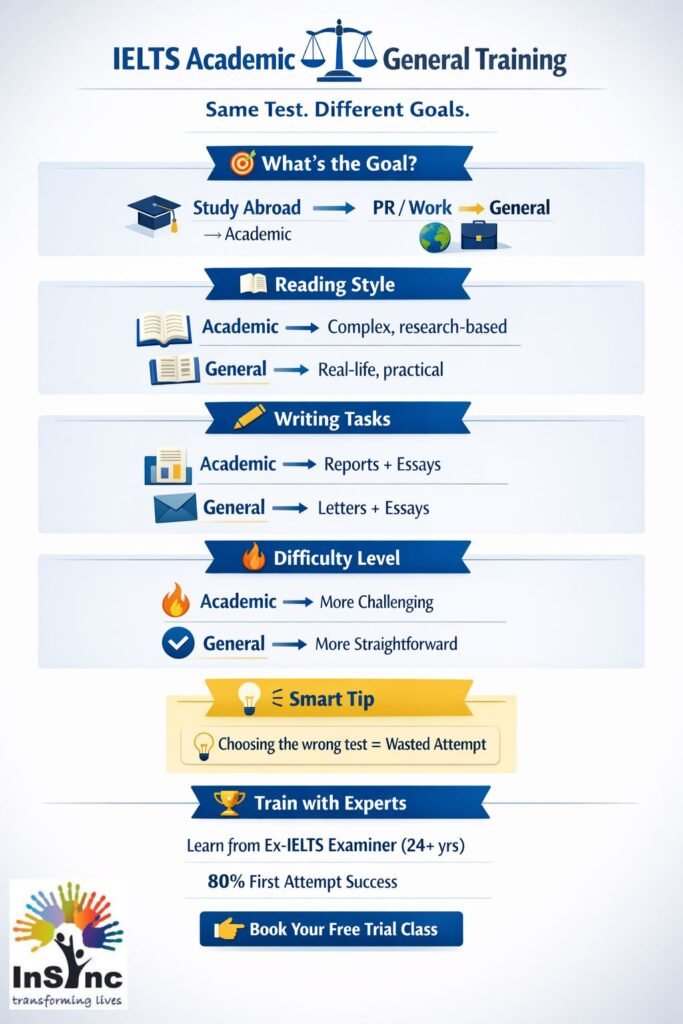
This is the most important part of your decision. While both tests assess the same four skills, the purpose and difficulty level differ in key areas.
Purpose
Academic is for higher education. General Training is for migration and work.
Reading Section
Academic reading includes long, complex passages taken from academic sources. General reading focuses on shorter, practical texts related to daily life.
Writing Section
Academic writing includes describing charts or graphs and writing formal essays. General writing includes letter writing and a simpler essay format.
Difficulty Level
Academic is generally considered more challenging, especially in reading and writing. General Training is more straightforward but still requires a clear strategy.
Scoring System
Both tests use the same band score system. A high score requires strong performance in all sections, regardless of the test type.
Understanding these differences helps you avoid a common mistake. Many students choose Academic thinking it is more valuable, even when they actually need General Training.
If you want to see why choosing the wrong strategy affects your score, this article explains it well:
Which IELTS Should You Choose in India?
Your choice should depend completely on your goal. There is no “better” test. There is only the right test for your situation.
If you are planning to study abroad, especially for undergraduate or postgraduate courses, you should take IELTS Academic. Universities require this test to assess your ability to handle academic content.
If your goal is immigration, such as Canada PR, IELTS General Training is the correct option. Most immigration programs specifically require this format.
If you are a healthcare professional, such as a nurse, then you will probably need to sit for the Academic IELTS to register with professional bodies.
If you are planning to work abroad, General Training is usually sufficient. However, it is always better to check the exact requirements of the country or employer.
This is where many students get confused. They rely on friends or agents instead of verifying official requirements. That often leads to delays and unnecessary expenses.
When you learn from a former British Council IELTS examiner, this step becomes much clearer. Proper guidance at the beginning saves time and helps you prepare in the right direction.
If you are still unsure, it is always better to get clarity before you start preparation. You can also explore structured guidance options here:
Common Mistakes Students Make
Choosing the wrong IELTS test is more common than you might think. Many candidates lose time, money, and confidence simply because they did not make the right decision at the beginning.
One of the biggest mistakes is following others blindly. A friend may have taken IELTS Academic for studies, but your goal might be immigration. Copying their path without checking your own requirements can create problems later.
Another common issue is not verifying official requirements. Different countries and visa categories have specific rules. Assuming that one test fits all situations often leads to rebooking the exam.
Some students also underestimate the importance of timing. They start preparation for one test type and then realise they need the other. Switching late can disrupt your preparation and affect your score.
Lack of expert guidance is another key reason. Without proper direction, it is easy to get confused between Academic and General Training.
If you want to see how structured preparation helps students avoid these mistakes, you can go through real experiences here:
Expert Insight: What a Former IELTS Examiner Recommends
When students are confused between IELTS Academic and General Training, the advice from a former British Council IELTS examiner is always simple. Start with your goal, not the test.
Many candidates believe that the academic program is more advanced and therefore a better choice. This is not how the exam works. Examiners do not judge you based on the test type you choose. They assess how well you perform in the format that matches your purpose.
Another important insight is this. Your preparation strategy depends heavily on the test type. Academic writing requires a different approach compared to General letter writing. Reading strategies also change based on the type of content you face.
This is why guidance at the beginning matters so much. When you learn from a former British Council IELTS examiner, you understand exactly what is expected in each format. This clarity helps you prepare more efficiently and avoid unnecessary mistakes.
You can also explore more expert-led insights and updates through their professional platforms:
https://www.linkedin.com/company/insync-learning-development-pvt-ltd/
https://www.instagram.com/insyncielts_oet/
IELTS Difficulty: Academic vs General Training
A common question among students is which test is easier. The answer is not as simple as it seems.
IELTS Academic is generally more challenging in the reading and writing sections. The texts are longer and more complex. You need to understand academic vocabulary and analyse information carefully.
IELTS General Training, on the other hand, uses more practical and everyday language. The reading passages are easier to understand, and the writing tasks are more straightforward. However, this does not mean it is easy to score high.
Both tests require strong fundamentals in grammar, vocabulary, and sentence structure. Speaking and listening remain the same for both formats, so your performance in these sections must also be consistent.
The real difference lies in the type of preparation you need. An academic requires analytical skills, while a general one focuses more on practical communication.
If you prepare in the right way for your chosen test, scoring well becomes much more achievable.

Frequently Asked Questions
Which IELTS test is easier, Academic or General?
General Training is usually easier in reading and writing, but both tests require proper preparation to achieve a high band score.
Can I use IELTS Academic for PR?
In most cases, no. Immigration programs typically require IELTS General Training. Always check official requirements before booking your test.
Is IELTS General accepted by universities?
Most universities require IELTS Academic. General Training is usually not accepted for higher education.
Can I switch from Academic to General later?
Yes, but you will need to book a new test. This is why choosing the correct type at the beginning is important.
Which IELTS should I take for Canada?
For Canada PR, IELTS General Training is required. For studying in Canada, IELTS Academic is needed.
Get the Right Guidance with InSync
If you are still unsure which IELTS test to choose or how to start your preparation, the right guidance can make all the difference. At InSync Learning and Development, you train directly under a former British Council IELTS examiner who understands exactly how both test formats are evaluated. With structured practice, clear strategies, and personalised feedback, many students gain the confidence to choose the right test and achieve their target score. To begin your preparation or get expert advice, you can visit or reach out directly here: