

Here’s the one correction that will save you months of confusion: moving to Canada and getting licensed to work as a nurse in Canada are related, but they are not the same process.
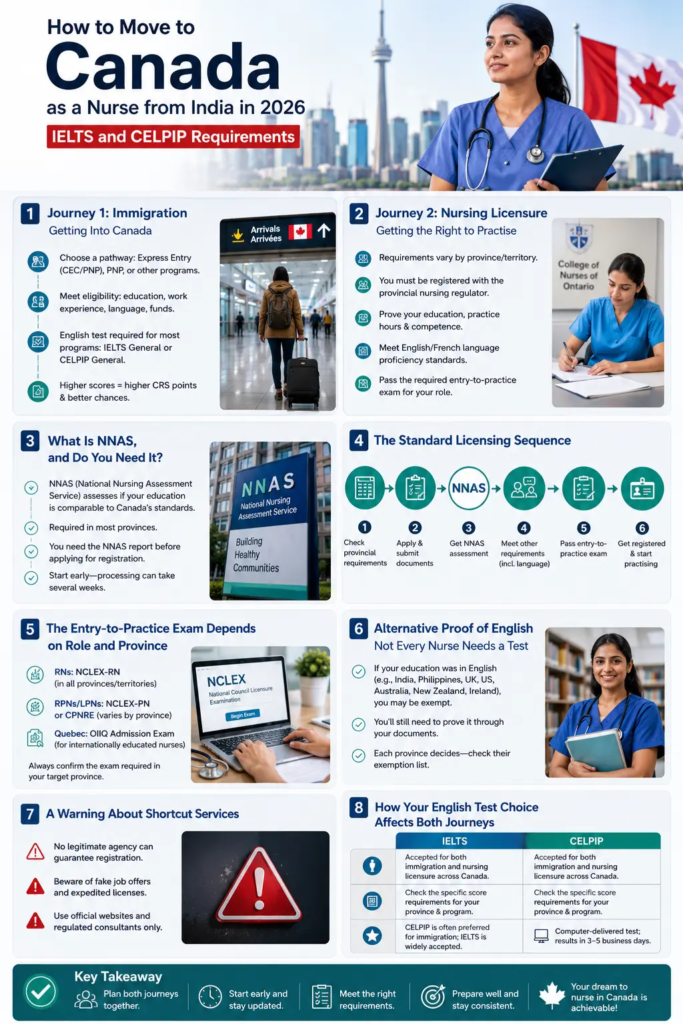
Many Indian nurses research this journey assuming a single English test, a single application, and a single approval will get them both a visa and a nursing licence. It doesn’t work that way. Immigration (getting permanent residence or a work permit) is handled by Immigration, Refugees and Citizenship Canada (IRCC). Nursing licensure (getting the legal right to practise as a nurse) is handled separately, by the nursing regulator in whichever province or territory you plan to work in.
These two journeys use different English tests in many cases, different timelines, and different authorities. Mixing them up assuming your IRCC-accepted IELTS score automatically satisfies your nursing regulator, for example is one of the most common and costly misunderstandings nurses run into. This guide keeps the two journeys clearly separated, then shows how they fit together.
Journey 1: Immigration Getting Into Canada
For Express Entry and most other IRCC permanent residence pathways, the accepted English tests are:
- CELPIP-General
- IELTS General Training
Both are valid for immigration purposes. IRCC scores your result by converting it into a Canadian Language Benchmark (CLB) level, which feeds into your Comprehensive Ranking System (CRS) score the more competitive your CLB, the stronger your overall profile.
We’ve covered the immigration-specific comparison between these two tests in full detail in our guide on CELPIP vs IELTS for Canada PR including the exact CLB equivalency tables, test format differences, and availability across Indian cities. If your primary goal right now is securing PR or a work permit, that’s the post to read in depth.
Nurses fall under high-demand National Occupational Classification (NOC) codes, which is one reason nursing immigration to Canada has been particularly strong but qualifying for PR through Express Entry doesn’t, on its own, give you the right to practise as a nurse in Canada. That right comes from the second journey.
Journey 2: Nursing Licensure Getting the Right to Practise
This is where things get more specific, and where most of the confusion happens.
Nursing in Canada is a regulated profession, and regulation happens at the provincial and territorial level, not federally. Each province and territory has its own nursing regulator, its own process, and critically its own accepted English language tests, which are often different from the IRCC immigration list.
This means a CELPIP-General score that satisfies IRCC for your PR application does not automatically satisfy your nursing regulator. You may need a different test, or the same test with different score requirements, depending on where you intend to work.
Examples of how this varies by province:
- British Columbia (BCCNM) accepts IELTS Academic and CELBAN as English test options for nursing registration.
- Manitoba’s nursing regulator accepts a broader list IELTS Academic, IELTS General Training, CELBAN, OET, PTE, and CELPIP.
Notice that BC’s list and Manitoba’s list aren’t the same. This is exactly why a blanket statement like “IELTS and CELPIP are both accepted for nursing” is misleading it depends entirely on which province’s regulator you’re applying to.
The practical rule: check the province first, then check that province’s regulator for its specific English test requirements. Don’t assume your immigration-accepted test automatically transfers to your nursing licensing application.
What Is NNAS, and Do You Need It?
For most internationally educated nurses (IENs), the National Nursing Assessment Service (NNAS) is the first stop in the licensing journey but not for everyone, and not in every province.
NNAS is a credential-verification service. It reviews your nursing education and professional licensing history and produces an Advisory Report, which most provincial nursing regulators use as part of their assessment process. NNAS itself does not grant licences only the provincial regulator makes that decision.
Important exceptions: the standard NNAS route does not apply in Quebec, Yukon, Nunavut, and the Northwest Territories these jurisdictions have their own separate processes. And even within provinces that do use NNAS, the requirement has been shifting: some regulators, including BCCNM, no longer require an NNAS report as mandatory, though they will continue to accept one if you already have it.
NNAS also no longer collects language proficiency test scores as part of its process. Applicants now submit their English test results directly to the provincial regulator, not through NNAS. This is a relatively recent change and is worth knowing if you’re working from older guides that describe NNAS as the place to submit language scores that’s no longer accurate.
The validity window that matters: your NNAS Advisory Report is valid for one year from the date it’s issued. You need to apply to your chosen regulator (or regulators) within that year, or you’ll need to reapply to NNAS and pay the fee again. Given that NNAS processing itself can take anywhere from a few weeks (under the Expedited Service) to several months (under the Regular Service, depending on how quickly your educational institutions respond), planning around this one-year window is a genuinely practical piece of advice don’t let your report sit unused while you deliberate on which province to choose.
The Standard Licensing Sequence
While the specifics vary by province, the general sequence most internationally educated nurses follow looks like this:
- Choose your province or territory this decision shapes almost everything that follows, including which English test you need and which regulator you’ll deal with.
- Create an NNAS account (if your chosen province uses NNAS) and submit your documents.
- Receive your NNAS Advisory Report, valid for one year.
- Apply to the provincial nursing regulator (e.g., College of Nurses of Ontario, BCCNM) with your Advisory Report and other required documents.
- Prove English (or French) language proficiency using whichever test(s) that specific regulator accepts.
- Complete any competency assessment or bridging program the regulator identifies as necessary based on gaps between your education and Canadian entry-to-practice standards.
- Pass the entry-to-practice exam for your intended role.
- Complete final registration and receive your licence to practise.
This sequence can take anywhere from several months to well over a year, depending on the province, how quickly your documents are processed, and whether bridging programs are required.
The Entry-to-Practice Exam Depends on Role and Province
A “Canada nurse exam” isn’t one single test which role you’re licensing for, and where, determines which exam you sit.
For example, in British Columbia, Registered Nurse (RN) applicants write the NCLEX-RN, while Licensed Practical Nurse (LPN) applicants follow a different exam pathway (REx-PN). Other provinces may structure this differently. This is another reason the “choose your province first” principle matters it determines not just your English test requirement, but your entire exam pathway.
Alternative Proof of English Not Every Nurse Needs a Test
It’s worth knowing that some regulators accept alternative evidence of English proficiency, not only standardised test scores. BCCNM, for example, accepts combinations of evidence in some cases such as having completed your education or prior nursing practice in English depending on your specific background.
This doesn’t apply to every applicant, and the specific conditions vary by regulator, but it’s worth checking directly with your target province’s regulator before assuming a test is mandatory in your case.
A Warning About Shortcut Services
One more practical note, because it protects real applicants from real harm: BCCNM explicitly warns nurses to be wary of agencies or individuals who claim they can complete your application for a fee, promising faster or guaranteed outcomes.
Licensing applications go through the regulator directly, and credential assessment through NNAS (where applicable) follows a defined process. No third party can bypass or guarantee the outcome of either. If you’re working with an agent or consultant for your immigration paperwork, keep their role clearly separate from your nursing licensing application and be cautious of anyone promising to “fast-track” your registration for an additional fee.
How Your English Test Choice Affects Both Journeys
Because the two journeys can require different tests, it’s worth thinking ahead about which test (or tests) cover both needs efficiently.
If your target province accepts IELTS for nursing licensing (as many do, in either Academic or General Training form depending on the regulator), and you sit IELTS General Training for your immigration application, you may be able to use overlapping preparation, though check carefully whether your specific regulator requires Academic specifically, since IELTS Academic and General Training are different tests with different content.
If your target province’s regulator doesn’t accept CELPIP for nursing licensing (many don’t list it, though Manitoba does), but you’ve used CELPIP-General for your immigration application, you’ll need a separate English test for your nursing licensing, most commonly IELTS Academic or CELBAN, depending on the province.
This is exactly why choosing your target province early matters so much it determines whether you can streamline your English test preparation across both journeys, or whether you’ll need to prepare for two different tests for two different purposes.
If you’re still deciding between IELTS and CELPIP for the immigration side specifically, our CELPIP vs IELTS comparison for Canada PR covers the format differences, CLB scoring, and which test tends to suit which kind of test-taker useful context before you commit to a test that may also need to serve your nursing licensing needs.
Key Takeaways
- Immigration and nursing licensure are separate processes with separate authorities IRCC for immigration, provincial regulators for licensing.
- IRCC accepts CELPIP-General and IELTS General Training for immigration purposes.
- Nursing regulators set their own English test rules, which vary by province for example, BCCNM accepts IELTS Academic and CELBAN; Manitoba accepts a broader list including OET, PTE, and CELPIP.
- NNAS is the credential-assessment starting point for most provinces, but not for Quebec, Yukon, Nunavut, or the Northwest Territories.
- NNAS no longer collects language test scores submit these directly to your provincial regulator.
- Your NNAS Advisory Report is valid for one year from issue apply to your regulator within that window.
- The entry-to-practice exam (e.g., NCLEX-RN for RN applicants in BC) depends on your role and province.
- Some regulators accept alternative evidence of English proficiency beyond test scores, depending on your background.
- Be cautious of paid agencies claiming they can guarantee or fast-track your licensing application.

Frequently Asked Questions
1. Is CELPIP enough for Canadian nurse licensing?
Not necessarily. CELPIP-General is accepted for immigration purposes by IRCC, but nursing licensing is decided by your provincial regulator, and not all provinces accept CELPIP for this purpose. Manitoba’s regulator does accept it; others may require IELTS Academic, CELBAN, or OET instead. Check your specific province’s regulator before assuming CELPIP covers both needs.
2. Is IELTS General or Academic needed for nursing in Canada?
It depends on the purpose. IRCC accepts IELTS General Training for immigration. Nursing regulators often require IELTS Academic specifically for example, BCCNM lists IELTS Academic, not General Training, as an accepted option. Always confirm with your target province’s regulator which version they require.
3. Do I need NNAS first?
For most provinces, yes NNAS credential assessment is typically the first step for internationally educated nurses. However, the standard NNAS route does not apply in Quebec, Yukon, Nunavut, or the Northwest Territories, and some regulators (such as BCCNM) no longer make an NNAS report mandatory, though they continue to accept one.
4. Which province is fastest for nursing licensing?
This varies and changes over time based on each regulator’s current processing capacity and requirements. Rather than chasing a “fastest province” answer, it’s more reliable to check current processing timelines directly on your target province’s regulator website, since these timelines are updated by the regulators themselves.
5. How long does NNAS take?
Under the Expedited Service, an Advisory Report can be issued within about five business days once all required documents are received though gathering those documents from your educational institutions can itself take weeks or months. Under the Regular Service, the full process can take significantly longer. Starting your NNAS application early is consistently recommended given these variable timelines.
6. Can I work before licensing?
You cannot work as a licensed nurse before completing your provincial registration. However, many internationally educated nurses work in related but unregulated roles (such as healthcare aide or personal support worker positions) while completing their licensing process, depending on their visa or work permit conditions.
Conclusion
The path to working as a nurse in Canada runs through two separate gates: immigration, where CELPIP-General and IELTS General Training are your accepted options, and provincial nursing licensure, where the rules depend entirely on which province you choose and can require a different test entirely.
The single most useful thing you can do early in this process is pick your target province and check that specific regulator’s current English test requirements directly rather than assuming your immigration test will carry over, or that one universal Canadian nursing pathway exists.
Whether you’re preparing for the IELTS or CELPIP needed for your immigration application, or the IELTS Academic many nursing regulators require, structured preparation matters for both. Our IELTS coaching centre in Chennai and CELPIP programme prepare candidates for both the immigration and academic versions of these tests, with mock testing and detailed feedback at every stage.
👉 Book a free assessment to plan your Canada nursing pathway