


Of the four OET sub-tests, Writing is the one most nurses get wrong and it’s rarely because their English isn’t good enough.
In my years of training nurses for OET, the pattern is consistent. A candidate will speak fluently, read quickly, and listen accurately and then sit down for the Writing sub-test and lose marks for reasons that have nothing to do with vocabulary or grammar. They misread who the letter is for. They include details the reader doesn’t need. They write in a tone that’s too casual, or too padded, for a clinical referral. They run out of time because they spent too long deciding what to include.
OET Writing is not an essay test. It’s a clinical communication task and once you understand what it’s actually asking you to do, the scoring criteria stop feeling abstract and start feeling like a checklist you can work through.
This guide breaks down exactly that: the format, the six scoring criteria, how to choose what goes into your letter from the case notes, the mistakes I see most often from Indian nurses, and sample letter breakdowns showing weak openings rewritten into strong ones.
If you’d like guided practice on this with feedback tied to these exact criteria, our OET classes in Chennai include dedicated Writing correction as part of the programme but let’s start with what the test is actually asking of you.
Why Nurses Lose Marks in OET Writing
Most nurses preparing for OET Writing focus on the wrong thing. They worry about vocabulary range, or whether their grammar is “advanced enough.” Those things matter but they’re only one of six things being scored, and often not the one costing the most marks.
OET Writing is assessed against six criteria: Purpose, Content, Conciseness and Clarity, Genre and Style, Organisation and Layout, and Language. Four of those six are about what you write and how you structure it not about grammar at all.
The most common pattern I see: a nurse writes grammatically correct English, but the letter doesn’t make clear why it’s being written, includes irrelevant background from the case notes, and reads more like a summary of everything in the notes than a focused referral. That letter can score well on Language and still fall short overall because Purpose, Content, and Conciseness are weak.
This is the first mindset shift: OET Writing is a selection and communication task that happens to be assessed in English not an English test that happens to use clinical content.
What the Referral Letter Really Is
A referral letter is not an essay, and it’s not a summary of the case notes. It’s a short professional letter that helps the next clinician continue care.
Think about what that means practically. The person reading your letter a GP, a specialist, a community nurse, a physiotherapist has their own job to do. They need to know: why is this patient being referred to me, what’s relevant to my role, and what do I need to do or know going forward. They don’t need a chronological retelling of the patient’s entire hospital stay.
The case notes you’re given in the test contain more information than your letter needs. That’s intentional. Your job is to select what the reader needs and leave out what they don’t. This single idea selection, not transcription is the difference between a letter that scores well on Content and Conciseness, and one that doesn’t.
OET’s own guidance is clear on this: candidates must select only the relevant information from the notes. The case notes also tell you whether the reader already knows the patient, and that detail changes how much background you include. If the reader already knows the patient (for example, their own GP), you don’t need to re-introduce who the patient is in detail. If the reader doesn’t know the patient (a new specialist, a different facility), you need enough context for them to understand the situation but still only what’s relevant to the referral itself.
OET Writing Format and Time Management
The Writing sub-test is 45 minutes total: 5 minutes to read the case notes, and 40 minutes to write your letter.
The official guide for length is 180–200 words. This is a guide, not a hard limit but it reflects what a real professional letter looks like. Letters that run significantly longer often do so because they include too much from the case notes (a Content and Concise problem). Letters that run much shorter often miss information the reader actually needs.
OET does not require a fixed template. This surprises a lot of candidates who’ve been taught a rigid structure. There’s no single “correct” opening sentence or paragraph order that you must follow. What matters is that your letter functions as a real referral letter would clear purpose, logical structure, professional tone, relevant content. A flexible structure that achieves this will score better than a rigid template applied mechanically to content it doesn’t fit.
On time management: the 5 minutes of reading time matters more than candidates think. This is when you should be identifying the purpose of the referral, the recipient and their relationship to the patient, and roughly which pieces of information from the notes are relevant. Going into the 40 minutes of writing without this clarity is the most common reason candidates run out of time or write unfocused letters.
The 6 OET Writing Scoring Criteria

This is the structure I use with every nurse I train, because it converts an abstract “write well” instruction into six concrete questions.
1. Purpose
Does your letter make clear, from the start, why it’s being written? The reader should not have to read three paragraphs to understand whether this is a referral, a discharge summary, or a transfer letter, and what action or information is being requested.
What strong Purpose looks like: the opening lines establish the reason for writing referring the patient for a specific reason, requesting a specific review, or handing over care for a specific concern.
2. Content
Does your letter include the information the reader needs to continue care and nothing more? This is where selection from the case notes matters most. Relevant medical history, current presentation, medications, and the specific reason for referral belong. Unrelated background details from earlier in the case notes usually don’t.
3. Conciseness and Clarity
Even with the right content, is it expressed efficiently? A letter can include all the right information and still score poorly here if each point is over-explained or repeated. Conciseness doesn’t mean short for its own sake it means no unnecessary words.
4. Genre and Style
Is the tone appropriate for a professional letter between healthcare colleagues? This means formal but not stiff, direct but not abrupt. A common issue here is nurses writing in a tone that’s too conversational phrases that would suit a chat with a colleague but not a written referral.
5. Organisation and Layout
Can the reader scan your letter and quickly find what they need? Information should be grouped logically for example, relevant history together, current situation together, the request or recommendation together rather than presented in the same scattered order as the case notes.
6. Language
Grammar, vocabulary, spelling, punctuation, and sentence control. This is the criterion most candidates over-focus on and it’s the only one of the six that’s purely about language mechanics rather than communication and structure.
The practical takeaway: if you’re only practising “writing better English,” you’re addressing one-sixth of what’s being scored. Practising case note selection, structuring, and tone addresses the other five.
How to Choose the Right Case Notes
This is the section that, in my experience, makes the biggest difference to scores and it’s the part most self-study candidates skip entirely.
Step 1: Identify the recipient and what they already know. The case notes will indicate who the letter is addressed to a GP, a specialist, a community care team. They’ll also usually make clear whether this person already knows the patient. If they do, you don’t need to re-establish basic patient information. If they don’t, you need enough context for the referral to make sense but still filtered to what’s relevant to their role.
Step 2: Identify the purpose of the referral. What is this letter actually asking the reader to do, or telling them? Review a wound? Continue medication management? Take over ongoing care? Everything else in your letter should support this purpose.
Step 3: Go through the case notes and sort information into three groups.
- Directly relevant needed for the reader to understand the current situation and act on the referral
- Background, possibly relevant useful context, but only if space allows and it supports the purpose
- Not relevant to this reader historical or administrative details that don’t affect this specific referral
Most candidates who run over the word count, or who lose marks on Content and Conciseness, haven’t done this sorting they’ve simply tried to fit in as much of the case notes as possible.
Step 4: Don’t guess what the reader doesn’t know. If the case notes indicate the reader already knows the patient, don’t pad your letter with introductory information “just in case.” This adds length without adding value, and can actually work against Conciseness and Clarity.
Sample Referral Letter Breakdown
These examples are built from common nurse scenarios for teaching purposes they are not OET test material, but they reflect the kinds of issues I see repeatedly in real practice letters.
Scenario: Diabetic Wound Referral
Weak opening:
“I am writing this letter regarding a patient who has been under our care for some time and who has a number of health issues that I would like to bring to your attention, including diabetes which has been managed with various medications over the years.”
Why it’s weak: The purpose isn’t clear until much later, if at all. “A number of health issues” and “various medications over the years” are vague they don’t tell the reader anything they can act on. This opening could belong to almost any letter about almost any patient.
Stronger rewrite:
“I am referring Mr. [Patient] for ongoing management of a slow-healing diabetic foot ulcer, which has shown limited improvement over the past three weeks despite regular dressing changes.”
Why it’s stronger: Purpose is immediate this is a referral, for a specific condition, with a specific current status. The reader knows within one sentence what this letter is about and roughly what’s being asked of them.
Scenario: Post-Operative Pain Review
Weak body paragraph:
“The patient had surgery and since then has been complaining of pain in the area. We have given pain relief medication at different times and the patient says it helps a bit but the pain comes back. The patient also has not been sleeping well and seems worried about the pain.”
Why it’s weak: “Complaining of pain,” “helps a bit,” and “seems worried” are imprecise. There’s no specific information about the type of analgesia, dosing, or pain pattern the kind of detail the receiving clinician would actually need to adjust the pain management plan.
Corrected version:
“Following [procedure] on [date], the patient has reported persistent pain at the surgical site, rated 6/10, partially relieved by prescribed oral analgesia but recurring within 3–4 hours of administration. Sleep has been disrupted as a result.”
Why it’s stronger: Specific, clinically useful detail pain rating, response to current medication, and timing pattern gives the reader something to act on. This is the difference between describing a situation and communicating it for a clinical purpose.
Scenario: Elderly Patient Transfer to Community Care
Closing sentence that fits the referral purpose:
“I would be grateful if your team could arrange a home visit within the next week to assess mobility and review the current care plan.”
Why this works: It’s specific (home visit, within the next week), it’s directed at the reader’s role (their team, arranging a visit), and it restates the purpose of the referral in action terms. A vague closing like “Please let me know if you need anything else” doesn’t reinforce purpose the way a specific request does.
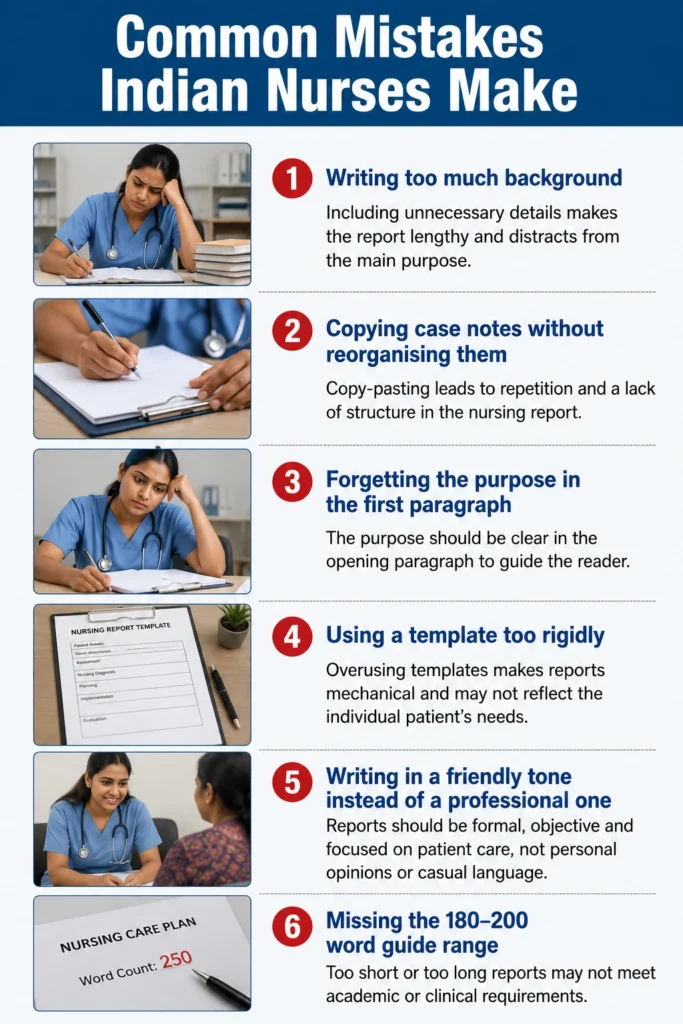
Common Mistakes Indian Nurses Make
1. Writing too much background The instinct to be thorough to include everything from the case notes “to be safe” works against Content and Conciseness. More information is not the same as more useful information.
2. Copying case notes without reorganising them Case notes are often presented in a loose, chronological, or fragmented format. Transferring that structure directly into your letter produces a letter that’s hard to scan which affects Organisation and Layout, even if the content itself is accurate.
3. Forgetting the purpose in the first paragraph If the reader has to read your whole letter to understand why it was written, Purpose suffers regardless of how well-written the rest of the letter is.
4. Using a template too rigidly Since OET doesn’t require a fixed template, forcing every letter into the same rigid structure regardless of whether that structure fits the specific scenario can create awkward letters where information is placed where the template says it should go, not where it makes sense for this particular referral.
5. Writing in a friendly tone instead of a professional one Phrases that would be natural in spoken handover “just wanted to let you know,” “I thought I’d mention” read as too informal in a written referral. Genre and Style expects professional register throughout.
6. Missing the 180–200 word guide range Letters that are significantly shorter often haven’t included enough relevant content. Letters that are significantly longer often haven’t selected from the case notes both point back to the selection step covered earlier.
If Writing consistently feels like your weakest sub-test, our post on 3 OET writing errors costing Band B goes deeper into specific error patterns we see across professions, and OET writing correction tips for beginners is a good starting point if you’re building these habits from scratch.
Teacher Trainer Checklist for a High-Scoring Letter
This is the sequence I teach every nurse to work through in the 5 minutes of reading time and the early minutes of writing, before they put pen to paper on the full letter.
1. Read the case notes for purpose first. Before anything else: why is this letter being written? What’s the core reason for the referral or transfer?
2. Identify the recipient and their knowledge level. Who is this letter going to, and do they already know this patient? This determines how much context you need to provide.
3. Group related notes together. Go through the case notes and mentally (or with quick marks) group information into categories relevant history, current presentation, medications, the referral request itself.
4. Remove irrelevant details. Anything that doesn’t serve the purpose or the reader’s role cut it, even if it was prominent in the case notes.
5. Draft with clinical wording. Use precise, professional clinical language specific rather than vague, professional rather than conversational.
6. Check tone and accuracy. Re-read for Genre and Style does this sound like a letter one healthcare professional would send another? And check that clinical details (dates, dosages, measurements) are accurate to the case notes.
7. Proofread for grammar and clarity. Only at this final stage focus purely on Language grammar, spelling, punctuation. This is intentionally last, because the structural and content decisions matter more and should be settled before fine-tuning language.
Mini Scoring Checklist
Before you finish, run through these six questions one for each scoring criterion:
- Purpose: Is the reason for writing obvious in the first lines?
- Content: Did I include only relevant information from the case notes?
- Conciseness & Clarity: Is everything expressed efficiently, without unnecessary repetition?
- Genre & Style: Is the tone formal and professional throughout?
- Organisation & Layout: Is information grouped logically so the reader can scan it?
- Language: Have I proofread for grammar, spelling, and punctuation?
If you can answer “yes” to all six, you’ve addressed the full scoring criteria not just the language quality.
A Note on Target Scores by Destination
OET Writing requirements differ depending on which regulator you’re registering with. For nurses applying to the UK via the NMC, the Writing requirement is Grade C+ (300+) notably lower than the other three sub-tests, which require Grade B (350+). We’ve covered this in detail in OET for Indian nurses going to the UK.
For nurses applying to Australia via AHPRA, the 2026 Writing requirement is 350, the same as Listening see our guide on OET nursing Australia AHPRA requirements for the full 2026 numeric breakdown across all four sub-tests.
The skills covered in this post purpose, content selection, structure, tone apply regardless of which numeric target you’re aiming for. But knowing your target score helps you gauge how much margin you need: C+ for NMC gives more room than 350 for AHPRA.
Key Takeaways
- OET Writing is scored on six criteria: Purpose, Content, Conciseness & Clarity, Genre & Style, Organisation & Layout, and Language Language is only one of six.
- The referral letter is a clinical communication task, not an essay your job is to select what the reader needs, not transcribe the case notes.
- The test is 45 minutes: 5 minutes reading, 40 minutes writing, with a 180–200 word guide.
- OET does not require a fixed template flexible structure that fits the scenario scores better than a rigid one applied mechanically.
- Whether the reader already knows the patient changes how much context you need to provide.
- Most marks are lost on Purpose, Content, and Conciseness not on grammar.
- Work through case notes in this order: identify purpose → identify recipient’s knowledge level → group related information → remove irrelevant detail → draft → check tone → proofread last.

Frequently Asked Questions
1. What is the OET referral letter?
It’s the Writing sub-test task for most healthcare professions, including nursing. Based on case notes provided in the test, candidates write a professional letter typically a referral, discharge, or transfer letter to another healthcare professional, summarising relevant information and the purpose of the communication.
2. How long is OET Writing?
45 minutes total: 5 minutes to read the case notes, and 40 minutes to write the letter.
3. How many words should I write?
OET’s official guide is 180–200 words. This is a guide rather than a strict limit, but letters significantly outside this range often indicate either too much irrelevant content (too long) or insufficient relevant content (too short).
4. Does OET require a template?
No. OET does not require a fixed template or structure. What matters is that the letter functions as a real professional letter would with clear purpose, relevant content, logical organisation, and appropriate tone not that it follows a specific memorised format.
5. What is the most important thing in OET Writing?
There isn’t a single most important criterion all six (Purpose, Content, Conciseness & Clarity, Genre & Style, Organisation & Layout, Language) contribute to the score. However, Purpose is often the first thing to get right, because if the reader can’t quickly identify why the letter was written, everything that follows is harder to evaluate favourably.
6. How do nurses know which case notes to include?
The case notes will indicate the recipient and the purpose of the letter, and often whether the recipient already knows the patient. From there, information should be sorted into what’s directly relevant to the purpose and recipient’s role, what’s useful background if space allows, and what isn’t relevant to this specific letter at all.
7. Can I use the same letter structure for every OET Writing task?
You can use a flexible approach for example, generally moving from purpose to relevant clinical information to the specific request but applying a single rigid template regardless of the scenario can lead to information being placed awkwardly or irrelevant sections being included just to “fill” the template.
Conclusion
OET Writing rewards nurses who think like communicators, not essay writers. The case notes give you more information than your letter needs your task is to identify what the reader actually requires, structure it clearly, and present it in a professional tone, with accurate language throughout.
If you’ve been preparing primarily by practising “good English” sentences, the shift that will move your score is practising selection and structure working through case notes the way the checklist above describes, before you write a single sentence of the letter itself.
Need guided practice for OET referral letters? Our OET classes in Chennai include dedicated Writing correction with feedback tied directly to these six scoring criteria so you know exactly which of the six is costing you marks, and how to fix it.