


If you’re an Indian nurse aiming for AHPRA registration in Australia, the score you’re preparing for may have just changed and a lot of guides online still have it wrong.
For OET tests taken on or after 23 April 2026, AHPRA and the Nursing and Midwifery Board of Australia (NMBA) require:
| Sub-test | Required Score (out of 500) |
| Listening | 350 |
| Reading | 360 |
| Writing | 350 |
| Speaking | 360 |
Notice that two sub-tests Reading and Speaking now need 360, not 350. If you’ve seen older content (or even older versions of this exact post) saying “Grade B everywhere is enough,” that’s no longer precise enough. AHPRA has moved from the old letter-grade flexibility to specific numeric targets, and Reading and Speaking are now the sections where the margin for error is smallest.
This guide covers exactly what’s required in 2026, how score combining works under the new rules, why OET suits Indian nurses, the mistakes that most often delay registration, and how our OET classes in Chennai are structured around these exact numbers.
Why Indian Nurses Choose Australia
Australia remains the top destination for nurses from Tamil Nadu and South India and for good reason. Registered Nurses in Australia have strong demand across aged care, hospitals, and community health, with clear pathways to permanent residency for those who complete registration successfully.
But the starting point for every pathway is the same: AHPRA’s English Language Skills registration standard. Whether you trained in Chennai, Madurai, or Coimbatore, and regardless of how many years you studied in English-medium institutions, this requirement applies to you. There are currently no exemptions based on prior English-medium education for nurses from India.
What AHPRA and NMBA Mean for Nurses
AHPRA (the Australian Health Practitioner Regulation Agency) and NMBA (the Nursing and Midwifery Board of Australia) work together to regulate nursing registration across Australia. The English Language Skills registration standard (2025), which came into effect on 18 March 2025, applies to all nurses and midwives seeking initial registration whether they trained in Australia or overseas.
This matters because it frames OET not as “just another English exam” but as a registration requirement with the same weight as your nursing qualification verification. You cannot proceed to the next stages of AHPRA assessment without meeting this standard.
AHPRA accepts several English tests for nursing registration, including OET, IELTS Academic, PTE Academic, TOEFL iBT, and Cambridge C1. For Indian nurses specifically, OET and IELTS Academic remain the two most commonly chosen.
Important note on recognised countries: under the current ELS standard, India is not on AHPRA’s list of recognised English-speaking countries which means Indian nurses must demonstrate English proficiency through one of the accepted tests. There is no alternative pathway based on country of origin or prior education alone.
OET Score Requirement for Australia in 2026
This is the section to bookmark.
For OET tests taken on or after 23 April 2026:
| Sub-test | Required Score |
| Listening | 350 |
| Reading | 360 |
| Writing | 350 |
| Speaking | 360 |
AHPRA has stated that these updated scores were aligned with current score-concordance research and Department of Home Affairs migration settings meaning the OET requirement now sits more precisely in line with how PTE, IELTS, and TOEFL scores are calibrated for the same proficiency level.
If your test was taken before 23 April 2026, it will be assessed under the previous requirements. If you’re planning your test date now, assume the new numbers apply and if you’ve already tested under the old rules and are within your validity window, check with AHPRA directly on which scoring applies to your specific application timeline.
The practical shift: Reading and Speaking moving from 350 to 360 changes where your preparation effort should go. Under the old “Grade B = 350” framing, a candidate could treat all four sub-tests as equally demanding. Now, Reading and Speaking carry a higher bar and they’re also two of the sub-tests where Indian candidates most commonly lose marks to timing pressure (Reading) and rehearsed-sounding responses (Speaking).

Can You Combine OET Scores for AHPRA?
Yes and this section is where many nurses save themselves a full retake.
AHPRA allows up to two OET sittings within a 12-month period, but with conditions:
- Each sitting must test all four components. You cannot retake a single sub-test in isolation.
- The applicant must meet the component minimums across the combined sittings.
- For tests on or after 23 April 2026, the combined-sitting minimums are:
| Sub-test | Overall Requirement | Minimum in Any Single Sitting |
| Listening | 350 | 320 |
| Reading | 360 | 340 |
| Writing | 350 | 350 |
| Speaking | 360 | 350 |
What this means in practice: if your first sitting gives you Listening 360, Writing 355, Speaking 360, but Reading only 345 that Reading score is above the 340 single-sitting minimum, so it’s combinable. If your second sitting then gives you Reading 360 or higher, your combined results meet the requirement across both sittings.
The sub-test to watch most carefully is Writing. Its single-sitting minimum for combining (350) is the same as its overall requirement (350) there’s no flexibility below that line. If you score under 350 in Writing in either sitting, that sitting cannot contribute toward meeting the Writing requirement through combining.
One detail that catches people out during the 2026 transition: if your first test was taken before 23 April 2026 and your second is on or after that date, each sitting is assessed against the rules that applied when it was taken not retroactively. If you’re mid-way through a two-sitting combination that spans this date, it’s worth getting clarity on how your specific scores will be assessed.
Also remember: scores from different test providers cannot be combined. If your first sitting was OET, your second sitting for combining purposes must also be OET you cannot mix an OET sitting with an IELTS sitting and combine them.
OET vs IELTS for Nurses
AHPRA accepts both OET and IELTS Academic (overall 7.0, with 7.0 in Listening/Reading/Speaking and 6.5 in Writing) for nursing registration. Both are valid, recognised pathways. But for working nurses, OET has a practical advantage that goes beyond which number you need to hit.
OET is built entirely around healthcare scenarios. The Listening section uses ward handovers, patient consultations, and healthcare lectures. The Reading section uses clinical extracts, care plans, and medical reference material. The Speaking test is a role-play between a nurse and a patient or relative the exact kind of conversation you have on shift. The Writing task is a referral letter, a real clinical document.
IELTS Academic, by contrast, tests general and academic English essays on broad topics, lectures unrelated to healthcare, and academic reading passages with no clinical relevance.
For a nurse already working in clinical English every day, OET preparation tends to feel like professional practice rather than exam cramming. The vocabulary and scenarios are ones you already use. This is one reason OET remains the most popular choice among Indian nurses applying to Australia, alongside the fact that it’s specifically accepted for nursing registration by AHPRA.
If you’re also exploring the UK pathway via the NMC, note that the score requirements differ NMC’s OET requirement (Grade B / 350+ in Listening, Reading, Speaking, and C+ / 300+ in Writing) is not the same as AHPRA’s 2026 numbers above. Don’t assume one certificate automatically satisfies both regulators’ thresholds; check each separately.
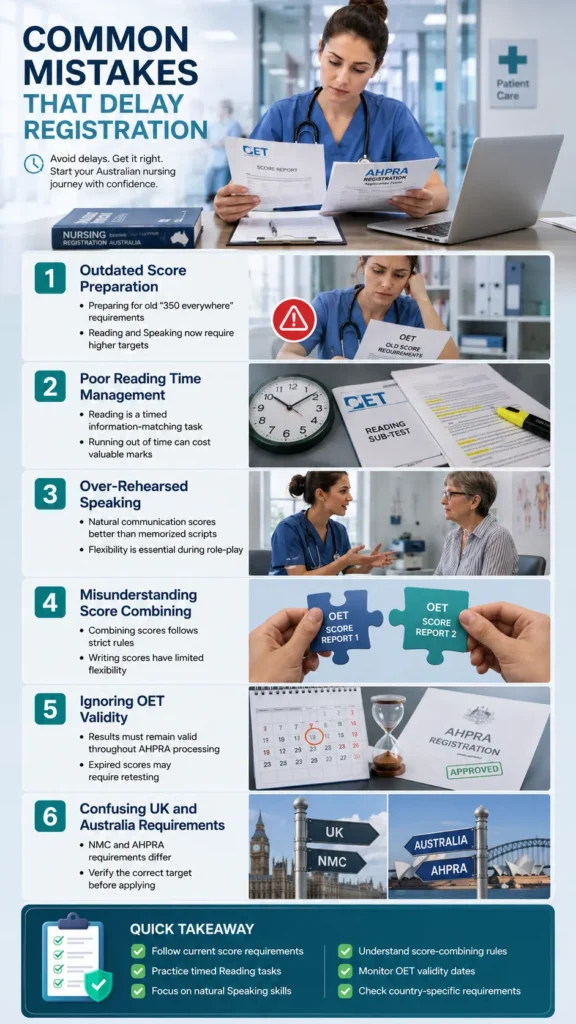
Common Mistakes That Delay Registration
1. Preparing for the old “350 everywhere” target If your preparation materials, mock tests, or coaching are still calibrated to the pre-April 2026 requirement, you may walk into the test under-prepared for Reading and Speaking specifically the two sub-tests where the bar rose to 360.
2. Treating Reading like a comprehension exercise rather than a timed exercise OET Reading Part A is tightly timed information-matching. Many capable nurses lose marks not because they don’t understand the texts, but because they run out of time scanning them. With the requirement now at 360 for Reading, there’s less room for time-management losses than there used to be.
3. Over-rehearsed Speaking responses OET Speaking assesses how you respond to what the patient/interlocutor actually says not how well you deliver a memorised script. With Speaking now at 360, responses that sound rehearsed (and therefore inflexible when the conversation goes slightly off-script) are a bigger risk than before.
4. Assuming combining is automatic Combining is allowed, but only within specific minimums per sub-test and Writing in particular has no flexibility below 350 in either sitting. Nurses sometimes assume “I’ll just retake the weak section next time” without checking whether their other scores still qualify for combining under the single-sitting minimums.
5. Not accounting for validity during AHPRA’s processing time AHPRA is strict about the two-year validity rule for nurses your OET results must remain valid not just when you apply, but throughout AHPRA’s review of your file. If your results expire while your application is still being processed, you may be asked to retest.
6. Mixing up UK (NMC) and Australia (AHPRA) requirements As noted above, these are different numeric targets from different regulators. A score that satisfies NMC for the UK does not automatically satisfy AHPRA’s 2026 thresholds for Australia, and vice versa. If you’re keeping both options open, prepare against the higher of the two targets for each sub-test.
How InSync Prepares Indian Nurses for OET Australia
Our approach is built around the 2026 AHPRA numbers specifically not generic OET prep.
Step 1 Diagnostic test. Before anything else, we run a full diagnostic OET mock to identify your current score against each of the four 2026 targets (350/360/350/360). This tells us exactly which sub-tests need the most work and for most nurses, it’s Reading and Speaking that need the focused attention now.
Step 2 Weak-skill targeting. Rather than spreading preparation evenly across four skills, we prioritise based on the gap between your diagnostic score and the AHPRA target for each sub-test. If you’re already comfortably above 360 in Listening but at 340 in Reading, your study plan reflects that imbalance.
Step 3 OET Writing correction. Referral letter writing is assessed against specific criteria content selection, structure, tone, and genre. We provide detailed, sub-test-specific feedback on practice letters so you understand exactly what’s costing marks, with a focus on consistently hitting 350+.
Step 4 Speaking role-play practice. Live role-play practice with feedback focused on the criteria OET Speaking actually scores: intelligibility, fluency, appropriateness, and resilience when the conversation doesn’t go as expected. Given the new 360 target, we put extra emphasis on flexibility responding naturally rather than reciting prepared answers.
Step 5 Timed mock tests. Full-length mocks under real test conditions, particularly for Reading, where time management is often the difference between 340 and 360.
Step 6 Score tracking. We track your progress against each of the four 2026 targets individually not as a vague “overall improvement” so you and your trainer both know exactly where you stand before you book your real test date.
This is a preparation framework, not a guarantee OET is a genuine test of English proficiency, and your result depends on your own performance on the day. But structured, target-specific preparation is what turns “I think I’m ready” into “I know which number I’m aiming for and I’ve hit it consistently in mocks.”
If you’re based in Chennai or nearby, our OET classes in Chennai run this exact process diagnostic, targeted modules, writing correction, speaking practice, and mock tracking, all calibrated to the current AHPRA 2026 thresholds.
For nurses also considering the UK pathway, we’ve covered the NMC-specific requirements separately in our guide on OET for Indian nurses going to the UK the score targets differ, so it’s worth reading both if you’re keeping multiple countries open. And if Writing is your current weak point regardless of destination, our post on3 OET writing errors costing Band B covers the most common patterns we see.
Key Takeaways
- For OET tests on or after 23 April 2026, AHPRA/NMBA require Listening 350, Reading 360, Writing 350, Speaking 360.
- Reading and Speaking have increased from 350 to 360 this is the biggest practical change for 2026.
- This standard applies to all initial nursing registration applicants, regardless of where they trained.
- Score combining across two sittings within 12 months is allowed, but with single-sitting minimums of L320/R340/W350/S350 Writing has zero flexibility below 350.
- Scores from different test providers cannot be combined both sittings must be OET (or both IELTS, etc.).
- Tests taken before 23 April 2026 are assessed under the previous requirements.
- AHPRA’s two-year validity rule means your scores must remain valid throughout the application review period, not just at submission.
- NMC (UK) and AHPRA (Australia) requirements are different numeric targets don’t assume one satisfies both.
Frequently Asked Questions
1. What OET score do I need for AHPRA in 2026?
For tests taken on or after 23 April 2026, you need Listening 350, Reading 360, Writing 350, and Speaking 360 each scored out of 500. This applies to all nurses and midwives seeking initial AHPRA registration.
2. Has the OET score requirement for Australia changed?
Yes. Effective 23 April 2026, AHPRA and NMBA updated the requirement. Reading and Speaking increased from 350 to 360, while Listening and Writing remain at 350. Tests taken before this date are assessed under the previous requirements.
3. Can I combine OET scores across two tests for AHPRA?
Yes, up to two sittings within 12 months, provided each sitting tests all four components. For tests from 23 April 2026, the combined minimums are L350/R360/W350/S360 overall, with no single sitting below L320/R340/W350/S350. Writing has no flexibility below 350 in either sitting.
4. Can I combine an OET score with an IELTS score?
No. AHPRA does not allow combining scores from different test providers. If you’re using the combining pathway, both sittings must be from the same test.
5. Does my OET score for AHPRA also work for NMC (UK)?
No the requirements differ. NMC requires Grade B (350+) in Listening, Reading, and Speaking and C+ (300+) in Writing. AHPRA’s 2026 requirement is L350/R360/W350/S360. If you’re considering both countries, check both sets of numbers and prepare for the higher target in each sub-test.
6. How long is my OET score valid for AHPRA registration?
AHPRA applies a two-year validity rule, and for nurses specifically, your results must remain valid throughout AHPRA’s processing of your application not just at the point of submission. If results expire while your application is under review, you may need to retest.
7. Is OET better than IELTS for nursing registration in Australia?
Both are accepted by AHPRA. OET’s advantage is that its content Listening, Reading, Writing, and Speaking tasks is built around healthcare scenarios, which many nurses find more directly relevant to their daily clinical English than IELTS Academic’s general and academic content.
8. What happens if my test was taken before 23 April 2026?
It will be assessed under the requirements that applied at the time it was taken. If you’re combining two sittings that span this date, each sitting is assessed under the rules in effect when that specific sitting occurred.
Conclusion
The headline for 2026 is simple: AHPRA now requires Listening 350, Reading 360, Writing 350, and Speaking 360 for OET and the increase in Reading and Speaking from 350 to 360 is the change that matters most for your preparation.
This isn’t a reason to be discouraged. It’s a reason to prepare with precision knowing exactly which number you’re aiming for in each sub-test, rather than a general sense of “I need a good score.” OET’s healthcare-focused format already plays to the strengths of working nurses; the 2026 update just means Reading speed and Speaking flexibility deserve more deliberate attention than before.
If you’re preparing for AHPRA registration and want a study plan built around these exact 2026 numbers, our OET classes in Chennai start with a diagnostic test against all four targets and build your preparation from there.