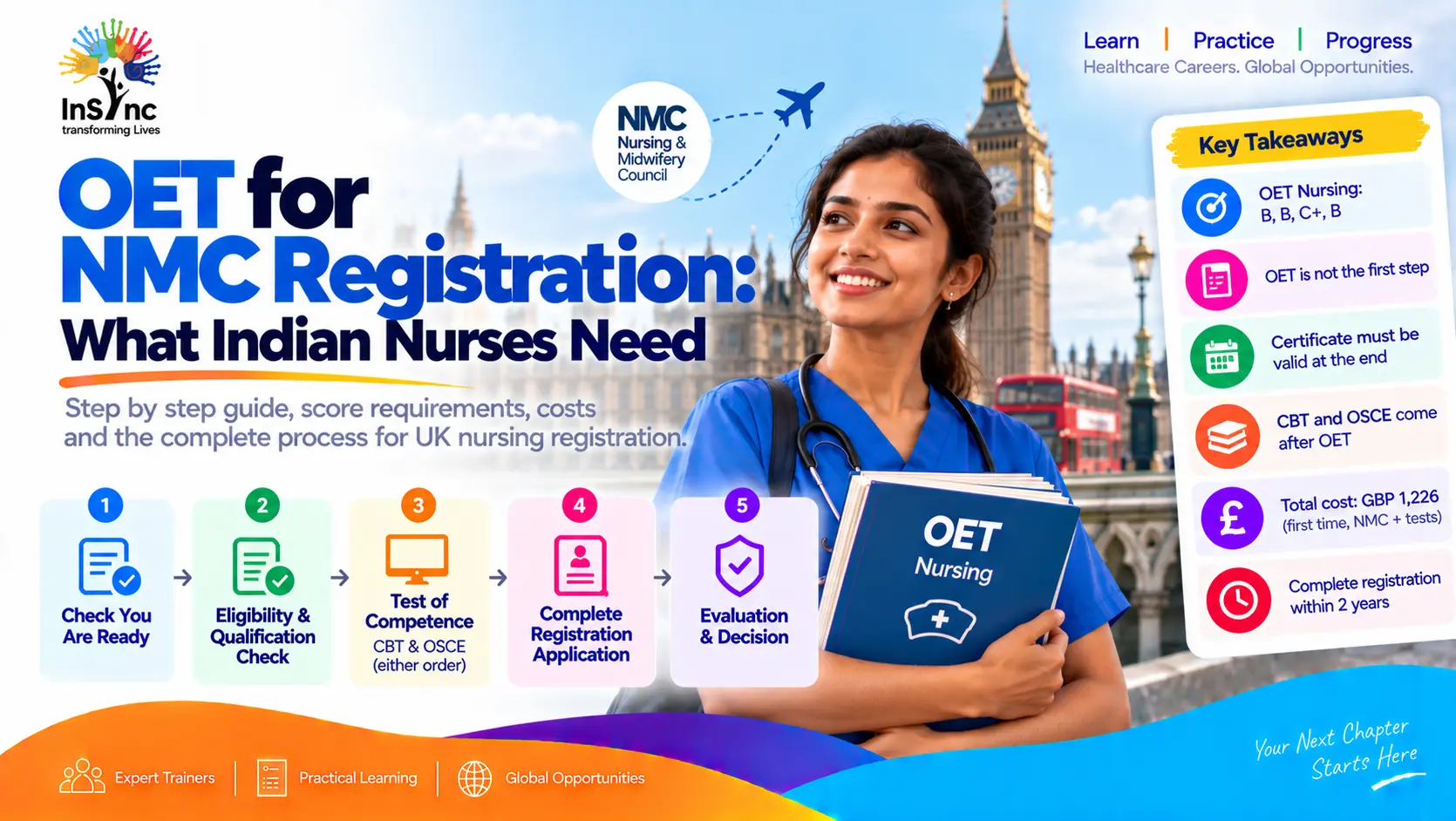
The NMC asks for OET Nursing at Grade B in listening, reading and speaking, and Grade C+ in writing. Three Bs and one C+. That is the whole score answer, and most pages on this subject stop there.
The part that costs nurses money is the order. OET is not step one. It is not a gate before either of the two exams that follow. And the certificate has to still be valid at the end of the process rather than the start, which is where a two-year clock quietly runs out.
What follows is the sequence the NMC publishes, the £1,226 it takes in NMC and test fees, and the pass rates it reports every quarter for the CBT and the OSCE. What OET is covers the test itself if that is still new to you.
The short version
| What score? | OET Nursing: B (350 or above) in listening, reading and speaking, C+ (300 or above) in writing. Paper, computer and OET@Home are all accepted. |
| Is OET first? | No. The NMC’s published order puts the eligibility and qualification check first. Language evidence sits alongside the Test of Competence, not before it. |
| When must it be valid? | When your application reaches the NMC’s assessment queue, which happens after both parts of the Test of Competence are passed. Not when you apply. |
| What comes after OET? | The CBT, a multiple-choice computer test, and the OSCE, a ten-station practical. Either order, both within two years of each other. |
| Total cost? | GBP 1,226 in NMC and test fees if you pass everything first time. Resits are extra, and the OSCE resit alone is GBP 397 or GBP 794. |
| How long? | Two years to complete registration once eligibility is confirmed. An application that has not progressed within three months of being opened is closed. |
The NMC accepts two tests and scores OET Nursing at B, B, C+, B
Two tests, and the NMC closes the list in writing: “These are the only tests we can accept as proof of English language competence.” They are IELTS Academic and OET.
| Test | Listening | Reading | Writing | Speaking |
|---|---|---|---|---|
| IELTS Academic | 7 | 7 | 6.5 | 7 |
| OET | B, 350+ | B, 350+ | C+, 300+ | B, 350+ |
Both rows are the NMC’s own table on its accepted English language tests page, last updated 08/03/2024. The mode and version instructions quoted below sit on its OET sub-page. The writing concession has applied since 28 January 2020, so a nurse reading that it is new is reading something six years old.
Two instructions on its OET sub-page are easy to miss. Book the Nursing version: “All applicants should choose the Nursing examination from the list of OET Professions versions.” Three delivery modes count: OET on Paper, OET on Computer at a venue, and OET@Home.
One rule decides whether a near miss is recoverable: “If you are retaking an IELTS or OET, we can only accept tests where you have retaken all modules.” So there is no single sub-test re-sit.
Language evidence is not step one, and the NMC’s own sequence shows where it sits
The process is published as four stages, and stage three holds two blocks joined by the word “and”. The language evidence sits in the second of them, so the five steps below split that stage in two.
• 1. Check you are ready. Read the cost and timing pages and assemble your evidence before you open an account. Any application that has not progressed within three months of being opened is closed, and the online account goes with it.
• 2. Eligibility and qualification application. This is what the NMC calls the first part of registration and checks you can register by this route. You pay the GBP 167 evaluation fee here, and it is non-refundable whatever the outcome. The NMC aims to assess a qualification within 14 days of having everything it needs.
• 3. Take the Test of Competence. Only after eligibility is confirmed. The CBT and the OSCE, in either order, both within two years of each other.
• 4. Complete the registration application, in parallel. Health evidence, character evidence, language evidence, a professional indemnity arrangement and the GBP 182 registration fee.
• 5. Evaluation and decision. Referees are contacted to verify your information, and the NMC aims to consider a complete application within 30 days. It must decide within three months, and a failure to do so carries a right of appeal, lodged within 28 days.
Stage order and quoted wording come from the NMC’s step-by-step guide for applicants trained outside the UK, last updated 16/09/2026. Timings come from its how long is it going to take page.
So the English test gates nothing. You can sit the CBT without it. You can sit the OSCE without it. Doing it early is recommended, not required. The wording sits on the NMC’s English language requirements hub: “We highly recommend you make sure you can meet our language evidence requirements before you apply to us.”
Taking that advice without reading the next section is how nurses lose a certificate they already paid for.
Your OET certificate has to be alive at the assessment queue, not at the application
This is the single most expensive sentence on the NMC website, and it sits in a collapsed FAQ on a step page rather than on the requirements hub:
“Your test result needs to be valid when your application joins our assessment queue after you have successfully completed both parts of test of competence, submitted your registration application/ fee and we have received all documents including third party verifications.”
Quoted from the NMC’s provide language evidence step page. The same page adds that where two tests are combined, “both tests need to be within the 2 year validity period when it reaches our assessment queue”.
Read it against the registration window and two clocks appear, both two years long, both starting at different moments.
| Clock | Starts | Runs out against |
|---|---|---|
| OET validity | The day you sit the test | The day your completed application reaches the assessment queue |
| Registration window | The day the NMC confirms your eligibility | Everything still outstanding, including the CBT and the OSCE |
The NMC’s wording on the second clock: “Once we’ve confirmed your eligibility to apply for registration, you’ll have two years to complete your registration. This includes taking your CBT and OSCE if we ask you to take a Test of Competence.”
Sit OET in January, get eligibility confirmed in August, then spend a year reaching and passing the OSCE, and the certificate can expire before the queue ever sees it. The fix is unglamorous. Sit OET close to the point where your qualification evidence is already moving, and check the published test dates before you assume a slot exists when you want one. Treat a slow CBT or OSCE stage as a reason to check your certificate date, not a reason to wait.
NMC registration costs GBP 1,226 before a single resit
Both the total and the breakdown are published. Neither includes OET, your visa, or anything an agency charges.
| Fee | Amount | What it buys, and whether you get it back |
|---|---|---|
| Qualification evaluation | £167 | Paid when you submit the eligibility and qualification application. Non-refundable even if you are found ineligible. |
| CBT, both parts | £83 | Paid to the test provider. A resit of both parts is £83 again, Part A alone £50, Part B alone £70. |
| OSCE | £794 | Paid to the test provider. A resit is £397 if you failed seven or fewer stations, £794 if you failed eight or more. |
| Registration | £182 | Paid when you submit the registration application. Refundable in stated circumstances, including an unsuccessful application. |
| Total, first time | £1,226 | The NMC’s own figure. Add the annual fee of £143 once you are on the register. |
From the NMC’s costs page, which states “The total cost of fees and tests is £1,226”. Its own international-applicants page still prints £1,170 in its EU specialist nurse section, the sum of the pre-October-2026 fees. Its step hub still shows the evaluation fee at £140. The itemised figures above are the current ones and they add to £1,226.
The annual fee rose from £120 to £143 on 1 October 2026, the first increase in eleven years. The NMC noted that inflation since 2015 would have taken it to about £168.
Two numbers in that table deserve a second look before you book anything. The evaluation fee is gone whatever happens. And a failed OSCE can cost as much again as the test itself did, which is why the pass rates below matter more than any score table. OET’s own fee is separate again, and what OET costs keeps that conversion current.
The CBT is two papers in one sitting, and the clinical paper is getting harder to pass
Part A is numeracy, 15 questions in 30 minutes. Part B is clinical, 100 questions in two and a half hours. You sit them together and they pass or fail independently, so a resit covers only the part you lost.
| CBT in Q1 2026 | First attempt | Second attempt | Third attempt |
|---|---|---|---|
| Part A, numeracy | 76% | 80% | 76% |
| Part B, clinical | 77% | 63% | 59% |
Read from the per-attempt quarter totals in the NMC’s Test of Competence pass rates for 2026, last updated 12/06/2026. Across the quarter 2,967 CBTs were delivered, resits included, and 63 per cent passed both parts.
Numeracy behaves the way a test should: miss it, revise, pass it. The clinical paper does the opposite, falling from 77 per cent on a first attempt to 59 per cent on a third. Our reading is that it is a comprehension problem as much as a nursing one. The reading and listening papers are worth time even before the CBT. No feedback is given on CBT results, “to protect the integrity of the test”, so a candidate resitting Part B is revising blind.
• Attempts. Three per application, at least 10 days apart, all within one year. After a year you resit both modules. After three failures the application closes and you wait six months.
• Results. In your Pearson account within 48 hours.
• Free practice. CBT practice tests on the Pearson site, which the NMC says “are accessible to all and do not need to be booked”.
The OSCE has ten stations, three test centres, and a first-attempt pass rate near 42 per cent
The practical exam used to have six stations. It has ten now. Four are linked around one clinical scenario, as assessment, planning, implementation and evaluation. Four more are skills stations in two pairs, and two cover values, behaviours and evidence-based practice.
It is reported two ways, and the two numbers are not the same kind of number.
| Q1 2026, OSCE | What the NMC reports | Unit |
|---|---|---|
| Candidates who sat | 3,009, and 78 per cent achieved a pass | People, on our reading, across however many attempts each took |
| Sittings delivered | 4,099, weighting to about 57 per cent | Individual attempts, resits included |
| First attempts only | About 42 per cent passed | Our weighting of the four centres with disclosed counts |
The candidate figure and the per-centre sitting tables both come from the same quarterly release cited above. The two do not reconcile as written, because 3,009 candidates produced 4,099 sittings, which is 1.36 attempts each. The 42 per cent is ours, weighted from the first-attempt columns of the four centres with disclosed counts; Northumbria’s is published as fewer than ten and cannot be weighted.
Our reading of the two together is that most nurses who pass the OSCE do not pass it first time. That is not a scandal. The NMC names what it thinks matters most: “two of the most important factors are test preparation and having access to good quality support”. It adds that applicants from social care and the independent sector tend to do worse than those backed by an NHS trust.
Where you sit it also moves the odds, by more than most candidates expect.
| Test centre, Q1 2026 | 1st attempts | 1st attempt pass | 2nd attempt pass |
|---|---|---|---|
| University of Northampton | 1,545 | 41% | 78% |
| Ulster University | 271 | 49% | 84% |
| Leeds Teaching Hospitals NHS Trust | 410 | 44% | 76% |
| Oxford Brookes University, now closed | 141 | 26% | 84% |
Same quarterly release as the table above, with the centre list from the NMC’s OSCE page, updated 02/10/2026. Northumbria closed inside that quarter, on 19 February 2026, and Oxford Brookes on 31 July 2026. That page now lists “three approved OSCE test providers”: Northampton, Ulster and Leeds. Northumbria sat fewer than ten first attempts that quarter, so it is left out above.
• Attempts. Three per application, 10 days apart, and every resit at the centre of your first attempt, so the choice is close to locked in at booking. One published exception applies right now. Candidates whose first attempt was at Oxford Brookes or Northumbria may request a transfer to another approved centre, which then becomes their centre for later resits.
• Resits. You resit only the stations you failed. Your test centre emails the result within five working days. A fail email names the stations and elements you did not pass, and the NMC states plainly that it cannot supply that feedback itself.
• Validity. Pass the CBT and OSCE within two years of each other and the Test of Competence then stands for five years. Your OET certificate does not get that grace, which is what the booking calendar is worth checking against.
• Free material. Mock OSCEs by field, marking criteria, station timings, equipment lists and reading lists, all published openly on the NMC’s Test of Competence resources page. The adult scenarios are named in advance, from pneumonia to ectopic pregnancy, though the NMC says new stations are designed to “actively discourage rote learning”.
Combining two OET sittings works, and the floor is what catches people
Known in India as clubbing, and the NMC allows it. Five conditions, and a sixth that does the damage.
1. Both sittings within 12 months of each other, by test date.
2. Both under two years old when the application is assessed.
3. All four sub-tests at each sitting, because individual domains cannot be retaken separately.
4. Two tests of the same type. An OET result cannot pair with an IELTS result.
5. Each domain must hit its pass score at least once across the two sittings. B in listening, reading and speaking, C+ in writing, and the passes can come from different sittings.
6. And every score in both sittings must clear C+ in listening, reading and speaking, and C in writing.
The windows and the same-type rule are on the NMC’s accepted-tests page; the floor and two worked examples are on its OET scores and combining page. Its accepted example pairs a C+ listening with a B listening, and a B writing with a C writing. Neither sitting is a clean pass on its own, and the NMC accepts the pair anyway. The equivalent IELTS floor is 6.5 in listening, reading and speaking and 6 in writing.
Step six is the one that refuses applications. A listening score below C+ in either sitting voids the pair, however strong the other sitting is. So when you re-sit, protect the papers you have already cleared instead of writing them off. How OET booking works matters here, because the 12-month rule runs on test dates.
A near miss is not always fatal, though the recovery route is narrow. Exhaust the combining options first. Then, if you have sat twice and missed one domain by no more than half a grade, the NMC may accept employer information. It calls this SIFE and treats it as supplementary only. The conditions are the catch. You must be in a non-registered UK health or care role, and have been for at least 12 months. The same NMC-registrant line manager must have supervised you for at least six. It reaches nurses already in the UK, not applicants in India.
From the SIFE sections of the NMC language evidence page and its narrowly missing the required scores page. Both set out the line-manager seniority rules, and both state that SIFE “is not a standalone evidence”.
Two NMC evidence routes replace the test, and neither usually fits a nurse in India
A test is one of three evidence types, so check the other two before paying for anything. Both are worded narrowly.
• Qualified in English. Your pre-registration programme must have been “taught and examined in English”. An NMC-approved programme counts outright; otherwise the transcript has to prove how much of your time was spent with patients and in which language. India is not on the NMC’s majority-English list, so a transcript alone may not carry it. An applicant already working in a UK health or care role can add employer information on top, which the NMC treats as supplementary only.
• Recent practice in English. One year of registered practice in a majority-English country, with an English assessment completed as part of that registration. That practice has to fall inside the two years before the NMC considers your completed application. The same clock governs this route too.
The routes have their own pages, qualified in English and recent practice in English, and the language evidence page refuses NARIC and ECCTIS certificates and the IELTS Indicator. The full set of English test options for UK nursing weighs each route against a nurse’s own paperwork. OET compared with IELTS Academic covers the choice between the two accepted tests.
For almost every nurse applying from India the answer is the test. Check what your transcript actually itemises first. Clinical interaction hours and language of instruction are the two lines that could save you the fee.
India-trained joiners fell 54.4 per cent in a year while India-trained registrants reached 73,026
Two numbers from the same NMC report point in opposite directions, and both matter for anyone deciding when to start.
| India on the NMC register | Figure | Change |
|---|---|---|
| On the register, 31 March 2026 | 73,026 | Up from 25,054 in September 2020 |
| New joiners, 2025-26 | 4,215 | Down 54.4% from 9,249 |
| All internationally educated joiners | 10,961 | Down 47% from 20,669 |
| Rank by country of training | 3rd overall | Behind England and Scotland, ahead of the Philippines |
From the NMC’s register report for 1 April 2025 to 31 March 2026 and its published registration data tables. Its wording: “India remains the largest source of international joiners, with 4,215 joiners in 2025-26 but this is a 54.4% fall compared to the previous year (9,249)”. Its percentage shares divide those full-year counts by the final half-year’s total joiners of 21,248. So the printed 19.8 per cent should read about 10 per cent of all joiners, or 38 per cent of international ones. Only the counts are used here.
India has been the largest non-UK country of training since the half-year to March 2023, and the Philippines now sits at 50,527. The stock kept growing. The inflow did not: India-trained joiners peaked at 7,392 in a single half-year and the latest half-year recorded 1,748.
The Test of Competence data says the same thing from the other end. CBT volume fell from 5,261 tests delivered in the first quarter of 2025 to 2,967 in the first quarter of 2026. That is a 43.6 per cent drop, and over the same five quarters the share passing both parts fell from 76 to 63 per cent. Fewer nurses are coming through, and a smaller share of them is clearing the first exam.
None of that tells you whether to apply. It does say the route is not a queue that will wait. Our reading is that it also explains why fewer employers now carry a candidate through the process. Placement support after registration sets out where that leaves the recruitment side.
Two claims circulating about NMC OET that the NMC’s own pages do not support
Both appeared in the search results or the community discussion for this topic in the last few months. One is wrong against a published NMC page. The other is right on the facts and six years late.
| The claim | Where it appears | What the NMC publishes |
|---|---|---|
| Your CBT pass is valid for two years from the pass date, so do not let it expire before the OSCE. | A recruitment site, 23 May 2026 | No standalone CBT validity exists. The rule is that the CBT and OSCE must fall within two years of each other, and the pair then stands for five years. The document that really can expire underneath you is the English test. |
| The NMC has now confirmed it will accept C+ in writing. | A coaching page’s post that this search result surfaced, three weeks old | The concession is real and took effect on 28 January 2020. A six-year-old change is circulating as news. |
Both are cited by source type and date rather than linked. One sits on a platform that refuses our tooling, and we hold no verified permalink for the other. The effective date comes from OET’s own notice of the change, which records the NMC moving IELTS writing to 6.5 first.
A third claim is worth defending rather than correcting, because it reads like an error and is not. Several pages say combined scores are accepted when no sub-test falls more than half a grade below the requirement. That is the NMC’s own vocabulary. It publishes a table headed “Half a grade lower than required score (OET)”, giving 300 to 340 for speaking, listening and reading and 250 to 290 for writing. Those are exactly the combining floor figures. What those pages leave out is the 12-month window, the two-year rule, and the requirement that every domain pass in at least one of the two sittings.
One more runs the other way. The NMC did investigate alleged fraud in the OET process. Its statutory reviewer records how that ended. “The NMC concluded this investigation during this review period and found insufficient evidence to prove fraud had taken place, with no further action taken.” A memorandum of understanding with OET followed.
From the Professional Standards Authority’s performance review of the NMC for 2024/25, reproduced in the NMC Council papers of 21 July 2026. The same review records separate CBT fraud cases, with 19 people removed from the register and 18 appeals lodged. Those are CBT cases rather than OET ones, and nothing in the four 2026 Council bundles ties either to India.
Where preparation actually helps, and where it does not
Everything on this page splits into two kinds of problem. One is administrative: fees, dates, document order, which clock is running. You can solve that yourself with the NMC pages linked here, and you should.
The other is a language problem with a number attached. In OET’s 2025 figures, nursing candidates reached Grade B or above in reading 24.9 per cent of the time. That is the lowest of the twelve professions OET tests, against a requirement of B. That gap does not close by reading a requirements page.
• What the nursing track covers. Sixty hours of skill-by-skill teaching plus 48 live lessons with Specialist Language Courses, two full practice tests, one marked letter and one marked role play. The OET coaching page carries the current intake and both delivery modes.
• Why marked work matters here. Writing and speaking are scored against criteria a candidate cannot apply to their own work. The six writing criteria and the role plays nurses actually get are where that shows.
• What we will tell you for free. If your reading is near the profession mean, the honest answer is months, not weeks. A free trial class and a short call will establish which of the four papers is your real problem.
Nurses in the city can sit this face to face in Chennai, and everyone else online.
Anyone not yet committed to the UK should fix the regulator before the course. The Australian requirement now asks 350, 360, 350 and 360, which withdraws the C+ writing concession a UK applicant leans on. The Canadian route runs on its own rules again.
The order, as a checklist
Printable, and in the sequence that avoids paying twice. The writing paper is the one most nurses underestimate, so what OET writing asks for is worth reading before step three.
| Do this | Because | |
|---|---|---|
| 1 | Check whether either test-free evidence route fits you, and ask your institution what your transcript contains. | It is the only step that can remove the English test and its fee. The GBP 1,226 of NMC and exam fees stands either way. |
| 2 | Open the eligibility and qualification application and pay the GBP 167 evaluation fee. | Nothing else starts until the NMC confirms you can register by this route. The two-year registration window begins at that confirmation, not at submission. |
| 3 | Book OET once your qualification evidence is moving. | Validity runs from the test date to the assessment queue, which is after both exams. Sitting too early wastes the certificate. |
| 4 | Sit the CBT, and treat Part B as the one to prepare for. | Numeracy improves on a resit. The clinical paper does not, and the NMC gives no feedback. |
| 5 | Choose your OSCE centre carefully, then book it. | Every resit goes back to the centre of your first attempt unless you are transferring from one of the two that closed, and first-attempt rates ran from 41 to 49 per cent across the three you can still book. |
| 6 | Submit health, character, language evidence and the GBP 182 fee. | The application only joins the assessment queue once all of it, plus third-party verification, is in. |
| 7 | Check your OET certificate date before the file goes quiet. | This is the failure this page exists to prevent. |
Each row rests on a published NMC page cited above. Nothing here covers the visa, the employer or the move itself, which sit outside the NMC process entirely.
What nurses ask about NMC OET
What OET score does the NMC accept?
OET Nursing at grade B, a scaled score of 350 or above, in listening, reading and speaking, and grade C+, a scaled 300 or above, in writing. Only IELTS Academic and OET count as test evidence, and all three OET modes are accepted: OET on Paper, OET on Computer and OET@Home. The writing concession has applied since 28 January 2020.
Does the NMC accept C+ in writing?
Yes, and only in writing. The other three papers need a full grade B. This is not a new change. The NMC moved writing to C+ with effect from 28 January 2020, after it had already moved IELTS writing from 7 to 6.5. Any post announcing it as news is six years late.
How long is an OET result valid for the NMC?
Two years from the test date, but the date it has to be valid on is not the date you apply. The result must be valid when your application joins the NMC assessment queue. That happens only after both parts of the Test of Competence are passed, the registration application and fee are in, and all third-party verifications are received. Sitting OET very early in the process is how a valid certificate becomes an expired one.
Do I need OET before the CBT or the OSCE?
No. The NMC’s published sequence puts the eligibility and qualification application first, then the Test of Competence alongside the registration application, with language evidence inside that second block. Neither exam is gated on your English result. The NMC does recommend confirming you can meet the language requirement before you apply, which is advice rather than a rule.
How much does NMC registration cost from India?
GBP 1,226 in NMC and test fees if you pass everything first time: GBP 167 for the qualification evaluation, GBP 83 for the CBT, GBP 794 for the OSCE and GBP 182 to register. The evaluation fee is non-refundable whatever happens. An OSCE resit adds GBP 397 or GBP 794 depending on how many stations you failed. The annual fee after registration is GBP 143. OET’s own fee, your visa and any agency charges are all separate.
How much does the NMC CBT cost, and how many attempts do I get?
GBP 83 for both parts. You get three attempts within one application, at least 10 days apart and all within one year. You resit only the part you failed, at GBP 50 for numeracy alone or GBP 70 for the clinical paper alone. After three failures the application closes and you wait six months before starting again.
Is the OSCE difficult to pass?
First time, usually. In the quarter to March 2026 the NMC reported 3,009 candidates sitting the OSCE and 78 per cent achieving a pass. Its own per-centre tables show first attempts passing at about 42 per cent. Those two figures measure different things, people against sittings, and read together they suggest most successful candidates needed more than one attempt. The NMC attributes outcomes mainly to preparation and the quality of support a candidate has.
What are the 10 stations in the OSCE?
Four stations linked around one clinical scenario covering assessment, planning, implementation and evaluation, four skills stations arranged in two pairs, and two stations on values, behaviours and evidence-based practice. The exam had six stations before and now has ten. The NMC publishes the station timings, the marking criteria, the equipment lists and mock papers free, and names the adult scenarios in advance.
How many attempts do I get at the OSCE, and can I change test centre?
Three within one application, at least 10 days apart, and normally no. Every resit must be at the centre where you sat your first attempt, so the choice is close to locked in at booking. One published exception stands at the moment. Candidates whose first attempt was at Oxford Brookes or Northumbria may transfer to another approved centre, which then becomes theirs for later resits. You resit only the stations you failed. Your test centre emails the result within five working days, and a fail email names the stations you did not pass. After a third failure you wait six months and retake all ten stations under a new application.
Can I combine two OET sittings for the NMC?
Yes. Both sittings must be within 12 months of each other, both under two years old when assessed, both OET rather than one OET and one IELTS, and you must sit all four sub-tests at each sitting because single domains cannot be retaken. Across the two you need B in listening, reading and speaking and C+ in writing. Underneath that, every score in both sittings must reach at least C+ in listening, reading and speaking and at least C in writing.
Is the UK still registering nurses from India?
Yes, and India is still the largest single source of internationally educated joiners, but the numbers have fallen sharply. India-trained first-time joiners dropped from 9,249 in 2024-25 to 4,215 in 2025-26, a 54.4 per cent fall, while all internationally educated joiners fell 47 per cent. India-trained professionals on the register still reached 73,026 by 31 March 2026, the largest non-UK country of training.
The words on an NMC application, defined
Eight terms a nurse has to read correctly on the NMC’s own pages.
| Term | What it means here |
|---|---|
| Test of Competence | The NMC’s two-part assessment for applicants trained outside the UK: the CBT and the OSCE. Valid for five years once both parts are passed. |
| CBT | The computer based test. Part A is 15 numeracy questions in 30 minutes, Part B is 100 clinical questions in two and a half hours, sat together and passed or failed independently. |
| OSCE | The Objective Structured Clinical Examination. A ten-station practical exam taken at one of three NMC-approved centres. Resits normally happen at the centre of the first attempt, apart from a published transfer route for candidates whose first attempt was at a centre that has since closed. |
| Assessment queue | The point at which a completed NMC application waits for assessment, reached only after both Test of Competence parts are passed, the registration fee is paid and third-party verifications are in. The date an English test result must still be valid on. |
| Qualification evaluation fee | The GBP 167 the NMC charges to check whether an applicant is eligible to register by the overseas route. Non-refundable even if the answer is no. |
| Clubbing | The common Indian term for combining required scores across two test sittings. The NMC allows it for two tests of the same type, subject to a minimum score in every domain of both sittings. |
| Grade C+ | A scaled OET score of 300 to 340. The grade the NMC accepts in writing, and in writing alone. |
| Majority-English list | The NMC’s published list of countries where English is a majority spoken language, used by its recent-practice and qualified-in-English routes. India is not on it. |
Each definition is drawn from the NMC page cited for it above. The OET test itself defines the test-side vocabulary that sits underneath these.