
Before an internationally trained nurse can register with the Nursing and Midwifery Council (NMC) and work in the UK, one requirement stands between every applicant and the rest of the process: proving English language proficiency.
For Indian nurses, this almost always means one of two tests. NMC currently accepts only IELTS Academic and OET as English language tests for this route. That’s the headline fact, and it’s worth stating plainly upfront because it answers the most common search behind this topic many nurses spend weeks researching options that simply aren’t accepted, when the actual decision is narrower and more straightforward than it first appears.
This guide covers exactly what NMC requires in 2026: the precise scores for each test, which formats are accepted and which aren’t, how score combining works if you fall short on one skill, the validity window you need to plan around, and the lesser-known alternative routes that don’t involve sitting a test at all.
The Accepted Tests Stated Clearly
NMC accepts exactly two English language tests for this registration pathway:
- IELTS Academic
- OET
That’s it. IELTS General Training is not accepted for NMC registration this catches out nurses who’ve already sat IELTS for a different purpose (a study visa, for example) and assume the scores transfer. They don’t. If you’ve taken General Training, you’ll need to sit IELTS Academic specifically, or switch to OET.
Both tests are equally valid in NMC’s eyes neither is preferred over the other. The right choice for you depends on your comfort with academic English versus healthcare-specific English, which we’ll come back to later in this guide.
The Exact Score Table
This is the number every nurse preparing for NMC needs memorised.
IELTS Academic Required Scores
| Skill | Required Score |
| Listening | 7.0 |
| Reading | 7.0 |
| Speaking | 7.0 |
| Writing | 6.5 |
OET Required Grades
| Sub-test | Required Grade | Required Score |
| Listening | B | 350+ |
| Reading | B | 350+ |
| Speaking | B | 350+ |
| Writing | C+ | 300+ |
Notice the pattern in both tests: Writing has a slightly lower bar than the other three skills. This is consistent across both tests and is worth knowing early, because it should shape how you allocate your preparation time many nurses over-prepare for Writing and under-prepare for Listening, Reading, or Speaking, where the actual requirement is higher.
We’ve covered the OET requirement for NMC in much more depth including sub-test strategies and the score-combining worked examples in our dedicated guide on OET for Indian nurses going to the UK. If OET is the test you’re leaning toward, that’s the next page to read after this one.
Which Test Formats Are Accepted (And Which Aren’t)
This is a section that trips up a surprising number of applicants, because IELTS in particular has expanded into several formats in recent years and not all of them are accepted by NMC.
IELTS accepted formats:
- Paper-based, taken at a test centre
- Computer-based, taken at a test centre
- IELTS UKVI (the version specifically designed for UK visa and immigration purposes)
IELTS NOT accepted:
- IELTS Indicator the remote, lower-stakes version designed for provisional decisions, not official registration
- IELTS Online a separate remote-proctored format
- IELTS One Skill Retake allows retaking a single skill on computer-delivered IELTS, but NMC does not currently accept this format for combining or standalone use
OET accepted formats:
- Paper
- Computer
- OET@Home
All three OET delivery formats carry equal weight with NMC there’s no preference for one over another. What matters is that you book the Nursing version of OET specifically, not a generic or different-profession version. The Listening and Reading content, and the Speaking role-plays, are profession-specific, and booking the wrong version is one of the most common avoidable mistakes nurses make.
How Score Combining Works
If you don’t meet the full requirement in a single sitting, both tests allow you to combine results across two sittings but the rules are specific, and getting them wrong can cost you months.
The shared rules across both tests:
- The two test dates must be within 12 months of each other
- All four skills must be tested together in each sitting you cannot retake a single skill in isolation and combine that with a previous full sitting
- The combined evidence must still be valid when NMC assesses your complete application (more on validity below)
The rule that catches people out most often: IELTS and OET cannot be combined together. If your first sitting was IELTS Academic, your second sitting for combining purposes must also be IELTS Academic not OET. The same applies in reverse. NMC treats each test as a separate, self-contained body of evidence; you cannot mix scores from two different testing systems into one combined application.
This means the choice between IELTS and OET is, in practice, a commitment for your full application not something you can hedge by sitting one test for some skills and the other for the remaining skills.
Validity Period Don’t Let This Slip
Both IELTS and OET scores are valid for two years from the test date for NMC purposes.
The detail that matters most here isn’t the two-year window itself it’s that your scores need to remain valid at the point NMC actually assesses your complete application, not just when you submit it. If your application sits in a queue for several months, or if you’re gathering other documentation (qualification verification, employment references, visa paperwork) that takes time, your test scores can expire mid-process.
The practical guidance: don’t sit your English test too early relative to your expected application timeline. If you’re still months away from having your full application ready, it may be worth delaying your test slightly rather than risking it lapsing before assessment.
The “Narrow Miss” Section What If You’re Just Short?
This is one of the most useful things to know if you’ve already tested and come up just short in one area.
If you’ve exhausted your score-combining options meaning you’ve already sat two valid sittings within the 12-month window and still narrowly miss the required score in only one domain NMC may, depending on circumstances, allow you to submit additional supporting information from your current UK employer as evidence of your English proficiency in a workplace setting.
This isn’t a guaranteed fallback, and it depends on your specific circumstances particularly whether you’re already working in the UK in a health or social care role, with evidence that can be verified by your employer. But it’s an important thing to know if you’re in this position, because it means a narrow miss after combining doesn’t automatically mean starting the entire testing process over from zero.
English Tests Aren’t the Only Route
This is worth stating clearly, even though most of this guide and most of our coaching is built around IELTS and OET preparation: NMC does not require every applicant to sit an English test.
NMC also accepts two alternative routes:
- A qualification taught and examined in English. If your nursing qualification was delivered and assessed entirely in English, this may satisfy the requirement without a separate test though the specific conditions and documentation NMC requires for this route should be checked directly against current NMC guidance, as requirements here can be detailed.
- One year of recent practice in a country where English is the majority spoken language. If you’ve worked as a registered nurse for at least a year in a country where English is the primary language, this period of recent practice may also satisfy the requirement.
For the large majority of Indian nurses applying directly from India without recent practice abroad, IELTS or OET remains the practical route which is why the rest of this guide, and our coaching, focuses there. But if either alternative route might apply to your specific situation, it’s worth checking before committing time and money to a test you may not need.
Common Mistakes That Create Delays
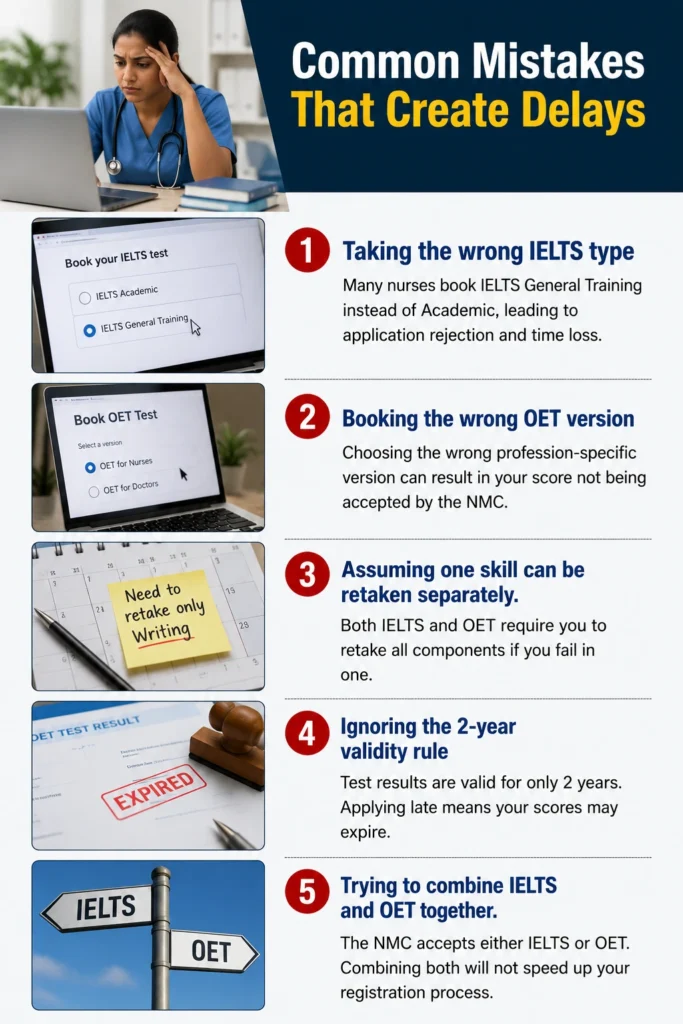
These are the mistakes we see most often, and each one has caused real delays for real applicants.
1. Taking the wrong IELTS type. Sitting IELTS General Training instead of Academic is the single most common version error. The two have different content and different score-to-skill mapping; NMC requires Academic. If you’re unclear on the difference, our guide on IELTS Academic vs General Training explains exactly when each version applies.
2. Booking the wrong OET version. OET offers profession-specific versions. Booking a version other than Nursing means your test content won’t match the registration pathway you’re on.
3. Assuming one skill can be retaken separately. Both IELTS and OET require all four skills to be tested together in any sitting used for NMC purposes. IELTS One Skill Retake exists as a feature of computer-delivered IELTS generally, but NMC does not currently accept it for this pathway a detail many applicants miss because it’s a legitimate IELTS feature, just not one recognised here.
4. Ignoring the 2-year validity rule. As covered above, scores must remain valid through NMC’s actual assessment of your complete application not just at submission. Applicants who test early and then take a long time assembling other documentation are most at risk here.
5. Trying to combine IELTS and OET together. As covered above, this isn’t permitted. Decide which test you’re committing to before your first sitting, because switching between them mid-process means starting your combining window over.
IELTS or OET Which Should You Choose?
Both meet NMC’s requirement equally. The difference is in what each test actually feels like to prepare for and sit.
IELTS Academic tests general and academic English essays on broad topics, academic reading passages, lectures unrelated to healthcare. If you’re already comfortable with academic-style English, or if you’ve prepared for IELTS before for university or visa purposes, this familiarity can work in your favour. Our guide on whether IELTS is difficult for Indian students covers the most common challenge areas in detail.
OET is built entirely around healthcare scenarios ward conversations in Listening, clinical reading texts in Reading, a referral letter in Writing, and patient role-plays in Speaking. For a working nurse, this content overlap with daily clinical practice often makes preparation feel more directly relevant. If Writing is a particular concern, our detailed breakdown of how to pass OET Writing for nurses written by an OET Teacher Trainer covers exactly what the referral letter task requires.
Whichever you choose, realistic preparation timelines matter. Most candidates benefit from 6–8 weeks of focused, consistent practice see our guide on how long to prepare for IELTS for a more detailed breakdown if you’re working toward a specific application deadline.
Key Takeaways
- NMC accepts only IELTS Academic and OET for this registration pathway not IELTS General Training.
- IELTS Academic requires 7.0 in Listening, Reading, Speaking; 6.5 in Writing. OET requires Grade B (350+) in Listening, Reading, Speaking; Grade C+ (300+) in Writing.
- Accepted IELTS formats: paper, computer, and UKVI. Not accepted: IELTS Indicator, IELTS Online, IELTS One Skill Retake.
- Accepted OET formats: Paper, Computer, and OET@Home all equally valid, but must be the Nursing version.
- Score combining is allowed across two sittings within 12 months, but IELTS and OET cannot be combined with each other.
- Scores are valid for 2 years, and must remain valid through NMC’s full assessment not just at submission.
- If you narrowly miss after exhausting combining options, UK employer-supported evidence may be an option depending on circumstances.
- English tests aren’t the only route a qualification taught in English, or one year of recent practice in an English-majority country, may also satisfy the requirement.
Frequently Asked Questions
1. What English Tests Does Nmc Accept For Indian Nurses?
NMC currently accepts only IELTS Academic and OET for this registration route. IELTS General Training is not accepted.
2. What Score Do I Need In Ielts For Nmc Registration?
IELTS Academic requires 7.0 in Listening, Reading, and Speaking, and 6.5 in Writing.
3. What Grade Do I Need In Oet For Nmc Registration?
OET requires Grade B (350+) in Listening, Reading, and Speaking, and Grade C+ (300+) in Writing.
4. Can I Combine An Ielts Score With An Oet Score?
No. NMC does not allow combining scores from two different tests. If you start with IELTS, your combining sitting must also be IELTS the same applies for OET.
5. Does Nmc Accept Ielts Online Or Ielts Indicator?
No. NMC accepts IELTS paper-based, computer-based, and UKVI formats. IELTS Indicator, IELTS Online, and IELTS One Skill Retake are not accepted for this pathway.
6. How Long Are My English Test Scores Valid For Nmc?
Two years from the test date. Your scores must remain valid when NMC actually assesses your complete application, not just when you submit it plan your test timing with this in mind.
7. What Happens If I Narrowly Miss The Requirement After Combining Two Sittings?
Depending on your circumstances, NMC may allow additional supporting information from a current UK employer as evidence of English proficiency in a health and social care setting. This isn’t guaranteed and depends on individual circumstances.
8. Do I Always Need To Take An English Test For Nmc?
Not necessarily. NMC also accepts a qualification taught and examined in English, or one year of recent practice as a registered nurse in a country where English is the majority spoken language, as alternative routes.
Conclusion
The English language requirement is the first major checkpoint on the path to NMC registration and getting it right the first time saves months compared to discovering a version mismatch, a combining error, or a lapsed validity window after the fact.
The core decision is simpler than it might first appear: choose IELTS Academic or OET, understand the exact score you need, and commit to that test through to the end of your combining window if needed. Both are well-trodden paths for Indian nurses, and both are entirely achievable with focused, structured preparation.
If you’re not sure which test fits you better, or want a clear sense of where your current English level stands against these targets, we offer a free assessment to help you decide whether that means a free IELTS evaluation, an OET Writing check, or guidance on how to approach score combining if you’ve already tested once.
👉 Book your free English test assessment or explore our OET coaching in Chennai and IELTS coaching in Chennai to see how we prepare nurses for both pathways.