

The first organic result in India for oet writing criteria is not a page. It is OET’s own two-page rubric PDF, sitting under an AI Overview. Read that as Google preferring the rubric to the pages written about it. Reading that PDF closely turns up two things nothing on that first page summarises. Its four described levels are the same four on every criterion, even though two different number scales disguise that. And OET separately publishes 19 real candidate letters carrying assessor comments and a grade badge, including a C+ and a B written from the same case notes. This page works through both. The task itself runs 45 minutes, and the criterion maxima add up to 38 marks by arithmetic rather than by anything OET prints, as the Writing component sets out.
Four described levels sit under every criterion, and a B is the second rung on each
Purpose is scored 0 to 3 and the other five criteria 0 to 7, which adds up by arithmetic to a 38-mark maximum OET itself never prints, and which looks like two unrelated systems. Read the descriptor table by row rather than by column and they turn out to be one. Purpose has written descriptors at 3, 2, 1 and 0. The 7-point criteria have written descriptors at 7, 5, 3 and 1, with bands 6, 4 and 2 defined only as performance sharing features of the bands either side, and band 0 as performance below band 1. Four described levels each, and the rows line up: the Purpose row that begins where band 7 begins is Purpose 3, the one that begins with band 5 is Purpose 2, and so on. Each Purpose row runs slightly deeper than the described band it starts on, because it also covers the thin transitional strip beneath, and at the bottom the band 0 strip.
| Described level | Purpose score | Other five score | What the reader experiences | What OET publishes about this rung |
|---|---|---|---|---|
| Top rung | 3 | 7 | Nothing to notice | OET tells candidates to aim for it |
| Second rung | 2 | 5 | Slips that do not reach the reader | The Grade B profile: 2 of 3 and 5 of 7 |
| Third rung | 1 | 3 | Strain and distraction | Nothing |
| Bottom rung | 0 | 1 | Meaning at risk | Nothing |
Source: our reading of the OET Writing assessment criteria and level descriptors, read 27 September 2026. The row alignment and the reader-experience column are ours; the scores and descriptors are OET’s.
That alignment carries a consequence the two scales hide. OET’s published Grade B profile lands on the second described rung of all six criteria at once, so a B is not stricter in one criterion and looser in another. One descriptor level, applied six times.
The B rung is where imperfection stops reaching the reader
We counted two vocabularies across the five 7-point criteria, excluding Purpose: hedges that excuse a fault, and words describing what the reader goes through.
| Described level | Hedging words | Reader-difficulty words | The words themselves |
|---|---|---|---|
| Band 7 | 0 | 1 | Interfere, and only inside do not interfere with meaning |
| Band 5, the B rung | 13 | 1 | Generally four times, minor and mostly three times each, occasional twice, slips once; interfere again only when negated |
| Band 3 | 3 | 5 | Strain twice, distract twice, interfere still negated; mostly twice and minor once |
| Band 1 | 0 | 7 | Strain three times, obscured, inadequate, not successful, and interfere no longer negated |
Our word counts across the Content, Conciseness & Clarity, Genre & Style, Organisation & Layout and Language descriptors in OET’s criteria and level descriptors. Hedges counted: minor, occasional, mostly, generally, slips. Reader-difficulty words counted: strain, distract, interfere, obscured, unclear, misunderstood, inadequate, not successful.
The two columns do not mirror each other. Reader-difficulty vocabulary climbs down the ladder, once, once, five times, seven times, with the jump falling between the B rung and the one beneath it. Hedging concentrates instead: thirteen at band 5, three at band 3, none at either end. So the B rung is the most heavily qualified level in the document, by more than four to one over the rung below, which is what makes it the level where faults exist without landing on the reader. Language shows it most exactly, because its four rungs make one sentence each: accurate and do not interfere with meaning at band 7, minor slips generally do not interfere at band 5, inaccuracies cause minor strain but do not interfere at band 3, and inaccuracies cause considerable strain and may interfere at band 1. Strain arrives one rung below a B. Unnegated interference arrives at the bottom described rung, two below.
Each criterion names a different fault at the rung below a B
The comparison below is condensed from OET’s descriptors, with its wording kept for the parts that do the work. The left column is the level a B profile reaches. The right column is the next level down.
| Criterion | Second rung, the B level | Third rung, one level below |
|---|---|---|
| Purpose | Apparent but not sufficiently highlighted or expanded | Not immediately apparent, and may show very limited expansion |
| Content | Appropriate to the reader and mostly addresses what is needed to continue care; case notes generally accurately represented | Mostly appropriate; some key information may be missing; there may be some inaccuracies in content |
| Conciseness & Clarity | Length mostly appropriate; information mostly summarised effectively and presented clearly | Some irrelevant information distracts from overall clarity; the attempt to summarise is only partially successful |
| Genre & Style | Clinical and factual with occasional minor inappropriacies; technical language, abbreviations and polite language used appropriately with minor inconsistencies | At times inappropriate to the document or the target reader; over-reliance on technical language and abbreviations may distract the reader |
| Organisation & Layout | Generally appropriate, logical and clear; occasional lapses in sub-sections or highlighting; layout generally good | Not always logical, creating strain for the reader; key information may not be highlighted; layout mostly appropriate with some lapses |
| Language | Minor slips generally do not interfere with meaning | Inaccuracies, particularly in complex structures, cause minor strain but do not interfere with meaning |
Source: quoted and condensed from the band 5 and band 3 rows of OET’s criteria and level descriptors, and the Purpose band 2 and band 1 rows. Two criterion names link to OET’s own guide post for that criterion.
Read down the right column and two verbs do the work. Conciseness and Genre distract the reader; Organisation and Language strain them. Four of the six describe the rung below a B by what it does to the person reading, and none of them counts mistakes, which is the frame the errors that cost a band uses too.
OET’s graded samples put a C and a C+ and a B on the same case notes
The descriptors say what a level looks like in the abstract. OET also publishes a booklet of real letters with a grade badge and an assessor commentary on each, and in our view it is the most useful writing document the organisation puts out. The letters came from candidates sitting sample test 5 for the first time, without access to the sample answer. We counted 19 graded letters across nine professions.
| Grade badge | Letters | Share | Professions represented |
|---|---|---|---|
| A | 2 | 11 per cent | Medicine, Speech Pathology |
| B | 10 | 53 per cent | Dentistry, Nursing, Medicine, Optometry, Pharmacy, Physiotherapy, Radiography, Speech Pathology |
| C+ | 2 | 11 per cent | Nursing, Medicine |
| C | 5 | 26 per cent | Nursing, Medicine, Occupational Therapy, Pharmacy, Physiotherapy |
Our count of the grade badges and assessor commentaries in OET’s Graded Writing Samples booklet. Nursing carries four letters and Medicine five, each written from the same case notes, which is what makes a direct comparison possible.
Two professions carry enough letters to compare across grades. Medicine runs the full range from C to A, and Nursing runs C to B. Our own worked nursing letter, taken apart criterion by criterion, is in a nurse’s referral letter, assessed. Because each set answers one brief, the assessor comments work as a controlled comparison rather than a collection of tips.
One condition travels with every quotation, and it is OET’s own. The comments were written for one particular set of case notes, and OET warns that copying the language these candidates used, in response to a different set of case notes, will not produce the same scores and is strongly discouraged. OET’s own instruction is narrower than a blanket ban: match what the assessor praised on this sample test, and do not carry the language to a different one.
Purpose separates the two grades on one word, and the word is immediate
The Purpose sentences from the Medicine set run as follows. The C+ letter: the candidate begins without an immediate purpose, although it is clear by the final sentence. The first B letter: this candidate presents purpose, but this would have been even clearer had the more specific concerns related to the medication side-effects been presented initially. The second B letter: a clear and immediate purpose establishes the context for the letter and guides the intended reader through the case to the future needs.
The Nursing set repeats the pattern from the other side. Its C+ letter provided an apparent purpose despite inaccurate tentative language that causes a slight distraction, which lands on the band 2 idea of a purpose that is present without doing its job. Its first B letter had the purpose immediately apparent despite failing to mention the patient’s fall. A letter can omit a clinically relevant event and still clear the B rung on Purpose, because Purpose is not scored on completeness. Content is.
The practical instruction follows from it. The reason for writing belongs early in the letter and expanded later, often near the end, and OET’s own guide to the criterion gives worked openings for a referral, a discharge and a transfer letter. If the reader has to reach your final sentence to learn why you wrote, the descriptor for that is Purpose band 1, not immediately apparent.
A C+ letter in OET’s booklet has better English than a B letter in the same set
On the Medicine case notes, the assessor wrote of the C+ letter that a wide range of vocabulary is noted, and highly accurate language structures are used well to present the case. Of the B letter immediately after it, the same booklet records that inaccuracies are noted at times, particularly in tense choices and collocations, but meaning generally remains clear.
So the letter with praised, highly accurate language scored a grade lower than the letter with noted tense and collocation errors. The C+ letter lost elsewhere, and the commentary says where: it began without an immediate purpose, showed insufficient and inaccurate coverage of key case details, organised information that is not always logical with disjointed paragraphing, and lacked a salutation or a date, which the assessor notes impacts the layout score.
Language is one criterion of six, carrying 7 of the 38 marks the published maxima add up to. Purpose, Content, Conciseness, Genre and Organisation carry the other 31. A candidate who treats OET Writing as an English test rather than a document task is working on one criterion of six and leaving the other five alone, which is the pattern behind our note on why strong doctors lose marks.
The reverse case is in the booklet too. A Nursing letter graded B contains a slip from formal language into slang, quoted by the assessor as If u have any queries, and still clears the rung. The descriptor leaves room for it: band 5 for Genre and Style allows occasional minor inappropriacies and minor inconsistencies. The booklet publishes only an overall grade, so what that letter scored on Genre and Style is not on the record. What is on the record is that it reached B overall with the slip noted. One lapse is survivable. A pattern of them is a different descriptor.
Overlength is noted on eight of the 19 letters, and charged to the score on one
The claim that exceeding 200 words costs marks is the most durable piece of misinformation about this sub-test, and the booklet lets you test it against cases rather than policy. We counted the word-count remarks across all 19 commentaries. Eight mention overlength, and six of those eight letters were graded B: Dentistry, Nursing, Medicine, Optometry, Pharmacy and Speech Pathology. Of the Nursing letter the assessor wrote that the word count of the response is significantly overlength in accordance with task instructions, and of the Medicine letter that the inclusion of some less critical detail makes this response notably overlength.
Both cleared the B rung, and in both the assessor charged the excess to a criterion rather than to a count. The Nursing commentary notes previous medical history that is slightly lengthy and somewhat irrelevant, then says explicitly that this does not distract from the overall clarity of the response, which is the band 5 test for Conciseness and Clarity. One of the eight goes the other way, and it is the case candidates should know about: an Occupational Therapy letter graded C is marked as a very overlength response at around 300 words, which has an impact on the score awarded. That is the only commentary in the booklet tying length to the score, and the letter in question is roughly half again over the range. Length matters as far as it reaches the reader, and the range it is measured against is 180 to 200 words, a rule set out with the rest of the task in the writing task.
Genre and Style is judged on respect for the reader and fit to that reader
Genre and Style carries 7 of the 38 marks, the same as every criterion except Purpose, and it is the one candidates most often mistake for formality of vocabulary. OET defines formal writing for this task as polite, respectful and non-judgmental, and locates those qualities in three places: how you make requests of the reader, how you present information to the reader, and how you present information about the patient. The case notes themselves carry the instruction, in reminders to expand the relevant notes into complete sentences and not to use note form.
Its guide contrasts two pairs, and the fault in each is a relationship rather than a register. Thanks for having a look at Priya becomes Thank you for seeing Mrs Priya Sharma, and I’ve sent her to you because she needs to lose some weight becomes I am referring her to you for your specialist advice. The guide’s note covers both pairs together: the informal versions use the patient’s first name and are not respectful toward her condition, while both formal versions are respectful to the reader’s role and polite about the patient. Being non-judgmental is handled by stating facts: he writes with his left hand and drove a manual car before the fall, rather than a characterisation of the patient.
The same criterion is where abbreviations are priced, and it is priced against one reader. The descriptors reward technical language and abbreviations used appropriately for document and recipient, and the criteria document works the contrast through in three steps. Judicious abbreviation is entirely appropriate to a colleague in a similar discipline. A colleague in a totally different discipline, or a specialist writing to a GP, needs more explanation and less shorthand. And where the readership includes the patient, OET asks for the information to be worded appropriately with medical jargon minimised. There is no list of permitted abbreviations, because the test is fit to reader rather than membership of a set. Even the closing formula is a genre decision OET has written about, in its post on how candidates end their letters.
Language is the criterion that prices linguistic accuracy, though the criteria document says it examines whether language is accurate and used appropriately, and Content prices both what you include and whether you represented it accurately. What moves it, on the evidence of the graded commentaries, is control of the structures that carry a case: tense choice for a timeline, prepositions, and articles. Connectors sit next door rather than here, and OET places them deliberately: its guidance on them describes their job as joining information within a sentence, and ties the choice to Genre and Style while also counting it toward the range of vocabulary that Language prices. The praise in the booklet’s B-graded letters goes to linking expressions used accurately, and clear links between and within paragraphs that make the letter easy to follow, alongside excellent control of a wide vocabulary where it appears.
Content scores what you put in, Conciseness scores what you left out, and one sentence can lose both
OET pairs these two criteria itself, describing Content as assessing the information you have included in your letter and Conciseness and Clarity as assessing the information you have omitted from it. Its writing guide names the three ways candidates get the omission wrong: including information the reader already knows or that falls outside the scope of the reader’s role, giving too much background or historical detail, and failing to group similar information together.
The graded comments show all three being priced. The Medicine C+ letter drew insufficient and inaccurate coverage of key case details, with the assessor listing what was missing: no mention of the patient being overweight, no quantity of alcohol, twenty cigarettes a day written as 20 PPD, today’s appointment given as recently, and no date at the top. The Medicine letter graded A drew the opposite note, that excellent selection of case note details allows the reader’s focus to remain on the main points. The difference between those two commentaries is selection, not expression.
The selection test OET gives in its guide is two questions about the reader, not about the notes. Is there an existing professional relationship between the patient and the reader, and which aspect of the patient’s care will that reader be involved with. Every detail survives or goes on those two answers, and the two-question test is the first thing to run in what to check in your last two minutes.
OET publishes no conversion from 38 raw marks to the 500 scale, so score calculators are guessing
OET Writing score calculator sits in Google’s related searches for this query, which tells you candidates want to turn a band profile into a number. That conversion is not published. Its own handbook states only that the scores for each criterion are combined and converted to the 500 scale, and OET publishes the profile a Grade B typically reaches, and there it stops. No table maps a raw 38-mark total to a scale score, and the conversion is not a simple percentage, because OET reports scale scores in ten-point increments with grade boundaries at 350 for B and 300 for C+.
That gap has consequences on both sides. Any tool promising your OET Writing score from your letter is producing a number OET has never published a method for. In the forum corpus we searched, ten of the 98 threads naming Writing name an AI tool. One from May 2026 asks whether ChatGPT is accurate because it returns between 280 and 300 while Claude returns a higher range, with the C+ boundary at 300 sitting at the top of the range one of them returned. A second, from August 2026, reports a single letter scored 350 by one tool and 370 by the other. Two estimators of a mapping neither can see are not obliged to agree, and on that letter they differed by two reporting increments.
What the descriptors do support is a self-assessment against levels rather than numbers. You can decide, criterion by criterion, whether your letter sits at the rung where slips do not reach the reader or the rung where they do, and the rungs feed a 38-mark maximum whose arithmetic is set out in OET’s writing paper.
Candidates argue about the score and rarely about the criteria that produced it
The same 824-thread Reddit corpus we used for the hub, covering 1 February to 18 September 2026, contains 98 threads with Writing in the title. Sorted by what they actually discuss, they are a conversation about numbers rather than about the rubric that produced them.
| In the 98 Writing threads | Count | Reading |
|---|---|---|
| Quote a score | 43 | Getting on for half put a figure in writing |
| Quote a score below 350 | 30 | Most quoted figures sit under the Grade B line |
| Quote a score inside the C+ band of 300 to 340 | 21 | The C+ band is where the discussion lives |
| Name an AI tool | 10 | Roughly one thread in ten |
| Name the criteria, the descriptors or the rubric | 3 | Three threads in 98 reach for the marking scheme itself |
Counts are ours and reproducible from the stated rule. A quoted score is a multiple of ten from 200 to 500 standing alone in a title or body, with no adjoining digit, comma or decimal point, because OET reports only in ten-point increments; two threads whose only such figure is 200 are excluded, since 200 there is the word limit rather than a result. The AI row counts a named tool, including one misspelling of ChatGPT. The criteria row counts the words criteria, descriptor or rubric, and reaches 10 if the six criterion names are added. The skew matters for reading them: 94 of these 98 threads sit in a single subreddit for candidates pursuing US certification, so the sample leans further toward doctors than OET’s own candidature does, which its 2025 figures put at 57.5 per cent Medicine and 38.15 per cent Nursing.
One thread from 6 May 2026 is worth reporting in full because it shows the stakes at the boundary. A candidate who scored 290 in Writing, having practised above 300, applied for a re-mark, and reported the outcome three weeks later as 360. The same letter moved from grade C to grade B. OET’s re-marking policy confirms outcomes can go up, down or stay the same, that the fee is refunded only when the grade changes, and that the wait is three to six weeks.
A single case proves nothing about the odds, and the same corpus contains candidates whose re-marks changed nothing. It does establish that a letter near a boundary can come back differently. OET’s 2025 test performance figures put Writing’s classification consistency at the Grade B boundary between 0.82 and 0.89 depending on delivery mode, which is the expected agreement of the grade decision across parallel administrations, a reading of the index rather than a definition OET prints, and not a direct measure of assessor disagreement.
Self-marking against rungs beats self-marking against a number
The useful question after a disappointing Writing score is not how many marks you were short. The question is which rung each criterion sat on, and the descriptors are specific enough to answer that from the letter itself. Purpose: did the reader learn why you wrote early on, and did you expand it later. Content: is anything the reader needs to continue care missing. Conciseness: on OET’s two reader questions, does every sentence survive. Genre: is there a lapse or a pattern of lapses. Organisation: does the order tell the patient’s story for this reader. Language: do the errors cause strain, or merely exist.
Every one of those six is finally a judgement about a reader you cannot consult. In our experience marked feedback moves a Writing score faster than more unmarked letters do. If you want that, work with an OET trainer who scores against the published descriptors rather than reading for fluency, online or from the Egmore centre in Chennai. And if the four sub-tests are still unfamiliar, the test itself covers what sits underneath this one.
Frequently asked questions
What are the six OET Writing criteria?
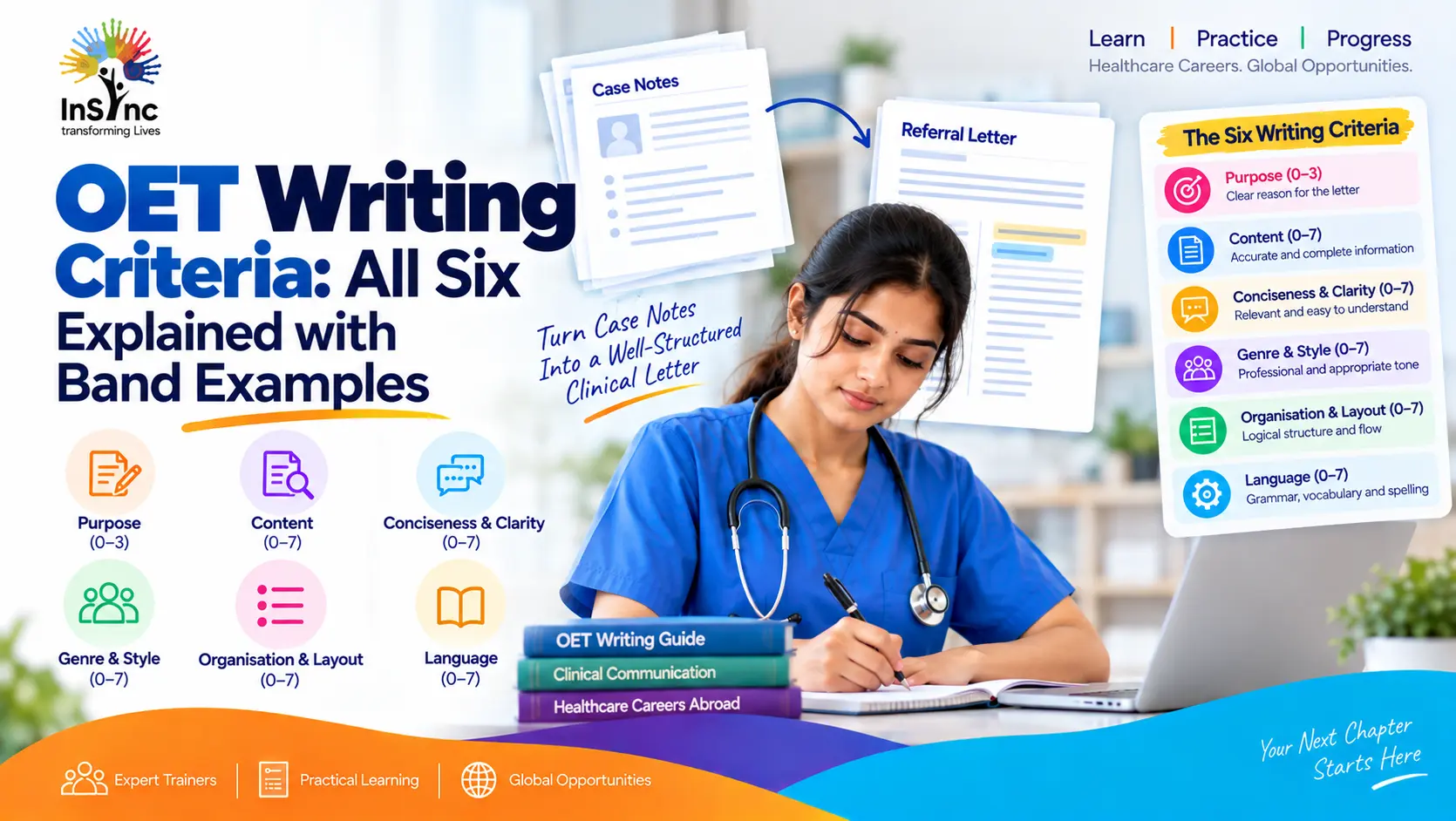
Purpose, Content, Conciseness & Clarity, Genre & Style, Organisation & Layout, and Language. Purpose is scored from 0 to 3 and the other five from 0 to 7 each. Every criterion has written descriptors at four levels: 3, 2, 1 and 0 for Purpose, and 7, 5, 3 and 1 for the other five, with bands 6, 4 and 2 defined only as sharing features of the bands on either side.
How is OET Writing scored against the criteria?
Two OET assessors score the letter against the six criteria, according to OET’s Writing preparation page. OET publishes that test-takers securing Grade B will have achieved 2 out of 3 for Purpose and 5 out of 7 for each of the other five. Those are the second described level on every criterion. The criterion scores are then combined and converted to the 0 to 500 scale, and OET does not publish the conversion.
What separates a B from a C+ in OET Writing?
OET publishes no mapping from criterion rungs to grades, so there is no descriptor labelled C+. What the descriptors do separate is the B rung from the rung beneath it: at the B level the faults are minor, occasional and mostly-right, and they do not reach the reader, while one rung down irrelevant information distracts from clarity, organisation creates strain and language inaccuracies cause minor strain. OET’s graded booklet supplies the rest of the answer, which is that a C+ letter can carry better English than a B letter and lose the grade on Purpose, Content and Organisation instead.
Which criterion do candidates lose most marks on?
OET publishes scores by sub-test rather than by criterion, so no public data answers this directly. The booklet publishes an overall grade on each letter rather than criterion scores, so it cannot rank the criteria either. What it does document is one matched pair: on the Medicine case notes, the letter graded C+ was praised for a wide range of vocabulary and highly accurate structures, while the B letter beside it was marked for tense and collocation errors.
Can I write more than 200 words in OET Writing?
There is no automatic penalty for exceeding the 180 to 200 word range, and eight of the 19 letters in OET’s graded booklet are noted as overlength, six of them graded B. OET’s own answer adds that significantly more usually means irrelevant material or weak organisation, and one letter in the booklet, graded C at around 300 words, is marked as overlength with an impact on the score awarded. The cost appears in Conciseness & Clarity and Organisation & Layout when the excess reaches the reader, not as a word-count deduction.
Do spelling and grammar mistakes stop me getting a B?
Not by themselves. Spelling, punctuation, grammar and vocabulary all sit under Language, which is one criterion of six. The band 5 descriptor states that minor slips in language generally do not interfere with meaning, and OET’s own guide says of spelling specifically that you will not need to be perfect to achieve a B.
Is there an OET Writing score calculator?
Not an accurate one. OET publishes the criteria, the level descriptors and the Grade B profile, but no table converting the 38 marks its criterion maxima add up to into a scale score, and scores are reported in ten-point increments. Any calculator or chatbot returning a number is estimating a mapping OET has never published, which is why one candidate in August 2026 reported the same letter scored 350 by one tool and 370 by another.
Where can I read the official OET Writing band descriptors?
OET publishes them as a two-page PDF titled Writing sub-test: Assessment criteria and level descriptors, It sets out every described band for all six criteria, and on 27 September 2026 it was the first organic result in India for that query. OET also publishes a separate booklet of graded candidate letters with assessor comments and a grade badge on each.
Does a formal-language slip cost me the B?
One slip usually does not. The Genre & Style descriptor at the B level allows occasional minor inappropriacies and minor inconsistencies, and a Nursing letter in OET’s graded booklet that slipped into writing If u have any queries still received a B. A consistent pattern of informality is a different matter, because the descriptor one level down describes writing that is at times inappropriate to the document or the target reader.
Can a re-mark change my Writing grade?
It can move in either direction or not at all. OET’s re-marking policy states outcomes can be increased, decreased or unchanged, takes three to six weeks, and refunds the fee only if the grade changes. One candidate on a public forum in May 2026 reported moving from 290 to 360 on a re-mark, which crosses a grade boundary, but a single reported case says nothing about the likelihood.