The OET tests four skills, Listening, Reading, Writing and Speaking, and each one has its own timing, task types and answer rules. This page sets out the full OET exam pattern as OET documents it in the 2026 handbook and its official guides, part by part, so you know exactly what the paper in front of you will ask. If you are still deciding whether the test suits your route, start with an overview of the OET and come back here for the detail.
The format in five lines
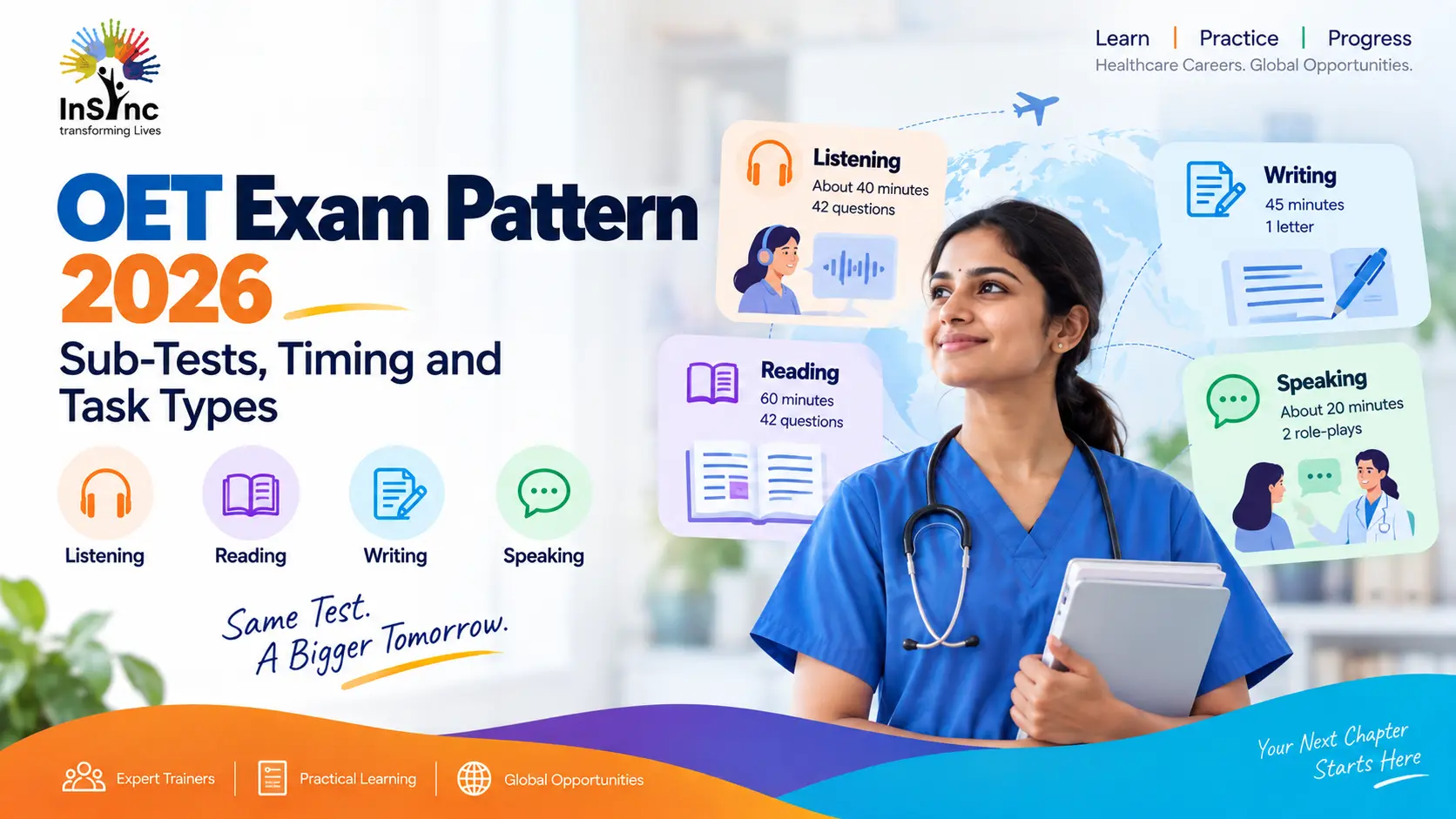
Listening: about 40 minutes, three parts, 42 questions, every recording heard once.
Reading: 60 minutes, three parts, 42 questions, with Part A timed separately at 15 minutes.
Writing: 45 minutes, one letter written from profession-specific case notes.
Speaking: about 20 minutes, two role-plays with an interlocutor.
Listening and Reading are identical for all 12 professions. Writing and Speaking are tailored to your profession.
The OET runs four sub-tests in about two hours and 45 minutes of testing time
Add the four official timings together and you get roughly 165 minutes of assessed time, before check-in, instructions and breaks.
| Sub-test | Time | Parts | Questions or tasks | Task types |
|---|---|---|---|---|
| Listening | About 40 minutes | 3 | 42 questions | Note completion (Part A), 3-option multiple choice (Parts B and C) |
| Reading | 60 minutes | 3 | 42 questions | Matching, short answer and sentence completion (Part A), 3-option and 4-option multiple choice (Parts B and C) |
| Writing | 45 minutes | None | 1 task | A letter, such as a referral, written from case notes |
| Speaking | 20 minutes | None | 2 role-plays | Profession-specific role-plays with an interlocutor |
Source: OET Test Handbook 2026, test structure table, checked 22 September 2026.
Each sub-test is reported separately on a scale from 0 to 500, and regulators set their minimum for each one. That is why the pattern matters: a weak part can hold back one sub-test even when the other three are comfortable.
OET Listening plays each recording once and asks 42 questions across three parts
One ground rule shapes everything else: as the handbook puts it, you hear each recording once only. Listening is also the same for every candidate, whatever their profession, and runs for about 40 minutes.
| Part | What you hear | Questions | Timing detail from OET’s guides |
|---|---|---|---|
| A | Two consultations between a health professional and a patient | 24 (12 per extract) | 30 seconds to read the notes before each recording, which runs about 4 to 5 minutes |
| B | Six short workplace extracts, such as a handover or a staff briefing | 6 (1 per extract) | 15 seconds to read each question, about 45 seconds of audio, then 5 seconds to choose |
| C | Two presentations or interviews on a healthcare topic | 12 (6 per extract) | 90 seconds to read the questions, then 4 to 5 minutes of audio per extract |
Sources: OET complete guides to Listening Part A, Part B and Part C; OET Test Handbook 2026.
Part A carries 24 of the 42 marks, which is 57 per cent of the sub-test. You complete a clinician’s notes with a word or short phrase you hear, so the task is listening and writing at the same time. OET’s Part A guide says answers are generally between one and three words, and that you must not change the word form or add extra words.
On spelling, OET’s own guidance for this task is reassuring. The Part A guide states that UK and US spellings are both accepted, and that minor spelling variations may be accepted as long as the intended meaning is clear. Human assessors mark Part A, so on paper, legible handwriting protects marks you have already earned.
Parts B and C test a different skill. Instead of catching words, you follow purpose, opinion and attitude, and you choose from three options. On the paper test, OET’s test day guide says you may use a pen or pencil for Part A but need a 2B pencil for Parts B and C, and you get two minutes at the end to check your answers across all three parts.
OET Reading locks Part A at 15 minutes and gives Parts B and C the remaining 45
Reading has a hard internal deadline. Part A is completed separately from Parts B and C, as the handbook specifies, and OET’s guide to test day on paper adds that Part A papers are collected before Parts B and C are handed out, so there is no going back.
| Part | Texts | Questions | Time | Time per question |
|---|---|---|---|---|
| A | Four short extracts on one healthcare topic, which may include a table, flowchart or diagram | 20 | 15 minutes | 45 seconds |
| B | Six workplace extracts of about 100 to 140 words each | 6 | 45 minutes shared with Part C | About 2 minutes across B and C |
| C | Two articles of about 800 words each | 16 | Shared with Part B | About 2 minutes across B and C |
Sources: OET complete guides to Reading Part A, Part B and Part C. Time per question is our arithmetic: 900 seconds over 20 questions, and 2,700 seconds over 22.
Part A mirrors the way clinicians use reference material: find the fact, record it, move on. The first questions are always matching, where the answer is a single letter from A to D, and they are followed by short-answer or sentence-completion items. OET’s Part A guide is strict on one point: copy the words exactly as written, because a spelling error or an unneeded extra word makes the answer wrong. That is stricter on spelling than Listening Part A, which accepts minor variations, so the two tasks need practising differently.
Parts B and C shift from finding information to understanding it. Part B asks one 3-option question per short text about its purpose, main idea or detail. Part C gives eight 4-option questions per article, and they follow the order of the text, which lets you work down each article without doubling back. Across the two parts you read roughly 2,200 to 2,400 words in 45 minutes.
OET Writing allows five minutes of reading and 40 minutes for one profession-specific letter
You write one letter to another healthcare professional, or to a person involved in the patient’s care, from a set of case notes. Of the 45 minutes, the handbook gives 5 to reading time and 40 to writing time. OET’s reading-time guide is explicit that those first five minutes are for reading only, so you cannot underline or make notes. It also calls them the most important five minutes of the test, because that is where you decide what the reader needs.
The body of the letter should be about 180 to 200 words, and OET describes this as a guide rather than a hard limit. Its word-limit article clarifies three points:
Only the body paragraphs count. The address, date, greeting, reference line and closing lines do not.
Assessors do not count your words. They judge whether the letter includes what the reader needs and leaves out what they do not.
On computer, the on-screen counter includes everything you type, not just the body, so the total shown will be higher than your body word count.
Marking uses six criteria: Purpose, Content, Conciseness and Clarity, Genre and Style, Organisation and Layout, and Language. OET’s Writing page states that two OET assessors mark each letter against them. The letter type changes with the case, and OET’s test page lists referral, advice, transfer and discharge letters among the documents you may be asked to produce. For a practical way to check your own drafts against those criteria, our OET writing correction tips end with a self-correction checklist.
OET Speaking runs two five-minute role-plays that assessors mark later from a recording
The Speaking sub-test is a conversation with an interlocutor who plays a patient, a relative or a carer. Its sequence, set out in the handbook, is a warm-up of about two to three minutes, followed by two role-plays, each with three minutes of preparation and five minutes of speaking.
The role-play card is the part candidates meet for the first time on the day, so it helps to know what is on it. Each card gives the setting, background information and task prompts. OET’s Speaking page confirms that you may make notes on the card and refer to it throughout, and that you return it at the end. During the three minutes of preparation, OET’s test day guide says you may ask the interlocutor what a word on the card means or how to pronounce it, but not how to complete the task.
The interlocutor does not grade you. The session is recorded, and OET’s Speaking page states that two OET assessors mark the audio using two sets of criteria:
| Criteria set | Scale | What is assessed |
|---|---|---|
| Linguistic | 4 criteria, each out of 6 | Intelligibility; Fluency; Appropriateness of language; Resources of grammar and expression |
| Clinical Communication | 5 categories, each out of 3 | Relationship building; Understanding and incorporating the patient’s perspective; Providing structure; Information gathering; Information giving |
Source: OET Test Handbook 2026, Speaking scoring section.
The warm-up is not assessed, which OET’s test day guide confirms, so treat it as a chance to settle your voice. OET’s Speaking page adds that a role-play usually comes to a natural end at around five minutes, and if it does not, the interlocutor will signal clearly that it is time to conclude. Nurses who want to see how nursing scenarios run can read our guide to OET Speaking for nurses.
Listening and Reading stay the same for all 12 professions, while Writing and Speaking follow yours
OET, owned by Cambridge Boxhill Language Assessment Unit Trust (CBLA), is available in 12 professions: Medicine, Nursing, Dentistry, Dietetics, Pharmacy, Physiotherapy, Podiatry, Radiography (listed as Radiology on OET’s test page), Occupational Therapy, Veterinary Science, Optometry and Speech Pathology. A nurse, a pharmacist and a vet sitting on the same day take the same Listening and Reading papers.
The reason is set out in OET’s test FAQ: the test assesses English language ability, not medical knowledge, so the shared sub-tests use topics of general healthcare interest and avoid rewarding one profession’s expertise. Writing and Speaking then switch to materials drawn from your own workplace. In the handbook’s example, Nursing candidates complete Nursing tasks and Radiography candidates complete Radiography tasks.
In 2025, medicine accounted for 57.5 per cent of OET candidates and nursing for 38.15 per cent, with all other professions together at 4.4 per cent, according to OET’s candidate performance report.
Test day order depends on the delivery mode you book
On OET on Paper, all four sub-tests take place on the same day at the same venue. OET’s test day guide gives the usual order as Listening, then Reading, then Writing, with a short break before Speaking, and notes that schedules can differ, for example in the Americas, where Speaking comes first.
On OET on Computer, Listening, Reading and Writing are taken at a venue on one day. The Speaking sub-test is taken on a different day, up to five days before or after, subject to availability, and usually at home through an online platform, with a venue option in select countries. Results are published only once all four sub-tests are complete.
The home Speaking platform itself changed in 2026. OET’s announcement says new or rescheduled OET@Home and OET on Computer bookings made after 9 June use a new Speaking platform, accessed through Prometric with a secure browser, and that there is no change to the format or marking. For a paper-based candidate, the Speaking sub-test stays face to face with an interlocutor in a private room at the centre. Candidates booking in Karnataka will find what to expect in a nurse’s guide to test day in Bangalore.
Paper, computer and OET@Home share one specification but differ in how you answer
The handbook states that all delivery modes use the same test format and specifications and are marked to the same standard. What changes is the mechanics, and those are worth practising in the mode you will actually sit.
| Feature | OET on Paper | OET on Computer | OET@Home |
|---|---|---|---|
| Where L, R and W happen | Test venue | Test venue | Your own computer, remotely proctored |
| Where Speaking happens | At the venue, face to face | At home online, or at a venue in select countries | At home online |
| Reading layout | Separate text booklet and question paper | Split screen: texts left, questions right | On screen, on your own computer |
| Answering B and C | Shade circles with a 2B pencil | Mouse click | On screen |
| Writing word count | Estimate from your lines | Automatic counter of all words typed | Automatic counter of all words typed |
Sources: OET Test Handbook 2026; OET on Paper; OET on Computer; OET complete guides to Reading Part A and Part B; word-limit article.
Profession availability is worth confirming too. The OET on Paper page lists seven professions under paper: Medicine, Nursing, Dentistry, Pharmacy, Physiotherapy, Radiology and Veterinary Science. The FAQ on the same page says both venue modes are available for all 12 professions, and the computer page lists all 12. OET’s own advice is to confirm the mode, profession, country and venue on the booking page before you book, which settles the question for your date.
OET@Home has an eligibility rule of its own. According to the handbook, it is available if there is no OET test venue in your country or if you have other access needs, so candidates in India will usually choose between paper and computer at a venue. Both are priced the same in India, and our breakdown of the OET test fee lists the reschedule, remark and resit charges on top.
Grade B in Listening and Reading typically takes about 30 correct answers out of 42
Both shared sub-tests are marked one point per question, and the raw score out of 42 is converted to the 0 to 500 scale. OET’s results and scoring page states that candidates awarded Grade B, a scaled score of 350, typically achieve at least 30 marks.
That target has a useful consequence: you can miss around 12 questions and still be in range for a B. Treat it as a working figure rather than a guaranteed cut score, because OET says typically. It also shows why the two Part A tasks deserve attention, since they hold 24 of the Listening marks and 20 of the Reading marks.
Forum threads centre on Speaking, while Indian score data centres on Reading and Listening
We reviewed 824 Reddit threads about the exam, posted between 1 February and 18 September 2026 in OET subreddits or carrying OET in the title. We removed crossposts, tutoring and class adverts, and threads unrelated to the test. Of the 334 threads whose title named a sub-test, 52 per cent named Speaking and 30 per cent named Writing, against 13 per cent for Reading and 11 per cent for Listening. Some titles named more than one.
OET’s own 2025 figures for candidates of Indian nationality point the other way. The share of grades at B or above was high in the sub-tests people discuss most and lower in the two they discuss least.
| Sub-test | Share of forum threads naming it | Indian-nationality grades at B or above, 2025 | Indian-nationality mean score, 2025 |
|---|---|---|---|
| Speaking | 52% | 86% | 370 |
| Writing | 30% | 73% | 343 |
| Reading | 13% | 32% | 313 |
| Listening | 11% | 37% | 322 |
Sources: our review of 824 Reddit threads, 1 February to 18 September 2026; OET Demographic data 2025 and OET Candidate performance 2025. Nationality is self-reported and may mean country of birth or of current or previous residence.
Both sets of numbers make sense on their own terms. Speaking is the only sub-test taken with a live interlocutor and, for most computer candidates, now depends on home technology: 30 of the 824 threads asked about the room, device, connection or software for Speaking at home, and the 10 that named the new secure browser or platform were all posted from 15 June onwards. The score data, though, suggests that for most Indian candidates, Listening and Reading are the harder sub-tests to clear. The encouraging news is that Listening and Reading are also the most mechanical sub-tests, with fixed question types and fixed timings, so practice under timed conditions pays back quickly.
The forum sample leans towards doctors on the US route, because 318 of the 334 threads came from r/OETforECFMG, so treat the thread shares as a picture of attention rather than of the whole candidate population.
First-language English candidates reach Grade B in Writing at almost the same rate as Indian candidates
OET’s 2025 statistics, which it publishes on its website, contain a comparison that explains the Writing task well. Among candidates who reported English as their first language, 74.5 per cent of Writing grades were B or above. Among candidates of Indian nationality the figure was 72.6 per cent, a gap of under two points.
The same two groups sit far apart elsewhere. In Listening, 71.4 per cent of first-language English grades were B or above, against 37.3 per cent for Indian-nationality candidates. First-language English candidates also averaged 345 in Writing, below their means of 377 in Listening, 360 in Reading and 394 in Speaking, although their median Writing grade was still B.
Sources: OET Demographic data 2025 and OET Candidate performance 2025. The first group is classified by self-reported first language and the second by self-reported nationality, so the comparison is indicative.
Fluent English, in other words, does not guarantee a strong letter. The six criteria reward choosing the right case notes, ordering them for a specific reader and keeping the register professional, and those are skills that can be taught. For Indian candidates, the remaining Writing gap is likely to be about technique, which responds well to marked practice.
The OET Test Handbook serves as the practical OET syllabus
Searches for an OET syllabus usually expect a list of topics to study. OET describes the shared sub-tests as covering “a variety of issues of general medical and health interest”, and the profession-specific ones as reflecting real workplace scenarios in your profession. What OET does publish in detail is the specification: parts, question counts, task types, timings and assessment criteria.
Read the OET Test Handbook 2026 as that syllabus. It is short, it covers all four sub-tests in one place, and it is the document most figures on this page were checked against. The assessment criteria for Writing and Speaking sit alongside it on oet.com.
Official sample tests reproduce the live format for every profession and delivery mode
According to the handbook, official OET sample tests cover all four sub-tests, for every profession, in both paper and computer formats, with transcripts and sample answers. Sitting one under full timing shows you how the timings on this page feel in practice.
Time Reading Part A strictly at 15 minutes, answer Listening Part A in real time without pausing, and write the letter inside 40 minutes after five minutes of reading only. If you are preparing for OET on your own, you can run this cycle every week.
For candidates who would rather work through those timed attempts with a trainer, structured OET preparation at InSync runs as live online classes and as classes at our Egmore centre in Chennai.
Key facts
• The OET has four sub-tests: Listening (about 40 minutes), Reading (60 minutes), Writing (45 minutes) and Speaking (20 minutes).
• Listening and Reading each contain 42 questions across three parts. Writing is one letter. Speaking is two role-plays.
• Listening Part A has 24 questions, Part B 6 and Part C 12. Each recording is played once.
• Reading Part A has 20 questions in a separate 15 minutes. Parts B and C have 22 questions in 45 minutes.
• Writing gives 5 minutes of reading time and 40 minutes of writing time. The body of the letter should be about 180 to 200 words.
• Speaking includes a warm-up of about 2 to 3 minutes, then 3 minutes of preparation and 5 minutes of role-play for each card.
• Listening and Reading are the same for all 12 professions. Writing and Speaking are profession-specific.
• Each sub-test is reported from 0 to 500. Grade B covers 350 to 440, and OET says candidates awarded 350 typically achieve at least 30 of 42 marks in Listening or Reading.
• All delivery modes use the same format and specifications. Computer candidates usually take Speaking at home on a separate day, or at a venue in select countries.
Frequently asked questions
What is the OET exam pattern?
The OET has four sub-tests. Listening takes about 40 minutes with 42 questions in three parts. Reading takes 60 minutes with 42 questions in three parts, and Part A is timed separately at 15 minutes. Writing takes 45 minutes for one letter. Speaking takes about 20 minutes for two role-plays.
How long is the OET exam?
The four sub-tests add up to about 2 hours and 45 minutes of testing time. Check-in, instructions and breaks add to the day. On OET on Computer, Speaking is taken on a separate day, up to five days before or after the other three sub-tests.
How many questions are there in OET Listening and Reading?
Each has 42 questions. Listening has 24 in Part A, 6 in Part B and 12 in Part C. Reading has 20 in Part A, 6 in Part B and 16 in Part C. Each correct answer earns one mark.
Is the OET the same for nurses and doctors?
Listening and Reading are identical for all 12 professions. Writing and Speaking are profession-specific, so a nurse writes a nursing letter and completes nursing role-plays, while a doctor completes medicine tasks.
Is there an official OET syllabus?
OET publishes a detailed test specification rather than a list of topics. The OET Test Handbook sets out every part, question count, task type, timing and assessment criterion, which makes it the practical syllabus for preparation.
How many words should the OET letter be?
OET gives a guide of about 180 to 200 words for the body of the letter. Assessors do not count words. On computer, the word counter includes everything you type, not only the body paragraphs.
Does spelling matter in OET Listening and Reading?
Yes, in both Part A tasks. OET accepts UK and US spellings in Listening Part A and says minor variations may be accepted if the meaning is clear. In Reading Part A, OET says answers must be copied exactly, and a spelling error makes the answer wrong.
Is the OET format different on computer and on paper?
No. OET states that all delivery modes use the same format and specifications and are marked to the same standard. The differences are practical: on computer you type and click, and Speaking usually takes place at home on a separate day.
Do I need medical knowledge for the OET?
No. OET says the test assesses English language ability, not medical knowledge. Listening and Reading use general healthcare topics, and Writing and Speaking use workplace situations from your own profession.
Can I make notes during the OET Speaking preparation time?
Yes. You may write on the role-play card and refer to it during the role-play. You can also ask the interlocutor what a word on the card means or how to pronounce it, but not how to complete the task