Many nurses and healthcare professionals walk out of the OET Writing sub-test feeling confident, only to receive a C+ instead of the Band B they expected. In most cases, the issue is not poor English. Candidates often have good grammar, acceptable vocabulary, and even strong clinical knowledge. The real problem is usually how the letter is planned, organised, and communicated.
OET Writing is different from traditional English exams. The exam does not reward complicated vocabulary or long sentences. It evaluates how effectively healthcare professionals communicate important clinical information in a real workplace situation. This is why many candidates who are fluent in English still struggle to achieve the required score.
After training healthcare professionals for more than 24 years, the trainers at InSync Learning & Development have noticed that the same writing mistakes appear repeatedly in candidates who miss Band B. These errors affect clarity, organisation, and clinical relevance, all areas that directly influence your writing score.
If you are preparing for the exam, especially for UK or Australia healthcare registration, understanding these common mistakes can make a major difference to your OET Writing performance.
Candidates looking for structured preparation and detailed writing evaluation often explore OET Coaching in Chennai to improve their writing accuracy, planning, and professional communication skills.
Why Many OET Candidates Struggle to Achieve Band B in Writing
One of the biggest misunderstandings about OET Writing is the belief that it is mainly a grammar test. In reality, OET assesses whether a healthcare professional can communicate clearly, professionally, and purposefully in a clinical setting.
Many candidates lose marks because they:
- start writing without proper planning
- include too much irrelevant information
- organise paragraphs poorly
- fail to understand the purpose of the letter
- copy large portions of the case notes directly
Examiners are not looking for memorised templates or advanced vocabulary. They want clear communication that helps the reader quickly understand the patient’s situation and the required action.
This is especially important in healthcare settings where communication mistakes can affect patient care. A well-structured OET letter should feel natural, professional, and easy for another healthcare professional to follow.
At InSync Learning & Development, candidates are trained using real exam-focused strategies, continuous writing evaluations, and detailed feedback sessions designed to improve clinical communication skills instead of simply memorising formats.

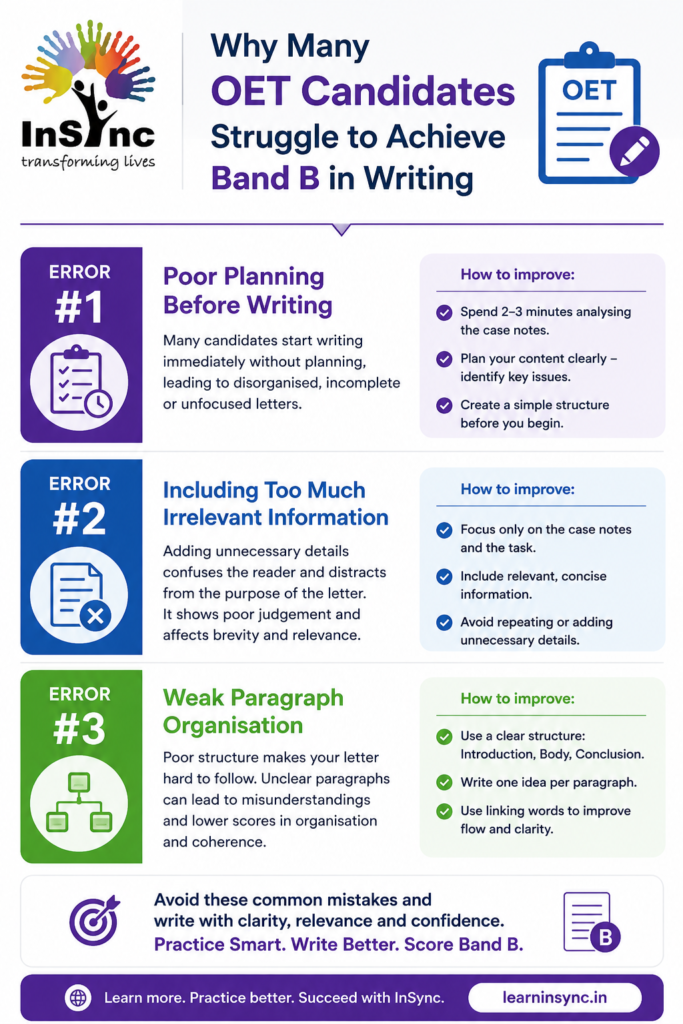
Error #1: Poor Planning Before Writing
One of the most common reasons candidates fail OET Writing is poor planning. Many test takers panic when they see the case notes and immediately start writing. As a result, their letters become disorganised, repetitive, and unclear.
Strong OET letters are not written randomly. They are carefully planned before the writing process begins.
Why Planning Matters in OET Writing
The OET Writing task gives candidates a large amount of information in a short period of time. Without proper planning, candidates often:
- miss important clinical details
- include irrelevant information
- repeat ideas unnecessarily
- create weak paragraph flow
- lose logical sequencing
This directly affects important assessment criteria such as Organisation & Layout, Conciseness & Clarity, and Genre & Style.
Experienced trainers often notice that candidates who struggle with Band B usually spend too little time analysing the case notes properly.
The Recommended 8-Minute Planning Method
A highly effective strategy used in professional OET preparation is the 8-minute planning approach.
This usually includes:
- 4 minutes selecting clinically relevant information
- 4 minutes organising paragraph structure and sequencing
Instead of copying every detail from the case notes, candidates should identify only the information that supports the purpose of the letter.
For example, if the task is a referral letter, the examiner expects information that helps the receiving healthcare professional continue patient care effectively. Irrelevant medical history or unnecessary social details can reduce clarity.
This is one reason why structured writing feedback is extremely important during OET preparation. At InSync Learning & Development, candidates receive detailed writing corrections, estimated grades, and practical guidance on selecting relevant information and improving letter organisation.
Many healthcare professionals preparing for UK and Australian registration also search for specialised programs such as OET Coaching in Bangalore because of the growing demand for healthcare-focused OET training in Karnataka.
How Poor Planning Affects Your OET Writing Score
Poor planning does not just make the letter look untidy. It affects almost every assessment area in OET Writing.
Candidates who skip planning often:
- jump between ideas without proper flow
- include information in the wrong paragraph
- forget important patient details
- write excessively long sentences
- lose focus on the purpose of the letter
As a result, the reader has to work harder to understand the message. In a real healthcare environment, unclear communication can create confusion and delay patient care. This is exactly why OET examiners place so much importance on organisation and clarity.
Another common issue is poor time management. Candidates who rush into writing usually spend too much time correcting mistakes later. Proper planning actually saves time because it gives the letter a clear structure from the beginning.
At InSync Learning & Development, candidates are trained through live interactive sessions, timed writing practice, and detailed assignment feedback so they learn how to structure letters efficiently under exam conditions. The institute also provides continuous progress checks, mock tests, and one-on-one guidance for candidates who need extra support in writing.
Healthcare professionals who are researching different training providers before joining an OET course often read resources like Top OET Coaching Centres in Chennai 2026 to understand what kind of support, feedback system, and trainer expertise can genuinely improve OET performance.
Error #2: Including Too Much Irrelevant Information
Another major reason candidates miss Band B is including unnecessary information from the case notes.
Many healthcare professionals believe they must use every detail provided in the notes. This is one of the biggest misconceptions in OET Writing.
The exam is not testing how much information you can copy. It is testing whether you can communicate clinically relevant information clearly and professionally.
Why Candidates Add Unnecessary Details
Most candidates include irrelevant details because they are afraid of leaving something important out. Others copy information directly from the notes without thinking about whether the receiving healthcare professional actually needs it.
This usually leads to:
- lengthy paragraphs
- reduced clarity
- repetition
- poor readability
- loss of focus on the purpose of the letter
For example, if a patient is being referred for physiotherapy, the examiner does not expect every minor detail from the patient’s previous medical history unless it directly affects current treatment or care.
Strong OET letters are selective. They focus only on information that supports the clinical purpose of the communication.
OET Writing Is Not a Case Note Copying Test
One of the most important things candidates must understand is that OET rewards effective communication, not information dumping.
Examiners prefer letters that are:
- concise
- organised
- clinically relevant
- easy to follow
- professionally structured
Candidates who try to include every case note often lose marks because the important information becomes hidden inside unnecessary detail.
This is where proper guidance and writing correction become extremely valuable. Through structured feedback, candidates learn how to identify which details support the purpose of the letter and which details should be excluded.
At InSync Learning & Development, candidates receive detailed writing evaluations with feedback on relevance, clarity, paragraph organisation, and professional tone. The training system also includes grammar support, speaking fluency classes, mock tests, and access to recorded lessons that help candidates continuously improve their communication skills.
Candidates who want to understand how to choose the right OET preparation program often explore guides such as How to Choose the Right OET Coaching for Healthcare Professionals before joining a course.

Error #3: Weak Paragraph Organisation
Even candidates with good grammar and strong vocabulary can lose marks if their paragraphs are poorly organised.
In OET Writing, the reader should be able to understand the patient’s situation quickly and easily. If the information is scattered randomly across the letter, the communication becomes difficult to follow.
Many candidates write long paragraphs that contain unrelated information. Others mix social background, medical history, current symptoms, and treatment recommendations together without proper sequencing. This creates confusion and weakens the overall clarity of the letter.
Why Paragraph Structure Is So Important
A well-organised OET letter should guide the reader naturally from one idea to the next.
Each paragraph should have a clear purpose. For example:
- introduction and referral purpose
- relevant medical background
- current condition and treatment
- recommendation or required follow-up
When paragraphs are organised properly, the letter becomes more professional and reader-friendly.
This is one reason why many experienced trainers recommend structured planning approaches such as SBAR thinking in OET Writing.
SBAR stands for:
- Situation
- Background
- Assessment
- Recommendation
Although candidates are not required to write formal SBAR headings in the exam, this framework helps healthcare professionals organise information more logically and communicate more effectively.
Common Paragraph Mistakes Candidates Make
Some of the most common paragraph-related mistakes include:
- writing extremely long paragraphs
- placing unrelated details together
- repeating information unnecessarily
- poor chronological sequencing
- unclear transitions between ideas
- weak referral purpose
These mistakes reduce readability and make it harder for the examiner to identify the important clinical information quickly.
Strong paragraph organisation becomes even more important in professions like nursing, where communication accuracy directly affects patient care and continuity of treatment.
At InSync Learning & Development, candidates are trained through small interactive batches, continuous writing evaluations, and detailed assignment feedback to improve structure, clarity, and professional communication. The program also includes up to 35 mock tests, speaking assignments, grammar support sessions, and access to expert preparation materials designed specifically for healthcare professionals.
What OET Examiners Really Look For
Many candidates focus too heavily on vocabulary and grammar while ignoring the actual purpose of the exam.
OET examiners are primarily looking for communication that is:
- clear
- concise
- clinically relevant
- professionally organised
- easy for the reader to follow
They want to see whether the candidate can communicate safely and effectively in a healthcare environment.
This means candidates should focus on:
- selecting relevant information
- organising ideas logically
- maintaining professional tone
- avoiding unnecessary detail
- understanding the purpose of the letter
In many cases, candidates already have the English ability needed to achieve Band B. The real challenge is learning how to apply that English effectively within a healthcare communication context.
This is why personalised feedback and guided correction play such an important role in OET preparation. Candidates often improve much faster when they receive detailed evaluation on their writing structure, relevance, and communication style instead of simply practising alone.
With more than 24 years of teaching experience, India’s 1st OET Teacher Trainer, and thousands of healthcare professionals trained successfully, InSync Learning & Development continues to support nurses and healthcare professionals through structured preparation, unlimited live classes until the test date, and continuous progress tracking designed to help candidates achieve their target scores.
Candidates can also explore student experiences and success stories through the Testimonials Page or connect directly through the Contact Page for course guidance and free trial class information.
For regular updates, student success stories, and healthcare-focused English preparation tips, candidates also follow InSync on LinkedIn and InSync on Instagram.

Frequently Asked Questions
Why do many nurses fail OET Writing even with good English?
Many healthcare professionals have acceptable English skills but still struggle in OET Writing because of poor planning, weak paragraph organisation, and the inclusion of irrelevant information. OET evaluates professional healthcare communication, not just grammar and vocabulary.
How much time should I spend planning my OET letter?
Most experienced OET trainers recommend spending around 8 minutes planning your letter before writing. A practical method is:
- 4 minutes selecting relevant case notes
- 4 minutes organising paragraph structure and sequencing
Proper planning improves clarity, organisation, and conciseness.
What is the biggest mistake candidates make in OET Writing?
One of the biggest mistakes is copying too much information directly from the case notes. OET examiners expect candidates to select only clinically relevant details that support the purpose of the letter.
How can I improve my OET Writing score faster?
Candidates usually improve faster when they receive detailed writing corrections and personalised feedback. Timed practice, paragraph organisation training, mock tests, and understanding examiner expectations are also important for improving OET Writing performance.
Is grammar the most important part of OET Writing?
No. Grammar is important, but OET Writing mainly focuses on clear and effective healthcare communication. Examiners also assess organisation, clinical relevance, professional tone, and how easily the reader can understand the letter.
What is the SBAR approach in OET Writing?
SBAR stands for:
- Situation
- Background
- Assessment
- Recommendation
It is a structured communication method widely used in healthcare settings. Many OET candidates use SBAR-style thinking to organise their letters more clearly and logically.
Can I prepare for OET Writing without coaching?
Some candidates do prepare independently, but many struggle to identify their mistakes without professional feedback. Detailed correction, mock tests, and guidance from experienced OET trainers often help candidates improve more efficiently and avoid repeated writing errors.