
CELPIP vs IELTS for Canada PR 2026: Which Is Easier for Indian Applicants?
If you are applying for Canadian permanent residence from India, you will hit this question early: CELPIP-General or IELTS General Training?
Both are accepted by Immigration, Refugees and Citizenship Canada (IRCC). Neither is officially “easier” — IRCC does not rank them by difficulty because both measure the same language benchmarks. But in practice, the two exams feel very different. The right choice depends on where you live in India, how comfortable you are with computer-based testing, and how you perform under different speaking conditions.
This guide covers every difference that matters — IRCC acceptance rules, CLB score equivalency, test format, speaking style, availability in India, and result speed.
What IRCC Accepts for Canada PR
Start here, because this is where many Indian applicants make a costly mistake.
For Express Entry and most IRCC permanent residence pathways, only two English language tests are accepted:
- CELPIP-General
- IELTS General Training
Tests Not Accepted for Express Entry
Two versions are not accepted for Express Entry:
- IELTS Academic — widely used for Canadian university admissions, but IRCC does not accept it for PR. Many applicants assume their academic scores will carry over. They do not. If you have already sat IELTS Academic, you need a fresh IELTS General Training attempt for immigration purposes. Still unclear on the difference between the two IELTS versions? Our post on IELTS Academic vs General Training explains exactly when each version applies.
- IELTS One Skill Retake — a newer format that lets you resit a single skill. IRCC does not currently recognise these partial results for Express Entry. You must submit a full test attempt. One more version to watch: CELPIP-General LS covers only Listening and Speaking — it is used for Canadian citizenship applications, not permanent residence. If you are at the PR stage, you need the full CELPIP-General covering all four skills. Booking the wrong version is a common and avoidable error.
CELPIP vs IELTS: Key Differences at a Glance
| Feature | CELPIP-General | IELTS General Training |
|---|---|---|
| Accepted for Canada PR | ✅ Yes | ✅ Yes |
| Test delivery | Fully computer-based | Paper-based or computer-based |
| Speaking format | Recorded responses to on-screen prompts | Face-to-face with a human examiner |
| Writing format | Typed (email + survey response) | Handwritten or typed (letter + essay) |
| Duration | ~3 hours, single sitting | ~2 hrs 45 min + Speaking on a separate day (paper) |
| Results timeline | 2–4 business days | 1–3 days (computer); ~7 days (paper) |
| Test centres in India | 5 cities | 140+ venues |
| Score validity for IRCC | 2 years | 2 years |
| Scoring scale | 1–12 (CLB maps 1:1) | 0–9 bands (CLB conversion varies by skill) |
CLB Equivalency: The Scores That Actually Matter for IRCC
IRCC does not rank you by IELTS band scores or CELPIP scores directly. It converts both into Canadian Language Benchmarks (CLB) — and your CLB level determines your Comprehensive Ranking System (CRS) points in Express Entry.
Most competitive applicants aim for CLB 9 across all four skills. Here is how both tests map to that target:
IELTS General Training → CLB
| CLB Level | Listening | Reading | Writing | Speaking |
|---|---|---|---|---|
| CLB 10 | 8.5 | 8.0 | 7.5 | 8.0 |
| CLB 9 | 8.0 | 7.0 | 7.0 | 7.0 |
| CLB 8 | 7.5 | 6.5 | 6.5 | 6.5 |
| CLB 7 | 6.0 | 6.0 | 6.0 | 6.0 |
CELPIP-General → CLB
| CLB Level | Listening | Reading | Writing | Speaking |
|---|---|---|---|---|
| CLB 10 | 10 | 10 | 10 | 10 |
| CLB 9 | 9 | 9 | 9 | 9 |
| CLB 8 | 8 | 8 | 8 | 8 |
| CLB 7 | 7 | 7 | 7 | 7 |
The critical difference most applicants miss:
On CELPIP, a score of 9 in every skill equals CLB 9 in every skill — clean and predictable.
On IELTS General Training, CLB 9 requires L 8.0 / R 7.0 / W 7.0 / S 7.0 — not 7.0 across the board. A 7.0 in IELTS Listening maps to only CLB 8, which costs you CRS points. Many applicants score 7.5 in three skills and 7.0 in Listening and are confused why their Listening registers as CLB 8 — this asymmetry is the reason.
CELPIP’s 1:1 CLB mapping removes that guesswork entirely, which some applicants find genuinely easier to plan around.
Speaking: The Biggest Practical Difference
Of all the format differences, Speaking creates the clearest split between candidates.
IELTS General Training Speaking
An 11–14 minute face-to-face conversation with a trained examiner. Three parts: an introduction and interview, a long turn where you speak for 1–2 minutes on a cue card topic, and a two-way discussion. Scored on fluency, lexical resource, grammatical range, and pronunciation.
The examiner follows a structured script but responds naturally — which can help or unsettle candidates depending on their confidence in live conversation.
CELPIP-General Speaking
Done entirely on a computer with no human in the room. You read a prompt on-screen and record your spoken response. Eight tasks covering everyday situations: giving advice, describing a scene, expressing an opinion, leaving a phone message.
For Indian test-takers, reactions split clearly. Many find CELPIP Speaking less pressured — no examiner, no social anxiety, no concern about how accent or eye contact is being received. Others find speaking into a screen genuinely uncomfortable because there are no conversational cues to follow.
Practical guidance: If nervousness in face-to-face situations has cost you marks before, CELPIP Speaking may suit you better. If you find a screen cold and unnatural, the IELTS format will feel more familiar.
For those going the IELTS route, our post on IELTS Speaking Band 9 — tips from a former examiner is worth reading before you book.
Writing: Typed vs Handwritten
CELPIP Writing is fully typed. Task 1 is an email; Task 2 is a response to a survey or online discussion. Both reflect everyday professional writing.
IELTS General Training Writing on paper requires handwriting in a booklet. Task 1 is a letter; Task 2 is a discursive essay. If you sit computer-delivered IELTS, you type — but the task formats remain the same.
For most Indian professionals who use computers daily — IT workers, engineers, nurses, doctors — typing at length is natural. Writing by hand under timed pressure is a separate skill that many have simply not practised in years.
If you plan to sit IELTS and want to strengthen your Writing score, our IELTS Writing Task 2 Band 7 guide covers exactly what examiners look for and where most Indian candidates lose marks.
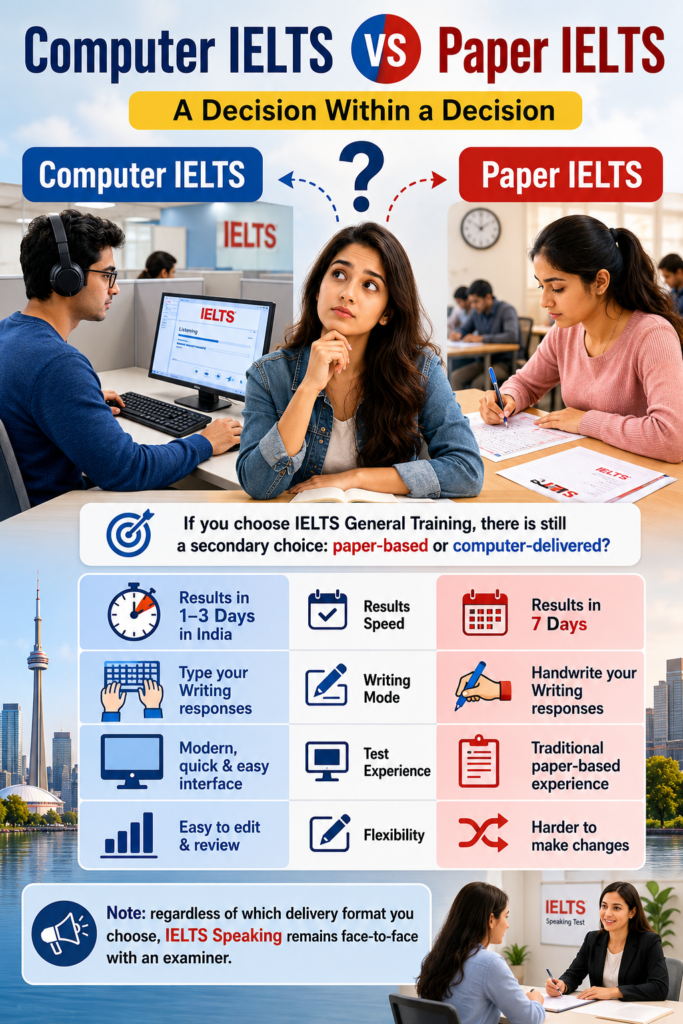
Computer IELTS vs Paper IELTS: A Decision Within a Decision
If you choose IELTS General Training, there is still a secondary choice: paper-based or computer-delivered?
This matters because computer IELTS returns results in 1–3 days in India versus 7 days for paper, and you type your Writing responses rather than handwriting them. We have covered this in full in our post on Computer IELTS vs Paper IELTS in India — worth reading before you book.
Note: regardless of which delivery format you choose, IELTS Speaking remains face-to-face with an examiner.
Test Availability in India
IELTS General Training is available at 140+ venues across India through IDP and British Council — metros, Tier-2, and Tier-3 cities. Wherever you are based, a centre is likely within reach.
CELPIP-General is currently available in five Indian cities only: New Delhi, Chandigarh, Ahmedabad, Chennai, and Hyderabad. If you live elsewhere, you would need to travel.
For applicants in Tamil Nadu, both exams are accessible. IELTS has multiple venues across Chennai and nearby cities, and CELPIP is available in Chennai. Our IELTS coaching centre in Chennai prepares candidates for IELTS General Training with dedicated Canada PR score targets, and our CELPIP programme is available for those who prefer the computer-based route.
Results Timeline and the 2-Year Validity Rule
- CELPIP-General: Scores available online in 2–4 business days.
- IELTS General Training:
- Computer-delivered: 1–3 days in India
- Paper-based: approximately 7 days
Both test results are valid for 2 years from the test date. IRCC requires your language results to be less than 2 years old at the time of application submission — not when you first created your Express Entry profile.
This catches applicants out regularly. If you test early and your ITA takes 18+ months to arrive, your scores may expire before you can submit. Time your test relative to your realistic ITA timeline, and budget for a retake if you are in a longer draw cycle.
Our post on how long to prepare for IELTS helps you build a test timeline that accounts for both preparation and validity window.
Which Test Should You Choose?
Neither exam is the universal right answer. Here is a straightforward framework:
Choose CELPIP-General if:
- You prefer a fully computer-based format with no face-to-face speaking
- You are based in Delhi, Chandigarh, Ahmedabad, Chennai, or Hyderabad
- You want a single uninterrupted sitting with no separate Speaking appointment
- The 1:1 CLB scoring scale makes planning simpler for you
- You want results in under a week
Choose IELTS General Training if:
- You live outside the five CELPIP cities and need a local test venue
- You have previously trained for IELTS and know the format
- You prefer speaking to a real person over recording into a microphone
- You want access to a wider range of coaching materials and mock tests
One practical point worth adding: IELTS has a far larger preparation ecosystem in India. More coaches, more mock test platforms, more freely available materials. That advantage narrows considerably with structured coaching — but if you plan to self-study, IELTS preparation resources in India are more abundant.
How to Prepare — Whichever You Choose
Hitting CLB 9 consistently across four skills requires targeted preparation, not just strong everyday English. Most candidates who fall short do so in Writing or Speaking.
For IELTS General Training, Writing Task 2 and Speaking Part 2 are where the majority of Indian applicants lose the marks they needed. Understanding what the examiner is scoring — not just writing or speaking fluently — is the difference between Band 6.5 and Band 7.0.
For CELPIP, the Speaking tasks feel unfamiliar at first. Fluency with the on-screen prompt format comes from repeated timed practice, not from general English ability.
At InSync, our IELTS coaching centre in Chennai is led by Shane Jordan — a former British Council IELTS Examiner with 24 years of experience, 765+ Google reviews at 4.9/5, and an 80% first-attempt success rate. Our CELPIP programme runs alongside it with the same structured approach: live classes, mock tests, and detailed feedback on every attempt.

Key Takeaways
- For Canada PR via Express Entry, only CELPIP-General and IELTS General Training are accepted. IELTS Academic and IELTS One Skill Retake are not.
- CELPIP-General LS is for citizenship only — not PR. Book the full CELPIP-General.
- IRCC uses CLB, not raw scores. CLB 9 on IELTS = L 8.0 / R 7.0 / W 7.0 / S 7.0. On CELPIP = 9 in all four skills.
- CELPIP Speaking is computer-recorded. IELTS Speaking is face-to-face with an examiner.
- IELTS has 140+ venues in India. CELPIP has 5 cities.
- Both scores are valid for 2 years from test date — plan your timing carefully.
- Computer IELTS results: 1–3 days. CELPIP results: 2–4 days. Paper IELTS: ~7 days.
Frequently Asked Questions
1. Is CELPIP easier than IELTS for Canada PR?
Neither is officially easier. Both are calibrated to the same CLB levels. CELPIP may feel more manageable if you prefer computer-based speaking; IELTS may feel more natural if face-to-face conversation suits you. The right choice depends on your strengths and test access.
2. Does IRCC accept IELTS Academic for PR?
No. IRCC requires IELTS General Training for Express Entry and most PR pathways. Academic scores from a university application cannot be submitted for immigration.
3. Which test gives results faster in India?
Computer-delivered IELTS returns scores in 1–3 days — the fastest option. CELPIP returns scores in 2–4 business days. Paper IELTS takes approximately 7 days.
4. Is CELPIP available in India?
Yes, but only in five cities: New Delhi, Chandigarh, Ahmedabad, Chennai, and Hyderabad. Applicants elsewhere would need to travel.
5. What CLB score do I need for Canada PR?
The minimum for Federal Skilled Worker eligibility is CLB 7 in all four skills. In practice, most successful Express Entry applicants score CLB 9 or above. Each CLB level above the minimum adds CRS points.
6. Is CELPIP-General LS accepted for PR?
No. CELPIP-General LS is for citizenship applications only. For PR, you need the full CELPIP-General covering all four skills.