
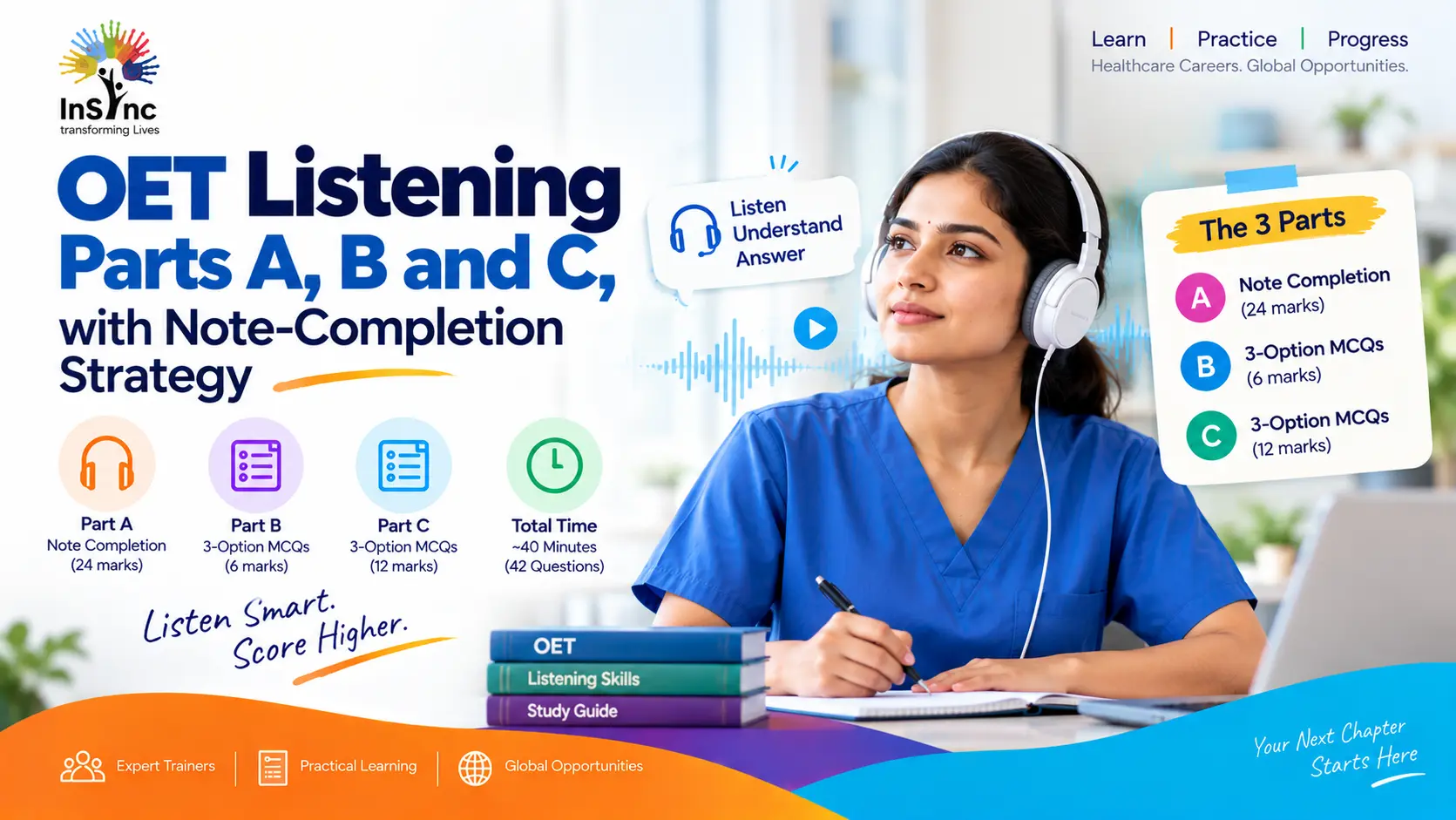

The three parts of OET Listening are not worth the same, and the numbering hides it. Part A alone carries 24 of the 42 marks, which is more than Parts B and C put together, and it is the only part of Listening where you write words instead of shading a lozenge. A study week split evenly across the three therefore spends a third of its time on 14 per cent of the marks. This page sets out the mark structure, the rules OET applies to note completion, the arithmetic behind a Grade B, and what candidates actually get wrong, using OET’s own published figures and 38 forum threads from 2026. If the test as a whole is still unfamiliar, start with the Occupational English Test.
OET Listening splits 42 marks across three parts, and Part A holds 24 of them
The sub-test runs about 40 minutes, contains three parts and 42 questions, and awards one mark per correct answer. OET publishes the distribution openly, and it is lopsided in a way the part numbering hides.
| Part | Task type | Recordings | Questions | Marks | Share of the sub-test |
|---|---|---|---|---|---|
| Part A | Note completion | Two consultations | 24 | 24 | 57 per cent |
| Part B | 3-option multiple choice | Six short extracts | 6 | 6 | 14 per cent |
| Part C | 3-option multiple choice | Two presentations or interviews | 12 | 12 | 29 per cent |
Sources: OET’s Listening preparation page for the mark distribution, and the OET Test Handbook 2026 for task types and question counts. The share column is our arithmetic.
Listening is identical for every candidate regardless of profession, which separates it from Writing and Speaking, and it is worth reading alongside how the test is structured to see where that line falls. And because each part has a different number of recordings, the cost of losing concentration is not constant across the sub-test.
Part A pairs two consultation recordings with medical notes, and each extract carries 12 marks
The OET Test Handbook 2026 sets out the task. In Part A you hear two recordings from different consultations between a healthcare professional and a patient. Each one comes with a set of incomplete medical notes, and you fill the gaps as you listen. Twelve questions attach to each extract, so a single recording is worth 12 marks, or 29 per cent of the whole sub-test.
That concentration is the reason Part A punishes a lapse harder than anywhere else in the test. Lose the thread thirty seconds into the first consultation and you are inside a block worth 12 marks with no second play, because OET runs every recording once only. In Part B, the same lapse costs one mark, since each of the six short extracts carries exactly one question. The marks per recording run 12 in Part A, 6 in Part C and 1 in Part B.
OET describes the Part A material only as a set of incomplete medical notes, and leaves the rest to the sample tests. From teaching the task, the practical point is that the notes are laid out in the order the consultation follows, so reading them before the audio starts turns the task from hunting for an answer into waiting for one. That is our observation rather than an OET instruction.
Note completion accepts the words you hear, and rejects your paraphrase of them
OET is specific about what a Part A answer may contain, and the rule runs against the instinct most candidates bring from academic writing. You complete the notes using the same word or short phrase you hear in the recording. You should not paraphrase the information, and you should not change it.
OET also lists what loses the mark, which is more useful than the positive rule because it names the four failure modes directly. You lose marks if you repeat words already printed in the notes, if you add information that is not in the recording, if you contradict yourself, or if you leave your meaning unclear. Each of those four is a habit rather than a gap in listening ability, which in our teaching is the reason they respond to practice faster than comprehension does.
Where the answer goes matters too. You write Part A answers in the space provided in the question booklet, while Parts B and C are recorded by shading the lozenge next to the option you choose. OET states plainly that answers written anywhere else in the booklet will not be marked, which turns a margin scribble into a lost mark rather than a rough draft.
Source: OET’s Listening preparation page, frequently asked questions.
Listening treats a misspelling more leniently than Reading does, and OET prints the difference
This is the detail that most often gets repeated wrongly, and OET settles it in a handful of FAQ lines across two of its own pages. In Reading, a response that is not spelled correctly receives no marks at all, and abbreviations are refused unless they appear in the texts. In Listening, OET says there is more flexibility than in Reading, but that you may still lose marks for spelling. The Reading page goes as far as stating outright that the two sub-tests differ in how misspellings are treated. Reading also collects the Part A booklet after 15 minutes, so there is no checking time later, which is one of several places where the OET test format separates two tasks that look alike on paper.
| Rule | Reading Part A | Listening Part A |
|---|---|---|
| Wording of the answer | Exactly the same form of the word or phrase as in the texts | The same word or short phrase as heard, not paraphrased |
| Misspelled answer | Receives no marks | More flexibility than Reading, but marks may still be lost |
| Abbreviations | Not accepted unless they appear in the texts | OET publishes no equivalent rule for Listening |
| Grammar errors | Not addressed separately | Can cost marks, since structure evidences proficiency |
| Spelling variants | British and American both accepted, such as foetus and fetus | OET publishes no equivalent rule for Listening |
Sources: OET on the Reading sub-test and OET on the Listening sub-test, both read 26 September 2026. The two blank cells mark rules that the Reading page states and the Listening page does not; we checked the Listening page for both and found neither.
Read that table as licence to write fast, not as licence to write carelessly. OET’s stated reason for marking spelling at all is that accurate spelling demonstrates an understanding of how sounds form in speech, and that medical records depend on it. Its own guidance on medical vocabulary draws the line at terms in public circulation, naming diabetes and cholesterol as the kind of word you are expected to spell correctly, rather than rare clinical terminology.
Grade B sits near 30 of 42 marks, and the boundary shifts with each test version
Scores out of 42 are converted to the 500 scale, and OET states that candidates awarded Grade B, a scale score of 350, will typically have at least 30 marks. It attaches an important qualification to that number. New listening tests are written for each test session with new material, so grade boundaries are adjusted slightly for each version to allow for differences in item difficulty, and the marks needed for a B therefore vary.
Treat 30 as a planning figure rather than a pass mark, and the mark distribution starts giving instructions. Parts B and C together are worth 18 marks. A candidate who answers every single question in both parts correctly, and scores nothing in Part A, finishes 12 marks short of 30. By that arithmetic Part A is not one part of three but the part that sets the ceiling, and any study plan that treats it as a third of the work has already capped the score it can produce.
| If you score | Part A (of 24) | Parts B and C (of 18) | Total against a 30-mark guide |
|---|---|---|---|
| Everything except Part A | 0 | 18 | 18, twelve short |
| Half of Part A, all the rest | 12 | 18 | 30, at the guide |
| All of Part A, a third of the rest | 24 | 6 | 30, at the guide |
| Three quarters across the board | 18 | 13, rounded down from 13.5 | 31, just above |
Source: mark totals from OET’s Listening preparation page; the Grade B guide of at least 30 marks is OET’s, the combinations are our arithmetic and not an OET scoring table.
The audio runs once, and your checking time depends on the mode you booked
Every recording plays once, which is why OET tells candidates to write answers in the booklet as they listen rather than after. What differs between delivery modes is when you get to look back at what you wrote.
On paper, you receive two minutes at the end of the whole sub-test to check your answers across all three parts. On computer and OET@Home, there is instead a short pause at the end of each question. The paper version gives you one pooled block of review time and asks you to ration it across 42 answers; the computer version hands back a pause after every question and removes the choice. OET does not say how long those pauses run, so treat the computer version as review you cannot bank, and settle the point alongside taking OET on computer before you book rather than discovering it on test day.
In May 2026 a candidate asked on a public forum whether the computer version gives extra time at the end of each Part A extract or moves straight into the next one. OET’s published answer is the per-question pause, which is a different mechanism from the extract-level break the question assumed.
Accents span Australian, British and American, with four more named in the mix
OET’s own answer on accents is a list rather than a single name: a range runs across all three parts, with Australian, British and American given as the main ones and New Zealand, Irish, Canadian and South African among the others. Its stated reason is that the healthcare workforce is global, and a nurse on a UK ward hears colleagues from everywhere. The question is asked less often than teaching experience suggests it should be, since across the 824 threads only three mention accents at all and just one asks which to prepare for.
The practical consequence is about exposure rather than accent study. Neither the Listening page nor the Test Handbook says anything about accent affecting how answers are marked, so naming three as the main ones is a statement about what you will hear and not about how you will be scored, and there is no case for drilling one and ignoring the rest. Since the same sub-test goes to every candidate regardless of profession, the spread is not something your profession or your preparation centre changes.
Candidates raise Part A and Part C by name, and never raise Part B on its own
To see which parts actually cause trouble, we searched a cleaned corpus of 824 Reddit threads about the OET posted between 1 February and 18 September 2026. Thirty-eight carried Listening in the title, spanning 22 February to 15 September. Counting which parts those threads name, in the title or the body, produces a pattern that is not the one the mark distribution would predict.
| Named in the thread | Threads | Marks at stake | What the threads are about |
|---|---|---|---|
| Part A | 10 of 38 | 24 | Exact wording, spelling of a heard term, timing between the two extracts |
| Part C | 8 of 38 | 12 | Losing the thread of a long argument and guessing the remaining questions |
| Part B | 5 of 38 | 6 | Every thread that names it also names Part C somewhere |
Source: our analysis of 824 Reddit threads dated 1 February to 18 September 2026, of which 38 name Listening in the title. Thirty-three of those 38 come from one subreddit for candidates pursuing US certification, so the sample skews toward doctors rather than nurses. Counts are ours, taken from thread titles and bodies, counting any named part whether the thread writes part or section, and a thread naming more than one part is counted under each.
Five threads name Part B, and every one of them names Part C as well, three of them inside a single phrase such as parts B and C. Not one raises Part B as a problem on its own, and the closest any comes is a candidate noting it went fine before describing Part C as a guessing game. That fits a part worth six marks spread one to a recording: hard to lose enough there to notice, and hard to gain enough there to repair a score.
One candidate asked in May 2026 whether writing extasis when the recording said ecstasy would be marked wrong, which is exactly the spelling question OET answers with its more flexibility than Reading wording rather than a yes or no. Another, in June 2026, described getting Part A comfortably and Part B solidly, then losing the thread early in Part C and guessing the rest. Four of the 38 threads state a repeat failure outright, ranging from twice to nine attempts, and the candidate at the far end reported passing every other sub-test while failing Listening nine times.
A pattern of repeat failure in one skill while the others pass is not a listening problem in the ordinary sense, and it is the situation covered in our note on why Indian doctors struggle to pass OET. In our experience it more often means a fixable technique is being repeated under pressure than a comprehension ceiling being hit, though nothing in the threads themselves establishes which.
Listening rewards targeted repair more than repeated full tests
OET’s own recommendation on practice cadence is one test every two to three weeks, with the interval spent working on whatever the last test exposed. It states the reasoning bluntly: taking test after test improves test-taking skill without improving language skill, and language is what moves the grade.
For Listening that cadence turns into a specific week. Take one full sub-test under timed conditions. Mark it against the answer key, then sort the errors by part, because a Part A error and a Part C error have nothing in common, and 24 of the 42 marks sit in the first of them. Errors in Part A tend, in our marking, to land on one of OET’s four named failure modes, and each has its own drill: rereading the note headings before the audio, writing exactly what you hear, and resisting the urge to tidy a phrase into better English. Part C errors are usually structural, a lost argument rather than a missed word, and respond to listening again with the transcript open.
Two cautions from teaching the task, offered as our view rather than OET policy. A transcript works better as a repair tool than as a practice mode, because reading along while listening removes the thing being tested. And if your Part A answers are right in substance but wrong in form, more listening practice will not help at all, because the comprehension was never the problem. Candidates working without a teacher will find the structure for this in our guide to preparing for OET on your own, and those working to a deadline in OET preparation on a short timeline.
The quietest sub-test carries the same 350 as the loudest
Listening attracts the least discussion of the four sub-tests. In the same forum corpus, counting the same way for all four, Speaking appears in 172 thread titles and Writing in 98, against 42 for Reading and 38 for Listening. The Speaking figure overstates the gap, because 62 of those 172 are candidates looking for a practice partner, a post type Listening has no version of. Strip them out and the order is unchanged, with Listening still last. Listening is reported on the same 0 to 500 scale in ten-point increments and carries the same letter grade from A to E. OET’s Test Regulations state that, to meet Recognising Organisations’ requirements, candidates must attain a minimum score for each of the measured sub-tests, which is why a weak Listening score can hold up an application on its own. OET tells candidates to confirm the figures that apply to them with the organisation they are applying to.
A sub-test with 24 of its 42 marks sitting in one task type, and with the rules governing that task type stated plainly enough to train against, rewards preparation aimed at the rules rather than at listening in general. If you want that structured rather than improvised, OET coaching at InSync runs online and from the Egmore centre in Chennai, and the Listening work starts with the note-completion habits above.
Frequently asked questions
How many questions are in the OET Listening sub-test?
There are 42 questions across three parts, and the sub-test runs about 40 minutes. Part A has 24 questions, Part B has 6 and Part C has 12. Each correct answer is worth one mark, and the total out of 42 is converted to the 500 scale.
What is OET Listening Part A?
Part A is a note-completion task. You hear two recordings from different consultations between a healthcare professional and a patient, each with a set of incomplete medical notes, and you fill the gaps with one word or a short phrase from the recording. Each extract carries 12 questions, so Part A is worth 24 marks in total.
Do I lose marks for spelling mistakes in OET Listening?
You may. OET states there is more flexibility in Listening than in Reading, where an incorrectly spelled response receives no marks at all, but it also says marks can be lost for spelling in Listening. For medical vocabulary, OET expects correct spelling of terms in public circulation, giving diabetes and cholesterol as examples.
Can I paraphrase the answer in Part A?
No. OET requires the same word or short phrase you hear in the recording, without paraphrasing and without changing the information. Marks are lost for repeating words already printed in the notes, adding information that is not in the recording, contradicting yourself, or leaving the meaning unclear.
How many marks do I need for a B in OET Listening?
OET states that candidates awarded Grade B, a scale score of 350, typically have at least 30 of 42 marks. It also says new listening tests are written for each session and grade boundaries are adjusted slightly for each version, so the exact number required varies from test to test.
Is the OET Listening sub-test the same for all professions?
Yes. Listening is identical for every candidate regardless of profession, and OET describes the topics as of generic healthcare interest. Only Writing and Speaking are profession-specific.
Which accents are used in the OET Listening recordings?
OET uses a range of accents across all three parts. It names Australian, British and American as the main accents, with New Zealand, Irish, Canadian and South African among the others, and gives the global nature of the healthcare workforce as the reason.
Do I get time to check my Listening answers?
It depends on the mode. On paper you get two minutes at the end of the sub-test to check your answers for all three parts. On computer and OET@Home there is a short pause at the end of each question instead. Every recording plays once only in both cases.
Where do I write my Listening answers?
Part A answers go in the space provided in the question booklet. For Parts B and C you shade the lozenge next to your chosen answer. OET states that answers written elsewhere in the booklet will not be marked.
Where can I find official OET Listening practice material?
OET publishes free sample tests, with separate versions for paper and for computer or OET@Home, and sells a self-paced Listening course containing six Part A, sixteen Part B and six Part C tasks with transcripts and answer keys. OET recommends one practice test every two to three weeks and advises against unofficial material circulating on social media.