
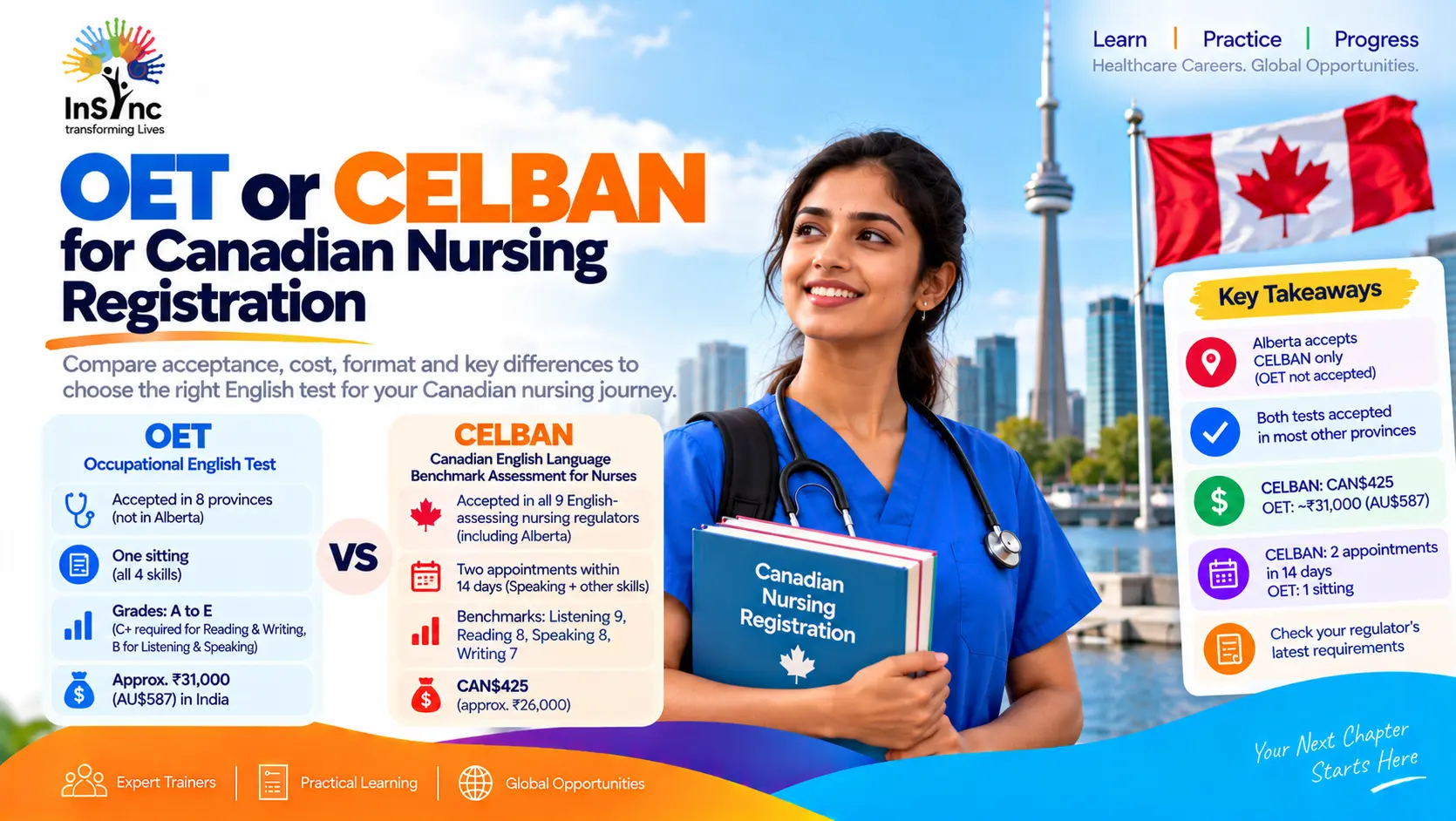
If you are heading for Alberta, stop reading comparisons. The College of Registered Nurses of Alberta accepts two language tests, and OET is not one of them. That single line decides this question for every nurse bound for Edmonton or Calgary who has to sit a test at all, and it is nowhere on the first page of Google for this search.
For the rest of Canada both tests are live options, and the choice turns on five things: which regulator holds your file, how many appointments you can protect in a fortnight, which scale your evidence has to land on, what the repair costs when one skill falls short, and whether you can actually sit the thing from where you live.
What this page settles, and where each answer comes from
• The one province where the choice is already made, with the regulator’s own wording.
• Why the people who ran CELBAN rate it closer to OET than to IELTS.
• One sitting against two appointments fourteen days apart, and what happens on day fifteen.
• CAN$425 against AU$587 in rupees, plus the rescore, reschedule and cancellation charges on both sides.
• Whether an Indian nurse can register for CELBAN at all, which the sources answer more clearly than the forums do.
Alberta accepts CELBAN and refuses OET, so one province decides this before any other criterion applies
The College of Registered Nurses of Alberta publishes its accepted tests in a sentence that leaves no room: it accepts the Canadian English Language Benchmark Assessment for Nurses and IELTS Academic. CELBAN at Listening 9, Writing 7, Reading 8 and Speaking 8. IELTS Academic at Listening 7.0, Writing 6.5, Reading 6.5, Speaking 7.0 and an overall 7.0. Both expire two years from the date you complete the test, and the college adds that it may consider a result beyond the expiry if you tell it.
Of the nine registered-nursing regulators we read that assess English, every one accepts CELBAN and every one except Alberta accepts OET. Quebec sits outside the comparison, because it requires French, assessed through the Office quebecois de la langue francaise, and publishes no English test requirement. So the acceptance question is asymmetric, and the asymmetry runs one way.
| Regulator | Accepts CELBAN | Accepts OET | Detail worth knowing |
|---|---|---|---|
| CRNA, Alberta | Yes | No | CELBAN or IELTS Academic only; results expire after two years |
| CNO, Ontario | Yes | Yes | Six tests accepted, including the IELTS One Skill Retake |
| BCCNM, British Columbia | Yes | Yes, in person only | Nurses who applied after 31 January 2023 are assessed by Inspire Global Assessments; BCCNM’s own table marks OET, IELTS and PTE in-person only and CELBAN in-person or online |
| CRNS, Saskatchewan | Yes | Yes | All components must be met on one test |
| NSNMR, Nova Scotia | Yes | Yes | IELTS, CELBAN, OET and PTE; it may download results directly or ask the test centre to forward them |
| CRNM, Manitoba | Yes | Yes | CELBAN accepted whether taken virtually or in a writing centre |
That table is the short version of a longer map. For the full picture, including the regulators that publish non-test routes, start with the score Canada wants. The province-by-province list, including Quebec and the territories, sits on which provinces accept OET.
CELBAN tests nurses only, and its own developers rate it closer to OET than to IELTS
Here is the fact that reframes the whole comparison, and it comes from the test’s own administrators rather than from a prep provider. In a 2016 retrospective in the TESL Canada Journal, two people who had run CELBAN cited their own earlier 2013 work for the proposition that CELBAN is more comparable to the Occupational English Test than to IELTS. The same article records that the seminal work of McNamara, whom it describes as a developer of both IELTS and OET, informed CELBAN’s development.
The resemblance is not an accident of marketing. When CELBAN’s developers examined adapting the speaking role plays for physicians, physiotherapists, pharmacists and midwives from 2009, that applied research was informed by OET’s conceptual model, in which Speaking and Writing are specific to each profession while the same Listening and Reading are given to all of them. The two tests were built separately, from the same body of language-testing thought, and CELBAN looked at OET’s model when it considered growing beyond nursing.
Which produces the cleanest structural difference between the two. OET is profession-specific in two skills of four, because the nursing version of the test shares its Listening and Reading papers with eleven other professions. Its rival is nursing-specific in all four, because it exists for nobody else: its listening scenarios are set in hospitals, homes, clinics and medical offices, its reading passages are charts, patient notes, manuals and short articles, and its writing starts from an incident report.
Neither design is automatically better for you. Shared Listening and Reading papers mean OET’s hardest two sub-tests were not written for nurses, which is a real disadvantage. A test built only for nurses has a far smaller candidate pool to calibrate against, which is a different kind of risk. What the research does establish is that these two tests are siblings, so anyone telling you they are different species is working from the IELTS comparison instead.
Sittings rules differ by regulator, and CELBAN needs two appointments inside fourteen days whatever they say
Ask how many sittings a regulator allows and the answers scatter, which is the opposite of what most comparison pages assume.
| Regulator | What its own policy says about sittings |
|---|---|
| CRNS, Saskatchewan | All components must be met on one test |
| CNNB, New Brunswick | The four components may come from two sittings of the same test within six months, with no mixing of components from different tests; results valid two years from writing |
| PEICNM, Prince Edward Island | Two sittings allowed within six months, provided all four sections were tested together except where a one-skill retake exists, no score sits more than one band below the cut, and both sittings fall inside two years |
| CRNNL, Newfoundland and Labrador | Scores valid two years, recommended to be within six months at initial application, and applicants may be eligible to retake individual sections |
| CRNA, BCCNM, CRNM, CNO, NSNMR | No sittings rule published in the pages we read |
Against that scatter, the two tests behave very differently. OET on Paper, which is the version sat at a venue, states on its own page that all four sub-tests must be taken the first time you sit the test and that you complete all of them on the same day at the same venue. CELBAN is two separately booked appointments that have to land inside a fortnight, and that is the most operationally consequential difference on this page.
Delivery splits in two: a Speaking Test, which is a virtual interview, and a computer-based test carrying Listening, Reading and Writing. Its own instruction is that both parts must be scheduled and completed within fourteen days of one another for the Centre to validate your results. Miss that window and you have not taken CELBAN. You have taken two unrelated appointments. One published escape exists and it is narrow. The Centre says it will grant an extension beyond the fourteen-day period to examinees affected by COVID-19, on an Exceptional Circumstances Request, with supporting documentation such as a medical note, a quarantine notice or a letter from an employer. No other ground for extending the window is published.
The rules that bite, in CELBAN’s own words
• No partial tests. Applicants must complete both parts within fourteen days of one another, in the Centre’s phrasing, regardless of any previous passing scores.
• No combining. Results are not issued with scores from two different registrations, and combining scores across two attempts is not permitted. A skill you already passed does not carry forward.
• Five minutes for the interview. Arrive later than five minutes after your Zoom slot and you will not be allowed to take the test.
• Thirty minutes for the computer test, whether you sit it at home or at a test centre. A no-show counts as an absence and the appointment is terminated without refund.
• Unlimited attempts, but no overlapping ones. Both parts of one attempt must finish before the next begins.
The attempt limit is worth a sentence of history, because the stale advice is still circulating. The 2016 journal article describes CELBAN test-takers as restricted to a maximum of three attempts. The current FAQ states there is no limit on the number of times CELBAN can be taken. The rule changed; the old number did not stop being quoted.
The constraint on the OET side is softer in one way and harder in another. There is no fourteen-day window to protect and no second appointment to lose. But OET sells single sub-test resits, and whether a regulator will look at one is the regulator’s decision rather than OET’s, which is the trap OET scores by regulator exists to close.
Fourteen listening tasks against forty-two questions: the two tests ask for different kinds of attention
Timetables tell you less than task design does. OET runs about two hours forty-five minutes of assessment across its four sub-tests. CELBAN runs a two and a half hour computer test plus an interview of up to thirty-five minutes, so a little over three hours across two appointments. What each does with that time diverges.
| Skill | CELBAN | OET |
|---|---|---|
| Listening | 45 minutes, 13 to 14 tasks, clips from 30 seconds to 3.5 minutes, one to twelve questions each, multiple choice plus chart completion | About 40 minutes, 42 questions across three parts, opening with note completion from two consultations |
| Reading | 40 minutes, four tasks, six to ten questions per text, final task a gap-fill from word options | 60 minutes, 42 questions, with Part A’s 20 questions inside 15 minutes |
| Writing | 40 minutes, two tasks: a narrative description built from an incident report in chart format, then an opinion piece on a healthcare issue | 45 minutes, one letter written from case notes |
| Speaking | Up to 35 minutes over Zoom: examiner questions plus role play, with prompts on screen for the duration of the task | 20 minutes in total, two role plays with an interlocutor playing a patient or carer |
Three details inside that table change how you prepare, and none of them appears in the usual comparison posts.
1. Replay. CELBAN gives no pause, stop or replay while a task is running, but once the tasks are finished any remaining time can be spent going back to double-check answers and replay the videos. OET’s handbook says you will hear each recording once only. CELBAN’s second chance is real and conditional on your own pace.
2. Note-taking. CELBAN’s remote rules clear your desk and prohibit note-taking tools, then its Listening page tells you to make notes on the online scratchpad. Both are true: paper is banned, a typed scratchpad is provided. If you are used to scribbling while you listen, that is a motor habit you have to relearn, and it is exactly the habit note completion in Part A rewards on OET paper.
3. Opinion writing. CELBAN’s second writing task asks you to take a position on a healthcare issue and support it. OET never does that; the letter you have to write is always a letter to a specified reader. A nurse who has only practised referral letters has not practised half of CELBAN’s writing paper.
One more asymmetry in the marking. The CELBAN interview is recorded so a second trained examiner can rate it independently, and if you do not agree to the recording you are not eligible to take the test at all. Writing is marked by one examiner with regular second ratings for quality assurance. Assessor training, by the Centre’s own account, puts heightened emphasis on telling benchmark 7 from benchmark 8, because 8 is the Speaking cut and that is the judgement an examiner has to get right.
CLB 9, 8, 7 and 8 against B, C plus, C plus and B, with no conversion published by anyone
The two tests report on scales that do not meet. CELBAN reports Canadian Language Benchmarks; OET reports letter grades on a 0 to 500 scale. No regulator, and neither test owner, publishes a conversion between them, so any blog that tells you a B equals CLB 9 has invented it.
What is published is what each regulator will accept, and here the picture is tidier than you would expect. The CELBAN minimums are national: Listening CLB 9, Reading CLB 8, Writing CLB 7, Speaking CLB 8, described by The CELBAN Centre as the requirements approved by all nursing regulatory authorities across Canada. Alberta, Saskatchewan, Nova Scotia, New Brunswick and Prince Edward Island all print those same four numbers.
There is a dated detail inside that set. Effective 14 November 2022 the Canadian Nurse Regulators Collaborative lowered the Listening requirement to CLB 9 from CLB 10. The phase one benchmarking study behind CELBAN, published in 2002, had identified speaking 8, listening 9, reading 8 and writing 7 as the language demands of Canadian nursing. In other words the 2022 change put Listening back where the original research had placed it, after more than a decade of a higher bar.
Ontario’s policy is the one to read if you want both scales side by side, because the College of Nurses of Ontario prints a table per test. Its CELBAN table carries the four benchmarks and a note that the standard error of measurement is already accounted for in them. Its IELTS table says the same and names that error as 0.5. Its OET table prints Writing C+ at 320, Reading C+ at 330, Speaking B at 350 and Listening B at 350, which is worth a second look: the same letter grade appears against two different scaled scores, because the C plus band runs from 300 to 340.
Two Ontario conditions on a CELBAN result, one of which has no OET equivalent
• CNO accepts a CELBAN written no more than two years before the date of registering, taken virtually or at a CELBAN administration site. The same two-year rule is printed against OET, so that part is not a CELBAN penalty.
• CNO does not accept results from CELBAN tests that educational institutions have administered for educational purposes. A bridging programme’s in-house CELBAN is not registration evidence.
One asymmetry runs the other way. Touchstone Institute recommends that CELBAN results be treated as valid for three years, while noting that validity decisions belong to the organisations using the results. Every regulator on this page enforces two. A certificate its own administrator would call current can therefore be too old for the college you are applying to.
Ontario also accepts the IELTS One Skill Retake, provided the retake happens within 60 days of the original test, with the retake score replacing that component. CELBAN offers no equivalent and says so. OET sells sub-test resits but leaves acceptance to the regulator. If Ontario is your destination, Ontario’s sub-test minimums goes through this policy in detail.
CELBAN costs about Rs 29,000 and OET about Rs 40,000, and the repair bills diverge after that
The fee is CAN$425, with no tax, because, in the Centre’s own words, the test is a requirement for professional registration. An OET booking runs to AU$587. At the most recent European Central Bank reference rates available at publication, those for 18 September 2026, they come to roughly Rs 29,084 and Rs 40,073, which makes CELBAN about 27 per cent cheaper on the headline. Both tests bill in their own currency, so what your card is charged will differ from a reference-rate conversion.
Headline prices are not the whole bill, and the two fee schedules are built on different assumptions about what goes wrong.
| What happens | CELBAN | OET |
|---|---|---|
| Sitting the test | CAN$425, no tax | AU$587, or US$455 for computer delivery at a venue and at home in the US |
| One skill falls short | No partial test exists; the whole test is taken again at full price | Single sub-tests on paper at AU$315 for one, AU$415 for two, AU$515 for three, after a full test |
| Challenging a mark | CAN$125 per skill, Speaking or Writing only, refunded if the result changes; no rescore for Listening or Reading | Remarking is offered per sub-test, and requests must reach OET within 72 hours of results being released |
| Moving the date | Speaking CAN$50 with more than five business days’ notice, CAN$100 with less; the computer test is free 30 days ahead, CAN$35 at 5 to 29 days, CAN$150 inside five days | Charges depend on delivery mode and where the test was booked, and are published by OET |
| Cancelling | A partial refund less a CAN$125 administrative fee, and only if the request arrives before the 20-business-day mark; later cancellations are refunded nothing | Charges set by OET’s withdrawal policy |
| Extra result copies | CAN$35 each, five business days | Results are released to your OET account and shared from there with recognising organisations |
Read the second row twice. OET’s AU$315 resit exists; CELBAN’s does not, at any price. Against that, CELBAN refuses to rescore Listening and Reading on the grounds that they are electronically recorded multiple choice with no possibility of human error, which is a defensible position and also one fewer avenue if you believe a mark is wrong.
Practice costs differ in kind as well as amount. CELBAN gives you a free 45-minute computer demo with the full tutorial, reusable without limit, and sells a 60-minute practice exam through Prometric at CAN$60.27 plus tax that issues no results and, in the Centre’s own warning, will not predict your success or failure on the real thing. The Centre endorses no preparation programme in particular, a position its 2016 literature also recorded, while selling practice material of its own. For the OET side of the ledger, the OET test fee carries the current conversions and the charges that sit around the booking.
An Indian nurse can register for CELBAN without a visa, and sits the interview on a Canadian clock
This is the question the forums get wrong most often, usually by asserting that CELBAN is Canada-only. The sources say something narrower and more useful.
1. Permanent residence and visas are not required to take CELBAN. The CELBAN Centre states that directly, with the condition that you meet the identification rules.
2. Those rules accept a passport. The list is a passport, a Canadian permanent resident or citizenship card, a Canadian driver’s licence, a Canadian health card or a Canadian identification card, so a passport alone clears the gate.
3. The computer-based test can be sat at a Prometric site or remotely under live proctoring, and The CELBAN Centre describes Prometric sites as being across Canada and around the world.
4. The Speaking interview cannot be sat at a centre at all. It is remote, over Zoom, from a location you supply that meets the technical rules.
5. Registration is sequential. You register with The CELBAN Centre and receive a confirmation email carrying your Speaking appointment and CELBAN ID. Prometric’s own page says an eligibility number follows within three business days, and the Centre’s FAQ says that if the confirmation does not arrive it will follow up inside the same three days with the number you need. Only then do you book the computer test, inside the fourteen-day window.
What we could not verify, and will not guess at, is whether any particular Indian city currently has CELBAN seats. Prometric’s scheduler refused automated access on 7 October 2026, so check availability for your own location in its scheduling tool before you plan around it. Nothing on either site restricts the examinee’s country. The wider acceptance picture, profession by profession, sits on OET in Canada.
Two practical consequences follow for a nurse in India. The first is equipment: a wired headset with a microphone is mandatory and you will not be allowed to test without one, no tablets or phones, no dual monitors, a minimum connection of 1.5 Mbps, and a 360-degree webcam scan of a room with nobody else in it, pets included. The second is the clock. Canadian examiners work Canadian hours, and Indian Standard Time runs 9.5 hours ahead of Eastern Daylight Time and 12.5 hours ahead of Pacific. A nine o’clock morning slot in Toronto is half past six in the evening for you; the same slot in Vancouver is half past nine at night, and later Canadian appointments run past midnight in India. Those gaps widen by an hour when Canada leaves daylight time at the start of November, which makes the same two slots half past seven and half past ten.
The OET position is the mirror image. Its handbook limits the at-home version to candidates who have no test venue in their country or who have other access needs, so wherever a venue exists the at-home option is not a choice the candidate makes. One test can be sat at your own desk at an awkward hour; the other is sat at a venue, after a trip across town.
OET published a 2025 grade distribution by profession; CELBAN publishes volumes and psychometrics but no pass rates
If you want to know your odds before you pay, the two tests treat you very differently, and this is the clearest transparency gap between them.
Grades by profession are published on the OET side. For Nursing in 2025, measured against the Canadian nursing cut for each skill, the shares look like this.
| Sub-test | Canadian cut | Share of 2025 Nursing grades that met it |
|---|---|---|
| Listening | B | 32.3% |
| Reading | C+ | 58.9% |
| Writing | C+ | 80.9% |
| Speaking | B | 82.2% |
Those are shares of grades awarded in each sub-test, not shares of candidates, and they cannot be multiplied into a single pass rate. What they do tell a nurse is where the study time belongs: Listening is the sub-test that ends Canadian nursing applications, by a distance.
Nothing equivalent exists on the CELBAN side. We read all six Facts and Figures reports, which cover the test’s history, a year in review and the renewal of each skill test, and none of them carries a pass rate or a score distribution. What the Centre does report is volume: more than 13,000 CELBAN tests administered to internationally educated nurses across Canada since 2015, against a documented earlier population of 4,509 candidates between 2004 and 2014, 85 per cent of them women, average age 34, drawn from 109 countries, with the Philippines and India the two largest origins. The journal record adds that examinee numbers grew from 574 in 2011 to 1,104 in 2013 once regulators narrowed the accepted tests to two. That two-test era is also why the same CELBAN page still describes its test as one of only two accepted across Canada, a line the regulator pages themselves have outrun, since eight of the nine now list OET as well.
So you can estimate the difficulty of each OET sub-test from published data and you cannot do the same for CELBAN. What the six reports do publish is psychometrics: reliability coefficients of 0.762, 0.738 and 0.741 for the three historical test versions, described as approaching the standard value of 0.8; reading booklets in excess of 0.80; and a KR20 of 0.91 for the renewed Listening test. A 2014 report from the previous administrator put inter-rater agreement for the Speaking model then in use at 0.841. Treat all of that as a difference in disclosure, not as evidence about which test is harder. If the scale itself is new to you, how the OET works explains what a letter grade represents before you compare it with a benchmark.
A note on the discussion you will find online. Our own collection of 8,669 nursing and medical forum items, gathered between 1 February and 19 September 2026, mentions CELBAN exactly zero times, while IELTS appears in 602 of them and CELPIP in 29. That corpus was assembled around OET questions and leans heavily on one community, so it does not measure CELBAN’s popularity. It does tell you that the peer advice you are about to read on a forum was probably written by somebody who has never sat the test you are considering.
Which test we would tell you to sit, including the cases where it is not the one we teach
We prepare nurses for OET. We do not prepare anyone for CELBAN. Read what follows knowing that, and notice that the first two rules send business away from us.
Sit CELBAN if any of these is true
• Your destination is Alberta and you need a test. OET is not accepted there, although the college also publishes routes that need no test at all, including an English-medium nursing programme of at least two years, or 250 hours of practice in an English-language jurisdiction, both inside the past five years where the programme was taken outside Canada.
• Canada is already home, so a Prometric seat, a quiet room and a daytime interview slot are all easy to arrange, and the CAN$425 fee is the cheaper of the two in your own currency.
• Several provinces are in play at once and you want one certificate that every English-assessing nursing regulator we read accepts, subject to its own currency and administration conditions.
• You are in British Columbia and cannot travel to a test venue. BCCNM’s own table marks OET, IELTS and PTE in person only, and CELBAN as in person or online.
Sit OET if any of these is true
• India is where you will test, and you cannot guarantee a room with nobody in it, a wired headset and a stable connection for a Zoom interview at a Canadian hour.
• The same certificate may be needed beyond Canadian nursing, whether for another country’s nursing register or a Canadian medical or pharmacy pathway, and OET publishes a list of the organisations that recognise it. A CELBAN certificate is built for Canadian nursing registration, and we found no other body that accepts it, while OET publishes a list of recognising organisations outside Canada. The immigration list is a third set again. For Express Entry, Immigration, Refugees and Citizenship Canada names CELPIP, IELTS General Training with the explicit exclusion of the One Skill Retake, PTE Core, TEF Canada and TCF Canada. Neither CELBAN nor OET appears on it.
• Published distributions matter to your planning, and you want a letter grade you can read against thousands of other candidates.
• One appointment suits you better than protecting two inside a fortnight.
If that lands on OET, the preparation question is narrow rather than general. Listening took 32.3 per cent of nursing grades to B or above, so that is where class time has to go, and the Reading paper you will face was written for twelve professions at once rather than for nurses. That is the shape of our OET preparation course at Egmore in Chennai, which runs onsite and online and streams by profession, so a nurse practises nursing letters and nursing role plays rather than a doctor’s discharge summary.
Whichever test you choose, two things sit outside it. The order of your application steps, including when the English evidence is actually needed, is set out in where the English test fits. Neither test is an immigration test either, and licensing is not immigration sets out which body scores your English for permanent residence, because it is not your regulator.
Recap, in the order the decision actually gets made
• Alberta accepts CELBAN and IELTS Academic, and not OET. Every other registered-nursing regulator we read accepts both CELBAN and OET.
• CELBAN’s national minimums are Listening CLB 9, Reading CLB 8, Writing CLB 7 and Speaking CLB 8, with the Listening bar lowered from CLB 10 on 14 November 2022.
• OET’s Canadian nursing cuts are Listening B, Reading C+, Writing C+ and Speaking B, printed by Ontario as 350, 330, 320 and 350.
• No conversion between the two scales is published by any regulator or test owner.
• OET is one test of four sub-tests. CELBAN is two separately booked appointments inside fourteen days, with no partial tests and no combining of attempts.
• The CELBAN fee is CAN$425, about Rs 29,084, against AU$587 for OET, about Rs 40,073. CELBAN has no cheap repair for a single weak skill; OET sells one that regulators may refuse.
• CELBAN needs no visa and no Canadian address, but its interview is remote-only on Canadian hours, and seat availability in your city has to be checked in Prometric’s scheduler.
• OET published a 2025 grade distribution by profession. CELBAN publishes volumes and reliability figures but no pass rates.
• Whichever way the decision falls, the preparation has to be weighted to Listening, which is what coaching for the score you need is built to do.
Questions nurses ask when choosing between the two
What is the CELBAN exam?
The Canadian English Language Benchmark Assessment for Nurses is a language test built only for internationally educated nurses seeking registration in Canada. It is owned by the Centre for Canadian Language Benchmarks and administered nationally by Touchstone Institute through The CELBAN Centre. It is delivered in two parts: a Speaking Test conducted as a virtual interview over Zoom lasting up to 35 minutes, and a computer-based test of Listening, Reading and Writing completed in one 2.5 hour sitting, at a Prometric test centre or remotely under live proctoring. Results are reported as Canadian Language Benchmarks rather than as a score out of 500.
Is CELBAN or OET better for Canadian nursing registration?
It depends on your province and your circumstances rather than on the tests. If you are applying in Alberta the question is settled: the College of Registered Nurses of Alberta accepts CELBAN and IELTS Academic, not OET. Everywhere else both are accepted and the deciding factors are practical. CELBAN costs less at CAN$425 against AU$587, is accepted by all nine English-assessing regulators we read, and needs no visa, but it requires two appointments within fourteen days, offers no partial retake, and its interview runs on Canadian time. The OET route is a single booking, is accepted by regulators in several other countries, and publishes annual grade distributions, but costs more and is refused in Alberta.
How much does a CELBAN test cost?
A CELBAN booking costs CAN$425 with no tax, which the Centre explains by noting that the test is a requirement for professional registration. At the European Central Bank reference rate for 18 September 2026 that is about Rs 29,084. Other charges apply around it: a partial refund on cancellation less a CAN$125 administrative fee, available only if the request arrives before the 20-business-day mark and nothing after it; CAN$125 to rescore Speaking or Writing, refunded if the result changes; CAN$35 for each additional official result sent to another institution; and reschedule fees of CAN$50 or CAN$100 for the interview depending on notice. The optional 60-minute practice exam is CAN$60.27 plus tax, paid to Prometric.
Which test is easier, CELBAN or OET?
Nobody can answer that honestly from published data, because only one of the two tests publishes outcomes. OET released a grade distribution by profession for 2025: 32.3 per cent of Nursing Listening grades reached B or above, which is the Canadian cut, alongside 58.9 per cent at C+ or above in Reading, 80.9 per cent in Writing and 82.2 per cent at B or above in Speaking. The CELBAN Centre publishes volumes and reliability statistics but no pass rates or score distributions, so there is nothing to compare those figures with. What can be said is that CELBAN’s content is nursing-specific in all four skills, while OET’s Listening and Reading papers are shared across twelve professions.
Can I take CELBAN from India?
The rules do not exclude you. The CELBAN Centre states that permanent residence and visas are not required, and its identification list accepts a passport. The computer-based test can be taken remotely under live proctoring or at a Prometric site, which the Centre describes as being across Canada and around the world, and the Speaking interview is remote only. Two cautions. We could not confirm whether specific Indian cities currently have CELBAN seats, because Prometric’s scheduler refused automated access, so check your own location in its scheduling tool. And the interview is run by Canadian examiners on Canadian hours, which for Indian Standard Time means evening or late-night slots.
Do Canadian nursing regulators accept a mix of scores from two CELBAN attempts?
No, and CELBAN enforces this itself rather than leaving it to the regulator. The Centre does not offer partial tests, requires both parts to be completed within fourteen days of one another regardless of any previous passing scores, and states that results will not be issued with scores from two different registrations. Combining scores across attempts is not permitted. There is no limit on how many complete attempts you may make, though the parts of one attempt must finish before the next begins, and a 2016 account of a three-attempt limit is out of date.
What CLB scores does CELBAN require, and did they change?
The current minimums are Listening CLB 9, Reading CLB 8, Writing CLB 7 and Speaking CLB 8, described by The CELBAN Centre as the requirements approved by all nursing regulatory authorities across Canada. The Listening requirement was lowered to CLB 9 from CLB 10 effective 14 November 2022 by the Canadian Nurse Regulators Collaborative. The 2002 study that established the language demands of Canadian nursing had set speaking 8, listening 9, reading 8 and writing 7, so the 2022 change returned Listening to the level the original research identified.
Will a CELBAN result work for Canadian permanent residence?
No. Immigration and licensing are scored by different bodies against different tests, and neither CELBAN nor OET appears on the Express Entry list published by Immigration, Refugees and Citizenship Canada, which names CELPIP, IELTS General Training without the One Skill Retake, PTE Core, TEF Canada and TCF Canada. CELBAN exists for nursing registration and is accepted for nothing else; OET is accepted by regulators in several countries but not by Immigration, Refugees and Citizenship Canada. Nurses planning both steps should expect to sit two tests, and should plan the order deliberately rather than discovering it after paying.