
Three in four nursing Reading grades awarded in 2025 sat below Grade B. Grade B in Reading is what the Nursing and Midwifery Council asks a nurse for. That single mismatch explains more failed OET attempts than any study tip on the first page of Google.
Start with what the test is. OET registers nobody and licenses nobody. It is a language test that proves to a regulator you can work safely in English, and the regulator then looks separately at your qualification and your practice. Passing OET makes you a registered nurse nowhere, which is the first thing to get straight if you have been comparing it with a licensing exam.
Four regulators are quoted here in their own words, and the marks data comes from OET’s own two 2025 statistics releases. Where the test itself is described, it is described from the five official Nursing sample packs rather than from a summary. What the four OET papers contain is the place to start if the test itself is new to you.
Six answers a nurse needs before booking
| What is the OET test for nurses? | Four papers set in a healthcare context. Listening and Reading are identical for all twelve OET professions, so only Writing and Speaking carry nursing material. The NMC instructs applicants to choose the Nursing version. It licenses nobody. |
| What score does the NMC want? | Grade B, a scaled 350 or above, in listening, reading and speaking, and Grade C+, a scaled 300 or above, in writing. Three Bs and one C+. |
| Is OET@Home accepted? | By the NMC, yes, explicitly, alongside paper and computer. By the Nursing Council of New Zealand, no, with one carve-out for the speaking component of the venue-based computer test. Two regulators, two answers, same test. |
| Can a nurse pass in a week? | Not from a standing start. Reading is where nurses lose the marks, at 24.9 per cent reaching A or B in 2025 and a mean of 303 against a Grade B of 350. A week fixes technique, not a grade band. |
| Can I combine two sittings? | Yes, within strict limits, and the limit that catches people is a floor: every score in both sittings has to clear C+ in listening, reading and speaking, and C in writing. |
| What does it cost? | AUD 587, the same figure on the paper and computer pages, with no rupee price published anywhere on oet.com. Convert it on the day you book. |
Three in four nursing Reading grades fall below the grade the NMC asks for
OET publishes a grade distribution for each of its twelve professions. Set nursing’s 2025 distribution against the four numbers the NMC prints, and the problem stops being vague.
| Paper | Nursing at A or B, 2025 | Rank of twelve | Share below B | What the NMC asks |
|---|---|---|---|---|
| Listening | 32.3% | 10th | 67.7% | B, 350 or above |
| Reading | 24.9% | 12th, last | 75.1% | B, 350 or above |
| Writing | 63.2% | 6th | 36.8% | C+, 300 or above |
| Speaking | 82.2% | 10th | 17.8% | B, 350 or above |
Shares are summed from the A and B columns of the profession tables in OET’s 2025 demographic release. Ranks were recomputed across all twelve professions for this page. The release prints percentages only and publishes no candidate counts, so none of these shares can be turned back into a number of nurses.
Read the table across rather than down. Writing is where nursing ranks highest against the other eleven professions, and it is the one paper the NMC discounts. Reading is where nursing ranks last, and it is held at full Grade B. Preparation that treats the four papers as equal work is aimed at the wrong paper.
The NMC accepts two tests and marks OET Nursing at B, B, C+, B
Two tests, and no others. They are IELTS Academic and OET, and the NMC puts the limit in writing: “These are the only tests we can accept as proof of English language competence.”
| Test | Listening | Reading | Writing | Speaking |
|---|---|---|---|---|
| IELTS Academic | 7 | 7 | 6.5 | 7 |
| OET | B, 350+ | B, 350+ | C+, 300+ | B, 350+ |
Both rows are the NMC’s own table on its accepted English language tests page, which records a last update of 08/03/2024. Scores stay valid for two years, counted to the date the NMC assesses a complete application and not to the date you submit it. A side-by-side read of the two tests sits in OET compared with IELTS for healthcare professionals.
The same page publishes the six criteria a test has to satisfy before the NMC will look at it, which is why that list is two tests long and has stayed that way.
• It tests English in a healthcare or academic context and is not a general test.
• It tests reading, writing, speaking and listening.
• The speaking element is tested by a person and not via a computer test.
• Test production and delivery carry high level security procedures.
• Score verification systems let the NMC confirm your results.
• There is evidence of the test’s reliability and the dependability of its scores.
That third criterion confuses candidates who have read about remote delivery. It governs how the speaking paper is conducted, not where the candidate sits. OET’s own handbook describes the Speaking sub-test as completed “with an interlocutor who plays the role of the patient”, with no mode attached to that sentence, and the NMC accepts all three modes, as the next section shows. It adds that it is “not looking to accept any other tests at the moment”. A nurse holding TOEFL or PTE has no UK route through either.
Four nursing regulators accept OET Nursing, and no two accept it on the same terms
Pick the regulator before the course. Four of the destinations Indian nurses apply to accept OET. The differences between them decide which sitting you book, whether a second attempt can help you, and how long your result lasts.
| Regulator | Listening | Reading | Writing | Speaking | Test taken at home | Two sittings combined |
|---|---|---|---|---|---|---|
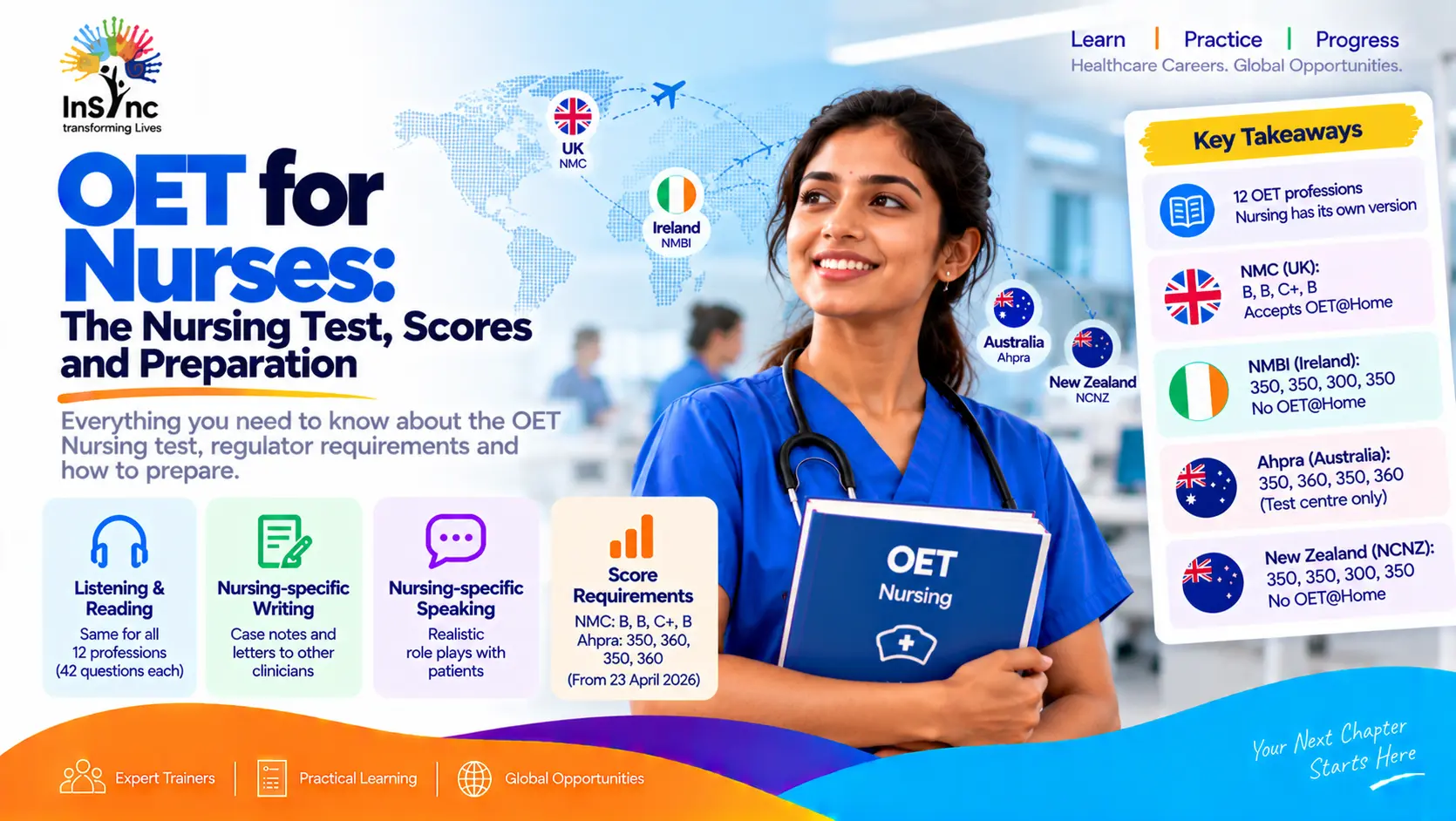
| NMC, United Kingdom | 350 | 350 | 300 | 350 | Accepted | Allowed, with a floor |
| NMBI, Ireland | 350 | 350 | 300 in one component | 350 | Refused | Refused outright |
| Nursing Council of New Zealand | 350 | 350 | 300 | 350 | Refused, one exception | Allowed, within 12 months |
| Ahpra, Australia, from 23 April 2026 | 350 | 360 | 350 | 360 | Test centre only | Allowed, with a floor |
Each row comes from that regulator’s own published page or policy, read 18 October 2026. The NMC pages are cited below, Ireland’s are on NMBI’s English language requirements, New Zealand’s guidance is dated 19 August 2022 and Australia’s is Ahpra’s accepted-tests standard. Three of the four ask for the same shape. The one that changed it raised two of its numbers, and Ireland is the one that does not name which component takes the C+.
Delivery mode is where the four diverge hardest. The NMC: “We accept the OET on Paper, OET on Computer, and OET@Home test. All applicants should choose the Nursing examination from the list of OET Professions versions.” OET publishes no midwifery version, and the NMC registers nurses, midwives and nursing associates, so that instruction has to reach midwives too. The NMC does not say so in as many words.
New Zealand says the reverse, and its exception is unusually precise: “The Nursing Council does not currently accept testing conducted completely online, such as OET@home. The only exception to this is the speaking component of the OET’s ‘on computer’ venue-based option, which we accept as part of this testing mode.” Ireland is blunter: “We do not accept IELTS online or OET at home.”
Book at a test centre if more than one of these countries is still open to you. A centre result satisfies all four. A home result satisfies one.
Combining is the second divide, and Ireland closes it completely: “We only accept one test result and do not accept combined results.” For an Irish application every number has to land in the same sitting, which makes Ireland the strictest of the four even though its four scores match the NMC’s.
Ireland also words its requirement differently, and the wording is worth reading twice. NMBI asks for “OET (Nursing) with Grade B in three components and C+ in one component”. The table beside that sentence shows the C+ against writing, labelled as an example. The sentence names no component. A nurse hoping to place that C+ against reading instead should get it confirmed by NMBI in writing before booking, because the page does not say either way.
Validity differs too. For the NMC the two years run to the date it assesses a complete application. Ireland accepts results less than two years old, and for applications started online the test has to be valid at the registration stage rather than at qualification recognition. New Zealand wants all sittings inside three years of commencing the application. Ahpra counts two years before you lodge. How OET@Home works covers what the remote mode involves, and the Australian route for Indian nurses takes the Ahpra standard apart.
No nursing regulator discounts Reading, and Australia has just stopped discounting Writing
Until April 2026 all four regulators asked a nurse for the same shape: Grade B in listening, reading and speaking, and C+ in writing. That shape entered the NMC rulebook with effect from 28 January 2020. New Zealand still prints it as 350, 350, 300 and 350.
Australia abandoned it. For tests taken on or after 23 April 2026, Ahpra asks 350 in listening, 360 in reading, 350 in writing and 360 in speaking. Writing rose from C+ to a scaled 350, which is the largest single change in that revision, and reading and speaking rose to 360. Ahpra left its IELTS requirement untouched at 7, 7, 6.5 and 7.
| What the regulator asks of a nurse | Listening | Reading | Writing | Speaking |
|---|---|---|---|---|
| NMC, United Kingdom | 350 | 350 | 300 | 350 |
| NMBI, Ireland | 350 | 350 | 300 | 350 |
| Nursing Council of New Zealand | 350 | 350 | 300 | 350 |
| Ahpra, to 22 April 2026 | 350 | 350 | 300 | 350 |
| Ahpra, from 23 April 2026 | 350 | 360 | 350 | 360 |
Ahpra publishes both tables side by side, the earlier one as grades and the later one as scaled scores. The effective date of the NMC concession comes from OET’s own notice of the change. That notice records the NMC accepting C+ in writing alongside B in the other three papers, after it had already moved IELTS writing from 7 to 6.5. It attributes the equivalence to engagement with OET and a standard-setting workshop with NHS trusts.
Two patterns survive that change. The only concession any of the four has ever granted a nurse falls on Writing, and not one of them has discounted Reading. When a regulator did move Reading, it moved it up. Ireland is the only one whose wording leaves the component unnamed.
| Measure | Listening | Reading | Writing | Speaking |
|---|---|---|---|---|
| Nursing mean scaled score, 2025 | 313 | 303 | 334 | 365 |
| Gap to a flat Grade B of 350 | 37 short | 47 short | 16 short | clears by 15 |
| Gap to the NMC’s four numbers | 37 short | 47 short | clears by 34 | clears by 15 |
| Gap to Ahpra’s four numbers | 37 short | 57 short | 16 short | clears by 5 |
Means are from OET’s 2025 candidate performance release. The gaps are arithmetic on those means. A mean scaled score is one sub-test’s average across that profession’s candidates, so adding four of them produces a total of averages and not any real nurse’s result.
Against the NMC’s four published numbers, the average nurse already clears two papers and misses two, and both misses are the comprehension papers. Against Australia’s new numbers the same nurse misses three of the four, and the extra ten points on Reading stretch the worst gap to 57. Whichever regulator you are aiming at, the concession lands on the paper that needed it least.
Combining two sittings has a floor, and one low score voids the pair
Most nurses discover combining after a near miss. It is permitted, and the conditions are published. They are tighter than the word “combining” suggests.
1. Sit the two tests within 12 months of each other, by test date rather than certificate date.
2. Keep both test dates no more than two years old when the NMC reviews your complete application.
3. Sit all four domains at each sitting. The NMC states it plainly: “you cannot take (or retake) individual test domains separately”.
4. Reach one required pass score in each domain across the two sittings.
5. Clear the minimum in every domain in both sittings, which is the condition people miss.
6. Combine two tests of the same type. An OET result cannot be paired with an IELTS result.
The minimum in step five is not the pass score. Across both sittings you need one Grade B in listening, one in reading, one in speaking and one C+ in writing. Underneath that, every score you present has to clear C+ in listening, reading and speaking, and C in writing. Drop below those and the better sitting cannot rescue the weaker one.
| Sitting | Listening | Reading | Writing | Speaking | Verdict |
|---|---|---|---|---|---|
| Accepted, test 1 | C+ | B | B | B | |
| Accepted, test 2 | B | B | C | B | Accepted |
| Refused, test 1 | C+ | B | B | B | |
| Refused, test 2 | C, below the floor | B | C+ | B | Refused |
Both pairs are the NMC’s own worked examples, reproduced row for row from its OET scores and combining page. The second pair fails twice over on the same paper, and the NMC gives both reasons. The listening C sits below the C+ floor, and no listening B was reached in either sitting.
Listening sinks that pair on two counts at once, so raising the C to a C+ would not rescue it. Never treat a weak paper as something a later sitting will cover, because the weak score still has to clear the floor and a pass still has to appear somewhere. And protect the papers you already passed when you re-sit, because a collapse in listening second time round can invalidate a first-time listening B that was never the problem.
A test combining calculator is published for exactly this arithmetic. Run your own numbers through it before paying for a second sitting, not after. The NMC route for Indian nurses maps where the language evidence sits in the wider application.
Reading holds 42 questions and a Grade B is about 30 of them
Grade B is a scaled 350, and a scaled score is not a mark count, so the number feels abstract. OET translates it: a candidate at Grade B typically achieves at least 30 marks. Both comprehension papers award one mark per correct answer and carry 42 questions. That makes the target countable.
| Paper | How the 42 questions are numbered | Time |
|---|---|---|
| Listening | Part A runs 1 to 24, Part B 25 to 30, Part C 31 to 42 | Approximately 40 minutes |
| Reading | Part A runs 1 to 20, then Parts B and C restart at 1 and run to 22, which is 42 in all | 15 minutes, then 45 minutes |
Question numbers and timings were counted first-hand inside Nursing Sample Test 1 rather than taken from a summary page. Writing sits outside this table because it carries no questions: one letter, five minutes to read the notes and forty to write. The booklet also states that marks are not deducted for incorrect answers, so a blank answer and a wrong answer cost the same. The 30-mark guide comes from OET’s results and scoring page.
Twelve marks of slack across 42 questions sounds generous until you see where nursing’s shortfall sits. A mean of 303 in Reading sits a full grade band below the target, not two or three questions. Nothing is deducted for a guess, so leaving blanks in the reading and listening papers is a self-inflicted loss.
One detail in that pack settles a recurring question. Listening Part A has the candidate take notes from a physiotherapist talking to a new patient, then from a consultant dermatologist. Those extracts sit in the official Nursing pack. Listening does not change with your profession, and neither does Reading, so half the test is identical for a nurse and a dentist.
Nursing ranks last of twelve on Reading and sixth on Writing
Nursing’s percentages mean more set against the other eleven professions, because the comparison separates a hard paper from a weak cohort.
| Nursing in 2025 | Listening | Reading | Writing | Speaking |
|---|---|---|---|---|
| Median grade | C+ | C+ | B | B |
| Mode grade | C+ | C | B | B |
| Rank of twelve at A or B | 10th | 12th | 6th | 10th |
| Share at A or B | 32.3% | 24.9% | 63.2% | 82.2% |
Medians and modes are printed per profession in the candidate performance release; the ranks and shares were computed for this page from the demographic release. Nursing’s Reading mean of 303 is the lowest Reading mean among the twelve professions, and nursing shares a Reading mode of C with dietetics, optometry and veterinary science. The letters themselves map to fixed score bands, set out in the OET Test Handbook 2026.
The mode grade is the one worth sitting with. The single most common Reading result for a nurse in 2025 was a C, two bands under the grade the NMC requires. Writing told the opposite story, with a B as both median and mode. No profession at all reached a tenth of a per cent at A. What the writing paper asks for explains why a B there is within reach for most nurses.
Only two professions, medicine and speech pathology, have mean profiles that clear the NMC’s 350, 350, 300 and 350. Nursing is not one of them, and neither are the other nine.
Four of the five official Nursing writing tasks address another nurse
OET publishes five Nursing sample packs, each with test questions, an answer key and an audio file. Opening all five settles what the profession-specific half of the test asks a nurse to do.
| Pack | Letter type | Recipient, as the task names them |
|---|---|---|
| 1 | Discharge letter | Resident Community Nurse at a community retirement home |
| 2 | Transfer of ongoing care | Community Health Nurse at a community health centre |
| 3 | Letter outlining history and concerns | Senior Nurse Practitioner at a university health centre |
| 4 | Referral, urgent assessment | Emergency Department Consultant on Duty |
| 5 | Discharge letter | Head Nurse at a nursing home |
Read out of the five downloadable Nursing question booklets on 18 October 2026. Every task sets a body of approximately 180 to 200 words. Each one instructs the candidate to expand the relevant notes into complete sentences, avoid note form and use letter format. The letter types OET sets goes through the formats in detail. The other half of the test does not move: OET’s test page confirms that Listening and Reading are common to all twelve profession versions.
Four recipients are nurses and one is a doctor. Candidates who practise only the doctor-facing referral are rehearsing the minority case. Two of the five are discharge letters, one hands over ongoing monitoring, one sets out a history and a set of concerns, and one is a referral. Those first four need different content from a referral: instructions and recommendations rather than a request for urgent assessment.
The recipient is marked, not assumed. OET scores the letter on six criteria: purpose, content, conciseness and clarity, genre and style, organisation and layout, and language. A consultant-style referral sent to a nursing home loses marks under genre and style. The OET writing criteria set out all six, and referral letters for nurses work through the one task on this list addressed to a doctor.
Speaking is profession-specific in the same way, and shorter than most candidates expect: twenty minutes in all, a two to three minute warm-up, three minutes to prepare each role play and five minutes to perform it. The nursing role plays put you in a nurse’s role with a patient or relative, not in a peer-to-peer clinical discussion. Two sets of criteria apply. Four linguistic ones are marked out of six. Five clinical communication ones are marked out of three: relationship building, understanding and incorporating the patient’s perspective, providing structure, information gathering and information giving. Role play tips for nurses works through the cards and the criteria they are marked against.
The NMC has two routes that skip the test, and neither fits a nurse trained in India
Before paying for OET, check whether you need it. Three kinds of evidence satisfy the NMC and a test is only one of them. New Zealand publishes two test-free pathways of its own alongside the test, and Ireland publishes none, accepting only a test. Here is what the NMC takes instead of a test, and what it takes after one.
• Qualified in English. An NMC-approved programme counts automatically. A programme from a country where English is not a majority language needs a transcript. That transcript has to show you spent at least half your time interacting with patients, service users, their families and other healthcare professionals. It also has to show that at least 75 per cent of those interactions were in English. A personal transcript in your name is required, showing the clinical practice and theory hour breakdown, not a course syllabus.
• Recent practice in English. One year of registered practice in a country where English is a majority spoken language. It has to fall within the two years before your application is assessed, with an English assessment completed as part of that registration. Unregistered roles do not count. India is not on the NMC’s majority-language list, so this route needs a stint abroad first.
• Narrowly missing on one paper. This one does not replace the test, it rescues a result. After the combining options are exhausted, a nurse who missed the required score in only one domain may be able to use additional information from a current employer. That employer has to be in the UK, so it reaches nurses already in post rather than applicants in India.
Quoted from the NMC’s qualified in English, recent practice in English and narrowly missing the required scores pages, last updated 28/01/2020, 29/01/2025 and 14/05/2024. Also stated there: NARIC and ECCTIS certificates are not accepted as English language evidence, which closes a shortcut candidates are often sold.
The first route sounds promising for an Indian nurse and then narrows. Indian nursing programmes are taught and examined in English, so the substance is often there. A transcript on its own is enough only where the qualification comes from a country on the NMC’s majority-English list, and India is not on it. For every other country the NMC says supporting information from a UK employer may be used “in addition to a transcript”. If its requirements cannot be met, it says, you need a language test.
The practical position is therefore narrower than the rule reads. Ask your institution whether its transcript itemises clinical interaction hours and the language of those interactions, because few Indian transcripts do. Then plan on the test, and read the English test requirements for UK nursing applicants alongside it.
New Zealand’s two test-free pathways are drawn by jurisdiction instead. Initial nursing education in Canada, Ireland, Singapore, the United Kingdom or the United States satisfies its education pathway. Current registration in Canada, Ireland, the United Kingdom or the United States satisfies its registration pathway, provided an English language test was required for that registration. Every jurisdiction on both lists belongs to the International Nurse Regulator Collaborative, which is why those names appear and no others. India is on neither list, so a nurse trained in India sits a test for New Zealand. Canada runs its own arrangements again, which the Canadian nursing regulators and OET compared with CELBAN deal with separately.
A funded programme for 249 Indian nurses passed 21 per cent of those who sat
The only published cohort evidence we could find on this question is an ex-post evaluation of the India English Language Programme, written up in BMC Nursing by four authors at NHS England’s Global Health Partnerships. Health Education England funded 249 Indian nurses through English language training to reach NMC proficiency. Recruitment ran through partner organisations in Indian states including Kerala and Tamil Nadu, and the programme itself operated from November 2020 to September 2021.
The paper gives two different entry levels, and the lower one is the safe reading. Its narrative says all 249 had demonstrated CEFR C1. Its participants section gives the study’s inclusion threshold as CEFR B2, at IELTS 6.5 or equivalent. The paper’s own benchmarking table puts C1 alongside OET Grade B and B2 alongside C+.
| Stage | Tests sat | Passes | Pass rate |
|---|---|---|---|
| Post-course examination | 223 | 46 | 21% |
| Relearn examination | 80 | 43 | 54% |
| Overall programme | 223 | 89 | 40% |
Goldstone, McCarthy, Byrne and Keen, BMC Nursing 22:169, 18 May 2023, read in full text. Of the 249 enrolled, 26 withdrew. They are excluded from the pass rates and kept in the cost figures. The 40 per cent therefore counts passes among the 223 who sat, not among the 249 funded.
Either reading leads to the same place. Nurses who entered at a level the paper benchmarks against C+ or above went into funded training. Four in five still missed the NMC standard at the post-course sitting. Holding a CEFR certificate and scoring 350 are not the same claim.
The paper also compared providers, and this is where its headline needs handling. At the post-course examination, candidates trained for OET passed at 22 per cent against 16 per cent for British Council provision, a six-point gap. After OET providers ran remedial relearn teaching the figures read 51 against 16, a 35-point gap, and that is the number usually quoted.
The comparison is not like for like, and the authors say so. British Council did not provide a relearn opportunity. Only seven of its candidates took the OET one and all seven failed. The relearn content was designed for OET, which the paper notes limits its applicability to IELTS preparation. Read it as a six-point gap at first sitting. The larger gap came after remedial teaching the comparison group was never offered. Of the OET candidates who did take the relearn, 59 per cent then met the requirement.
Cost per pass came to 3,521 pounds for OET provision and 8,103 pounds for British Council provision, against 4,139 pounds across the whole programme. Those are programme costs for a funded cohort, not course fees. The ratio is the part worth noticing: the cheaper route per pass was the one with remedial teaching attached. What that teaching covered is not broken down in the paper. If you are planning your own, the structure of OET case notes is where the Reading and Writing papers meet.
Nursing and medicine are the only professions on every OET paper date
Access is the one dimension where nursing has every advantage, and it is the paper test that shows it. OET published 148 sittings for 2026, across 132 calendar days. Nursing appears on every one of them, and ten of the twelve professions do not.
| Date type | Dates in 2026 | Professions listed | Booking closes |
|---|---|---|---|
| Paper, two-profession series | 24 | Nursing and Medicine only | 24 days before |
| Paper, seven-profession series | 24 | Those two plus dentistry, pharmacy, physiotherapy, radiography and veterinary science | 24 days, or 26 on two dates |
| Computer | 100 | All twelve | 7 days before |
Counted in code from the date records behind OET’s booking page as read on 17 and 18 October 2026. The 48 paper dates run four a month across all twelve months, two in each series. The 100 computer dates fall between March and July 2026, so a computer sitting is not available year-round on the calendar as published. The published date calendar and how an OET booking is made are kept current as OET adds dates.
Seven days is what makes a second attempt a plan rather than a next quarter. Computer bookings close a week before the test; paper bookings close 24 days before. The paper route, meanwhile, is open to a nurse every month of the year. Five professions have no paper date at all, and the other five share the seven-profession series.
Fees are the same in both modes at AUD 587, and nothing on oet.com states a rupee price. Your real cost depends on the exchange rate and your card’s charges on the day. The fee page tracks what AUD 587 converts to.
One caution on centres. The NMC’s Open Council papers of 2 July 2025 reference alleged fraud at an OET testing centre in Chandigarh. The practical lesson is narrow: book through OET’s own system, keep your confirmation, and avoid any agent offering more than a seat.
A regulator verifies your result itself, and an ungranted permission is what delays it
Nobody reads a scan of your certificate. The NMC and NMBI both verify the result at source, using a number printed on your paperwork, and the step candidates skip is granting that permission in advance.
• United Kingdom. Grant the NMC permission to verify through your MyOET account before you submit the application, not after, because a missing permission can delay assessment. Supply both certificates, with your candidate number, if you are combining two sittings.
• Ireland. NMBI verifies scores independently and asks for the OET Candidate Number, which it describes as the nine-digit number printed under your name on the Statement of Results. Its assessment fee is not refunded if you apply without meeting the scores.
• After the language test. An English result is one requirement among several. The NMC then sets its Test of Competence, a multiple-choice computer based test and a practical OSCE. Both have to be passed within two years of each other, in either order. OET is the gate, not the finish.
Taken from the NMC’s OET page and its Test of Competence pages, and from NMBI’s requirements page, all read 18 October 2026. None of this replaces a regulator’s own checklist. It is the part candidates most often leave until the application is already in.
Reach OET B Nursing runs 48 live lessons and marks one letter and one role play
Preparation that fits this evidence has three features. Disproportionate hours on Reading, a letter habit aimed at nurse recipients rather than consultants, and one regulator’s four numbers as the target instead of a vague Grade B. The nursing track built on that Reading gap is organised that way.
• Structure. Sixty hours of skill-by-skill teaching, plus 48 live lessons at four a week delivered with Specialist Language Courses, a UK medical English provider. Course duration runs 2.5 to 3 months with up to three months of access.
• Practice and marking. Two full practice tests, one marked writing task and one marked speaking role play, with more than 70 videos covering all four papers. Marked work matters more than volume here, because a nurse cannot self-diagnose a genre and style problem.
• Modes and price. Online live classes and face-to-face classes in Chennai, priced separately on the course page and payable in two parts. The figures move with offers, so read them there rather than here.
• Before you pay. A free trial class, and a free thirty-minute call with the trainer to check your level. Sit one timed Reading paper from OET’s free sample packs before that call, because the Reading number is the one this page predicts will be furthest from your target.
What a course cannot do is change the arithmetic. Moving Reading from 303 to 350 is months of reading, not a technique session. Anyone promising a week should be asked which paper they mean.
Honest limits are worth stating too. Doctors need the Medicine version and a different track, which the course page sets out separately. Nurses who have not settled on a destination should fix the regulator first. Australia now asks 360 in Reading and the UK asks 350, and those are different study plans.
Free material is worth using alongside any course, and the regulator itself says so. The NMC’s own preparation page points nurses at OET’s study guide, its sample tests and its Introduction to OET Nursing course. What a paid track adds is marking, a fixed schedule and someone reading your regulator’s wording with you. Classroom preparation in Chennai covers the offline option.
Four questions decide whether a nurse needs OET at all
One of these can remove the test altogether, and the rest decide what you are aiming at. All four come before any comparison of courses.
| The question | What the answer changes | |
|---|---|---|
| 1 | Which regulator are you applying to? | The NMC, Ireland and New Zealand all want 350, 350, 300, 350. Ahpra wants 350, 360, 350, 360. Ireland refuses combined results and at-home sittings; New Zealand refuses at-home sittings. One regulator is your target, not Grade B in general. |
| 2 | Does your transcript prove the interaction requirement? | India is not on the NMC’s majority-English list, so a transcript alone will not carry it and UK employer information is asked for on top. Ask your institution what the transcript contains, then plan on the test. |
| 3 | Where is your Reading, measured rather than guessed? | Sit a timed Reading paper and work from your own number rather than the cohort mean. This is the paper the published averages put furthest behind, for every regulator in the table. |
| 4 | Is one sitting realistic, or are you planning to combine? | If combining, protect every paper in both sittings. A single score below C+ in listening, reading or speaking, or below C in writing, voids the combination however good the other sitting was. |
A nurse who answers all four before booking spends the fee once.
Nurses ask the same ten questions about OET Nursing
What is the OET test for nurses?
A four-paper English test in a healthcare setting, with the nursing version of the Writing and Speaking papers. Listening and Reading are identical for all twelve OET professions, so only half the test is nursing-specific. It is a language test and not a licensing exam, so passing it registers you nowhere. What it does is satisfy the English requirement a regulator sets before assessing your qualification.
What OET score do nurses need for the NMC?
Grade B, meaning a scaled score of 350 or above, in listening, reading and speaking, and Grade C+, meaning 300 or above, in writing. Those four figures sit in a single table, and only IELTS Academic and OET are accepted as test evidence. Scores must be no more than two years old when the NMC assesses your complete application.
How much is OET for nurses?
AUD 587, the same on the Test on Paper and Test on Computer pages, with no country-specific or rupee price published anywhere on oet.com. Your actual cost depends on the exchange rate and your card charges on the day you book. A re-sit is the full fee again, because OET sells no single sub-test re-sit and the NMC will not accept individually retaken domains in any case.
Is OET harder than IELTS for nurses?
They are scored differently rather than one being harder. The NMC asks for the two levels side by side, B against 7 and C+ against 6.5. OET records that the NMC accepted C+ in writing only after satisfying itself that it matched IELTS 6.5. OET content is clinical, which usually helps a working nurse on Listening and Writing. A 2023 study of 249 Indian nurses found OET-trained candidates passed at 22 per cent against 16 per cent for the comparison group at the first sitting. One difference matters for Australia: Ahpra now asks a scaled 350 in OET writing while leaving IELTS writing at 6.5. IELTS allows a one-skill retake with some regulators and OET does not.
Can I pass OET in one week?
Not from a standing start, and the published figures say why. Nursing’s mean Reading score in 2025 was 303 against a Grade B of 350, which is a gap of roughly 47 scaled points. In a funded NHS programme, nurses entering at CEFR B2 or above passed at 21 per cent at the post-course examination. That is the level the study benchmarks against OET C+ and Grade B. A week can fix test technique. It does not move reading comprehension a full grade band.
Can I combine scores from two OET sittings for the NMC?
Yes, within limits. The two tests must be within 12 months of each other, both under two years old at assessment, and both the same test type. You must also sit all four domains at each sitting, because individual domains cannot be retaken separately. Across the two you need a B in listening, reading and speaking and a C+ in writing. Underneath that, every score in both sittings must reach at least C+ in listening, reading and speaking and at least C in writing.
Does the NMC accept OET@Home?
Yes. The NMC accepts OET on Paper, OET on Computer and OET@Home, and allows an OET@Home result to be combined with either of the others. The Nursing Council of New Zealand takes the opposite position. It does not accept testing conducted completely online, with one exception for the speaking component of the venue-based computer option. Ahpra accepts the computer test at a test centre only. From 23 April 2026 it asks 350, 360, 350 and 360, rather than the B, B, C+, B shape it used before. Ireland refuses OET at home outright. If you are keeping more than one country open, sit at a test centre.
Which OET version should a nurse book?
Nursing. The NMC instructs applicants to choose the Nursing examination from the list of OET Professions versions. Nursing also has the widest access of any profession. It and Medicine are the only two professions listed on all 48 paper dates OET published for 2026. All twelve appear on all 100 computer dates.
What kind of letter does OET Nursing Writing ask for?
A letter of about 180 to 200 words built from case notes, and the recipient varies more than candidates expect. Across the five official Nursing sample packs, four letters are addressed to another nurse. Those four are a resident community nurse, a community health nurse, a senior nurse practitioner and a head nurse. The fifth is a referral to an Emergency Department consultant. Two are discharge letters, one hands over ongoing monitoring and one sets out a history and concerns. Most of the five therefore need instructions and recommendations, not a request for urgent assessment.
Which paper should a nurse study first?
Reading, on the evidence. Nursing recorded 24.9 per cent at A or B in Reading in 2025, last of the twelve professions. That leaves 75.1 per cent of grades below the B the NMC requires. Its most common single Reading grade was a C. Writing is the opposite case, with 63.2 per cent at A or B and a regulator that asks only for C+, so time spent there returns less.