A Canadian residency post and a Canadian medical licence are issued by different organisations, on different documents, against different English rules. Most Indian doctors meet the second one first, in a coaching advertisement, and arrive at the first one late. The residency match has its own language criteria, written province by province, and they are not the ones printed on a college policy page.
We read the Canadian sources for this on 4 October 2026. The first page of Google for this query, searched from Canada, returned coaching providers, a Facebook post, a YouTube testimonial and one 2021 article. It returned no page from CaRMS, no college policy and nothing from the Medical Council of Canada. The rules exist and are public. They are simply not where the search results point.
One of those ranking pages tells doctors that British Columbia and Ontario accept either IELTS or OET. Both provinces also accept CELPIP, which the sentence leaves out, and the version of OET that CaRMS names is narrower than the word OET suggests. This page works from the primary documents instead, and quotes them.
What this page settles, with the source for each
• Which organisation sets the English rule at each stage, and which one asks for nothing.
• The exact CaRMS grid, including the three kinds of evidence Ontario accepts and seven provinces do not.
• Why an Indian MBBS falls outside the country exemption that covers 23 jurisdictions.
• Four dating rules over one certificate, running in different directions, two of which can be failed while the other two are met.
• Which colleges accept your language of instruction in place of a test, and which ask about the country instead.
• What the 2025 Medicine statistics say about a rule requiring all four grades at once.
Four organisations shape your pathway, and only two of them ever ask to see your English
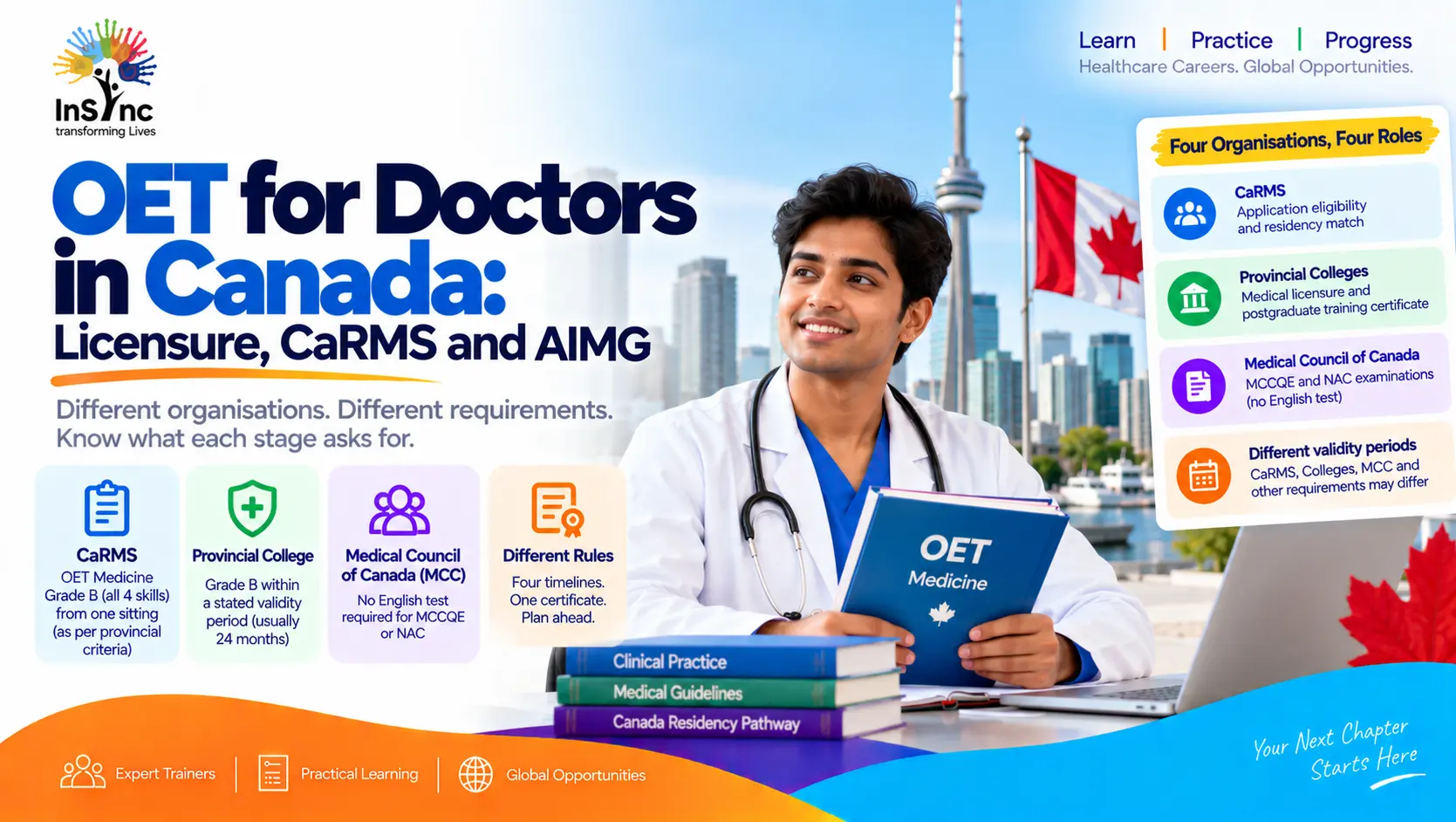
Start with who holds what, because almost every confused question about OET and Canada is a question about the wrong organisation. The Canadian Resident Matching Service runs the application and the match itself. Each province writes the eligibility criteria that CaRMS publishes and enforces. A provincial college of physicians and surgeons registers you to practise, including the certificate you need to begin postgraduate training. The Medical Council of Canada examines you, and asks nothing at all about your English.
| Body | What it decides | What it asks about your English | Where the rule lives |
|---|---|---|---|
| CaRMS | Whether your application is eligible, and runs the R-1 match | OET Medicine at grade B in all four skills from one sitting, or another route its provincial grid allows | Provincial criteria published by CaRMS |
| The province | The criteria CaRMS applies to its own applicants | Which kinds of evidence count at all | Reviewed by the province before publication |
| Provincial college | Registration, including the postgraduate certificate | Grade B within a stated window, usually 24 months | The college’s own policy |
| Medical Council of Canada | The MCCQE and the NAC examination | Nothing. No language test appears in its examination requirements | MCC examination pages |
Read the second row again, because it is the one the coaching pages collapse. CaRMS publishes the language criteria, and its own page says the 2027 criteria will appear once they have been reviewed by the province. The criteria are provincial instruments that CaRMS administers. That is why they differ by province on the same page, and why a single national answer to whether Canada accepts OET does not exist.
The bottom row is the one that saves money. CaRMS publishes a second provincial grid for Medical Council of Canada examinations, and that document names the MCCQE, the NAC examination and the transfer of records from physiciansapply.ca without naming a test of English anywhere. Its summary for internationally trained physicians does mention OET Medicine at grade B, with the hedge that most authorities adhere to those minimums, which makes it a description of provincial practice rather than a rule of its own.
Sources: CaRMS R-1 summary of language proficiency requirements, CaRMS R-1 summary of MCC examination requirements and the MCC pre-arrival guidance for internationally trained physicians, read 4 October 2026. CaRMS also publishes separate provincial grids for citizenship and for practising physicians.
CaRMS names OET Medicine at a venue and at home; the college policies name OET and stop there
The CaRMS criteria do something no college policy we read does. They specify the delivery mode in the requirement itself: OET Medicine, at a test venue or at home, minimum grade B in each of the four skills, in the same sitting. The at-home version is written into the eligibility rule, not tolerated beside it. The Alberta International Medical Graduate Program goes the same way, accepting an OET Medicine or OET at Home statement of results at grade B in each component on a single test.
Now the other side. We searched the English language proficiency policies of the colleges in Ontario, British Columbia, Alberta and Nova Scotia for the words at home, @ home and Home Edition on 4 October 2026. None of the four contains any of them. These policies name the test and the grade and say nothing about how the test was delivered.
Silence is not consent, and it is not refusal either. A college that has never published a delivery-mode rule has not promised to accept one, which means an at-home result is settled for the match and unaddressed for the licence. If your pathway ends at a college counter, write to that college before you book. The province by province picture of where OET is accepted in Canada is the place to confirm which college that is.
There is a tighter constraint, and it belongs to OET rather than to Canada. OET’s own handbook offers the at-home version where there is no test venue in your country, or where you have other access needs. India has venues. A doctor in Chennai may therefore be ineligible for a version of the test that CaRMS would happily accept, which is a sentence worth reading twice before planning around it.
Primary documents: the AIMG English language proficiency requirements for the 2027 cycle, the OET Test Handbook 2026 and OET’s own page on the at-home test. College policies checked for delivery-mode wording: Ontario, British Columbia, Alberta and Nova Scotia, all read 2 to 4 October 2026.
Ontario accepts a Dean’s letter, a TOEFL score and a FAIMER printout, and seven provinces accept none of them
This is the part of the CaRMS criteria that nobody has written up for Indian applicants, and it is the part that can remove a test from your plan entirely. The language table for international medical graduates has four columns of provinces, and they do not agree. Column one holds five entries covering seven provinces: Newfoundland and Labrador, Nova Scotia with New Brunswick and Prince Edward Island, Manitoba, Alberta and British Columbia. Saskatchewan stands alone. Ontario stands alone. Quebec sends you to the individual programme descriptions.
| Evidence CaRMS lists | NL, NS with NB and PEI, MB, AB, BC | Saskatchewan | Ontario |
|---|---|---|---|
| OET Medicine at a venue or at home, B in each skill, one sitting | Accepted | Accepted | Accepted |
| IELTS Academic 7.0 in each skill, one sitting | Accepted | Accepted | Accepted |
| CELPIP General 9 in each skill, one sitting | Accepted | Accepted | Accepted |
| Letter from your Dean attesting instruction was solely in English | Not accepted | Accepted | Accepted |
| TOEFL iBT or iBT Home Edition, 93 total with 24 in Speaking | Not accepted | Not accepted | Accepted |
| World Directory of Medical Schools programme details printout | Not accepted | Not accepted | Accepted |
Three consequences follow, and they are worth more than any score tip on this page.
• If your medical school taught solely in English and will say so over the Dean’s signature, Ontario and Saskatchewan will read that letter in place of a test. The other seven provinces will not.
• TOEFL appears on no Canadian medical college policy we have read, and it appears in the CaRMS grid for Ontario only. A TOEFL score is therefore the narrowest of the accepted routes, not an alternative to OET.
• The World Directory printout is a document about your school rather than about you, and Ontario asks, in its own provincial criteria rather than in the grid, that the listing state the language of instruction is English or French. The same directory decides something else at the licence gate, which is the next section. For what the test itself asks of a doctor, the medicine version of the test sets it out.
None of this changes what happens at the college. Ontario’s college accepts IELTS Academic at 7.0, OET Medicine at grade B and CELPIP General at 9, each taken within the last 24 months and each in the same sitting, and its page is scoped in its own words to applicants for postgraduate education. It also opens with a line the coaching pages never quote: the College may consider language proficiency through a variety of means, and the test scores are an option applicants have. A Dean’s letter that satisfies the match is not automatically the thing the college asks for, so the two gates can take two different documents from the same applicant. The two gates also disagree about French: Ontario’s college lists TEF Canada and TCF Canada with their own component scores, while the CaRMS grid marks every French examination as not accepted for Ontario.
Source: the CPSO language proficiency page for postgraduate applicants, read 3 October 2026, alongside the CaRMS grid cited above. The grid’s own tick and cross marks were resolved cell by cell on 4 October 2026.
The country exemption names 23 jurisdictions, and an Indian medical degree sits outside every one of them
The provincial criteria CaRMS publishes require no proof of language proficiency from international medical graduates applying to Alberta, British Columbia, Newfoundland and Labrador, Nova Scotia with New Brunswick and Prince Edward Island, Manitoba and Saskatchewan, on one condition: the basic medical education and the patient care experience were both completed in a listed country. The list runs Australia, Bahamas, Bermuda, British Virgin Islands, Canada, Ireland, New Zealand, Singapore, South Africa, United Kingdom, United States, U.S. Virgin Islands, Anguilla, Antigua and Barbuda, Barbados, Dominica, Grenada, Grenadines, Jamaica, St Kitts and Nevis, St Lucia, St Vincent, and Trinidad and Tobago.
India is not on it. Neither is Pakistan, Nigeria, the Philippines or the United Arab Emirates. An MBBS taught entirely in English, examined in English, followed by three years of English-language ward work in a Chennai hospital, does not reach this exemption, because the exemption is written by jurisdiction and not by language of instruction.
Two details in that clause catch people out. The condition is conjunctive: education and patient care experience both have to be in a listed country, so a UK degree followed by Indian internship does not qualify. And Ontario is absent from the list of exempting provinces, which means a London graduate applying to Toronto still files language evidence. Ontario’s grid grants no country exemption, and offers the Dean’s letter and the World Directory listing instead.
For Indian graduates the practical reading is short. The exemption is closed, the three tests are open, and OET Medicine is the one of the three built around clinical English rather than academic English. What the test actually asks of a doctor is a separate question, and why strong doctors lose marks on it is the most useful thing to read before you book.
The colleges ask which language you were taught in; CaRMS asks which country you trained in
The exemption in the last section is a rule about jurisdictions, and it is the reason most Indian doctors conclude that a test is unavoidable. At the licence gate that conclusion is premature. Five college policies read for this page publish a route out of testing, and every one but Alberta’s turns, at least in part, on the language your medicine was taught and practised in rather than on where the building stood.
| College | The route out of a test, as written | What it turns on |
|---|---|---|
| CPSBC, British Columbia | The registrar may determine proficiency where the primary language of medical education was English and the primary language of patient care was English, and the college reads the language of medical education from the World Directory of Medical Schools listing. A second route covers a valid licence in a majority native English-speaking country with independent practice primarily in English, and the registrar may exempt in exceptional circumstances | Language of education and of patient care, at the registrar’s determination |
| CPSNL, Newfoundland and Labrador | The majority, meaning more than half, of undergraduate or postgraduate medical education in English, or more than half of the patient care the applicant has provided in English | Proportion taught or practised in English |
| CPSM, Manitoba | Education taken in English in a country with English as a first or native language, or evidence satisfactory to the Registrar, which may be more than half of education, more than half of patient care, or substantially equivalent clinical, teaching or research experience | Either, at the Registrar’s judgement |
| CPSA, Alberta | Education, or more than half of medical and postgraduate education, taken in a country where English is the first or native language, or independent practice in such a country having already met its requirements | Country |
| CPSNS, Nova Scotia | Applies only to applicants whose first language is not English. An independent Canadian licence; or the MCCQE Part I, or the College of Family Physicians or Royal College certification examinations, written and oral, in English; or postgraduate training within the last five years conducted in English with English as the primary language of patient care; or undergraduate education in English within the last five years plus acceptance into a Nova Scotia postgraduate programme; or the Registrar’s discretionary waiver | A licence, examinations, recency, or discretion |
Read the first row against your own file. An Indian MBBS whose World Directory listing records English as the language of instruction, followed by ward work conducted in English, is describing the two conditions British Columbia’s registrar may act on. Alberta’s version of the same idea is shut to that applicant, because Alberta asks about the country and publishes a list that does not include India. Two policies treat their lists differently, which is worth knowing if you trained elsewhere: British Columbia states that its list is complete and that only those countries will be considered, while Manitoba says its list includes but is not limited to its entries, and names Nigeria among them. One applicant, one degree, two provinces, two answers, and the difference is a single word in the policy.
Nova Scotia’s fourth route is written around this reader almost exactly: undergraduate education in English within the last five years, plus acceptance into a postgraduate programme in the province. That college also waives the English requirement for the Dalhousie clinical assessment and then requires it before training starts, so the waiver moves the deadline rather than removing it.
Three cautions before you plan around any of this
• Every clause above is permissive. It is written as what a registrar may determine, not as something an applicant is owed, and each route needs evidence you have to assemble.
• None of these routes carries across to the match in the seven provinces of column one, whose criteria recognise no language-of-instruction route outside the 23 listed jurisdictions. Ontario and Saskatchewan are the exception, through the Dean’s letter.
• A college route and a match route can therefore send the same doctor to the same test. Clearing one gate without a test does not clear the other.
Canada’s nursing regulators publish non-test routes of their own with quite different time limits, set out in OET for nurses in Canada.
Read at source: the CPSBC policy, the CPSNL licensing policies, the CPSM registrar policies, the CPSA page and the CPSNS policy, between 2 and 4 October 2026. Each clause is quoted or paraphrased from the policy text rather than from a summary of it.
Four Canadian clocks run on the same certificate, and they do not run in the same direction
OET sets no global expiry. Its handbook states plainly that there is no global standard for how long results are valid and that each organisation sets its own. Canada takes that invitation seriously. A 24-month window is the common pattern at the colleges, including British Columbia, Manitoba, Newfoundland and Nova Scotia, so the four clocks below are the ones that depart from it or sit alongside it.
| Body | The rule, as written | What shape of clock that is |
|---|---|---|
| AIMG, 2027 cycle | Test dated no earlier than 1 July 2025, results valid and current at the start of residency training, everything uploaded by 28 August 2026 at 3:30pm Mountain Time | A fixed floor plus a hard upload deadline |
| CaRMS provincial criteria | Exams must be valid until 1 July 2027 and submitted by the application deadline | A forward-looking requirement, measured from the future |
| CPSO and CPSA | Within the last 24 months at the time of application | A rolling window, counted backwards |
| CPSNS | IELTS Academic and CELPIP General accepted only until 1 January 2027, with results dated before that still considered | A sunset on two of the three tests |
Put a single certificate against those four and the collisions appear. A test sat in June 2025 is inside CPSO’s 24 months in early 2027 and outside AIMG’s floor of 1 July 2025 forever. A test sat in August 2026 clears both, and still fails the 2027 AIMG cycle if the upload lands after 3:30pm Mountain Time on 28 August 2026. Any sitting after that date is too late for that cycle, whatever a college would accept. Nova Scotia’s clause is the one with teeth beyond the match: from 1 January 2027 OET Medicine is the only one of the three tests from which that college will accept a new result, while IELTS and CELPIP results dated before then stay in play, and the footnote under that college’s test table gives those results 24 months from the date on them.
Sittings differ too, and the differences are not cosmetic. The college in British Columbia states the single-sitting rule three ways in one policy: combined scores from multiple attempts will not be accepted, the minimum in each component must be achieved in the same sitting, and the college will not consider a combination of components from multiple sittings. Newfoundland’s college allows grade B across no more than two combined sittings of the same test. Manitoba’s college is asymmetric, letting IELTS components arrive from different sittings while requiring OET Medicine in one. CaRMS adds its own exception, allowing Newfoundland and Labrador applicants to combine a maximum of two sittings of the same test.
If you want the mechanics of that rule rather than the map of it, why the same sitting matters is the piece to read, and what grade B means on the 0 to 500 scale explains why a 340 is not a near miss but a different grade. Nothing exists between 340 and 350.
Sources: the CPSBC English language proficiency requirements policy (version 2.2, effective 7 April 2026, revised 11 September 2026), the CPSA English language proficiency page, the CPSNS policy with its 1 January 2027 clause and the CPSNL licensing policies. Saskatchewan’s college blocked every request from this session, so its policy is not reported here.
A Master of Medicine earns no exemption, and Alberta exemptions are subject to CPSA approval
Alberta writes its refusals down, which makes it the easiest province to plan against. The AIMG Program lists two options for the 2027 cycle. Option A is a test. Option B is an exemption as determined by the College of Physicians and Surgeons of Alberta. The programme adds that exemptions are subject to CPSA approval, that it may consult CPSA when it reviews an exemption survey, and that individual conversations with CPSA registrars do not constitute an appropriate possibility of exemption.
Three pieces of evidence can support that exemption, and each has an edge to it.
1. A CPSA practice permit with an effective date on or before 31 May 2026, uploaded with the rest of the file.
2. The exemption survey in the application portal, reachable only while the portal is open and gone once it closes.
3. A medical degree from a country CPSA recognises as English speaking, verified through physiciansapply.ca.
Then the line that answers a question thousands of postgraduates ask: a Master of Medicine degree does not qualify for an exemption from testing. The page allows that registering with CPSA and dealing with it directly may yield a different result, which is an invitation to ask the college and not a reason to skip the booking.
One asymmetry in the same document deserves your attention if you are a single skill short. AIMG accepts the IELTS one skill retake, and states that the original test report form continues to exist alongside the retake score with both valid. For OET it requires grade B in each component on a single test. CaRMS, for its part, requires IELTS in the same sitting and says nothing about one skill retakes at all. Two bodies, one of which you also have to satisfy, treat the same repair differently, so settle it in writing with both before you pay for anything.
There is a cost consequence. OET sells single sub-tests for OET on Paper at most venues outside the United States, at AU$315 for one, AU$415 for two and AU$515 for three including its AU$7 booking fee, and only to candidates who have already sat the full test. OET attaches its own warning to that offer, telling candidates to check that the organisation receiving the results accepts scores from individual sub-tests. Against a single-sitting rule the answer is usually no, because a repaired sub-test does not produce four grades from one sitting. Newfoundland allows two combined sittings of the same test at both gates, and neither document says whether a single sub-test counts as a sitting, so ask CPSNL before you pay. Everywhere else a shortfall in one skill costs the full fee again, which is set out in what the OET costs with the current rupee conversion.
Sources: the AIMG English language proficiency page cited earlier, and OET’s own pricing article, read 4 October 2026. Resit prices are quoted in Australian dollars because OET sets them in that currency.
Listening caps the Canadian bar at 77.6 per cent of Medicine grades, and the joint figure is nobody’s to publish
OET publishes the distribution of grades by profession each year. For Medicine in 2025, the share of grades awarded at A or B, which is the Canadian bar, looks like this.
| Sub-test | Grade A | A or B | What the number tells a Canadian applicant |
|---|---|---|---|
| Listening | 15.6% | 77.6% | The lowest of the four, and the limit on any requirement for all four |
| Reading | 11.0% | 78.9% | Second lowest, on the same 42 questions all professions answer |
| Writing | 0% | 79.9% | Not one Medicine candidate was graded A in Writing in 2025 |
| Speaking | 4.5% | 92.8% | The least likely of the four to end an application |
Two readings of that table are legitimate and one is not. These are marginal rates, one sub-test at a time, so they cannot be multiplied together into a joint figure: the same candidates appear in all four rows and their performances are related, not independent. OET does not publish how many candidates cleared all four at once, and neither does anyone else.
What the table does support is a ceiling, and the arithmetic is simple. A requirement for all four cannot be met more often than its rarest component is met. Listening reached B or above in 77.6 per cent of Medicine Listening grades, so within that population no more than 77.6 per cent can have cleared the Canadian bar in all four. The tables report shares of grades awarded per sub-test and publish no denominator, so the bound holds inside the Listening figures and is not a pass rate for people. The true share is lower, by an amount nobody has published. That is the honest version of a number the coaching pages state with false confidence.
Writing deserves its own sentence, and a correction to the obvious reading of it. No profession recorded a single A in Writing in 2025, Medicine included, so the whole 79.9 per cent sits inside the B band. That zero is a feature of how OET Writing is graded rather than anything about doctors. What is distinctive is the size of the B share: 79.9 per cent is the second highest of the twelve professions, behind Speech Pathology at 82.9 per cent, so doctors sit above this line more often than almost anyone and sit there without headroom. If you want to see what that margin looks like in practice, a marked doctor’s letter is more instructive than any score table.
One structural fact explains why Listening and Reading decide so many medical applications. OET’s handbook states that Listening and Reading are the same for every candidate regardless of profession, while Writing and Speaking are tailored to the profession. The content is still clinical, recordings of consultations and texts on healthcare topics, but none of it is pitched at a doctor in particular. Half of the grades that gate your Canadian application are earned on material written for twelve professions at once.
Source: OET 2025 test statistics, demographic data, profession tables, read 3 October 2026. These are the profession tables, not the nationality tables, which pool all twelve professions and answer a different question.
A result that arrives after the deadline is a result you cannot use, and withdrawal is not always reversible
Every rule above assumes the paper reaches the right desk in time, and that assumption is where applications die quietly. CaRMS requires language exams to be submitted by the application deadline. AIMG requires everything uploaded by 28 August 2026 at 3:30pm Mountain Time, and says so in a sentence that lists re-writes, re-takes, re-marking, re-evaluation, appeals and enquiries on results, which is an unusually explicit way of saying that no appeal stops the clock.
Doctors ask about this on the forums in exactly the terms you would expect. In June 2026 a thread asked whether OET could be sat after what the poster took to be a September 2026 application deadline for the 2027 cycle, which is the right question asked slightly too late to act on. In March 2026 a different thread described an application withdrawn because an OET result was delayed past a verification deadline, with the poster reporting that the withdrawal could not be reversed. That case concerned the United States match and its verification process, not CaRMS, and the lesson transfers while the rule does not.
Work backwards from the deadline, not forwards from today
1. Find the application deadline for your cycle and province, then find the upload deadline, which is usually earlier and sometimes stricter.
2. Allow for OET result release, and then for verification by whoever has to see the result rather than by you.
3. Add one full retest cycle, because a single-sitting rule means a shortfall in one skill costs a whole new sitting, and the grade CaRMS wants in each sub-test leaves no partial credit.
4. Authorise access in advance. AIMG will not verify results unless you designate the programme, and British Columbia’s college asks to be added as a verified organisation on your myOET account.
5. Book the sitting that leaves room for step three, not the one that just clears step one.
That fourth step is a small administrative act with a large failure mode. A valid result that the receiving body cannot verify behaves exactly like a missing result, and the deadline does not care which it was.
Sources: the March 2026 thread on a withdrawal after a delayed result and the June 2026 thread on sitting OET for the 2027 cycle, both r/IMGreddit, read with the CaRMS and AIMG deadlines cited above. The first thread concerns the United States match.
Where Medicine candidates lose the four grades, and how we teach against a single-sitting rule
A single-sitting rule changes what good preparation looks like. If any one of four grades can end the application, the right target is not your best sub-test lifted higher but your weakest one lifted over 350. The 2025 distribution points to where that weakness usually sits for doctors: Listening at 77.6 per cent and Reading at 78.9, a gap of only 1.3 points between them, then Writing at 79.9 and Speaking far clear at 92.8.
Our teaching follows that order rather than the order of the test. We run OET by profession, so a doctor writes a letter from medical case notes, a referral for example, rather than a nurse’s handover, and we weight class time towards the two sub-tests that are not tailored to any profession and therefore reward technique. Our OET preparation course at Egmore in Chennai runs onsite and online, taught by a trainer with CELTA, DELTA and a qualification in testing principles, which matters here because two of your four grades turn on reading and listening technique rather than on clinical knowledge.
What we would do in your first week, in this order
• Settle which gate you are aiming at. The match and the licence can take different documents, and the answer changes your deadline.
• Check whether a Dean’s letter is available to you and whether your province accepts one. For Ontario and Saskatchewan applicants this can replace the test.
• Sit a timed Listening and Reading paper before any teaching. Those two sub-tests are shared across all twelve professions and are where the Canadian bar is most often missed.
• Write one referral letter under 45 minutes and have it marked against the criteria, not corrected for grammar.
• Only then book a date, with one full retest cycle still inside your deadline.
Nurses reading this for a colleague will find a different answer in both the grade and the route, set out in OET for nurses in Canada. Where the plan is permanent residence rather than a licence, neither CaRMS nor any college scores your English for immigration, and why immigration needs a different test explains which body does.
Recap, in the order a Canadian application actually asks the questions
• CaRMS publishes provincial language criteria. The colleges publish registration policies. The Medical Council of Canada asks for no language test at all.
• CaRMS and AIMG both name OET Medicine at home as acceptable. No college policy we read mentions delivery mode, and OET limits the at-home version to candidates without a venue in their country.
• Ontario accepts a Dean’s letter, a TOEFL score at 93 with 24 in Speaking, and a World Directory printout. Saskatchewan accepts the Dean’s letter. The seven provinces in column one accept only OET, IELTS Academic or CELPIP.
• The country exemption names 23 jurisdictions and excludes India, and it requires both education and patient care experience inside a listed country.
• British Columbia, Newfoundland and Manitoba can accept English-medium education in place of a test at the licence gate. Alberta asks about the country instead, and Nova Scotia about examinations and recency.
• The dating rules run in different directions: AIMG forward from 1 July 2025, CaRMS until 1 July 2027, CPSO and CPSA 24 months backwards, Nova Scotia with a sunset on new IELTS and CELPIP results from 1 January 2027.
• A Master of Medicine is not an exemption, and an Alberta exemption is subject to CPSA approval rather than settled by the programme that collects the file.
• Of 2025 Medicine Listening grades, 77.6 per cent reached B or above, which bounds how often all four can be cleared within that population. It is a share of grades awarded, not of candidates, and the joint figure is not published.
• Single sub-test resits exist at AU$315 and do not help under a single-sitting rule. Newfoundland allows two combined sittings of the same test at both gates, and neither document says whether a single sub-test counts as a sitting. Preparation weighted to that rule is what our OET Medicine course is built around.
Questions doctors ask about OET and Canada
What is the OET test for doctors?
OET Medicine is the medical version of the Occupational English Test. All candidates sit the same Listening and Reading papers, 42 questions each, while Writing and Speaking are built around a doctor’s work: a letter written from case notes, a referral for example, and two role-plays with a patient or carer. OET’s handbook states that Listening and Reading are identical across all twelve professions and that Writing and Speaking are tailored to the profession, which is why two of your four Canadian grades are decided by test technique rather than by clinical knowledge.
Is OET valid in Canada for doctors?
Yes, in two separate places. CaRMS lists OET Medicine, taken at a test venue or at home, at grade B in each of the four skills from the same sitting, as accepted language evidence in its provincial criteria for international medical graduates. Provincial colleges including those in Ontario, British Columbia, Alberta, Manitoba, Nova Scotia and Newfoundland and Labrador accept OET Medicine at grade B for registration, usually within 24 months of application. The Medical Council of Canada requires no language test for the MCCQE or the NAC examination.
Does CaRMS accept OET at Home?
CaRMS names it in the requirement itself: OET Medicine at a test venue or at home, grade B in each of the four skills, in the same sitting. AIMG also accepts an OET at Home statement of results. Two cautions. No provincial college policy we read mentions delivery mode, so an at-home result is explicitly fine for the match and unaddressed for the licence. And OET offers the at-home version where there is no test venue in your country, or where you have other access needs, so an applicant in India with a local venue may not be eligible to sit it.
Can I combine two OET sittings for a Canadian medical application?
Almost never. CaRMS requires the four skills from the same sitting, with one exception: for Newfoundland and Labrador, the minimum scores may be achieved across a maximum of two combined sittings of the same test. Newfoundland’s college allows grade B across no more than two combined sittings as well. British Columbia’s college states the single-sitting rule three times in one policy and will not consider components from multiple sittings. Manitoba’s college permits IELTS components from different sittings but requires OET Medicine in one.
How much does OET cost for a doctor applying to Canada?
OET lists the full test at AU$587, about Rs 40,000 at the European Central Bank reference rate for 18 September 2026, and quotes US$455 for OET on Computer at a venue and OET at Home in the United States. OET also sells single sub-test resits on paper after a full test, at AU$315 for one, AU$415 for two and AU$515 for three. For Canadian medicine those resits are largely unusable, because the routes require all four grades from one sitting and Newfoundland’s allowance of two combined sittings does not say whether a single sub-test is one, so budget for a full retest rather than a repair and ask the college first.
Is it easy to get 400 in OET?
A 400 is inside the B band, which runs from 350 to 440, so it is above the Canadian requirement rather than at it. In 2025, 15.6 per cent of Medicine Listening grades and 11 per cent of Medicine Reading grades were an A, which is 450 or more, and no Medicine Writing grade was an A at all. Scores are reported in ten-point increments, so there is nothing between 340 and 350, and a 340 is a C+ and not a near miss.
Do I need a language test if my MBBS was taught in English?
For most provinces, yes. The CaRMS criteria drop the requirement only where both the basic medical education and the patient care experience were completed in one of 23 listed jurisdictions, and India is not among them. Two provinces offer a document route instead: Ontario and Saskatchewan accept a letter from your Dean attesting that the programme of instruction was completed solely in English, and Ontario additionally accepts a World Directory of Medical Schools printout or a TOEFL iBT score of 93 with 24 in Speaking. Your college may still ask for its own evidence.
Does a Master of Medicine exempt me from the English requirement in Alberta?
No. The AIMG Program states that a Master of Medicine degree does not qualify for an exemption from English language proficiency testing, while noting that registering with CPSA and communicating with it directly may yield a different result. Exemptions in Alberta are granted by the College of Physicians and Surgeons of Alberta, not by the AIMG Program, and the programme warns that individual conversations with CPSA registrars do not amount to an exemption.