

Most IELTS candidates prepare for the Speaking test the wrong way.
They rehearse answers. They memorise impressive vocabulary. They worry about their accent. And then they sit across from an examiner, deliver a polished-sounding response — and score Band 6.
The frustrating part is they often have the English ability to score higher. What they are missing is an understanding of what examiners are actually assessing.
I have been on the other side of that table. As a former British Council IELTS examiner — and having been part of assessments covering over 35,000 test takers — I have seen the same patterns play out repeatedly. The candidates who score Band 7 and above are not always the ones with the richest vocabulary or the cleanest grammar. They are the ones who understand how the test is scored and prepare accordingly.
This post explains exactly that. Not generic tips — the actual marking logic, in plain language, with observations from real assessments.
(Shane Jordan is a Cambridge-certified, former British Council IELTS examiner with 24+ years of teaching experience. Read more about his background and approach to IELTS coaching.)
The 4 Criteria IELTS Examiners Actually Score
Before anything else, understand this: IELTS Speaking is not scored on “good English” as a vague impression. Examiners assess four specific, equally weighted criteria:
- Fluency and Coherence
- Lexical Resource
- Grammatical Range and Accuracy
- Pronunciation
Each one carries exactly 25% of your speaking score. Most candidates spend 80% of their preparation time on vocabulary and grammar, while fluency and pronunciation — which together make up half the score — receive almost no deliberate practice.
That imbalance is one of the most common reasons Indian candidates plateau at Band 6.5.
Here is what each criterion actually measures.
Fluency and Coherence: The Criterion Most Candidates Misunderstand
What it is not: speaking fast, sounding confident, or avoiding silence at all costs.
What it actually is: the ability to keep talking without your speech breaking down — and to organize ideas so the listener can follow them without effort.
The official IELTS descriptors reward candidates who can produce long, connected turns without excessive pausing, repetition, or self-correction. The key phrase in those descriptors is “without noticeable effort.” Examiners are listening for whether your speech flows naturally or whether it keeps stopping and restarting.
Coherence is equally misunderstood. Many candidates think it means loading answers with linking words — “however,” “moreover,” “in addition to this.” It does not. Coherence means your ideas are logically sequenced and easy to follow. You can achieve strong coherence with simple connectors and a clear train of thought. You can destroy coherence with complex connectors used incorrectly, or with answers that wander off topic.
What I observed in real assessments: The biggest mark losses in this criterion come from answers that stop and restart too often — not from one grammatical error. A candidate who speaks continuously with minor mistakes will outscore a candidate whose accurate but hesitant speech keeps breaking. The examiner is not waiting for perfection. They are listening for flow.
Lexical Resource: Vocabulary That Actually Matters
What examiners want: range, precision, appropriacy, and — crucially — the ability to paraphrase.
This last point is where many candidates lose marks they did not need to lose. When a strong candidate does not know a word, they work around it fluently. They describe the concept, use a related term, or rephrase the idea. That is exactly what the IELTS band descriptors reward at Band 7 and above.
What examiners do not want: rare or obscure words inserted to impress, vocabulary that does not match the context, or the same handful of words recycled across every answer.
What I observed: Many Indian candidates have strong passive vocabulary — they know many words — but use a narrow active range under pressure. The fix is not learning more words. It is practising using the words you already know more flexibly, and practising paraphrase so it becomes a reflex rather than a last resort.
The difference between a Band 6 and Band 7 vocabulary score is often not the words themselves. It is how naturally and precisely they are used in context.
Grammatical Range and Accuracy: What “Range” Really Means
Grammar in IELTS Speaking is scored on two things: range (can you use a variety of structures?) and accuracy (do errors affect meaning?).
Most candidates focus entirely on accuracy — avoiding mistakes. But at Band 7 and above, range matters just as much. Examiners want to hear conditionals, passive constructions, relative clauses, different tenses used appropriately — not just simple, safe sentences that are grammatically clean but limited in structure.
There is also an important nuance on accuracy: not all errors are equal. A small slip in subject-verb agreement matters far less than an error that makes your meaning unclear. The official descriptors note that error impact on communication is what drives the score, not error frequency.
What I observed: Candidates who play it safe with simple structures often cap themselves at Band 6.5. They produce accurate English, but the range is too limited for a higher band. The solution is deliberate practice using more complex structures — not in every sentence, but consistently enough that the examiner hears variety.
Pronunciation: Accent vs Intelligibility — Getting This Right
This is the area where Indian candidates worry most, and often unnecessarily.
IELTS pronunciation scoring is not about accent. It is not about sounding British, American, or Australian. The official IELTS criteria are explicit: a natural local accent has no negative effect on the score, and candidates are not expected to sound like native speakers.
What examiners score in pronunciation:
- Intelligibility — can the listener understand you without excessive effort?
- Rhythm and stress — do you stress the right syllables and words?
- Intonation — does your pitch variation help convey meaning?
- Connected speech — do sounds link naturally in flowing speech, or does each word sound isolated?
A strong Indian accent with clear rhythm, correct word stress, and natural intonation will score higher than an attempted foreign accent that disrupts the candidate’s fluency. Trying to sound like someone you are not usually makes your speech less natural, not more.
What I observed: Accent is rarely the real problem. Clarity and rhythm are. The most common pronunciation issues I saw were incorrect word stress — stressing the wrong syllable — and flat intonation that made speech sound monotone and harder to follow. Both are trainable. Accent is not something to fix.
What Examiners Do Not Care About
To be direct:
- They do not care if you use a British or American accent
- They do not penalise Indian English when it is clear and well-structured
- They do not reward memorised answers — rehearsed delivery often sounds unnatural and actually damages the fluency score
- They do not give extra credit for complex words used incorrectly
- They do not mark you down for disagreeing with the examiner’s view in Part 3
- They do not expect perfection — even Band 9 descriptors allow for occasional slips
The candidate who speaks naturally, organises ideas well, and recovers smoothly from vocabulary gaps will consistently outscore the candidate who delivers a polished but obviously rehearsed monologue.
If you want to understand more about why capable candidates still underperform, our post on why IELTS candidates in Chennai fail and how to fix it covers the patterns we see most often.
The Three Parts of IELTS Speaking — How to Handle Each One
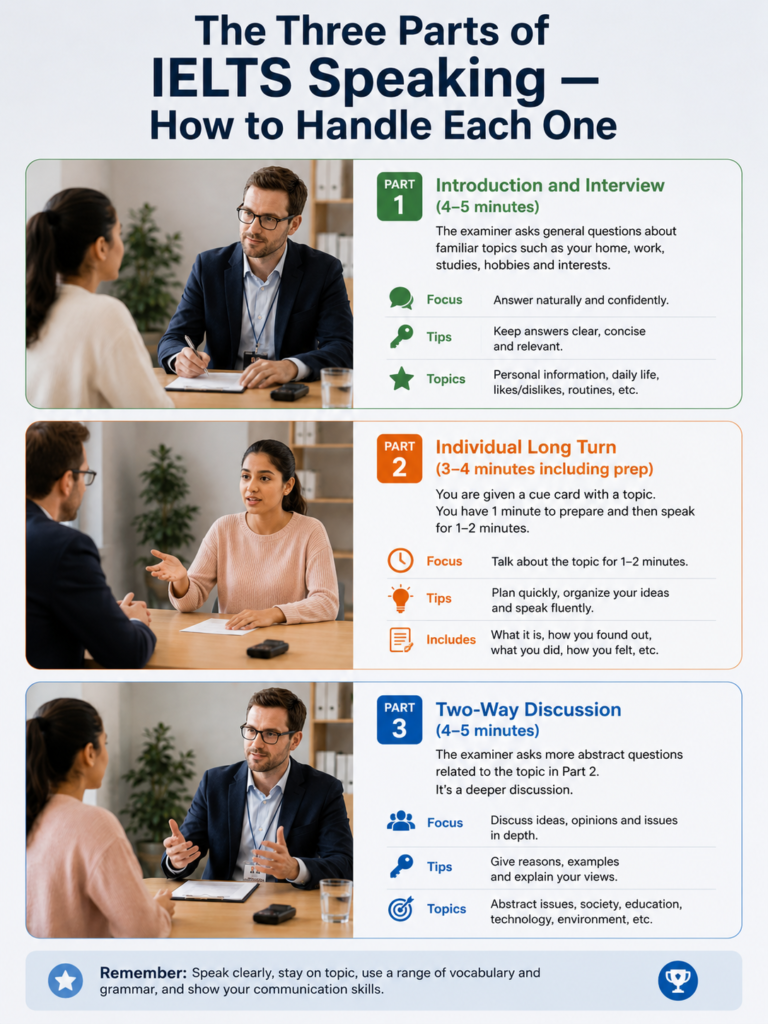
Part 1 — Introduction and Interview (4–5 minutes)
The examiner asks questions on familiar everyday topics: home, family, work, studies, hobbies, daily routines. This section is designed to warm you up, not trip you up.
What candidates get wrong: they give answers that are either too short (“Yes, I like music”) or too long (a three-minute monologue on why they enjoy music). Part 1 answers should be 2–4 sentences — enough to demonstrate vocabulary and grammar, short enough to keep the conversation moving.
Part 2 — Individual Long Turn (3–4 minutes including prep)
You receive a task card and have one minute to prepare. Then you speak for up to two minutes on the topic. The examiner may ask one or two brief follow-up questions.
What candidates get wrong: they run out of things to say after 45 seconds, or they memorise a response so thoroughly it sounds scripted.
Use your one minute of preparation time to build a simple structure: an opening statement, two or three main points, and a brief closing thought. That structure alone will carry you through two minutes without your speech collapsing. You do not need to cover every bullet point on the task card — depth on two points is better than surface coverage of four.
Part 3 — Two-Way Discussion (4–5 minutes)
The examiner asks more abstract, analytical questions related to the Part 2 topic. This section is designed to test your ability to discuss ideas, give opinions, and develop arguments.
What candidates get wrong: short, surface-level answers. Part 3 is where Band 7+ candidates separate themselves by developing their responses — offering a view, supporting it with a reason or example, and acknowledging an alternative perspective.
You are not expected to have expert knowledge on the topic. You are expected to speak at length, coherently, with some analytical depth.
Common Mistakes Indian Candidates Make in IELTS Speaking
These are patterns from real assessments, not generalisations:
1. Stopping to search for the perfect word When a vocabulary gap appears, many candidates pause visibly — sometimes for several seconds — trying to recall the exact word they want. This directly damages the fluency score. The better move is to keep speaking and paraphrase. “I can’t remember the exact word, but it’s something like a plan that you make before you start a project” is better than a four-second silence followed by “blueprint.”
2. Starting answers multiple times Restarting an answer — “I think… actually, what I mean is… so basically…” — is one of the clearest signals of low fluency to an examiner. Practise finishing your thoughts even when they are imperfect.
3. Using the same grammar structures throughout Safe, simple sentences score well for accuracy but poorly for range. If every answer uses present simple or past simple, the range score will not reach Band 7 regardless of how accurate the sentences are.
4. Treating Part 3 like Part 1 Short, direct answers work in Part 1. In Part 3, they signal limited ability to develop ideas. Extend every Part 3 answer with a reason, an example, or a counter-point.
5. Over-rehearsing specific topics Memorised answers are identifiable. They typically have unnatural fluency — too smooth in places, then a collapse when the candidate deviates — and they often do not directly answer the question asked.
If these patterns sound familiar, our post on why some IELTS learners get stuck at 6.5 explains the plateau in detail and what specifically breaks it.
What Band 7 Speaking Actually Looks Like
Understanding what Band 7 looks like in practice is more useful than aiming for abstract improvement.
At Band 7, a candidate:
- Speaks at length with only occasional loss of fluency or coherence
- Uses a range of vocabulary flexibly, with some less common items, and paraphrases effectively when needed
- Uses a mix of simple and complex structures with generally good accuracy — some errors remain but do not affect communication
- Is mostly easy to understand throughout, with clear rhythm and stress, even if accent features are present
The gap between Band 6.5 and Band 7 is not usually a grammar gap or a vocabulary gap. It is a fluency and range gap. Candidates at 6.5 tend to speak accurately but restrictively — safe structures, safe vocabulary, answers that stay short to avoid mistakes.
The move to Band 7 requires the willingness to attempt longer turns, more complex structures, and less common vocabulary — even at the cost of an occasional error.
For a full breakdown of practical Band 7+ speaking strategies, see our detailed post on IELTS Speaking Band 9 tips from a former examiner.
How to Prepare if Your Goal Is Band 7+
Step 1 — Record yourself, then listen back critically Most candidates have never heard themselves speak English under test conditions. Recording Part 2 responses and listening back reveals fluency patterns, vocabulary habits, and pronunciation issues that are invisible in the moment. It is uncomfortable the first few times. It is also the single most effective preparation exercise.
Step 2 — Practise paraphrasing deliberately Take a word you know — “expensive,” “difficult,” “important” — and practise expressing the same idea six different ways. This builds the reflex for in-test vocabulary gaps and directly improves your Lexical Resource score.
Step 3 — Extend every answer by one more sentence Whatever length you naturally produce, add one more sentence. A reason, an example, a qualification. This trains the long-turn habit that Part 2 and Part 3 reward.
Step 4 — Use complex structures deliberately in practice Pick one complex structure per practice session — a conditional, a passive, a relative clause — and find natural opportunities to use it. Over time, variety becomes automatic rather than effortful.
Step 5 — Time your preparation honestly The question of how long to prepare is often underestimated. Our guide on how long you should prepare for IELTS gives an honest answer based on starting level and target band. If you have a fixed deadline, our 3-month IELTS study plan from a former examiner maps out a realistic preparation schedule.
Also worth knowing: if you are still deciding between paper and computer IELTS, the format affects more than just writing — check our post on computer IELTS vs paper IELTS in India before you book.
Step 6 — Get feedback from someone who knows the criteria Self-study can take you a long way. But the fastest improvement comes from feedback tied directly to the four scoring criteria — not just “that sounded good” or “your grammar was off.” At our IELTS coaching centre in Chennai, every Speaking assignment is assessed against the official band descriptors, with written feedback on each of the four criteria and a supposed band score so you know exactly where you stand.
We also offer Speaking preparation as part of our IELTS programme in Pondicherry for candidates in Tamil Nadu outside Chennai.

Key Takeaways
- IELTS Speaking is scored on four equally weighted criteria: Fluency and Coherence, Lexical Resource, Grammatical Range and Accuracy, and Pronunciation. Each carries 25% of the score.
- Fluency means uninterrupted, well-organised speech — not speed. Pausing to search for words damages this score more than a grammar mistake does.
- Vocabulary scoring rewards paraphrasing and range, not rare words. When you do not know a word, describe it and keep going.
- Grammar scoring rewards range of structures as much as accuracy. Safe, simple sentences cap your score at 6.5 regardless of how correct they are.
- Pronunciation is about intelligibility, rhythm, and stress — not accent. A clear Indian accent scores well. An imitated foreign accent that disrupts fluency does not.
- Memorised answers are identifiable and typically score lower than natural, slightly imperfect speech.
- The Band 6.5 to Band 7 jump is almost always a fluency and range issue, not a knowledge gap.
Frequently Asked Questions
1. Do IELTS examiners care about accent?
No. IELTS official criteria are explicit that a natural local accent does not negatively affect the score. Examiners score intelligibility — whether you can be understood without effort — not whether your accent sounds British or American. A clear Indian accent with good rhythm and stress scores well.
2. Is a native accent needed for a high IELTS Speaking score?
No. IELTS does not require or reward native-speaker accent. Band 9 is achievable without any attempt to imitate a native speaker. Trying to adopt an unnatural accent often makes speech less fluent, which damages the score.
3. What is the most important criterion in IELTS Speaking?
All four criteria are equally weighted at 25% each. In practice, Fluency and Coherence is the one that catches most candidates off guard because it is least understood and least practised.
4. How is IELTS Speaking scored?
A trained, certificated examiner scores the 11–14 minute interview against four criteria: Fluency and Coherence, Lexical Resource, Grammatical Range and Accuracy, and Pronunciation. Each criterion is scored on the 0–9 band scale, and the four scores are averaged for the final Speaking band.
5. How long is the IELTS Speaking test?
The full Speaking test lasts 11–14 minutes. It is conducted face-to-face with an examiner and is recorded. Part 1 lasts 4–5 minutes, Part 2 includes one minute of preparation and up to two minutes of speaking, and Part 3 lasts 4–5 minutes.
6. What should I do if I forget a word during the test?
Paraphrase immediately and keep speaking. Describe the concept, use a related word, or rephrase the idea. Do not pause visibly while searching for the exact word — the pause damages your fluency score more than the vocabulary gap does. Paraphrasing under pressure is itself a skill examiners reward.
7. Does speaking faster help?
No. Speed is not scored. Fluency means smooth, connected speech without breakdowns — not rapid delivery. Speaking too fast can actually reduce clarity and hurt your pronunciation score. Aim for a natural, comfortable pace.
8. Why do some candidates score 6.5 repeatedly despite strong English?
Usually because they are scoring well on accuracy but poorly on range — using safe, simple structures that limit the grammar score — or because their answers are stopping and restarting too often, limiting fluency. Our post on why learners get stuck at 6.5 covers this in detail.
Conclusion
IELTS Speaking is a test with a defined marking system. Once you understand what each criterion actually measures — rather than what you assume it measures — preparation becomes far more targeted and results follow faster.
The candidates I have seen score Band 7 and above are not always the most gifted English speakers in the room. They are the ones who keep talking, organise their thoughts under pressure, recover from vocabulary gaps without stopping, and produce enough grammatical variety to show real range. Those are trainable skills, not fixed abilities.
If your Speaking score is not where it needs to be, the gap is almost certainly in fluency, range, or both — not in your underlying English level.
Not getting the Speaking band you need? Work directly with Shane Jordan. With 24+ years of examining and teaching experience, our IELTS coaching centre in Chennai offers structured Speaking preparation with feedback tied directly to the official band descriptors — so you know exactly what to improve and how.
Healthcare professional preparing for UK or Australian registration? OET assesses Speaking through a role-play format specific to healthcare — it may be more relevant to your pathway than IELTS.