


By this point, most Indian IELTS students have watched 47 YouTube videos, memorised 12 “high-scoring” essay templates, and developed a deep emotional attachment to the word “Furthermore.”
And yet… the Writing score still refuses to move.
That’s because the problem usually isn’t intelligence or effort. It’s a handful of very specific habits that creep into Task 2 essays again and again.
In Part 1, we broke down five of those habits. You can read it here. Common IELTS Writing Task 2 Mistakes Indian Students Must Stop Making (And How to Score Band 7+)
And in this part, we’re tackling five more.
Mistake #1: Informal Language and Indian English Expressions
This is a very specific issue for Indian students, and it’s worth addressing directly.
IELTS Writing Task 2 requires formal academic English. That means:
- No contractions (don’t → do not, it’s → it is)
- No colloquial phrases (a lot of → a significant number of, things → aspects/factors)
- No vague vocabulary (stuff, nice, bad)
- No phrases common in Indian English that don’t translate to standard academic writing
Using informal language is penalised under Lexical Resource and will limit your score to Band 5 or below. Similarly, Indian students sometimes use translated expressions from Hindi or their regional language that sound slightly off in formal English – not wrong exactly, but not quite right either.
Since we’re talking about Indian English, here are a few commonly found Indian-isms that our Assessors here at Insync Learning come across frequently.
Wrong — “Discuss about the issue.”
Correct — “Discuss the issue.”
Wrong — “Pass out from college.”
Correct — “Graduate from college.”
Wrong — “Batchmates.”
Correct — “Classmates” / “People in the same graduating class.”
Wrong — “Nowadays, children are addicted towards mobile phones.”
Correct — “Nowadays, children are addicted to mobile phones.”
Wrong — “Cousin brother / cousin sister.”
Correct — “Cousin.”
Wrong — “People are using social media for timepass.”
Correct — “People use social media to pass the time.”
Wrong — “The crime rate is increasing day by day.”
Correct — “The crime rate is increasing steadily.”
Here’s the fix – Every time you write a practice essay, read it back and ask: “Would this sentence appear in a published academic article or newspaper?” If not, revise it.

Mistake #2: Memorised Language and Template Phrases
Examiners are trained to spot memorised language and clichés, and they will discount those phrases. This includes opening lines like:
- “In today’s rapidly changing world…”
- “It is a well-known fact that…”
- “Since time immemorial…”
These openings tell the examiner nothing about your ideas. They’re filler. And they signal that you’re relying on a rehearsed template rather than engaging naturally with the specific question in front of you.
Many Indian students spend significant preparation time learning template essays by heart – an approach that is actively counterproductive.
Here’s the fix – Your introduction should do two things: paraphrase the question in your own words and state your position (thesis). That’s it. Two to three sentences within 55 words. No padding, no theatrical or stuffy openings.
Mistake #3: Weak Idea Development (Stating Without Explaining)
Band 7 essays present “extended and supported” ideas. Band 6 essays have main ideas that are “insufficiently developed or may lack clarity.”
This gap – from insufficient to extended – is where most Indian students lose marks. They state a point and then move on. They don’t explain why the point is true, how it works in practice, or what the consequences are.
A common pattern that caps students at Band 6:
- “Technology helps students learn. Many students use phones for education.”
A Band 7 development:
- “Technology has transformed how students access information. With a single device, learners in remote areas of India can now access the same coursework as students in metropolitan cities, effectively reducing the educational inequality that has persisted for decades.”
Notice the difference? The second version explains the mechanism, gives a concrete context, and extends the idea to a broader implication.
Here’s the fix – After every main point you write, ask yourself: “So what? Why does this matter? How does it happen?” Then write one or two more sentences that answer those questions.
Mistake #4: Grammar Errors Specific to Indian English Users
Grammar accounts for 25% of your Task 2 score. And while Indian students generally have strong grammar foundations, there are a few recurring error patterns that are particularly common.
And these are the most frequent culprits:
- Articles (a, an, the): Indian languages don’t have articles, which means using them correctly in English requires deliberate practice. The most common errors:
Wrong – “The people should exercise regularly.” (no “the” needed with people in general)
Correct – “People should exercise regularly.”
- Subject-verb agreement with collective nouns:
Wrong – “The government have decided…”
Correct – “The government has decided…”
- Uncountable nouns:
Wrong – “She gave me many informations.”
Correct – “She gave me a lot of information.”
- Run-on sentences – Long sentences strung together without proper punctuation or conjunctions, which is a pattern influenced by longer sentence rhythms in regional Indian languages.
Here’s the fix – Identify your personal two or three recurring errors (get feedback from a teacher or a peer with good skills). Then drill those specific rules, not English grammar in general.
Mistake #5: Poor Time Management
Task 2 carries twice the weight of Task 1 in your Writing score. Yet many Indian students either run out of time on Task 2 or don’t plan their essay at all.
The recommended time breakdown for Task 2 is:
- 3–4 minutes: Planning (underline key words, identify question type, brainstorm 2 main ideas)
- 30 minutes: Writing
- 3–4 minutes: Proofreading for grammar and coherence
If time management is a weakness for you, consider writing Task 2 first – since it’s worth more, it deserves your freshest thinking and your full 40 minutes.
Here’s the fix – In every practice session, use a stopwatch. Never skip the planning stage. Never skip proofreading. Make this a part of your routine before exam day.
The Band 7+ IELTS Writing Task 2 Checklist
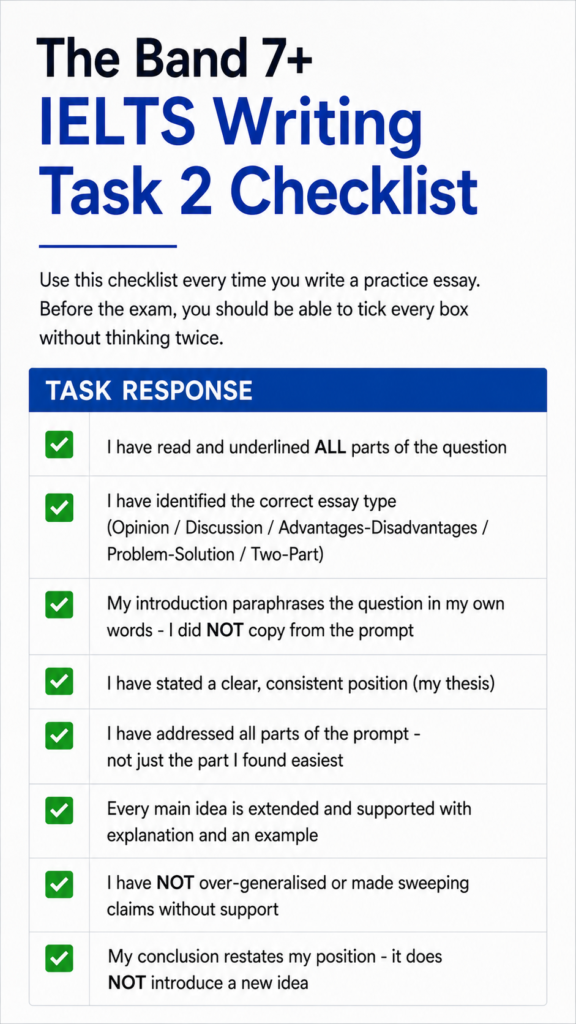
Use this checklist every time you write a practice essay. Before the exam, you should be able to tick every box without thinking twice.
- TASK RESPONSE
- ✔️ I have read and underlined ALL parts of the question
- ✔️ I have identified the correct essay type (Opinion / Discussion / Advantages-Disadvantages / Problem-Solution / Two-Part)
- ✔️ My introduction paraphrases the question in my own words – I did NOT copy from the prompt
- ✔️ I have stated a clear, consistent position (my thesis)
- ✔️ I have addressed all parts of the prompt – not just the part I found easiest
- ✔️ Every main idea is extended and supported with explanation and an example
- ✔️ I have NOT over-generalised or made sweeping claims without support
- ✔️ My conclusion restates my position – it does NOT introduce a new idea
- COHERENCE AND COHESION
- ✔️ My essay has a clear four-part structure: Introduction → Body 1 → Body 2 → Conclusion
- ✔️ Each paragraph has a clear topic sentence
- ✔️ Ideas within each paragraph flow logically from one sentence to the next
- ✔️ I have used a range of cohesive devices – not just “Furthermore” and “Moreover”
- ✔️ I have used reference words (this, these, it, such) to avoid repetition
- ✔️ I have NOT over-used linking words to the point where they feel mechanical
- ✔️ Paragraphing is clear and each new idea has its own paragraph
- LEXICAL RESOURCE
- ✔️ I have used topic-appropriate vocabulary. Not forced or unnatural “advanced” words
- ✔️ I have not repeated the same word or phrase more than twice in the essay
- ✔️ I have used word forms correctly (noun/verb/adjective/adverb)
- ✔️ I have NOT used informal language, contractions, or colloquial expressions
- ✔️ I have NOT started my introduction with a cliché (“In today’s rapidly changing world…”)
- ✔️ My spelling is accurate, including in less common vocabulary
- ✔️ I have used some less common vocabulary, but only where I’m confident it is accurate
- GRAMMATICAL RANGE AND ACCURACY
- ✔️ I have used a MIX of simple and complex sentence structures
- ✔️ I have used at least one relative clause (who, which, that)
- ✔️ I have used at least one conditional or passive construction appropriately
- ✔️ My articles (a/an/the) are used correctly, especially with general statements
- ✔️ Subject-verb agreement is correct throughout
- ✔️ Uncountable nouns (information, advice, evidence, research) are used correctly
- ✔️ I have checked for run-on sentences and added punctuation or conjunctions
- ✔️ The majority of my sentences are error-free
- ✔️ I spent 3–4 minutes proofreading before finishing
BONUS – OVERALL
- ✔️ My essay is between 270–300 words
- ✔️ I used 3–4 minutes planning before writing
- ✔️ I did NOT use a memorised template or stock phrases
- ✔️ I addressed the specific question asked – not the general topic
- ✔️ I am confident a Band 7 examiner would find my essay clear, logical, and well-developed

FAQs on Indian Students Scoring Band 7+ in Task 2
1. What grammar mistakes are common among Indian IELTS students?
Common mistakes include:
- Incorrect article usage (a/an/the)
- Subject-verb agreement errors
- Incorrect use of uncountable nouns
- Run-on sentences
- Indian-English phrasing that sounds unnatural in formal academic English
2. Is Indian English accepted in IELTS Writing?
IELTS accepts different English accents and styles in speaking, but Writing Task 2 is assessed using standard academic English conventions. Some Indian-English phrases may sound unnatural or informal in IELTS essays.
3. What are examples of Indian-English phrases to avoid in IELTS?
Examples include:
- “Discuss about”
- “Myself Rahul”
- “Kindly revert back”
- “Pass out from college”
- “Avail the opportunity”
These expressions are common in Indian English but are not considered standard academic English.
4. How important is grammar in IELTS Writing Task 2?
Grammar contributes 25% of your Writing Task 2 score under Grammatical Range and Accuracy. Frequent grammar errors can significantly reduce your band score.
5. How much time should I spend on IELTS Writing Task 2?
The recommended breakdown is:
- 3–4 minutes planning
- 30 minutes writing
- 3–4 minutes proofreading
Task 2 is worth twice as much as Task 1, so proper time management is essential.
6. You Don’t Need a Perfect Essay to Get a Band 7 in IELTS Writing Task 2
The official band descriptors make clear that a Band 7 essay can still have occasional errors, some over-generalisation, and a few cohesive device inaccuracies – and still score 7!
The key is that your ideas are developed, your argument is clear, your vocabulary is appropriate, and your grammar is mostly accurate.
The students who move from a 6 to a 7 are almost never the ones who suddenly discovered a new sophisticated word. They’re the ones who stopped making the same avoidable mistakes , and started writing essays that actually answer the question.
Go through this checklist with every practice essay you write. Not after the exam. Now.
Ready to get hands-on training and raise your Band score? ENROL NOW!