


You studied hard. You practised writing essays for weeks. You even memorised a few “impressive” words. And then you got your results… it’s a 6 or a 6.5 in IELTS Writing, when you need a 7.
If that sounds familiar, you are not alone.
India sends more IELTS test-takers to the exam hall than almost any other country in the world. And yet, Writing remains the most stubborn section for Indian students.
Not because Indian students lack intelligence or English ability (they clearly don’t) but because many of the mistakes they make are predictable, repeatable, and completely fixable.
This blog is about those exact mistakes. Specifically in IELTS Writing Task 2 – the essay section that carries two-thirds of your total Writing score. Read this carefully, and by the end, you’ll have a clear picture of what’s actually holding you back and what to do about it.
Why IELTS Writing Task 2 Trips Up Indian Students Specifically
Before we dive into individual mistakes, it’s worth understanding something. Most Indian students are genuinely good at English. They read it, speak it, and think in it – often from a young age. So why does the writing score lag?
The honest answer is a mix of three things.
First, Indian English has its own rhythm. Phrases like “kindly do the needful,” longer sentences that build toward a point, and a tendency to write formally but with a slightly different structure – these are habits that transfer from regional languages and Indian English conventions. IELTS examiners, however, are trained to look for standard academic English.
Second, Indian students often prepare the wrong way. They memorise vocabulary lists, copy template phrases, and practise writing long essays without understanding what examiners are actually looking for.
Third, and most importantly, most test-takers don’t know what the band descriptors actually say. Once you know exactly what a Band 7 requires (and what keeps you stuck at Band 6) everything changes.
So let’s start there.

What Does Band 7 Actually Require?
Your essay is marked across four criteria, each worth exactly 25% of your Task 2 score:
| Criterion | What It Measures |
| Task Response (TR) | Did you fully answer the question with a clear, developed position? |
| Coherence and Cohesion (CC) | Is your essay logically organised with good paragraph flow? |
| Lexical Resource (LR) | Do you use a wide and accurate range of vocabulary? |
| Grammatical Range and Accuracy (GRA) | Do you use varied sentence structures with minimal errors? |
For Band 7 specifically, the official descriptors state,
- Task Response – All parts of the task are addressed (though some may be less fully covered). A clear and developed position is presented. Main ideas are extended and supported – but there may be a tendency to over-generalise.
- Coherence and Cohesion – Information and ideas are logically organised with clear progression. A range of cohesive devices including reference and substitution is used flexibly, but with some inaccuracies or over/under-use.
- Lexical Resource – The resource is sufficient to allow some flexibility and precision. Less common vocabulary is used with awareness, though not always successfully.
- Grammatical Range and Accuracy – A variety of complex structures is used. The majority of sentences are error-free. Occasional errors or inappropriacies do not impede communication.
Now that you know the destination, let’s talk about the ten most common mistakes that keep Indian students away from it.
Mistake #1: Not Fully Answering the Question
This is, without question, the single most score-damaging mistake in IELTS Writing Task 2. Because not answering the question fully stops you from scoring above Band 5 on Task Response – no matter how good your English is!
Think about that. Perfect grammar, rich vocabulary, and a beautifully structured essay can all be undone simply by missing part of the question.
Here’s what this looks like in practice:
The question says: “Some people believe the government should fund the arts. Others argue this money should be spent on public services. Discuss both views and give your own opinion.”
Many Indian students write a fine essay – but only really discuss one view, or they forget to give a clear personal opinion at the end. That’s an incomplete answer. It’s like being asked “What did you eat for breakfast and why?” and only answering one half.
Here’s the fix – Before you write a single word, underline every part of the prompt. Ask yourself: how many things is this question asking me to do? Then make sure your essay does all of them.
Many assessors in IELTS coaching centres emphasise that the most frustrating thing about marking essays is finding one with great grammar and vocabulary that completely misses the point of the question.
So, writing everything you know about the topic without addressing the specific question asked is a huge no-no.
Mistake #2: Misreading the Question Type
IELTS Writing Task 2 has five main question types: Opinion (Agree/Disagree), Discussion (Both Views), Advantages and Disadvantages, Problem and Solution, and Two-Part Questions. Each requires a different structure.
Using the wrong structure is one of the most common reasons students score below Band 6 on Task Response. If you treat a “Discuss both views and give your opinion” essay like a pure opinion essay, you’ve already lost marks even before the examiner reads your first paragraph.
Here’s the fix – Spend the first two minutes identifying the question type. Then use the structure that matches it. Don’t guess. Know these five types cold before exam day.
Mistake #3: Poor Paragraphing (A Hidden Band 5 Trap)
Here’s something that surprises a lot of students. Using only two paragraphs – one enormous body paragraph and a one-sentence conclusion – matches the Band 5 descriptor for Coherence and Cohesion. Just two paragraphs.
Indian students sometimes write this way because, in other forms of academic writing they’ve done, the focus was on content rather than structure. In IELTS, structure is content.
A well-organised Task 2 essay has:
- An introduction (paraphrase the question + thesis statement)
- Body Paragraph 1 (first main idea + development + example)
- Body Paragraph 2 (second main idea + development + example)
- A conclusion (summary of main points + restated position)
Each paragraph should start with a clear topic sentence. Each idea needs to be developed, and not just stated.
Here’s the fix – Think of each body paragraph as a mini-essay. State your point. Explain it. Give a concrete example. Link back to the question.
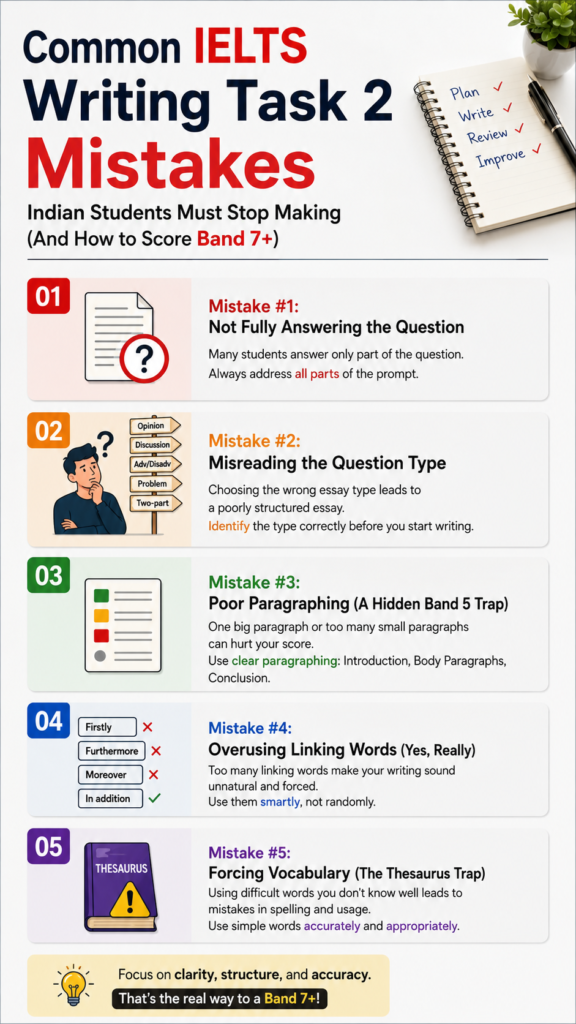
Mistake #4: Overusing Linking Words (Yes, Really)
This one surprises most students, and it’s especially common among Indian test-takers who’ve been told that “transition words” are essential.
They are – for sure. But there’s a right and a wrong way to use them.
Many students pepper their essays with “Furthermore,” “Moreover,” “Additionally,” “In addition,” and “Consequently” in almost every sentence. This kind of mechanical, overused linking is a hallmark of a Band 6 writer. Band 7 and above writers use cohesion naturally through referencing (this, these, it), substitution, and logical paragraph flow, not just by bolting on a discourse marker at the start of every sentence.
The difference between:
- “Furthermore, this shows that pollution is increasing.”
- “This trend, in turn, has accelerated environmental degradation.”
…is the difference between sounding mechanical and sounding genuinely fluent.
Here’s the fix – Learn to vary your cohesive devices. Use pronouns, relative clauses, and logical paragraph flow, not just a list of transition words. Read well-written essays and notice how they connect ideas.
Mistake #5: Forcing Vocabulary (The Thesaurus Trap)
A perfect example is from F.R.I.E.N.D.S. (the TV show) when Joey Tribbiani writes the adoption recommendation letter for Monica Geller and Chandler Bing using a thesaurus… and accidentally turns simple words into absolute chaos.
Remember how “They’re warm, nice people with big hearts” became “they’re humid, pre-possessing homosapiens with full-sized aortic pumps”?
Many Indian students prepare by memorising long lists of academic words and then try to wedge them into their essays regardless of context.
The result is words that are either inappropriate (the meaning is slightly wrong) or inaccurate (grammatically wrong in that sentence). And this actually lowers your Lexical Resource score.
A classic example: instead of writing “many people,” a student writes “a preponderance of individuals” – a phrase that is technically possible but sounds unnatural and forced. Examiners notice this immediately.
Band scores are not only about complex grammar and vocabulary – accuracy matters too. Your first aim is to produce accurate, natural-sounding sentences. Complex vocabulary used incorrectly is worse than simpler vocabulary used precisely.
Here’s the fix – Instead of memorising word lists, read about common Task 2 topics – education, technology, environment, health, society – and note vocabulary in context. Learn phrases, not just words, and practice using new vocabulary in full sentences before exam day.

FAQs on Indian Students Scoring Band 7+ in Task 2
1. Why do Indian students lose marks in IELTS Writing Task 2?
Indian students often lose marks because they do not fully answer the question, use memorised templates, overuse linking words, or force advanced vocabulary unnaturally. Many also follow preparation methods that focus more on “sounding sophisticated” than writing clearly and accurately.
2. What is the most common mistake in IELTS Writing Task 2?
One of the biggest mistakes is not answering all parts of the question. For example, in a “Discuss both views and give your opinion” essay, many students only discuss one side or forget to include their own opinion clearly.
3. Does using advanced vocabulary improve IELTS Writing scores?
Not always. IELTS examiners reward accurate and natural vocabulary use, not complicated words used incorrectly. Simple vocabulary used precisely often scores higher than forced “academic” language.
4. How many paragraphs should an IELTS Task 2 essay have?
A well-structured IELTS Task 2 essay usually has four paragraphs:
- Introduction
- Body Paragraph 1
- Body Paragraph 2
- Conclusion
This structure helps improve Coherence and Cohesion scores.
We hope this piece aids in your IELTS journey. If you found this interesting and want more – check out the 5 more common mistakes Indian students.
Want hands-on training from a former IELTS examiner? ENROL NOW!