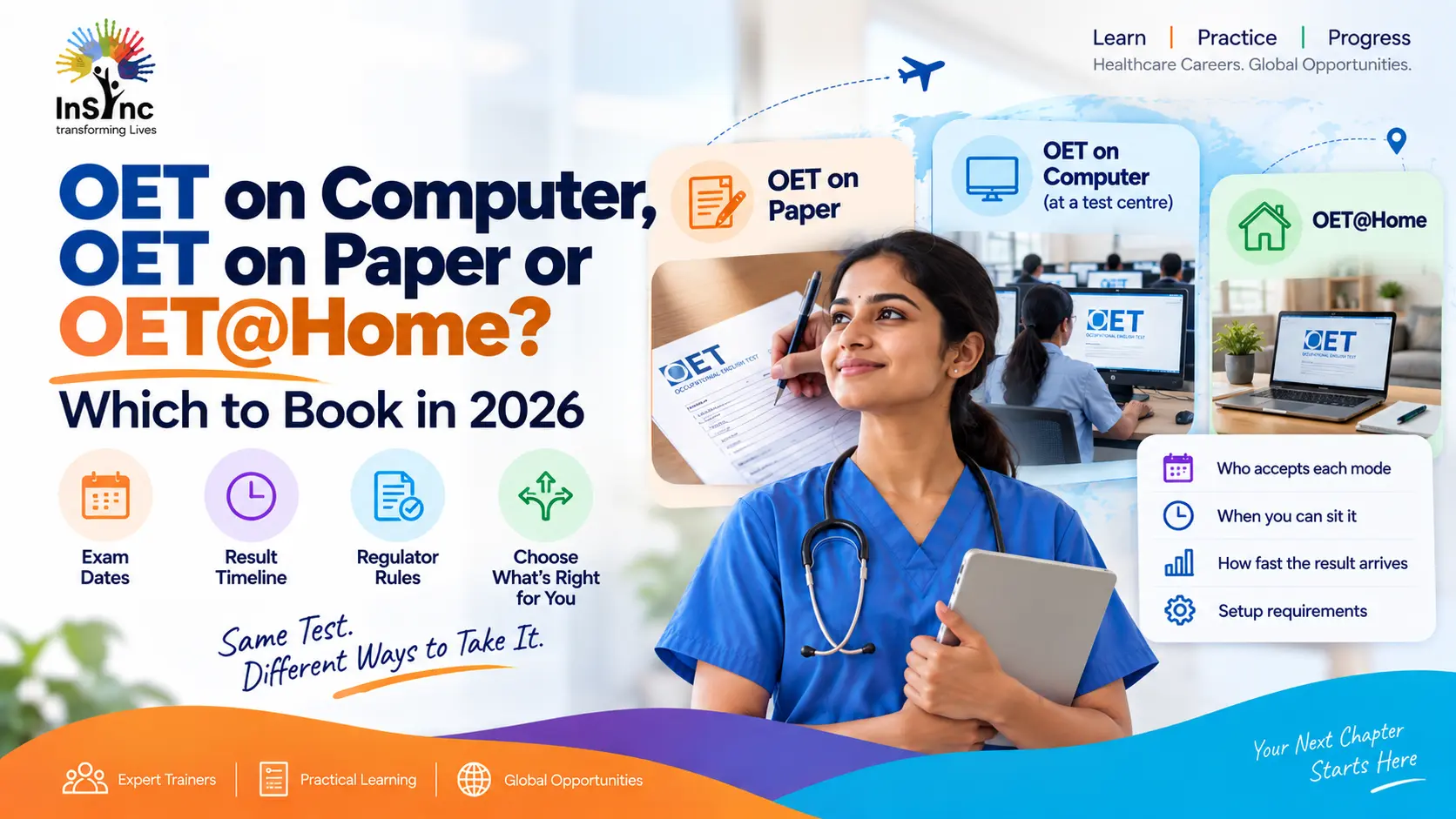
Three delivery modes carry the same OET: on paper at a centre, on computer at a centre, and OET@Home on your own machine. They share one specification and one fee in India, so the decision is not about difficulty. It is about who accepts the mode, when you can sit it, how fast the result arrives, and what you are willing to set up in your own room.
If you are still working out what the test involves, how the OET works covers that first. This page answers the booking decision in the order it actually happens, starting with the rule that removes one option for most candidates in India.
OET@Home is offered where a country has no test venue, which settles the question for most Indian candidates
OET’s OET@Home page answers the eligibility question directly: the mode is offered in countries where taking the test at a venue is not yet available, and not all regulators accept it. India has both paper and computer venues, so the practical choice here is between the two venue modes. The OET Test Handbook adds a second route the website does not mention: the mode is also available if you have other access needs.
ECFMG says the same thing from the other side for doctors on the US pathway: the at-home mode is available only to applicants who do not have a physical test venue in their country, and applicants who do have one should plan to take OET on paper or on computer at a test centre.
That does not make the OET@Home rules irrelevant. Candidates who move countries mid-application meet them, and every computer candidate meets a version of them, because the Speaking sub-test usually runs from home. The requirements section below covers both.
Your regulator sets the mode rule, and the major ones disagree with each other
Book the wrong mode and a perfectly good Grade B is unusable, so check the body you will apply to before you check dates.
| Body | Paper | Computer at venue | OET@Home | What it publishes |
|---|---|---|---|---|
| NMC, UK nursing | Yes | Yes | Yes | Accepts OET on Paper, OET on Computer and OET@Home, and will combine OET@Home with either venue mode |
| GMC, UK medicine | Yes | Yes | Yes | Accepts all three versions, with the Medicine test required |
| Ahpra, Australia | Yes | Yes | No | Rejects at-home and remote-proctored versions, with one exception: the computer-based test at a test centre |
| Nursing Council of New Zealand | Yes | Yes | No | Requires an OET testing centre, while accepting the online Speaking element of the venue computer test; its policy guidance names OET@Home as not accepted |
| ECFMG, United States | Yes | Yes | Only with no venue | Directs applicants with a venue in their country to paper or computer |
| AIMG, Alberta | Not itemised | Not itemised | Yes | Names OET Medicine or OET@Home results, without itemising paper or computer delivery |
| College of Nurses of Ontario | Silent | Silent | Silent | Lists OET without naming a delivery mode, so confirm before booking |
Sources: NMC OET page, GMC OET certificate page, Ahpra accepted English language tests, Nursing Council of New Zealand and its English language competence policy guidance, ECFMG OET page, AIMG English language proficiency and CNO language proficiency, all read on 23 September 2026.
Ahpra’s wording is the one to read closely, because it explains why Australian applicants can still use the computer mode. Ahpra does not approve at-home versions or versions with any element of remote proctoring, then makes a single exception for the OET computer-based test at a test centre, whose one remote-proctored element it has assessed as acceptable. Nurses working through that route will find the rest of the requirement in our guide to the Australian nursing route.
Visa rules sit on top of registration rules and can differ. The Australian Department of Home Affairs says a test must take place in a secure testing centre and names OET@Home among the online tests it does not accept. Immigration New Zealand requires the test to be sat in person at a test centre and rules out at-home tests. The UK runs the other way, and most clearly for four professions. Under the heading for doctors, dentists, nurses and midwives, gov.uk states that you do not need to prove your knowledge of English if you have already passed an assessment accepted by the relevant regulated professional body, which means an OET result the NMC has accepted also settles the knowledge-of-English requirement for the Health and Care Worker visa. Indian nurses on that route can read the score detail in the UK nursing route.
OET on Computer sends your Speaking sub-test home unless your country is on OET’s venue list
This is the detail candidates miss when they book the computer mode to avoid remote testing. OET’s computer page places Listening, Reading and Writing at a venue on one day, and the Speaking sub-test on a different day, up to five days before or after, taken at home through an online platform, with a venue option in select countries.
OET’s booking page puts the responsibility on you in one line: ensure the Speaking mode you select is accepted by the organisation you are applying to. The Nursing Council of New Zealand names the arrangement directly, accepting the OET on computer at an approved venue with the Speaking sub-test hosted online. Ahpra stops short of naming Speaking, saying only that the computer-based test at a test centre has one remote-proctored element it has assessed as acceptable.
The platform behind it changed during 2026. OET’s announcement says new or rescheduled OET@Home and OET on Computer bookings made after 9 June use a new Speaking platform, reached through Prometric with a secure browser, with no change to the format or the marking. Candidates download that browser from Prometric’s candidate page at least a day before, according to OET’s computer test day guide.
Where Speaking does run at a venue, it is not the paper experience. OET’s guide describes a secure computer and headset at your test centre, a separate check-in 30 minutes before, and a role-play card shown on screen. Only OET on Paper keeps the interlocutor in the room with you.
The computer mode publishes far more dates than paper, and paper alternates which professions can sit it
We counted the dates OET published on its booking page on 23 September 2026. Between 12 January and 3 June 2026, where the two tables overlap, it listed 99 OET on Computer dates against nine global OET on Paper dates.
| Question | OET on Paper | OET on Computer |
|---|---|---|
| How often | Saturdays, mostly fortnightly: 24 global dates across 2026 | Most days from Monday to Saturday, though OET has published computer dates only to 3 June 2026 |
| Professions per date | Alternates: 12 dates carry seven professions, 12 carry Nursing and Medicine only | All 12 professions on every listed date |
| Booking closes | 24 days before the test date, marked subject to change | 7 days before the test date, as for OET@Home |
| Results | As little as 5 days in India, from 13 days elsewhere | As little as 48 hours, with 95 per cent inside 6 calendar days |
Source: OET book a test, OET on Paper and OET on Computer, read 23 September 2026. Date counts are ours, from the tables published on that page. OET’s computer table runs to 3 June 2026 and its global paper table to 19 December 2026, so only the shared window is compared. A separate Americas paper table lists 24 Friday dates with the same profession split.
Read the profession row before you plan around a Saturday. Half the paper dates in 2026 are open to Nursing and Medicine only, so a physiotherapist or a pharmacist who wants paper has a date roughly once a month rather than once a fortnight. Dietetics, Podiatry, Occupational Therapy, Optometry and Speech Pathology appear on no paper date in 2026 and on no paper profession list, which leaves the computer mode as their venue route. OET’s paper page contradicts itself here, because its FAQ says both venue modes are available for all 12 professions, so candidates in those five should confirm with OET before planning a paper booking.
The closing dates matter just as much when a registration deadline is near. Paper closes 24 days ahead, so a candidate who decides in the last three weeks cannot book it, while the computer mode stays open until seven days before. Venue and city availability is a separate question, and candidates sitting in Karnataka can see how it works in practice in our guide to OET exam centres in Bangalore.
Computer results start at 48 hours, while paper results in India start at five days
India is already the fastest market for paper. OET publishes results in as little as five days after the test date for candidates tested in India and the Philippines, against 13 days or more elsewhere. The computer mode is faster still, from 48 hours after the last sub-test, with 95 per cent of results inside six calendar days.
One caution belongs with those numbers. The clock starts when every sub-test is complete, so a computer candidate whose Speaking session sits five days after the written papers effectively adds those days to the wait. OET also notes that timings are indicative and can stretch for quality or security checks, and its results page gives slightly different figures again, at 12 days for other regions and six days for the Philippines, so treat every window as the earliest case.
Recent forum activity shows how much attention the wait attracts. In 824 Reddit threads about the exam posted between 1 February and 18 September 2026, 88 per cent of them from a subreddit for doctors on the US ECFMG pathway, 90 carried the word result in the title. Twenty-three of those titles used a word such as when, how long, delay or waiting, and another 17 threads were about what happens after the result, such as ECFMG verification. If your registration or interview date is fixed, book with room to spare rather than to the published minimum.
Only OET on Paper allows a single sub-test booking after a full test
This rule outranks convenience for anyone who may need one sub-test again. OET’s support article on cost states that single sub-tests can be booked at lower cost for OET on Paper at the majority of its venues, though not in the United States, and only if you have previously taken the full test. It also asks you to confirm that the organisation receiving your results accepts scores from individual sub-tests.
Several regulators will not take a result built that way. The College of Nurses of Ontario asks for the minimum scores in all components during one complete attempt. The NMC and Ahpra both allow two sittings to be combined, but each sitting must contain all four sub-tests, so a single sub-test result still does not qualify. Our breakdown of OET fees in India sets out what a second full sitting costs, and for candidates applying to those bodies the resit advantage of paper disappears.
OET@Home requires a solid-walled room, a wired headset and a mirror for the environment check
OET’s OET@Home user guide sets the conditions out in detail, and they are stricter than most candidates expect. The room must be indoors, fully enclosed with solid walls and well lit, with no transparent glass panels. You must be alone, and if anyone enters, the proctor ends the test and no result is issued.
| What you bring | What stays outside the room |
|---|---|
| Original valid ID, in the document you booked with | Bags of any type, including a pencil case |
| Your own laptop or desktop with a webcam, wired headphones and a stable connection | Mobile phone, watch and any electronic device |
| A clear plastic bottle of water with the label removed | Pens, pencils, paper or a notepad |
| A mirror of about 30cm by 30cm for the 360-degree environment check | Dictionaries and correction fluid |
Source: OET@Home Listening, Reading and Writing User Guide, version 2.1, May 2026.
The technical bar is specific too: Windows 8.1 or higher, or macOS 12.0 or higher except versions 13.0 to 13.2.1, Google Chrome, a download speed of 5.0 Mbps and an upload speed of 1.0 Mbps, with tablets, company-issued devices and dual monitors all excluded. A desktop needs an external webcam so the 360-degree check can be completed, and Bluetooth headphones are not allowed at any point.
Two practical differences in the home sitting are worth knowing. Listening, Reading and Writing run together through Prometric’s ProProctor system after a 10-minute tutorial, and there is a 10-minute break after Reading Part A, which you take by telling the proctor. OET’s own wording differs between documents: the user guide calls it one scheduled break, and its OET@Home test day guide calls it optional. If you are sitting in a country that did not issue your ID, OET’s test day guide asks for proof of residency showing you were physically there on test day.
A venue booking trades home setup risk for travel, lockers and a 30-minute check-in
The venue experience removes the equipment problem and replaces it with logistics. OET’s computer test day guide asks you to arrive 30 minutes before the Listening, Reading and Writing sitting, issues a locker for your phone and belongings, and blocks locker access once the test starts. Leaving for the toilet means repeating the security check, and no extra time is given.
Paper follows the same shape with different tools, including the 2B pencil that OET’s paper test day guide requires for the multiple-choice parts, and a face-to-face Speaking session in a private room. The sub-test structure itself does not change between modes, and the test format page sets out every part, timing and task type in one place.
Where candidates ask for help with a mode, it is the home Speaking setup rather than the test content
We read 824 threads about the exam posted on Reddit between 1 February and 18 September 2026, after removing crossposts, adverts and threads unrelated to the test. Thirty of them, one thread in 28, asked about the room, device, connection or software for a Speaking session at home, and the ten that named the new secure browser were all posted from 15 June onwards, when the platform changed.
Another six asked whether a remote element would be accepted: two about OET@Home and ECFMG, three about the home Speaking session inside the computer mode, naming ECFMG and AMC or Ahpra, and one about NMBI and the venue computer mode. No thread in the set argued that one delivery mode is harder than another.
The pattern points to one preparation task that costs nothing: run the system check, the browser install and the room setup several days early, on the machine and in the room you will use. Candidates studying without a class can build that into their plan, and our guide to studying OET at home shows how a week of preparation is usually organised.
All three modes share one specification, one fee in India and one marking standard
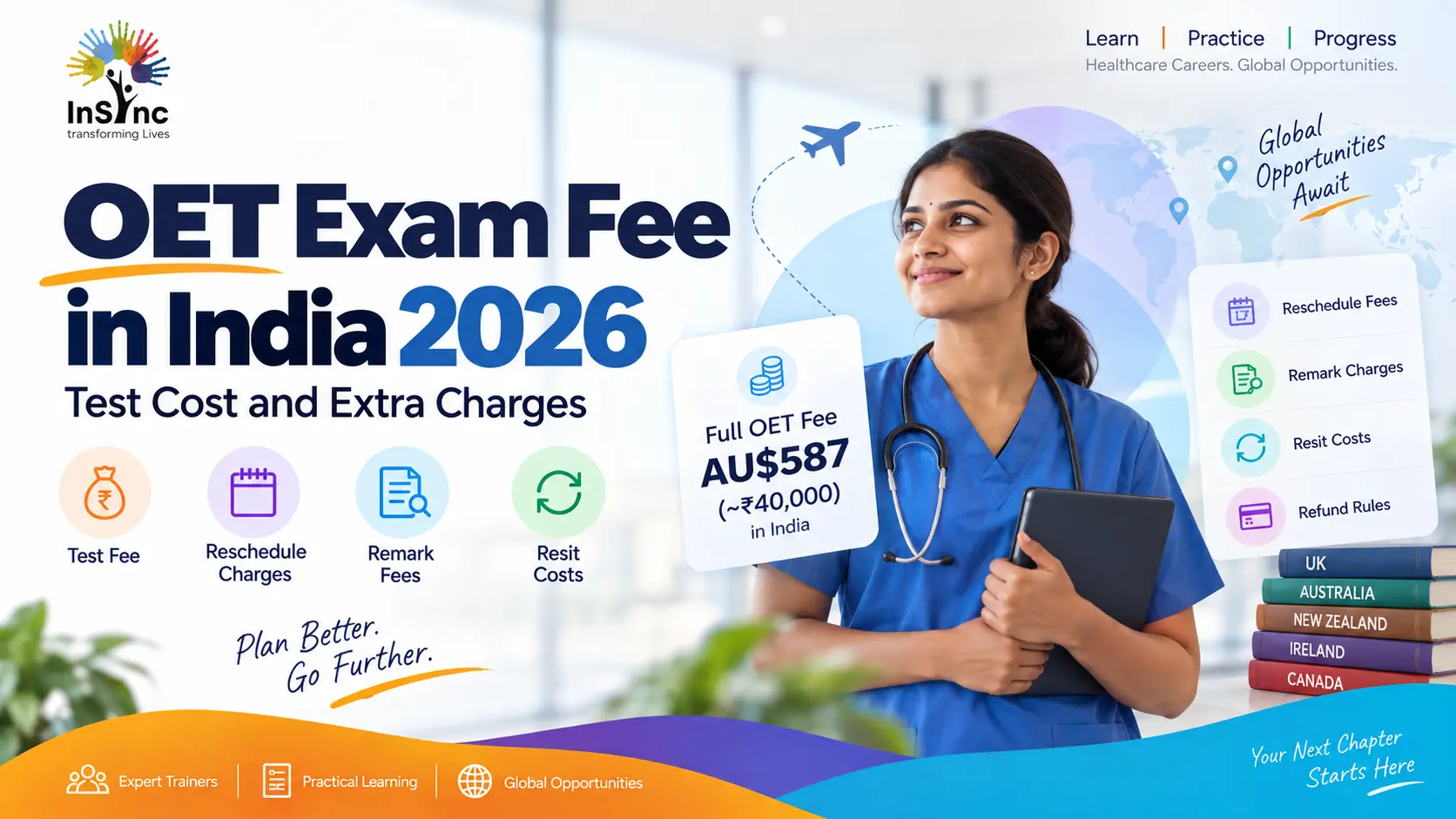
The OET Test Handbook states that all delivery modes use the same test format and specifications and are marked to the same standard. OET lists AUD 587 for the full test in each mode, so price cannot decide the choice for an Indian candidate.
All 12 professions can sit OET@Home and the computer mode, while OET on Paper lists seven. All three release the same statement of results, with a score from 0 to 500 and a grade for each sub-test, as OET’s results page describes.
Four questions settle the mode for most candidates applying from India
Ask them in this order, because each one can end the decision before the next is needed.
1. Does the body you are applying to accept the mode, including the home Speaking element? If it publishes a venue-only rule, as Ahpra and the Nursing Council of New Zealand do, book a venue mode.
2. Is your profession listed for paper, and is a date within reach? Five professions are not listed for paper at all, and half the paper dates carry Nursing and Medicine only.
3. How close is your deadline? Paper closes 24 days ahead, computer seven days ahead, and computer results can arrive within 48 hours of the last sub-test.
4. Might you need one sub-test again? Only paper allows a single sub-test booking afterwards, and only if your regulator accepts a result assembled that way.
For most nurses and doctors applying from India in 2026, questions one and three point at OET on Computer, and question four is the reason a paper booking still makes sense for candidates with a regulator that accepts single sub-test results. Whichever you book, the content to prepare is identical, although OET’s own guide adds one personal test: if you cannot type at least as fast as you write by hand, you may be better off on paper. Candidates who want support alongside that work can prepare with a trainer online or at our Egmore centre in Chennai.
Booking checklist
• Confirm in writing what your regulator and, separately, your visa authority accept, including Speaking taken at home.
• Check whether your profession appears on the date you want: paper lists seven professions, computer and OET@Home list all 12.
• Count backwards from your deadline: paper closes 24 days before the date, computer and OET@Home close 7 days before.
• Add the Speaking gap to your result estimate, because the result clock starts when the last sub-test finishes.
• If you might need one sub-test again, check that your regulator accepts single sub-test results before ruling paper out.
• For OET@Home, test the room, the wired headset, the webcam and the 5 Mbps connection days in advance. For Speaking at home, test the same room and connection, but note that headphones and headsets are not permitted for that sub-test.
• Keep the original ID you booked with, and proof of residency if you are sitting outside the country that issued it.
Frequently asked questions
Can I take OET at home in India?
Usually not. OET states that OET@Home is offered in countries where taking the test at a venue is not yet available, and India has both paper and computer venues. Check the booking page for your date and profession before assuming either way.
What is the difference between OET on Computer and OET@Home?
OET on Computer is taken at an approved test venue for Listening, Reading and Writing, with Speaking usually at home. OET@Home is taken entirely on your own computer with remote proctoring. Both cost AUD 587 and follow the same test specification.
Is OET@Home accepted by regulators?
It depends on the body. The NMC and the GMC accept OET@Home. Ahpra and the Nursing Council of New Zealand do not accept at-home testing. ECFMG accepts it only from applicants with no test venue in their country. Confirm with your own regulator before booking.
Do Australian authorities accept OET@Home?
No. Ahpra does not approve at-home or remote-proctored versions, apart from the computer-based test at a test centre, and the Department of Home Affairs names OET@Home among the online tests it does not accept for visa purposes.
Is the computer-based OET easier than paper?
No. OET’s handbook states that all delivery modes use the same test format and specifications and are marked to the same standard. The differences are in dates, results speed, resit options and how you answer.
Which OET mode gives the fastest results?
OET on Computer. Results can arrive as little as 48 hours after the final sub-test, with 95 per cent inside six calendar days. Paper results reach Indian candidates in as little as five days after the test date.
Can I resit only one sub-test?
Only on OET on Paper, at the majority of OET venues though not in the United States, and only after you have taken a full test. You also need a regulator that will accept it. The NMC and Ahpra combine two OET sittings, but each sitting must include all four sub-tests, and the College of Nurses of Ontario asks for one complete attempt.
What equipment do I need for OET@Home?
A laptop or desktop with a webcam, a wired headset, Windows 8.1 or higher or macOS 12.0 or higher but not versions 13.0 to 13.2.1, Google Chrome, 5.0 Mbps download and 1.0 Mbps upload speeds, and a mirror of about 30cm by 30cm for the environment check. Tablets, company-issued devices and dual monitors are not allowed.
Which professions can sit OET on Paper?
OET’s paper page lists Medicine, Nursing, Dentistry, Pharmacy, Physiotherapy, Radiology, which its booking table calls Radiography, and Veterinary Science. The computer mode and OET@Home list all 12 professions, and half the 2026 paper dates are open to Nursing and Medicine only.
Does the OET fee change with the delivery mode?
Not in India. OET publishes AUD 587 for the full test on paper, on computer and at home. The United States is the exception, where the computer and home modes are priced in US dollars.