

If you’re comparing online vs offline IELTS coaching in Chennai, the real question is not which format looks better. The real question is which one will keep you consistent, improve your weak skills, and give you enough correction before test day.
That’s the honest starting point for this post and it’s worth being upfront about where it’s going: neither format has a built-in advantage when it comes to band scores. What actually moves a score from 6 to 7, or from 6.5 to 7.5, is the same regardless of whether you’re sitting in a classroom or attending a class from your laptop. It’s the quality of feedback you get, how often you practise under timed conditions, and whether you actually show up and do the work week after week.
At InSync’s IELTS coaching centre in Chennai, we run both formats side by side every week, so this isn’t a theoretical comparison. This guide walks through what genuinely improves IELTS results, where online coaching shines, where offline coaching shines, and because this matters more in 2026 than it did even a year ago why computer-based test readiness should now be part of your preparation regardless of which format you choose.
Is There a Real Difference in Band Scores?
Not in any way that’s been reliably demonstrated. Both the British Council and IDP, the organisations that run IELTS, offer structured preparation in both online and face-to-face formats. If one format reliably produced better outcomes, you’d expect the test’s own administrators to favour it. They don’t. Official IELTS preparation resources include practice tests, model answers, webinars, and structured courses across both online and in-person delivery.
Research on online and blended learning generally points to the same conclusion: outcomes depend far more on course design and learner engagement than on the delivery mode itself. A well-structured online course with regular feedback will outperform a poorly run classroom course, and a well-run classroom will outperform a passive online course where a student logs in but doesn’t engage.
In other words, the format is not the variable that determines your score. What you do within that format is.
What Actually Improves IELTS Results
Before getting into online vs offline, it’s worth being clear about what the actual score-drivers are because this is the checklist you should apply to any coaching, in either format.
Writing correction quality. Generic feedback like “good effort, work on grammar” doesn’t move a Writing score. What moves it is correction tied to the actual band descriptors: task achievement, coherence and cohesion, lexical resource, and grammatical range, with specific examples from your own writing. Our guide on IELTS Writing Task 2 Band 7 breaks down exactly what this kind of feedback should look like.
Speaking practice frequency. Speaking is the skill most affected by infrequent practice. A student who speaks in English for 10 minutes once a week will improve far more slowly than one who practises several times a week, even in shorter sessions. For a deeper look at what’s actually being assessed, see what IELTS examiners look for in Speaking.
Timed mock tests. IELTS is as much about managing time under pressure as it is about language ability. Official IELTS preparation materials are built heavily around practice tests under timed conditions, and for good reason. Students who’ve never done a full timed mock are often surprised by how different real exam pressure feels. If you’re looking for where to access these, our roundup of the best platforms to book IELTS mock tests online is a good starting point.
Review of mistakes. Taking a mock test without reviewing what went wrong is one of the most common ways students plateau. The mock itself doesn’t improve your score; understanding why you lost marks does. This is also the single biggest reason students get stuck at Band 6.5 despite months of practice.
Consistency over 4–8 weeks. IELTS preparation experts generally recommend 6–8 weeks of focused preparation. Short bursts of intense study followed by long gaps tend to produce less reliable improvement than steady, regular practice. Over this period, we will go into this in more detail on how long you should prepare for IELTS.
None of these five things is inherently easier or harder in an online format versus an offline one. They depend on how the course is run, which is exactly why the “online vs offline” framing can be a bit of a red herring. The better question is: does this specific course, in this specific format, deliver these five things consistently?
When Online Coaching Works Best
Online IELTS coaching has matured significantly. The British Council’s own IELTS preparation offerings include fully personalised online coaching, live online classes, and online practice tools which is a reasonable signal that online delivery, done properly, is a legitimate format rather than a compromise.
Online coaching tends to work best when you need:
- Flexibility especially if you’re working, studying, or managing a schedule that doesn’t allow fixed class timings every day
- No travel time particularly valuable if you’re outside Chennai, in a smaller town, or simply want to reclaim the hours otherwise spent commuting to a centre
- Recorded lessons the ability to rewatch a class on a concept you didn’t fully grasp the first time
- Easy rescheduling life happens, and online formats generally make it easier to shift a session without losing momentum
- Access to live feedback modern online coaching isn’t just pre-recorded videos; live classes with real-time correction are standard in well-run programmes
The honest caveat: online coaching works best for reasonably self-disciplined students. If you join an online programme but don’t complete the homework, don’t review your mock test feedback, and treat classes as optional when something else comes up the format itself won’t compensate for that. This isn’t a flaw specific to online learning; it’s just that online formats place slightly more of the consistency burden on the student’s own habits, because there’s no physical classroom routine doing some of that work for you.
If you’re outside Chennai for example, in Pondicherry or elsewhere in Tamil Nadu online is also simply the practical choice, since it means you’re not limited to coaching available in your immediate area. Our online IELTS programme for Pondicherry and Tamil Nadu runs on exactly this model live classes, Writing correction, and mock tests, fully online. And wherever you are, you can join our online classes from anywhere location stops being a constraint on the quality of coaching you can access.
When Offline Coaching Works Best
Offline (in-person, classroom) coaching has its own genuine strengths and research on face-to-face learning continues to recognise the value of in-person interaction, particularly where engagement and participation are concerned.
Offline coaching tends to work best when you need:
- Routine a fixed time and place to be, which can help build the consistency that’s so central to score improvement
- Classroom accountability when other people are around you, working toward the same goal, on the same schedule, it’s harder to skip a session “just this once”
- In-person speaking confidence for many students, practising Speaking face-to-face with a trainer and classmates feels more like the real exam experience than speaking into a microphone or camera
- Direct supervision a trainer who can immediately see where you’re stuck, in real time, without the slight lag of an online interaction
- A study environment away from distractions for students preparing from home, the home environment itself can be the biggest obstacle; a classroom removes that variable
Some students simply perform better when they’re physically present not because online doesn’t work, but because the structure of “I have to be at this place at this time” does something for their consistency that a more flexible format doesn’t. If you’re based in Chennai and this sounds like you, our offline IELTS batches in Chennai run alongside our online classes, with the same trainers and the same Writing correction standards.
Online vs Offline: Honest Comparison
Rather than a long feature-by-feature table, here’s the practical reality:
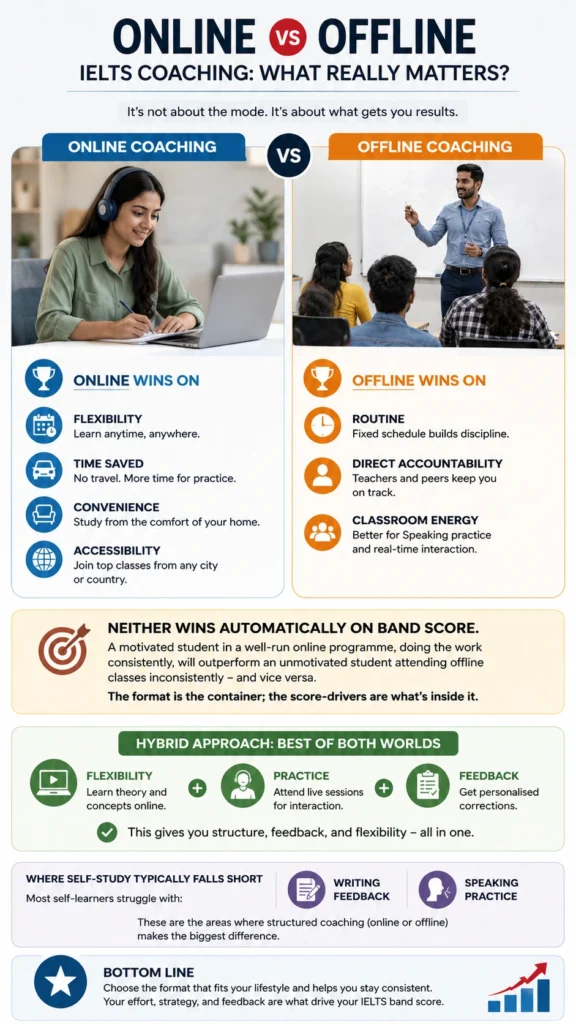
Online wins on: flexibility, time saved on travel, convenience, and accessibility you can join from anywhere, which matters enormously if you’re not based in a city with strong in-person IELTS coaching options.
Offline wins on: routine, direct accountability, and the energy of a classroom environment particularly for Speaking practice and for students who know they study better with structure imposed from outside.
Neither wins automatically on band score. This is worth repeating because it’s the actual answer to the question in this post’s title. A motivated student in a well-run online programme, doing the work consistently, will outperform an unmotivated student attending offline classes inconsistently and vice versa. The format is the container; the five score-drivers covered earlier are what’s inside it.
If you’re genuinely unsure which suits you, a hybrid approach flexibility for theory and practice sessions, combined with live correction gives you elements of both without forcing a single choice. This is also why, if you’re self-studying with free materials, it’s worth knowing where self-study typically falls short usually in Writing feedback and Speaking practice, the two areas where structured coaching (in either format) makes the biggest difference.
Why Computer Practice Matters in 2026
This is a recent development, and it changes IELTS preparation for everyone regardless of coaching format.
From mid-2026, all IELTS tests are moving to computer-delivered format, with paper-based IELTS being phased out in most markets. In some locations, a “Writing on Paper” hybrid option will remain available for candidates who prefer handwriting their Writing responses but Listening and Reading will be computer-based regardless.
What this means practically: if your preparation has been built entirely around paper-based practice reading printed passages, writing essays by hand, marking answers on paper answer sheets you now need computer-based practice as part of your preparation, even if you’re not specifically targeting “computer IELTS” as a separate choice. It’s becoming the default. We’ve covered the format differences in detail in computer IELTS vs paper IELTS in India though with this 2026 shift, the “choice” between the two is narrowing quickly.
This affects all four skills in subtle ways:
- Reading on a screen involves scrolling and navigating between the passage and questions differently than flipping pages
- Listening answer entry is typed rather than handwritten, which has its own timing considerations
- Writing if you’re used to handwriting, typing under timed conditions is a different skill, and even if you opt for Writing on Paper where available, Listening and Reading will still be on computer
- Time management generally shifts slightly when navigating a screen-based interface versus a paper booklet
Good IELTS coaching in 2026 in either format should now include computer-based mock practice as standard, not as an optional extra. This is one of the most overlooked preparation gaps for candidates who haven’t sat IELTS in the last year or two and may not be aware the format itself has changed.
What to Look for in Any IELTS Coaching Program
Whether you choose online, offline, or a mix, here’s a practical checklist these apply equally to both formats:
- Live speaking practice not just recorded model answers, but actual back-and-forth conversation with feedback
- Writing feedback tied to band descriptors specific, actionable correction, not general comments
- Timed mock tests full-length, under real exam conditions, ideally including computer-based mocks given the 2026 changes
- Progress tracking some way of seeing whether you’re actually improving over the weeks, not just attending classes
- Doubt clearing a way to ask questions and get them answered, ideally without long delays
- Exam strategy guidance on time management, question types, and common pitfalls specific to each section, including Reading time management, which is one of the most common gaps we see regardless of format
If a programme online or offline covers all six of these consistently, the format becomes much less important than it might initially seem.

Frequently Asked Questions
1. Does Online Or Offline Ielts Coaching Give Better Band Scores?
Neither format has a demonstrated advantage. Band score improvement depends on the quality of feedback, frequency of practice, and consistency all of which can be delivered well (or poorly) in either format. The format that suits your routine and that you’ll actually stick with consistently is generally the better choice for you specifically.
2. Is Online Ielts Coaching As Effective As Offline?
Yes, when the online programme includes live classes, real feedback on Writing and Speaking, and regular timed mock tests. Official IELTS preparation resources from the British Council include fully personalised online coaching as a standard offering, which reflects how mainstream and effective online delivery has become.
3. Can I Join An Online Ielts Class From Outside Chennai?
Yes. Online IELTS coaching can be joined from anywhere there’s no geographic restriction. This is particularly useful for students in smaller towns or outside Tamil Nadu who want access to experienced trainers without needing to relocate or travel.
4. Which Is Better For Working Professionals Online Or Offline?
Online tends to suit working professionals better simply because of scheduling flexibility and no travel time. However, if a working professional finds that a fixed evening class helps them actually show up consistently, offline can work just as well the right answer depends on which format you’ll realistically stick with.
5. Do I Need To Prepare Differently For Computer-Based Ielts?
Yes, to some extent. With IELTS moving to computer-delivered format for all tests from mid-2026 in most markets, practising on a screen navigating reading passages, typing responses, and managing time in a digital interface is now an important part of preparation, regardless of whether your coaching is online or offline.
6. Is Offline Coaching Better For Speaking Practice?
Many students feel more confident practising Speaking face-to-face, and in-person classroom environments can offer that naturally. However, well-run online coaching with live (not pre-recorded) speaking sessions can replicate much of this the key factor is whether the practice is live and interactive, not whether it’s online or offline.
7. How Long Should I Prepare For Ielts In Either Format?
Most guidance suggests 6–8 weeks of focused, consistent preparation, regardless of format. Shorter, irregular bursts of study tend to be less effective than steady weekly practice over this period.
Final Verdict
If you’ve read this far hoping for a clear “online is better” or “offline is better” the honest answer is that the format is not where the real difference lies. The real difference is in whether your coaching delivers consistent Writing correction, regular Speaking practice, timed mocks, mistake review, and steady weekly engagement and increasingly in 2026, whether it includes computer-based practice.
Online suits you if you value flexibility, want to avoid travel time, or you’re not based in Chennai and want access to experienced trainers from anywhere. Offline suits you if you know that a fixed routine and classroom environment helps you stay consistent and you want in-person Speaking practice.
At InSync, we offer both. Our IELTS coaching centre in Chennai runs both online and offline batches, so you can choose or combine based on what fits your routine. For students in Pondicherry and elsewhere in Tamil Nadu, our online IELTS programme gives you the same live classes, Writing correction, and mock test structure, fully online and wherever you’re based, you’re welcome to join our online classes from anywhere.
Not sure which format suits you? Try 5 free classes to decide in either format, with no pressure either way.