

If you are an Indian nurse aiming for UK NMC registration, here is exactly what OET score you need in 2026 and how to get it.
The NMC requires Grade B (350+) in Listening, Reading, and Speaking, and Grade C+ (300+) in Writing. That is the entire ballgame. Every section of this guide builds toward that target what it means, how OET scoring actually works, how to prepare for each sub-test, and what to do if you narrowly miss it on your first attempt.
Every year, thousands of nurses across Tamil Nadu and South India sit OET for exactly this reason. Many pass comfortably. Many others retake the test two or three times not because their English isn’t good enough for nursing, but because they didn’t understand what OET is actually scoring, or how the NMC’s rules around combining scores work.
If you’re based in Chennai and want structured preparation rather than self-study guesswork, our OET classes in Chennai are built specifically around this NMC target but first, let’s walk through exactly what you need to know.
Why OET Matters for Indian Nurses Applying to the UK in 2026
The Nursing and Midwifery Council (NMC) requires every internationally trained nurse to prove English language proficiency before they can register and work in the UK. For most Indian nurses, there are two accepted routes: OET or IELTS Academic.
NMC accepts OET in Paper, Computer, and OET@Home formats giving Indian candidates flexibility in how and where they sit the test.
OET registration is the first major checkpoint in the UK nursing pathway. After language proficiency, nurses move on to the Test of Competence (ToC) a Computer-Based Test (CBT) followed by an OSCE (clinical exam taken in the UK). But none of that matters until the English language requirement is cleared. A failed or partial OET attempt does not just cost a test fee it delays your entire registration timeline by months.
This is why getting OET right the first time, or understanding exactly how to combine scores if you don’t, matters so much.
What NMC Actually Requires The Exact Score Target
Let’s put this front and centre, because it is the single most important fact in this article.
For OET, the NMC requires:
| Sub-test | Required Grade | Required Score |
| Listening | B | 350+ |
| Reading | B | 350+ |
| Speaking | B | 350+ |
| Writing | C+ | 300+ |
Notice that Writing has a lower threshold than the other three skills. This matters because many nurses spend disproportionate time on Writing prep when listening, reading, or speaking are actually closer to the cut-off and easier wins.
One critical fact most candidates don’t realise: OET reports a score out of 500 and a letter grade for each individual sub-test. There is no overall average score. A nurse can score B in three sub-tests and C+ in Writing and pass but if even one sub-test (say Listening) comes in at C, the full requirement is not met from that sitting alone, regardless of how high the other scores are.
This is different from IELTS, where many candidates are used to thinking in terms of an “overall band.” With OET for NMC, every sub-test has its own pass/fail line, and all four must clear their respective lines either in one sitting, or through score combining (covered below).
OET vs IELTS for Nurses: Why OET Feels More Relevant
NMC accepts OET Grade B or IELTS Academic 7.0/7.0/7.0/6.5 (Listening/Reading/Writing/Speaking, with an overall of 7.0). Both are valid. But for working nurses, OET has a practical edge that goes beyond the score requirement.
OET is built entirely around healthcare scenarios. The Listening section features ward handovers and patient consultations. The Reading section uses clinical extracts, care plans, and healthcare-related texts. The Speaking test is a role-play between a nurse and a patient (or a patient’s relative) situations you encounter on a hospital floor every day. The Writing task is a referral letter, which is a real document nurses write as part of their job.
IELTS Academic, by contrast, tests general and academic English essays on social topics, lectures on unrelated subjects, and academic reading passages. None of it relates to clinical practice.
For a working nurse, this means OET preparation doubles as professional communication practice. The vocabulary, scenarios, and writing format you train on are the same ones you’ll use on a UK ward. If you want a fuller breakdown of how the two tests compare for clinical roles, we’ve covered it in detail in OET vs IELTS for healthcare professionals.
How OET Scoring Actually Works Making Grade B and C+ Easy to Understand
OET scores each sub-test on a scale of 0 to 500, which then converts to a letter grade from A to E.
| Grade | Score Range | What It Means for NMC |
| A | 450–500 | Exceeds requirement |
| B | 350–490 | Meets requirement for Listening, Reading, Speaking |
| C+ | 300–340 | Meets requirement for Writing only |
| C | 200–290 | Below NMC requirement |
| D / E | Below 200 | Well below requirement |
A useful way to think about it: Grade B is roughly equivalent to an advanced level of English comparable to what a second-year university student studying a foreign language would be expected to achieve. It is a genuinely high bar, and that’s intentional. NMC sets it because nurses need to communicate precisely in situations where misunderstanding has real clinical consequences.
The practical takeaway: do not assume that because your spoken English is strong in daily ward conversations, OET Speaking will be easy. The test assesses specific criteria intelligibility, fluency, appropriateness of language, resilience, and clinical communication structure and scoring B requires consistent performance against all of them, not just “getting the message across.”
How to Pass OET for NMC Sub-Test Strategies
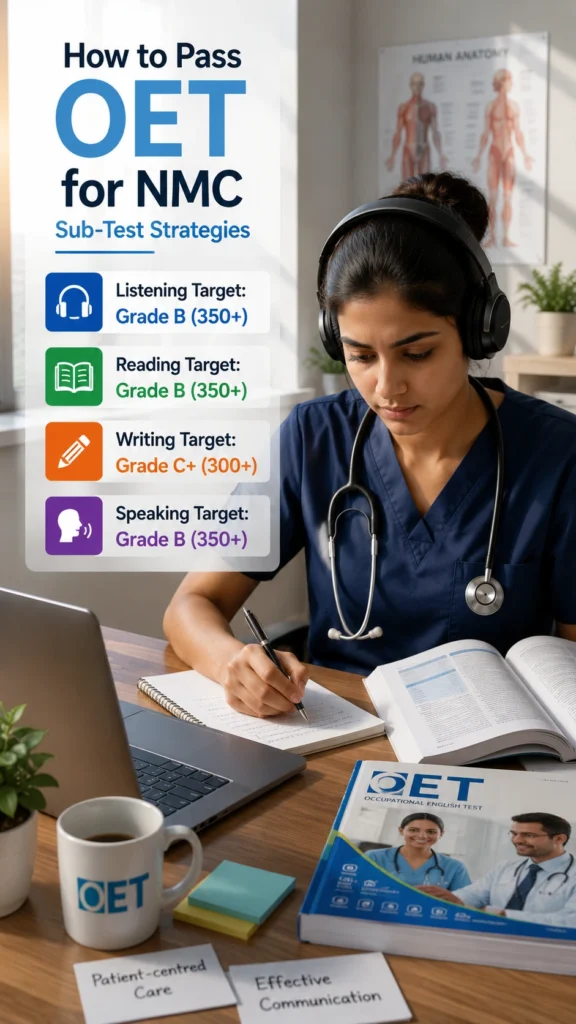
If you’re working toward this on a deadline, our guide on how to pass OET in 30 days lays out a week-by-week plan but the strategies below are the foundation regardless of your timeline.
Listening Target: Grade B (350+)
OET Listening has three parts: a consultation extract, a healthcare lecture or talk, and a series of short healthcare-related extracts.
What trips up candidates: the audio is played only once, and note-taking under time pressure is a skill in itself. Many Indian nurses have strong comprehension but lose marks because they’re still writing down the previous answer when the next one is being spoken.
Strategy: Practise listening to UK and Australian healthcare audio ward rounds, GP consultations, patient interviews at natural speed, not slowed down. The accents and pacing in OET Listening reflect real clinical environments, and the only way to get comfortable with that pace is repeated exposure.
Reading Target: Grade B (350+)
Reading has three parts: quick information-matching from short texts, two texts with detailed comprehension questions, and a longer text requiring inference and understanding of writer’s opinion.
What trips up candidates: Part A (the information-matching section) is timed tightly 15 minutes for multiple texts and candidates who read every word in order run out of time. Part C, the longer text, requires understanding tone and implied meaning, not just literal facts.
Strategy: For Part A, practise scanning for keywords rather than reading linearly. For Part C, practise identifying the writer’s stance is this text arguing for something, presenting balanced views, or raising concerns?
Writing Target: Grade C+ (300+)
The Writing task is a referral letter based on case notes provided in the test. You’re given patient information and asked to write a letter typically to another healthcare professional summarising the relevant details and making a clear request or recommendation.
What trips up candidates: including too much information from the case notes (or too little), incorrect letter format, and tone that’s either too informal or too clinical-jargon-heavy for the recipient. These are exactly the patterns we break down in 3 OET writing errors costing Band B worth a read if Writing is your weaker area.
Strategy: Practise selecting relevant information not every detail in the case notes belongs in the letter. Learn the standard referral letter structure (opening, relevant history, current situation, request/recommendation, closing) until it becomes automatic. For beginners still building this structure from scratch, our OET writing correction tips for beginners walks through common corrections step by step. Since C+ is the target here (not B), the bar is genuinely achievable with structured practice this is often the sub-test nurses worry about most and need to worry about least.
Speaking Target: Grade B (350+)
The Speaking test is two role-plays, each about 5 minutes, based on your profession. You play the healthcare professional; the interlocutor plays a patient, carer, or relative.
What trips up candidates: candidates who prepare “model answers” and try to recite them sound unnatural, and OET Speaking specifically assesses your ability to respond to what the patient actually says which varies. Also, many candidates under-use the warm-up techniques built into the role-play (acknowledging concerns, checking understanding, summarising back).
Strategy: Practise the clinical communication behaviours OET rewards: active listening, empathy, clear explanations without excessive jargon, and checking the patient has understood. These are the same skills good nursing communication requires in real practice which is exactly why OET tests them this way.
Score Combining Rules Critical If You’re Close to the Cut-Off
This section matters enormously, and it’s where the rules have recently become more nurse-friendly.
The basic rule: If you don’t meet all four targets in a single sitting, NMC allows you to combine scores from two OET sittings, provided:
- Both sittings are within 12 months of each other
- Both test dates are within 2 years of when NMC assesses your complete application
- All four skills must be tested together in each sitting you cannot retake individual sub-tests separately
The flexibility that was added recently: Under updated NMC rules, when combining scores, no sub-test can be more than half a grade below the required score. In practice, this means:
- For Writing, a score of C (above 250) in one sitting can be combined with C+ or higher in the other sitting
- For Listening, Reading, or Speaking, a score of C+ in one sitting can be combined with B or higher in the other sitting
Example: Suppose in your first attempt you score B, C+, C+, B (Listening, Reading, Writing, Speaking) Writing is fine at C+, but Reading came in at C+ instead of B. In your second attempt within 12 months, if you score B in Reading (and maintain C+ or better elsewhere), your combined scores can satisfy the NMC requirement because Reading was only half a grade below the target in the first sitting.
This rule exists specifically to help nurses who are genuinely close but fall just short in one area it removes the need to retake everything from scratch if you’ve nearly cleared the bar.
One more option for nurses already working in the UK: if you’ve taken OET (or IELTS) at least twice and narrowly missed one sub-test by half a grade, your UK employer may be able to submit supporting evidence of your English proficiency in a health and social care setting provided you’ve worked for them for at least 12 months within the last 2 years, and the evidence is signed off by NMC-registered seniors. This is a secondary route, not a replacement for OET, but it’s worth knowing if you’re already employed in the UK and close to the requirement.
If you’re preparing for a second sitting while already working long shifts, our post on how to study OET at home covers realistic study routines that fit around hospital schedules.
Common Mistakes Indian Nurses Make With OET for NMC
1. Booking the wrong OET version or sub-test combination Make sure you book OET for Nurses, not a generic profession version the Listening and Reading content is profession-specific, and the Speaking role-plays are tailored to nursing scenarios.
2. Treating Writing as the hardest skill Because the target for Writing (C+) is lower than the other three (B), many nurses over-invest in Writing prep and under-invest in Listening or Speaking where the bar is actually higher. Allocate prep time according to the target grade, not according to which skill feels most unfamiliar.
3. Poor time management in Reading Part A This is the single most common reason capable candidates score C instead of B in Reading. Part A’s strict time limit punishes linear reading. Timed practice with scanning techniques is non-negotiable.
4. Misunderstanding the “no overall score” rule Some candidates assume a strong Speaking score can “make up for” a weaker Reading score, the way an IELTS overall band can average out. It cannot. Each sub-test stands alone against its own target.
5. Letting the validity window slip Remember: test dates must be within 2 years of NMC’s assessment of your complete application, and combined sittings must be within 12 months of each other. If you take OET early and then delay your full application for other reasons (visa processing, job offers, documentation), check these dates carefully a lapsed score means resitting even if you originally passed.
These patterns aren’t unique to nurses we see similar issues across professions, as covered in why Indian doctors struggle to pass OET. The underlying causes time pressure, unfamiliarity with native-speed audio, and treating OET like a general English test are common across healthcare professions, and the fixes are similar too.
Key Takeaways
- NMC requires Grade B (350+) in Listening, Reading, and Speaking, and Grade C+ (300+) in Writing for OET.
- OET has no overall score. Every sub-test must independently meet its target.
- OET is accepted in Paper, Computer, and OET@Home formats.
- Score combining across two sittings within 12 months is allowed, with test dates valid for 2 years before NMC assesses your full application.
- Under updated rules, a sub-test can be combined even if it’s up to half a grade below target in one sitting, provided it meets the target in the other.
- Writing’s target (C+) is lower than the other three skills (B) allocate prep time accordingly.
- All four skills must be tested together in each sitting individual retakes of single sub-tests are not allowed.

Frequently Asked Questions
1. Is C+ In Writing Enough For Nmc?
Yes. NMC’s requirement for Writing is specifically C+ (300+), which is lower than the B (350+) required for Listening, Reading, and Speaking. C+ in Writing meets the requirement on its own you do not need B in Writing.
2. Can I Combine Two Oet Tests For Nmc?
Yes. NMC allows combining scores from two OET sittings within 12 months of each other, provided the test dates are within 2 years of your full application assessment. Under current rules, a sub-test can be up to half a grade below its target in one sitting as long as the other sitting meets or exceeds the target for that sub-test.
3. Does Nmc Accept Oet@Home?
Yes. NMC accepts OET results from Paper, Computer, and OET@Home formats equally. Choose whichever format suits your preparation and access the score requirements are the same across formats.
4. How Long Is The Oet Score Valid For Nmc Registration?
Your OET test date must be within 2 years of the date NMC assesses your complete application. If your application process takes longer than expected, check this window carefully an expired score means you’ll need to retest even if you originally met the requirement.
5. Can I Retake Just The Writing Sub-Test If I Pass The Other Three?
No. OET does not allow retaking individual sub-tests in isolation. Each sitting tests all four skills together. If you need to improve one sub-test, you sit the full test again but you can then combine the improved result with your previous sitting under the combining rules.
6. Is Oet Easier Than Ielts For Nurses?
Neither is officially “easier,” but OET’s content is built entirely around healthcare scenarios ward conversations, clinical reading texts, referral letter writing, and patient role-plays. For working nurses, this often makes preparation feel more directly relevant and efficient compared to IELTS Academic’s general and academic content.
7. What Happens After I Clear The Oet/Ielts Requirement?
Clearing the English language requirement is the first step. After that, NMC registration continues with the Test of Competence a Computer-Based Test (CBT) covering nursing knowledge, followed by an OSCE clinical exam taken at an approved UK test centre. The English language requirement must be met before these stages.
Conclusion
The path to NMC registration starts with one number: Grade B in Listening, Reading, and Speaking, and C+ in Writing. Everything in your OET preparation should be measured against that target not against a vague sense of “improving your English.”
The good news is that OET is designed for nurses. The scenarios, vocabulary, and communication skills it tests are the ones you already use at work. With focused preparation particularly around Reading time management and Speaking role-play technique, where Indian candidates most often lose marks Grade B is a realistic, achievable target on a single attempt. And if you fall just short, the score-combining rules give you a genuine second chance without starting from zero.
Ready to prepare for OET the right way for UK NMC registration? Our OET classes in Chennai are built around exactly this target Grade B in Listening, Reading, and Speaking, and C+ in Writing with mock tests, role-play practice, and detailed feedback from India’s 1st OET Teacher Trainer.